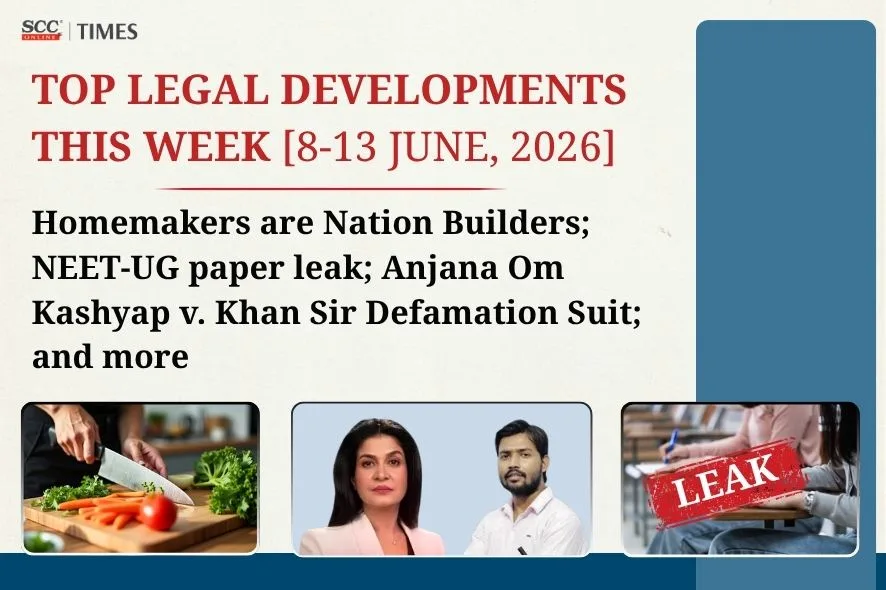
Catch up on the top legal developments this week (8—13 June 2026), including Naga Chaitanya’s Personality Rights, Doctrine of Proportionality, Pre-Marital Physical Relationship, Child Custody and Access Guidelines, Cryopreserved Embryos, Audit of Sabarimala Temple Accounts, Bareilly Violence Case, Ankita Bhandari case, Ocean Pearl, Balaramapuram Child Murder, and much more.
STORIES OF THE WEEK
MOTOR ACCIDENTS | Homemakers Are “Nation Builders”: New Compensation Head “Loss of Domestic Care” Created; Enhances MACT Award from ₹8.43 Lakhs to ₹62.77 Lakhs
In an appeal titled Shishu Pal v. Surjeet,1 arising from a motor accident claim concerning the death of a homemaker in a road accident, the Supreme Court recognised Homemakers as “Nation Builders” and enhanced the compensation from ₹8,43,400 awarded by the High Court to ₹62,77,900, together with the same interest regime prescribed by the High Court. The Court introduced a new compensatory head titled “loss of domestic care” towards the “homemaker’s contribution towards smooth functioning of the household, the loss of maternal support for children and loss of spousal support/the support and care of their child who is an adult, for the parents of the deceased”, fixed at ₹30,000 per month subject to periodic enhancement payable at her death. The Court also issued comprehensive directions to be followed while deciding motor accident claims.
Read more HERE
NEET-UG PAPER LEAK | Bail denied to Manisha Waghmare, an accused in NEET-UG paper leak case
In a bail application titled CBI v. Manisha Sanjay Waghmare2, filed by applicant, an accused in NEET-UG paper leak case, under Section 483, Nagarik Suraksha Sanhita, 2023 (BNSS) (corresponding to Section 439 CrPC), Ajay Gupta, the Rouse Avenue Court dismissed the bail application and refused to grant her bail.
Read more HERE
SUPREME COURT HIGHLIGHTS
INVESTIGATION | Constitutional Courts Can’t Remain Mute Spectators to Endless Investigations; Conclusion of Two-Decade-Old Probe Ordered To Be Done Within Six Weeks
In Sahil Abdulsattar Mansuri v. Safimahamad Fafirbhai Mansuri, 2026 SCC OnLine SC 1073, an appeal presenting a disturbing instance of prolonged investigative delay where a criminal complaint lodged in 2007 remained unresolved even after nearly 2 decades and challenging High Court’s order refusing to issue directions for filing of a charge-sheet despite repeated orders of the Magistrate and despite the complainant’s persistent efforts to secure completion of investigation, the Supreme Court reaffirmed that “the right to speedy trial is intrinsically linked to Article 21 of the Constitution” and held that the High Court erred in not taking the note of the inordinate delay in filing of the chargesheet and intervening in the matter.
Read more HERE
LAND LAW | Doctrine of Proportionality Bars Demolition 17-Year-Old Commercial Complex Affecting 8,000 Livelihoods; Regularisation of Illegal CIDCO Allotment on Payment of ₹318.31 Crores, directed
In K. Raheja Corpn. (P) Ltd. v. State of Maharashtra, 2026 SCC OnLine SC 945, the Supreme Court granted regularisation of illegal CIDCO allotment subject to payment of approximately ₹ 318.31 crores plus ₹ 1 crore towards the unfulfilled garden obligation, with adjustment of amounts already paid, holding that demolition of “a fully operational commercial complex after 17 years, ₹ 450 crores of investment, 8000 livelihoods, and ₹ 100 crores of annual tax revenue”, impermissible where financial loss to public authority is fully remediable through monetary recovery.
Read more HERE
CRIMINAL TRIAL | Section 386(a) CrPC | Appellate Court Reversing Acquittal Must Itself Hear Convict on Sentence; Can’t Remit Matter to Trial Court Solely for Sentencing
In Mukesh Kumar Yadav v. State (UT of Andaman & Nicobar Islands), 2026 SCC OnLine SC 938, the Supreme Court set aside the part of para 108 of the impugned judgment by which the appellant was directed to surrender before the trial court and the trial court was directed to hear him on sentence and impose punishment, holding that where an appellate court reverses an acquittal and records a conviction for the first time, the appellate court is duty-bound to itself hear the convict on the question of sentence and impose punishment. The appellate court cannot remit the matter to the trial court solely for sentencing.
Read more HERE
TENANCY LAW | Landlord Cannot Be Held Accountable for Tenant’s Environmental Violations: Interference with NGT Order, refused
In an appeal preferred by the Gujarat Pollution Control Board (GPCB), titled Gujarat Pollution Control Board v. Jagmohan Lachiram Jalan,3 assailing the National Green Tribunal (NGT) order holding the landlord not accountable for the tenant’s environmental violations, the Division Bench of Satish Chandra Sharma and Sanjeev Sachdeva, JJ., found no reason to entertain the appeal challenging the NGT order.
Read more HERE
PRACTICE AND PROCEDURE | Larger Bench Referred to: Whether Third Judge Under S. 392 CrPC Can Go Beyond Points of Disagreement and Revisit Unanimous Findings of Division Bench
In Rakesh Kumar Gupta (Dr) v. State of U.P., 2026 SCC OnLine SC 1102, the Supreme Court examined whether the third Judge’s jurisdiction extends beyond the points of disagreement and permits reconsideration of findings unanimously reached by the original Bench. Finding that the issue raises substantial questions regarding the interpretation of Section 392 CrPC and the correctness of the decision in Sajjan Singh v. State of M.P., (1999) 1 SCC 315, the Court referred the matter to a larger Bench for authoritative determination.
Read more HERE
SERVICE LAW | Pre-Marital Physical Relationship Between Consenting Adults Not Ground to Draw Adverse Inference on Character: Police Constable’s Appointment Restored
In a case titled Gajula Thirupathi v. State of Telangana4, wherein the appellant challenged the cancellation of his provisional selection for the post of Stipendiary Cadet Trainee Police Constable (SCTPC) by the respondent on grounds of moral turpitude, the Division Bench of Manoj Misra* and Manmohan, JJ., allowed the appeal and held the respondent’s action to be arbitrary. The Court stated that merely because the appellant’s pre-marital relationship with his neighbour did not culminate in marriage, the same is not a ground to believe that the appellant had cheated and draw an adverse inference. The Court stated that pre-marital relationships are common today and physical relationship between 2 consenting unmarried adults cannot and should not by itself be a ground to draw an adverse impression about the character of the person in that relationship.
Read more HERE
HIGH COURT HIGHLIGHTS
DELHI RIOTS | Inspection of Unrelied Documents in Malkhana Permitted to Ensure Fair Trial
In the writ petition titled Devangana Kalita v. State (NCT of Delhi)5, filed by one of the persons accused of being part of Delhi Riots in the backdrop of protest against Citizenship Amendment Act, 2019 and National Register of Citizens, challenging the order concerning inspection of unrelied documents in Malkhana and the supply of deficit documents under Section 207, Criminal Procedure Code, 1973 (CrPC), the Delhi High Court considering the importance and significance of the issues raised, allowed the petition seeking permission to inspect unrelied Malkhana documents and directed the prosecution to facilitate and ensure inspection of the Malkhana expeditiously and strictly in accordance with law.
Read more HERE
CENSUS | “Establishment” Under Census Act Not to Be Narrowly Construed; Private Sector Employees Including LIC Staff Can Be Requisitioned as Enumerators
In North Central Zone Insurance Employees v. Union of India, 2026 SCC OnLine All 11163, filed against the entrustment of census duties upon Life Insurance Company (LIC) employees as enumerators/supervisors, the Allahabad High Court held that the authorised authority had not committed any error in issuing orders to the LIC employees in exercise of delegated powers under Section 4(4), Census Act, 1948 (Census Act) read with Rule 3, Census Rules, 1990 (Census Rules). Thus, the Court upheld the appointment of LIC employees as enumerators for census operations, and accordingly dismissed the petition as misconceived and devoid of merits.
Read more HERE
CUSTODY | ‘Child Cannot Be Treated as a Pawn’: Family Courts directed to Follow Calcutta HC’s Child Custody and Access Guidelines; Restores minor’s custody to mother
In Hayarunisa Abdul Hakkim v. State, 2026 SCC OnLine Ker 5409, wherein a minor was taken away by the father in violation of a Family Court’s decree granting permanent custody to the mother, the Kerala High Court held that the illegal removal of a child, despite a subsisting Family Court’s decree granting custody was unlawful and restored the child’s custody to the mother. The Court directed that the Calcutta High Court’s child custody guidelines must be followed by the Family Courts in Kerala till the committee constituted to consider the said plan had finally placed its recommendations.
Read more HERE
PREVENTIVE DETENTION | Can Preventive Detention be Invoked Immediately After Bail is Granted? Explained Why it Cannot be Used to Bypass Judicial Decisions
While considering an illegal detention petition titled Dishant Goel v. Union of India, 2026 SCC OnLine P&H 10289, the Punjab & Haryana High Court held that the preventive detention order was legally unsustainable, as the unexplained delay in its passing and execution snapped the “live and proximate link” between the alleged prejudicial activities and the need for detention.
Read more HERE
Also Read: Loss of Amenities Cannot be Ignored: Karnataka HC Enhances Motor Accident Compensation
PERSONALITY RIGHTS| Naga Chaitanya’s Personality Rights Protected; Use of Name and Likeness in Deepfakes, Pornographic Content and Unauthorised Merchandise, Restricted
In a suit seeking protection of personality and publicity rights, titled Akkineni Naga Chaitanya v. www.sexvid.xxx6, filed by Telugu film actor and entrepreneur Akkineni Naga Chaitanya against the unauthorised commercial exploitation of his name, image, likeness and persona, including their use in pornographic content, artificial intelligence (AI)-generated and deepfake material, and unauthorised merchandise, the Delhi High Court granted an ex parte ad interim injunction restraining the defendants from using or exploiting the plaintiff’s personality attributes for commercial or personal gain.
Read more HERE
ASSISTED REPRODUCTIVE TECHNOLOGY ACT | Age limit under ART Act Applies to Initiation of Treatment, Not Continuation Through Cryopreserved Embryos: 50-Year-Old Woman Permitted to Undergo Frozen Embryo Transfer
In Shewta Tuteja v. Union of India7, filed seeking directions permitting the petitioners to undergo frozen embryo transfer (FET Procedure) of their remaining 5 cryopreserved embryos at Cloudnine Hospital, Dwarka, under the provisions of the Assisted Reproductive Technology Regulation Act, 2021 (ART Act), the Delhi High Court held that the denial of permission solely on the ground that the petitioners had marginally crossed the statutory age threshold after the commencement of the ART process would not advance the object and purpose of the ART Act.
Read more HERE
Also Read: Order XIII Rule 9 CPC| Read why Karnataka High Court rejected plea seeking return of document
SERVICE LAW | Recruitment Transparency Prevails: Disclosure of Merit List and Marks Sought Under RTI Ordered, Subject to No Social Media Publication
In Sikkim PCS v. Sikkim Information Commission8, a writ petition filed by the Sikkim Public Service Commission (SPSC) assailing the orders of the Sikkim Information Commission directing disclosure of recruitment-related information under the Right to Information Act, 2005, the Sikkim High Court directed the State Public Information Officer to furnish the relevant information to the RTI applicant and recorded the applicant’s undertaking not to place the information on any social media platform.
Read more HERE
TEMPLES | 10-year Audit of Sabarimala Temple Accounts Over Alleged Financial Irregularities in Procurement and Management, Ordered
In Suo Motu v. State of Kerala9, a suo motu matter initiated on the basis of a report submitted by the Sabarimala Special Commissioner, which highlighted alleged misuse of temple funds, failure to maintain mandatory records, acceptance of pooja materials without proper accounting, and the absence of adequate safeguards to prevent financial impropriety within the Travancore Devaswom Board, the Kerala High Court directed the Travancore Devaswom Board (TDB) to produce records relating to various temple rituals and offerings (Vazhipadu) conducted at the Sabarimala Temple over the past 10 years and ordered an independent audit of its financial practices.
Read more HERE
TRADE MARK | MakeMyTrip trade mark protected; Use of deceptively similar “MakeMyIndiaTrip” marks, restrained
In MakeMyTrip (India) (P) Ltd. v. MakeMyIndiaTrip10, the Delhi High Court granted an ex parte ad interim injunction restraining the defendant from using the impugned marks, trade name, logo and domain name “www.makemyindiatrip.com”, or any other mark deceptively similar to the plaintiff’s well-known “MakeMyTrip”/ trade marks.
Read more HERE
MEDIATION | Default Clause in Mediated Settlement MOU Enforceable Despite Delayed Payment; Judgment Debtor Cannot Escape Consequences of Contractual Default
In Venkatesh v. Mahadeva, 2026 SCC OnLine Kar 3004, the Karnataka High Court dismissed the writ petition filed under Article 226 of the Constitution, considering the delayed deposition of payment and non-compliance of the terms of the mediated settlement agreed by the parties.
Read more HERE
BAREILLY VIOLENCE| “Communal Harmony Forms the Bedrock of a Democratic Nation”: Bail Denied to Main Conspirator in Bareilly Violence Case
In a bail application tiled Tauqeer Raja Khan v. State of U.P.11, filed by the President of Ittefaq Minnat Council who allegedly gave the call for the crowd to assemble and cause violence in the Bareilly Violence case, the Allahabad High Court rejected the application, holding that there was a significant risk that, if released, he may once again incite a particular community and disturb peace and harmony.
Read more HERE
ABETMENT TO SUICIDE | Can Loan Recovery Action by Bank Officials or Creditors Amount to Abetment of Suicide?
In Amit Padmakar More v. State of Maharashtra12, the Bombay High Court stated that normal or even harsh reaction, made in anger or momentarily, does not amount to abetment. Section 306 IPC requires a clear, deliberate, and intentional act to drive a person to suicide. Lawful actions such as loan recovery by bank officials, reminders for repayment, or strict conduct by authorities or parents do not constitute abetment of suicide. The Court stated that prima facie, the allegations, apart from being unsustainable and untenable, were also clearly contrary to the medical reports. Even if the allegations are accepted at face value, the same were general and vague in nature. Accordingly, the application was allowed.
Read more HERE
DEFAMATION | Anjana Om Kashyap & TV Today Network Files Defamation Suit Against Khan Sir and Others; Summons Issued
In a ₹2 crores defamation suit titled Anjana Om Kashyap v. Faisal Khan13, filed under Order 39 Rules 1 and 2, Civil Procedure Code, 1908 (CPC), by Journalist Anjana Om Kashyap and the TV Today Network against popular educator Faisal Khan (popularly known as Khan Sir) and several other individuals over their allegedly defamatory, insulting and derogatory comments following her criticism of the growing influence of “star teachers”, the Delhi High Court issued summons to the defendants.
Read more HERE
CHILD RIGHTS | Procedural Limitations Cannot Defeat a Child’s Right to Identity: Inclusion of Biological Father’s Name in IVF Child’s Birth Certificate Ordered
In X v. State of Kerala,14 concerning the right of a child born through IVF to have her biological father’s name recorded in her birth certificate, the Kerala High Court held that statutory procedures should not become instruments of injustice when they prevent the recognition of undisputed facts. The Court observed that although the Registration of Births and Deaths Act, 1969 (1969 Act) does not expressly provide for the subsequent insertion of a father’s name in the birth register of a child originally registered as born to a single mother, Constitutional Courts possess wide powers under Article 226 of the Constitution to remedy injustice and safeguard fundamental rights.
Read more HERE
Also Read: Here’s why Karnataka High Court declined interference in plea to amend final decree
CRIMINAL LAW | Ankita Bhandari case: ‘To Malign a Person’s Image to Implicate Them in a Concluded Murder Case Is a Serious Issue’: Two FIRs Against Former MLA quashed; Probe Ordered
While considering a batch of 4 petitions filed by former MLA Suresh Rathore, titled Suresh Rathore v. State of Uttarakhand15, for quashing of FIRs on the ground that all 4 FIRs did not disclose any cognizable offence and that he was himself a victim and had not uploaded any conversation with his wife in any social media platform pertaining to the Ankita Bhandari’s murder case, the Uttaranchal High Court held that while 2 FIRs were liable to be quashed, the remaining 2 prima facie disclosed cognizable offences and therefore required thorough investigation.
Read more HERE
BLACK MONEY | Interim Relief Granted to Anil Ambani in Black Money Case; CIT(A) Appeal to Continue but No Prosecution or Penalty Till Writ Petition Disposal
In a petition titled Anil Dhirajlal Ambani v. Union of India16, challenging certain provisions of the Black Money (Undisclosed Foreign Income and Assets) and Imposition of Tax Act, 2015 (Black Money Act), the Bombay High Court directed that since the petitioner, Anil Ambani, had already appealed the assessment order, the said appeal can proceed and orders can be passed thereon, but no coercive action shall be taken against the petitioner, including that of prosecution and penalty, till the hearing and final disposal of the present petition.
Read more HERE
CONTEMPT OF COURT | Immediate Takedown of “Scandalous” Social Media Posts Against Sitting Judge, Directed; Further Dissemination in Criminal Contempt Case Restrained
In a criminal contempt petition titled Delhi High Court Bar Assn. v. Kapil Kakar17, alleging publication and circulation of scandalous social media content targeting a sitting Judge of the Court and the institution of the judiciary, the Delhi High Court held that freedom of speech does not extend to publications which prima facie scandalise the Court, undermine public confidence in the administration of justice, or interfere with the independent discharge of judicial functions. Finding the impugned videos and posts to be “absolutely scandalous, contumacious” and a direct interference with the justice delivery system, the Court directed their immediate takedown and restrained further dissemination of the content.
Read more HERE
TRADE MARK | Use Of ‘Prestige Ocean Pearl’ Restrained, ‘Ocean Pearl’ Found to be Dominant Feature of Impugned Mark; Parties Referred to Mediation
In a trade mark infringement and passing off suit titled Ocean Pearl Hotels (P) Ltd. v. Prestige Estates Projects Ltd.18, the Delhi High Court held that the impugned mark “PRESTIGE OCEAN PEARL” prima facie subsumed the plaintiff’s registered trade mark “Ocean Pearl”, with the expression “Ocean Pearl” being used as the dominant and distinctive element of the defendant’s branding and granted an ex parte ad interim injunction restraining the defendant from using the impugned marks and directed removal of all websites, domain names and promotional material bearing the said marks.
Read more HERE
BAIL | Balaramapuram Child Murder: Bail Granted to Mother Accused Finding No Direct Evidence Linking Her with Crime
While dealing with a bail application in Balaramapuram child murder case titled Sreethu v. State of Kerala19, the Kerala High Court held that, despite the grave nature of the allegations, the absence of direct evidence connecting the applicant to the crime and the overall circumstances warranted her release on bail subject to strict conditions.
Read more HERE
TRADE MARK | “GLASS SKIN” Held to be Descriptive; Directed Removal of Trade Mark Registration in Class 3
In Renee Cosmetics (P) Ltd. v. Rupali Sharma,20 the Delhi High Court held that the impugned mark was “descriptive” of the goods in question and fell within the prohibition under Section 9(1)(b), Trade Marks Act, 1999. The Court held that the expression “GLASS SKIN”, used in relation to skincare and cosmetic products, directly conveyed the intended purpose and end result of the goods, and therefore lacked inherent distinctiveness. Consequently, the Court allowed the petition and directed cancellation and removal of the registration of the mark “GLASS SKIN” from the Register of Trade Marks.
Read more HERE
FOREIGN COURTS
RIGHT TO PRIVACY | Scanning Thousands of Faces Without Consent Is Lawful If Policy Is Structured and Proportionate: Metropolitan Police Live Facial Recognition Policy Upheld
The case tiled The King (On the Application of Shaun Thompson and Silkie Carlo) v. Commissioner of Police21 concerned a challenge to the legality of Metropolitan Police Service’s policy, entitled “MPS Overt LFR Policy Document” (the Policy), in relation to the deployment in London of live facial recognition technology (LFR). The UK High Court stated that the purpose of LFR deployment is to locate persons on police watchlists, and any deployment not aimed at locating such persons would fail under the Policy. Further, the inclusion of additional persons on watchlists, even without a direct connection to the deployment location, did not create any greater intrusion on innocent individuals’ rights, and therefore did not undermine the foreseeability or legality of the Policy. Thus, the Court held that the Policy was both “in accordance with the law” and “prescribed by law” and therefore did not violate the claimants’ rights under Articles 8, 10, or 11 of the European Convention of Human Rights (ECHR).
Read more HERE
DEATH SENTENCE | When Motive Remains Unclear, Can Death Sentence Be Imposed? Double Murder Case Examined
In a petition titled Faisal Mehmood v. State22, challenging a Lahore High Court judgment whereby the petitioner was sentenced to death in a double murder case, the Pakistan Supreme Court stated that is a well settled principle that where the motive for the offence is shrouded in mystery, then the extreme penalty of death is not warranted. Since, in the present case, the alleged motive remained doubtful and was not conclusively established by the prosecution, the Court held that the imposition of the death sentence was unjustified. Accordingly, while upholding the petitioner’s conviction, the death sentence was commuted to imprisonment for life.
Read more HERE
TRIBUNALS & COMMISSIONS
ELECTRICITY | Material change in bid conditions after tariff discovery vitiates competitive bidding process; MERC approval set aside
In a batch of appeals titled Diwakar Renewable & Infra (P) Ltd. v. Maharashtra Electricity Regulatory Commission, App No. 220 of 2026, filed against the Maharashtra Electricity Regulatory Commission’s (MERC) order approving Maharashtra State Electricity Distribution Company Ltd. (MSEDCL) procurement of 2000 MW/4000 MWh Battery Energy Storage System (BESS) capacity through competitive bidding, the Appellate Tribunal for Electricity held that the bidding process stood vitiated when the Ministry of Power (MoP), after completion of the bidding process, imposed a condition requiring MSEDCL to retain a contractual right to utilise the BESS for at least 6300 cycles during the contract period. The Tribunal observed a post-bid condition materially altered the basis on which bidders had submitted their financial bids, and set aside MERC’s tariff adoption order and quashed the entire bidding process.
Read more HERE
OTHER UPDATES
NEWS
- President Appoints Three Advocates as Judges and Four Advocates as Additional Judges of Patna High Court
-
President Appoints 6 Additional Judges as Permanent Judges of Bombay High Court
LEGISLATIONS
- From 3.35% to 6.85%: Finance Ministry Raises Senior Citizens Welfare Fund Interest Rate for FY 2025—26
- India Exempts Foreign Institutional Investors and BIS from Tax on G-Secs Income to Deepen Bond Market and Attract Global Capital: Income-tax (Amendment) Ordinance 2026
- GPCB Ends Physical Submission of Documents, Mandates XGN Portal from June 5, 2026
- IBBI CIRP Fourth Amendment 2026: Key Changes to CoC Assistance, Cost Approval & Resolution Plan Rules
-
BCI Announces 24th Qualifying Examination for Foreign Law Graduates; Applications Begin June 25
ALSO READ
- Charting the Course of Dispute Resolution: Insights from Sanjeev Kumar
- Know Thy Judge | Supreme Court of India: Justice R. Mahadevan’s Inspirational Journey and Notable Judgments
- Know Thy Newly Appointed Judge of Supreme Court of India: Justice Shree Chandrashekhar
- Criminal Law May 2026: Degrading Bail Conditions; Rise in Child Marriages; Custodial Deaths; Acid Attack Law and More
- Top Legal Developments [1-7 June]: Victim Protection Plan, Chambal Sand Mining, Right to Be Forgotten, PoSH & Other Key Verdicts & Policy Updates
- Family Law May 2026 Roundup: SC Expunges Cruelty Findings Against Dentist Wife; Courts Also Address Ardhangini Guardianship, Void Marriage Pension, Child Marriage Gaps and More
- LIDW 2026 | Geopolitical Fragmentation and Commercial Disputes: Experts Examine Contractual Risk, Investment Protection and Quantum in an Era of Polycrisis
- Legal Leaders Chart the Roadmap for Viksit Bharat 2047 Through Governance, Innovation, and ADR Reform at GCAI Conference on Indo-UK Partnership
- ‘Those AI Solutions Must Have Their Foundations in Our Own Laws’: Sir Geoffrey Vos on AI, Digital Sovereignty and the Future of Arbitration at ICA’s 4th Indo-UK Conference
- Raising red flags, navigating parallel proceedings, underlying illegalities: 39 Essex Chambers & Fieldfisher discuss overlap between arbitration & corruption
- ICA 2026 | India—UK Economic Growth Must Be Matched by Strong Dispute Resolution Systems: Deputy High Commissioner Kartik Pande at 4th ICA Conference
1. 2026 INSC 634
2. Bail App. No.150/2026
3. Civil Appeal Diary No. 25268 of 2026
4. CIVIL APPEAL No. 8059 OF 2026
5. W.P.(CRL) 925/2025
6. CS(COMM) 644 of 2026
7. WP (C) 6103/2026
8. WP(C) No. 57 of 2025
9. SSCR No.14 of 2026
10. CS(COMM) 650 of 2026
11. Criminal Misc. Bail Application No. 14507 of 2026
12. Criminal Application No. 412 of 2025
13. CS(OS) 538/2026
14. WP(C) No. 25973 of 2024
15. Criminal Writ Petition No. 96 of 2026
16. WP No. 5321 of 2022
17. CRL.M.A.17927 of 2026
18. CS(COMM) 531 of 2026
19. Bail Appl. No. 2683 of 2026
20. C.O. (COMM.IPD-TM) 107 of 2025
21. Case No. AC-2024-LON-001764
22. Crl. Appeal No. 876 of 2025