Early Life and Education1
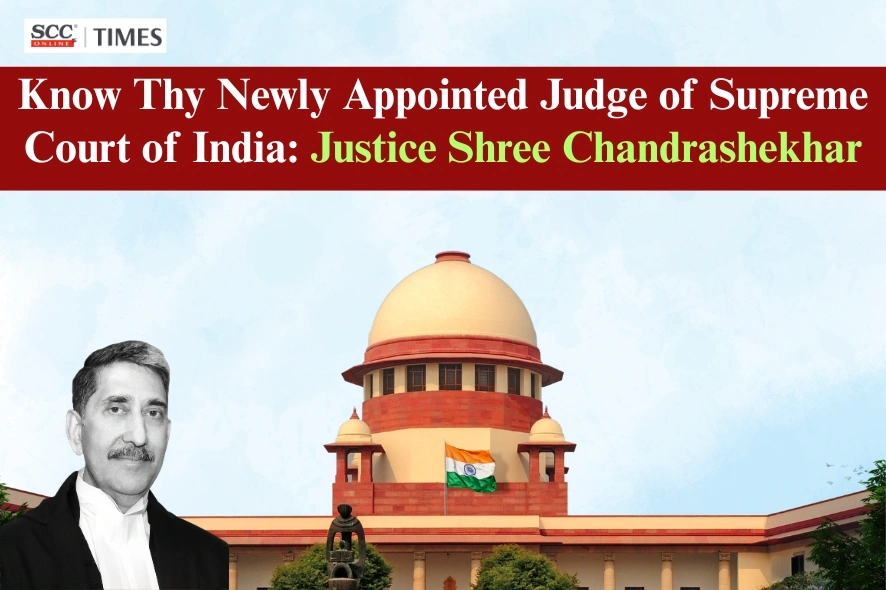
Born on 25 May 1965, Justice Shree Chandrashekhar pursued his legal education at the prestigious Campus Law Centre, University of Delhi, and obtained his LL.B. degree in 1993. He was enrolled as an Advocate with the Delhi State Bar Council on 09 December 1993, marking the beginning of an illustrious legal career.
Career as an advocate2
Upon entering the legal profession, he commenced practice in Delhi and established himself on both the civil and criminal sides. During nearly 19 years of practice as an Advocate before various courts, he handled approximately 3,500 cases, predominantly before the Supreme Court of India. He served as Standing Counsel for the All-India Council for Technical Education and the State of Jharkhand before the Supreme Court. Over the course of his practice, he represented several public bodies and institutions, including the Bihar State Housing Board, Bihar State Pollution Control Board, Jharkhand State Electricity Board, and the Indian Council of Agricultural Research, among others. He also acted as retained counsel for various private companies and corporate entities.
Did you know: Justice Shree Chandrashekhar appeared as counsel in around 140 reported Supreme Court decisions.3
Career as a judge
Justice Shree Chandrashekhar, whose parent High Court is Jharkhand High Court, began his judicial career as an Additional Judge of the Jharkhand High Court, Ranchi, on 17 January 2013, and was made a Permanent Judge on 27 June 2014.
Justice Chandrashekhar was appointed as the Acting Chief Justice of the Jharkhand High Court with effect from 29 December 2023. Subsequently, he was transferred to the Rajasthan High Court, and then to the Bombay High Court in July 2025.4
On 25 August 2025, the Supreme Court Collegium, headed by then Chief Justice of India B.R. Gavai, recommended Justice Chandrashekhar’s name for elevation as the Chief Justice of the Bombay High Court.5 In exercise of powers under Article 217 of the Constitution, the President of India appointed him as Chief Justice of the Bombay High Court on 4 September 2025, succeeding Justice Alok Aradhe.6
Recognizing his distinguished contributions at the Bar and his deep understanding of legal principles, on 27 May 2026, Justice Chandrashekhar was recommended for elevation as Judge of the Supreme Court of India7 and was appointed to the post on 1 June 2026.8
Did you know: Justice Shree Chandrashekhar was also the part of the three-member Inquiry Committee to investigate allegations against Justice Yashwant Varma, Judge, Allahabad High Court which was constituted on 12 August 2025 by the Speaker of the Lok Sabha.9
Notable Judgements by Justice Shree Chandrashekhar
In Nikhil Ashok Dumane v. Police Recruitment Board, 2026 SCC OnLine Bom 2817, writ petitions challenging the recruitment process for Police Constable posts, the Division Bench of Shree Chandrashekhar, CJ., and Anil S. Kilor, J., examined whether vacancies in Vimukta Jatis [VJ(A)] and Nomadic Tribes [NT(D)] categories left unfilled due to non-availability of suitable candidates should be filled by preparing a common merit list of (NT) (B) and NT(C) candidates or by distributing them proportionately according to reservation percentages. The Court held that proportional distribution was the correct method under Section 4(3), Maharashtra State Public Services Reservation for Scheduled Castes, Scheduled Tribes, De-Notified Tribes (Vimukta Jatis), Nomadic Tribes, Special Backward Category and other Backward Classes Act, 2001 (Act of 2001), and dismissed the petitions.
In the case of Sheraz Ahmed v. State of Maharashtra, 2026 SCC OnLine Bom 1754, a writ petition under the Juvenile Justice (Care and Protection of Children) Act, 2015 (JJ Act), the Division Bench of Shree Chandrashekhar, CJ., and Gautam A. Ankhad, J., held that the plea of juvenility can be raised at any stage of the proceedings and that delay in raising such a claim cannot justify rejection. The Court noted that the petitioner had sought an inquiry before the Juvenile Justice Board (JJ Board), but the Special Judge had dismissed the application, restricting the JJ Board powers to Section 19, JJ Act. Referring to Umesh Singh v. State of Bihar, (2013) 4 SCC 360 and Abuzar Hossain v. State of W.B., (2012) 10 SCC 489, the Court found the rejection contrary to settled law, set aside the order dated 6 February 2026, and directed transmission of records to the JJ Board for inquiry by 7 March 2026, thereby disposing of the writ petition.
In Kedar Mahadeo Jadhav v. Maharashtra Cricket Association, 2026 SCC OnLine Bom 29, the writ petitions challenging the election programme of the Maharashtra Cricket Association (‘MCA’) published on 23 December2025, the Division Bench of Shree Chandrashekhar*, CJ., and Gautam A. Ankhad, J., held that largescale admission of about 400 new members immediately before elections raised serious questions on legality and fairness. The Court emphasised that the purity of elections requires real opportunity to stakeholders to raise objections and observed that the process adopted was prima facie arbitrary and violative of natural justice. Accordingly, the Court directed that the elections scheduled on 06-01-2026 shall not proceed without leave of the Court.
In Green Gene Enviro Protection and Infrastructure Ltd. v. State of Maharashtra, 2025 SCC OnLine Bom 5455, a writ petition challenging an amended circular dated 15 February 2024 and Clause 19 of a Consent to Operate (‘CTO’), the Division Bench of Shree Chandrashekhar*, CJ., and Gautam A. Ankhad, J., held that the restrictions imposed were illegal, arbitrary, discriminatory, and beyond jurisdiction. The Court observed that the Maharashtra Pollution Control Board (‘MPCB’) lacked authority under the Hazardous and Other Wastes (Management and Transboundary Movement) Rules, 2016 (‘HWM Rules’) to curtail an industry’s area of operation, and that such limits infringed the right to trade under Article 19(1)(g) of the Constitution. Accordingly, both the circular and Clause 19 were quashed.
In Kartiki Awantika v. State of Maharashtra, 2025 SCC OnLine Bom 5427, the writ petitions concerning the Civil Judge (Junior Division) and Judicial Magistrate (First Class) Competitive Examination—2022, the Division Bench of Shree Chandrashekhar*, CJ., and Gautam A. Ankhad, J., held that while candidates may be permitted to peruse their answer-books to ensure fairness, there exists no enforceable right to re-evaluation or recalculation of marks dehors the Rules. Emphasising the sanctity of the judicial service exam, the Court observed that writ jurisdiction under Article 226 of the Constitution may be exercised only in exceptional circumstances to avoid grave injustice. Accordingly, the petitions were disposed of in those terms.
All three writ petitions were filed by employees of Air India Ltd., seeking reliefs related to dismissal, promotion orders, and pension scheme benefits. Though the facts were distinct, the common employer and issue of maintainability led to the petitions being heard together. During pendency, Air India Ltd.’s status changed due to privatisation, raising questions under Article 226 of the Constitution. The Division Bench of Shree Chandrashekhar and Manjusha A. Deshpande*, JJ., in M. Yogeshwar Raj v. Air India Ltd., 2025 SCC OnLine Bom 3013, held that all the three writ petitions, although maintainable on the dates on which they were instituted, have ceased to be maintainable, due to privatisation of Air India Ltd. The Court emphasised that due to the change in the status of Air India Ltd., after its privatisation it had become a private entity and was not performing any public functions, therefore, it was not amenable to writ jurisdiction, and no writ could be issued against it.
Bombay High Court Quashes FIRs Rooted in Long-Standing Rivalry, Holds Vague Conspiracy Allegations Amount to Abuse of Process
While considering writ petitions seeking quashing of multiple FIRs arising out of interlinked cross-cases between the parties, the Division Bench comprising of Shree Chandrashekhar, C.J. and Suman Shyam, J., in Shekhar Kakasaheb Jagtap v. State of Maharashtra, 2026 SCC OnLine Bom 3296, examined whether the allegations disclosed any cognizable offence or were an outcome of personal vendetta and abuse of the criminal process. The Court, applying settled principles governing quashing under Article 226 of the Constitution and Section 528, Nagarik Suraksha Sanhita, 2023 (BNSS), held that vague and retaliatory allegations cannot sustain criminal proceedings. Finding the FIRs to be manifestly vexatious and an abuse of process of law, the Court allowed the writ petitions and quashed all impugned criminal proceedings.
Allegations of Procedural Irregularities Insufficient to Sustain PIL Without Demonstrable Public Injury: Bombay High Court
While considering the public interest litigation (PIL) challenging sanctions, permissions and approvals granted for redevelopment of a building on CTS No. 648 at Altamount Road, Mumbai in Altamount Road Area Citizens Committee v. State of Maharashtra, 2026 SCC OnLine Bom 2544, the Division Bench comprising of Shree Chandrashekhar, C.J. and Suman Shyam, J. held that such proceedings cannot be used to stall construction or pursue private disputes. Finding no demonstrable public injury and clear abuse of process, the Court dismissed the petition and disposed of pending applications.
Municipal Licence Fee Fixation by Delegated Authority Upheld; No Excessive Delegation Where Legislative Policy Provides Adequate Guidance: Bombay HC
In Rushabh Outdoors v. State of Maharashtra, 2026 SCC OnLine Bom 2475, a writ petition filed by a partnership firm engaged in outdoor publicity business, along with the proprietress of M/s. Synnovation, challenging the constitutional validity of Section 479(2), Mumbai Municipal Corporation Act, 1888 and the consequential enhancement of advertisement licence fees by Resolution No. 999 dated 11 December 2009 of the Municipal Corporation of Greater Mumbai, a Division Bench of Shree Chandrashekhar, C.J. and Gautam A. Ankhad, J., upheld the validity of Section 479(2) of the MMC Act and dismissed the writ petition.
The Court held that the power conferred upon the Municipal Commissioner to fix licence fees for sky-signs and advertisements, subject to sanction of the Corporation, is neither unguided nor arbitrary and does not suffer from the vice of excessive delegation. It further held that Article 243-X of the Constitution is enabling in nature and does not mandate the State Legislature to prescribe rigid limits or detailed procedures for fixation of fees by municipal authorities. Reiterating that in matters of regulatory and licence fees a strict quid pro quo is not required and only a reasonable nexus between levy and services is sufficient, the Court upheld the annual 10% increase as part of a permissible regulatory framework.
Allegations of Gas Tapping and Delayed Complaints Indicative of Malicious Prosecution; Bombay HC Dismisses Writ Petition
While considering a writ petition seeking a direction for registration of an FIR against Reliance Industries Limited and its officials for alleged offences of theft, criminal breach of trust, conspiracy and allied provisions under the Penal Code, 1860 (IPC), the Division Bench comprising Shree Chandrashekhar, C.J. and Suman Shyam, J., in Jitendra Punamchand Maru v. CBI, 2026 SCC OnLine Bom 2235, dismissed the writ petition on not finding any public interest element or prima facie criminality. The Court held that the petition lacked bona fides, was highly belated, and amounted to an abuse of the criminal process as it intended to convert a civil dispute into a criminal proceeding.
PIL Challenging Dharavi Redevelopment Tender and Allotment of Salt Pan & Mother Dairy Lands by Non-Bidder Not Maintainable: Bombay HC
In Vasant Shiwappa Pailwan v. State of Maharashtra, 2026 SCC OnLine Bom 1606, a PIL filed by the petitioner, a senior citizen and Technical Consultant, seeking a writ of certiorari for quashing various Government Resolutions, tender notice dated 1 October 2022, Letter of Allotment dated 17 July 2023, and development agreements relating to the Dharavi Redevelopment Project, a Division Bench comprising of Shree Chandrashekhar, C.J. and Gautam A. Ankhad, J., dismissed the petition holding that the petitioner, who was admittedly a stranger to the tender process and had not participated therein, could not be permitted to maintain the PIL by seeking to reopen a concluded tender process under the guise of public interest, particularly when the challenge was substantially a reiteration of issues already examined and upheld in earlier proceedings.The Court held that vague assertions regarding alleged undervaluation and inclusion of government lands, without any demonstrable illegality or breach of public trust, cannot be made the basis of judicial review so as to stall a large-scale public infrastructure project serving the rehabilitation of lakhs of displaced persons.
Alleged Misuse of ESOP Scheme, Diversion of Corporate Funds and False Criminal Complaint Disclose Cognizable Offences; Bombay HC Refuses to Quash FIR and PMLA Proceedings
In Rashmi Saluja v. State of Maharashtra, 2026 SCC OnLine Bom 363, a batch of writ petitions filed by petitioner, the erstwhile Executive Chairperson and Key Managerial Personnel of Religare Enterprises Limited (REL), challenging the registration of FIR dated 6 September 2024 and ECIR/MBZO-I/27/2024 under the Prevention of Money Laundering Act, 2002, the Division Bench comprising of Shree Chandrashekhar, C.J. and Gautam A. Ankhad, J., held that the investigation discloses prima facie involvement of the petitioner in complex financial transactions and corporate decisions. At this stage, a detailed examination of evidentiary value is not required. Finding no manifest illegality, abuse of process, or lack of jurisdiction, the Court dismissed the writ petitions.
Disability Pension Cannot Be Denied by Treating Service-Aggravated Diseases as Mere Lifestyle Disorders: Bombay High Court In Union of India v. Lt. Col. S.K. Rathore, 2026 SCC OnLine Bom 362, a batch of writ petitions filed by the Union of India challenging the orders passed by the Armed Forces Tribunal, Mumbai Bench, in Original Applications filed by Army and Navy personnel seeking grant of disability pension under the Pension Entitlement Rules, 2008 and the relevant Navy Pension Regulations, 1964, a Division Bench of Shree Chandrashekhar, C.J. and Gautam A. Ankhad, J., dismissed the petitions. The Court held that the Tribunal had granted disability pension in cases involving diseases such as primary hypertension, diabetes mellitus, chronic myeloid leukaemia, ankylosing spondylitis, panic disorder and other ailments, on the finding that the disabilities were either attributable to or aggravated by military service, particularly in operational or arduous postings, and had correctly applied the statutory framework governing disability pension. It further held that the opinion of the Medical Board is not sacrosanct and is subject to judicial review, especially where it lacks adequate reasoning or ignores relevant service conditions. The Court reiterated that pensionary provisions are beneficial in nature and must be interpreted liberally in favour of service personnel, and that the presumption of attributability or aggravation cannot be lightly displaced. Finding no perversity or jurisdictional error in the Tribunal’s findings, the Court upheld the grant of disability pension and dismissed the writ petitions.
Hostile Witnesses, Missing Links in Circumstantial Evidence and Failure to Prove Fake Encounter Allegations: Bombay High Court upholds Acquittal
In Rubabuddin Shaikh v. CBI, 2026 SCC OnLine Bom 2934, a criminal appeal filed by the brothers of deceased challenging the 2018 special court judgment acquitting all 22 accused, including 21 police officers, in the alleged fake encounter killings of deceased , his wife , and Tulsiram Prajapati, a Division Bench of Shree Chandrashekhar*, CJ., and Gautam A. Ankhad, J., upheld the acquittals. The Court observed that the CBI had accepted the trial court’s findings and chose not to file an appeal. It held that the trial court was correct in concluding that the prosecution failed to prove the alleged abduction, illegal detention, and fake encounters beyond a reasonable doubt. The Court further noted that the trial court’s conclusions were reasonable, well-reasoned, and supported by the evidence, and accordingly dismissed the appeals.
In a habeas corpus petition filed in the case of Gorkha Ram v. State of Rajasthan, 2024 SCC OnLine Raj 3560 seeking a direction upon the State authorities for the production of ‘X’, a 32-year-old married woman, with whom the petitioner claimed to be in a live-in relationship, a Division Bench of Madan Gopal Vyas and Shree Chandrashekhar*, JJ., dismissed the petition and held that “in no case, a person who claims live-in relationship with a married woman who is his own sister and makes a vague statement that ‘X’ is under illegal confinement of her husband and uncle-in-law can maintain a habeas corpus petition.”
In a writ petition filed by Junior Personal Assistants (JPAs) in the case of Twinkle Singh v. High Court of Judicature for Rajasthan, 2025 SCC OnLine Raj 471, employed under the Rajasthan High Court, Jodhpur challenging the requirement to pass an Efficiency Test for promotion to the post of Personal Assistant-cum-Judgment Writer, a Division Bench of Shree Chandrashekhar* and Kuldeep Mathur, JJ., allowed the petition to the extent that the 2020 batch is barred from competing for pre-2020 vacancies and the Efficiency Test results shall be published, and promotions must to be granted as per the prescribed method. The Court further held that government employees have no inherent right to promotion, but only the right to be considered under existing rules.
Additional Physical Impairments Cannot Override Eligibility Under Prescribed Disability Benchmark for Employment Consideration: Rajasthan High Court
In State of Rajasthan v. Sunita, 2024 SCC OnLine Raj 2690, a writ petition filed by disabled nursing challenging their disqualification from nursing recruitment on the ground that they did not meet the “40% or more disability in one leg” criterion due to deformities in other body parts, a Division Bench of Chandrashekhar* and Kuldeep Mathur, JJ., dismissed the appeals filed by the State Government and upheld the Single Judge’s decision in favour of the candidates. The Court held that if a person is suffering from disability in another leg or body part, the same cannot, by any stretch of imagination, be construed to mean that the candidate is unfit to perform her/his duties. The Court’s ruling effectively allowed meritorious disabled candidates to be considered for recruitment despite not meeting the narrow criterion of disability in a single leg.
Rajasthan High Court refuses to interfere in Sewage Treatment Plant site selection policy decision; dismisses PIL
In Rajendra Choudhary v. State of Rajasthan, 2025 SCC OnLine Raj 2535, a Public Interest Litigation (PIL) filed by practicing advocates at the Gram Nyayalaya, Khokharia, Jodhpur, seeking cancellation of the No Objection Certificate (NOC) granted for setting up a Sewage Treatment Plant (STP) and for relocation of the STP from its proposed site adjacent to the Gram Nyayalaya, a Division Bench of Shree Chandrashekhar and Sandeep Shah,* JJ., dismissed the writ petition with direction to the State authorities to ensure strict compliance with environmental and operational safety standards.
In Suo Moto v. State of Rajasthan, 2025 SCC OnLine Raj 2171, a suo motu matter based on a news report published in the Hindi daily newspaper Dainik Bhaskar dated 13 May 2025, regarding a grave issue related to “Access to Justice,” i.e., State Government, vide an order dated 9 April 2025, rendered 16 permanent Lok Adalats (PLAs) non-functional, a Division Bench of Shree Chandrashekhar and Sandeep Shah, JJ., expressed its displeasure at the vague response from the State and issued direction to respondent 4 (Principal Secretary, Law and Legal Affairs Department) to file personal affidavit with relevant information and records on denial of tenure of Chairman and Members of PLAs.
Also Read: Rajasthan High Court takes suo moto action over non-functioning of 16 Permanent Lok Adalats
In an arbitration application filed by the Petitioner-Smart Chip Private Limited for appointment in Smart Chip (P) Ltd. v. Jharkhand State Cooperative Bank Ltd., 2024 SCC OnLine Jhar 1577, sole arbitrator under Section 11(6), Arbitration and Conciliation Act, 1996 (‘the AC Act’) for resolution of disputes between the parties, Shree Chandrashekhar, ACJ., opined that under Section 11 of the AC Act, in cases where the parties did not agree to a procedure for appointment of an arbitrator for resolving the dispute on making an application by the aggrieved party, the power under Section 11(6) was exercisable by the Chief Justice of the High Court or a Judge nominated by the Chief Justice. At the present stage, it was not required to look beyond except existence of the arbitration clause; no more no less. Therefore, exercising the power under Section 11(6), the Court requested Saibal Kumar Laik, a practicing Advocate of the High Court of Jharkhand to act as the sole Arbitrator for resolving the dispute between the parties.
In Shiv Kumar Deora v. Union of India, 2024 SCC OnLine Jhar 1956, a case wherein the petitioner was interrogated till past mid-night and was permitted to go home only after his statement was recorded to the satisfaction of the GST Officer, the Division Bench of Shree Chandrashekhar, ACJ and Navneet Kumar, J., opined that the proper officer under the Central Goods and Services Tax Act, 2017 (‘CGST Act’) should not be requiring/forcing/coercing a person so summoned to give statement after the office hours. The Court also directed that the GST officers should follow the guidelines and instructions issued by the Commissioner (GST-Investigation) and the Central Board of Indirect Taxes and Customs (‘CBIC’) while summoning a person by exercising the powers under section 70, CGST Act.
The instant Petition was filed by the petitioner to direct Respondent 2-Jharkhand Bijli Vitran Nigam Limited (‘JBVNL’) to issue TDS Certificate for Rs 2,90,32,000 deducted as Income Tax at the rate of 2% from the bills raised by petitioner towards supply of materials. The Division Bench of Shree Chandrashekhar, ACJ.*, and Navneet Kumar, J., in Anvil Cables (P) Ltd. v. State of Jharkhand, 2024 SCC OnLine Jhar 1149, opined that the JBVNL had no authority in law to withhold Rs 2,90,32,000 as “kept back” amount for the purpose of litigation with the Income Tax Department. Therefore, the Court held that the action of the JBVNL in withholding Rs 2,90,32,000 was illegal and deprecated, and cost must be imposed upon it.
The Court further opined that any unjust retention of money or property of another should be against the fundamental principles of justice, equity and good conscience. Thus, the Court opined that petitioner was unnecessarily and knowingly dragged to the Court that there was no fault on petitioner’s part, and accordingly imposed the cost of Rs. 5 lakhs on the JBVNL, which should be recovered from the Managing Director.
In Court on its own motion v. Rajiv Ranjan, 2024 SCC OnLine Jhar 1224, a present criminal contempt proceeding registered against the Advocate General and Additional Advocate General (‘respondents’), following the order passed in Bijay Kumar Agrwal v. Union of India, WPCR No. 139 of 2021, the Division Bench of Shree Chandrashekhar, ACJ* and Ambuj Nath, J., opined that without framing a charge and affording an opportunity to the respondents to explain their conduct, a reference under Section 17, Contempt of Courts Act, 1971 (‘the Act’) for registering a criminal contempt proceeding against the respondents was not maintainable. The Court opined that this reference against respondents contravened the provisions under Section 15(3) of the Act and the rules of natural justice and therefore, was liable to be discharged.
*Judge who has penned the judgment.
1. https://dumka.dcourts.gov.in/Judges/honble-the-chief-justice-shree-chandrashekhar/
2. Supra
3. Supra
4. Justice Shree Chandrashekhar appointed as Chief Justice of Bombay High Court, SCC Times
5. Supreme Court Collegium recommends Justice Shree Chandrashekhar as Chief Justice of Bombay High Court, SCC Times
6. Supreme Court Collegium recommends Justice Shree Chandrashekhar as Chief Justice of Bombay High Court, SCC Times
7. Collegium Recommends Elevation of 4 Chief Justices and Senior Advocate V. Mohana to Supreme Court, SCC Times
8. Supreme Court Judges’ Appointments 2026 | President Appoints 5 Judges to Supreme Court Following Collegium Recommendations
9. Lok Sabha Reconstitutes 3-Member Inquiry Committee in Justice Yashwant Varma Case, SCC Times