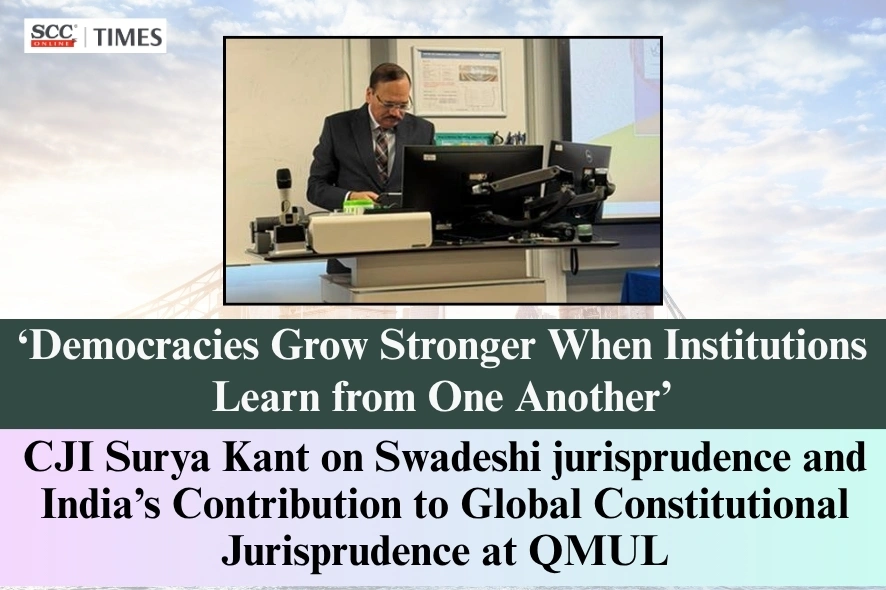
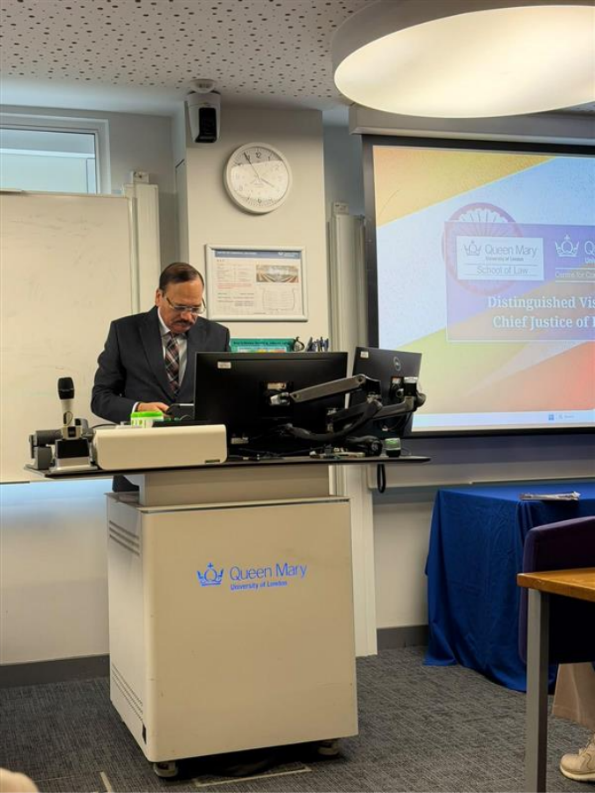
Recently, Queen Mary University of London (QMUL) hosted the Chief Justice of India (CJI), Justice Surya Kant at the Centre for Commercial Law Studies (CCLS). The event, held in association with the India Law Centre, brought together students, academicians, legal practitioners, and members of the Indian diaspora to interact with the head of the Indian Judiciary, Justice Surya Kant, and engage with contemporary legal and constitutional questions within the broader context of the shared legal traditions of India and the United Kingdom.
Welcome Address by Professor Julia Hörnle
Welcoming the gathering, Professor Julia Hörnle highlighted QMUL’s longstanding association with Indian legal education and the contribution of its Indian alumni to the legal profession. Reflecting on the increasing role of technology in the legal sector, she observed that while artificial intelligence may transform legal practice, the independence of Judges and the education of lawyers would remain indispensable in safeguarding constitutional values and the Rule of Law.
Address by Professor Sanmeet Kaur Dua
Professor Sanmeet Kaur Dua, Deputy Head of Department and Director of the India Law Centre, spoke about the establishment of the Centre, noting that it was conceived in response to the growing engagement of Indian and Indian-origin students with QMUL. She said that the Centre seeks to create meaningful opportunities for students to connect with the legal profession in India while fostering a deeper understanding of Indian law within the UK context.
Introduction by Advocate Reena Singh
Introducing Justice Surya Kant, Ms Reena Singh, Advocate, Supreme Court of India, reflected on the significance of bringing one of India’s foremost constitutional authorities to engage with students, academicians, and members of the Indian diaspora at a leading research university. Referring to the common law heritage shared by India and the United Kingdom, she observed that the occasion was not merely ceremonial but an opportunity to reflect on the future of law, justice, and public life. She remarked that for students aspiring to careers in law, governance, and public service, the interaction provided a unique opportunity to hear directly from the head of the Indian Judiciary at a formative stage in their professional journeys.
Keynote Address by CJI Surya Kant
Delivering the keynote address, Justice Surya Kant considered it most appropriate to speak to the students about the contribution of the Indian Supreme Court in developing global constitutional jurisprudence.
1. Constitutional adjudication and comparative learning
Justice Surya Kant observed that constitutional courts across jurisdictions are often confronted with similar questions concerning liberty, equality, democracy, institutional power, and human dignity. While every democracy is shaped by its own history, political culture, and institutional design, courts have frequently found value in understanding how comparable legal systems have approached similar challenges. He emphasised that comparative constitutional reasoning does not require courts to imitate foreign models; rather, ideas may be accepted, adapted to suit local conditions, or rejected altogether. Such engagement, he observed, broadens the range of constitutional possibilities and enables courts to better understand the distinctive features of their own legal system, and reflects confidence rather than insecurity.
Turning to the Indian Constitution, Justice Surya Kant observed that its framers approached constitution-making with remarkable openness, studying constitutional systems across the world while adapting them to India’s unique social realities. He described Indian constitutional jurisprudence as comparative in inspiration but Indian in character, which he termed Swadeshi jurisprudence, evolving in response to India’s specific challenges of inequality, pluralism, uneven access to institutions, and democratic inclusion.
2. Basic structure doctrine and constitutional identity
Justice Surya Kant identified the basic structure doctrine as the most significant contributions to comparative constitutional jurisprudence of the Indian Supreme Court. This principle was laid down by a 13-Judge bench of the Supreme Court in 1973.1
Drawing an analogy with the philosophical paradox of the ship of theseus, he explained that the central question was whether a Constitution could retain its identity if all its essential features were altered over time. In the landmark decision in Kesavananda Bharati v. State of Kerala2, the Supreme Court held that while Parliament possesses wide powers to amend the Constitution, certain foundational features remain beyond the reach of the amending power. Democracy, judicial review, secularism, separation of powers, federalism, and constitutional supremacy came to be recognised as part of the Constitution’s basic structure and identity.
He observed that the doctrine has influenced constitutional jurisprudence in several jurisdictions, noting its adoption in Bangladesh, Malaysia, Uganda, Kenya, and several other African countries.
3. Public interest litigation: A procedural innovation
Justice Surya Kant described public interest litigation (PIL) as perhaps the Indian Supreme Court’s most significant procedural innovation.
Explaining the traditional concept of locus standi, he noted that courts ordinarily require a litigant to establish a direct personal stake before seeking judicial intervention. However, the Supreme Court recognised that large sections of society, socially and economically disadvantaged, living in remote areas, and unaware of their rights guaranteed under Part III of the Constitution, were unable to approach courts to vindicate those rights.
To address this, Justice Surya Kant mentioned, the Court liberalised the rules of standing, permitting any bona fide individual, lawyer, journalist, or civil society organisation to seek judicial remedies on behalf of those unable to represent themselves. The Chief Justice cited the early example of undertrial prisoners in Bhagalpur who had served their full sentences but remained incarcerated due to a failure of record-keeping. A simple letter to the Supreme Court was treated as a petition on their behalf and orders for their release were passed, even though none of them were formally before the Court.
Justice Surya Kant observed that while PIL expanded access to justice for the marginalised and voiceless, the judiciary also developed safeguards, parameters, and self-regulatory principles to prevent misuse of the jurisdiction. He noted that the PIL framework has been adopted in various jurisdictions, particularly across South Asia and Africa.
4. Article 21 and the right to education
Highlighting the evolution of Article 21 of the Constitution, the Chief Justice noted that the Indian Supreme Court adopted an expansive interpretation of the right to life and personal liberty. The Court recognised that the right to education for children up to the age of 14 years is implicit in the right to live a dignified life, reasoning that a child denied education cannot fully realise the right to life with dignity guaranteed under Article 21. This principle was developed through landmark Constitution Bench decisions, including Mohini Jain (Miss) v. State of Karnataka3 and Unni Krishnan, J.P. v. State of A.P.4.
This jurisprudential development ultimately led to the insertion of Article 21-A, guaranteeing free and compulsory education for children up to the age of fourteen years.
5. Judicial independence and constitutional institutions
Justice Surya Kant referred to the Supreme Court’s interpretation of the constitutional provisions governing judicial appointments, explaining that the Court developed the collegium system to preserve judicial independence by ensuring the primacy of the judiciary in the appointment process. Referring to the evolution of the collegium system through the judges cases5, he observed that judicial primacy in appointments was developed to preserve judicial independence.
Justice Surya Kant further highlighted the Court’s contribution to strengthening constitutional institutions, particularly the Election Commission of India. Referring to the interpretation of Article 324, he observed that the Supreme Court has consistently reinforced the institutional mechanisms necessary for ensuring free and fair elections, recognising that robust constitutional institutions are indispensable to the effective functioning of a constitutional democracy.
6. Environmental jurisprudence and Article 21
Another significant contribution of the Indian Supreme Court, according to Justice Surya Kant, has been the development of environmental jurisprudence through Article 21. The Court interpreted the right to life as encompassing the right to a clean and healthy environment, and recognised corresponding obligations upon the State, society, and individuals.
Chief Justice Surya Kant illustrated how judicial intervention had translated environmental concerns into enforceable rights and obligations for both the State and individuals. He observed that environmental protection had thereby moved from the margins of policymaking into the domain of constitutional rights and public obligations. He noted that this jurisprudence has been followed in Colombia, Brazil, and Argentina, as well as in Bangladesh and other South Asian countries.
7. Indian constitutional jurisprudence and the global conversation
Concluding his address, Justice Surya Kant observed that the examples he discussed reflected a broader feature of Indian constitutional jurisprudence. Through an expansive understanding of rights, institutional accountability, dignity, and democratic inclusion, the Indian Supreme Court has sought to address complex democratic questions while remaining responsive to the realities of a diverse society.
He observed that India’s constitutional experience offers not ready-made solutions but a long history of engagement with difficult democratic questions.
Concluding on the importance of comparative constitutional engagement, he stated:
“Democracies grow stronger when institutions remain sufficiently confident to learn from one another while remaining faithful to their own constitutional identity.”
1. Kesavananda Bharati v. State of Kerala, (1973) 4 SCC 225
2. supra
3. Mohini Jain (Miss) v. State of Karnataka, (1992) 3 SCC 666
4. Unni Krishnan, J.P. v. State of A.P., (1993) 1 SCC 645
5. S.P. Gupta v. Union of India, 1981 Supp SCC 87 (First Judges Case), Supreme Court Advocates-on-Record Assn. v. Union of India, (1993) 4 SCC 441 (Second Judges Case), and In re Special Reference No. 1 of 1998, (1998) 7 SCC 739 (Third Judges Case)
,