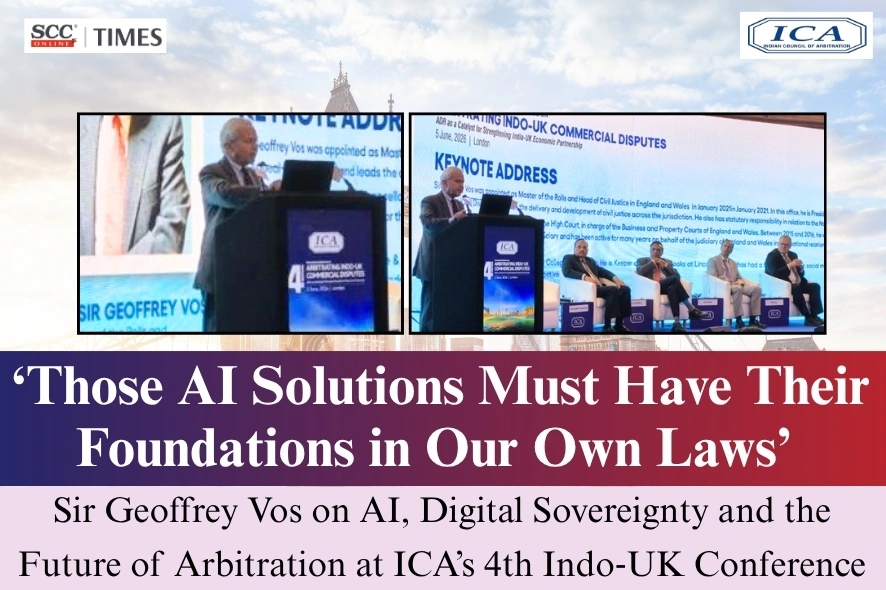
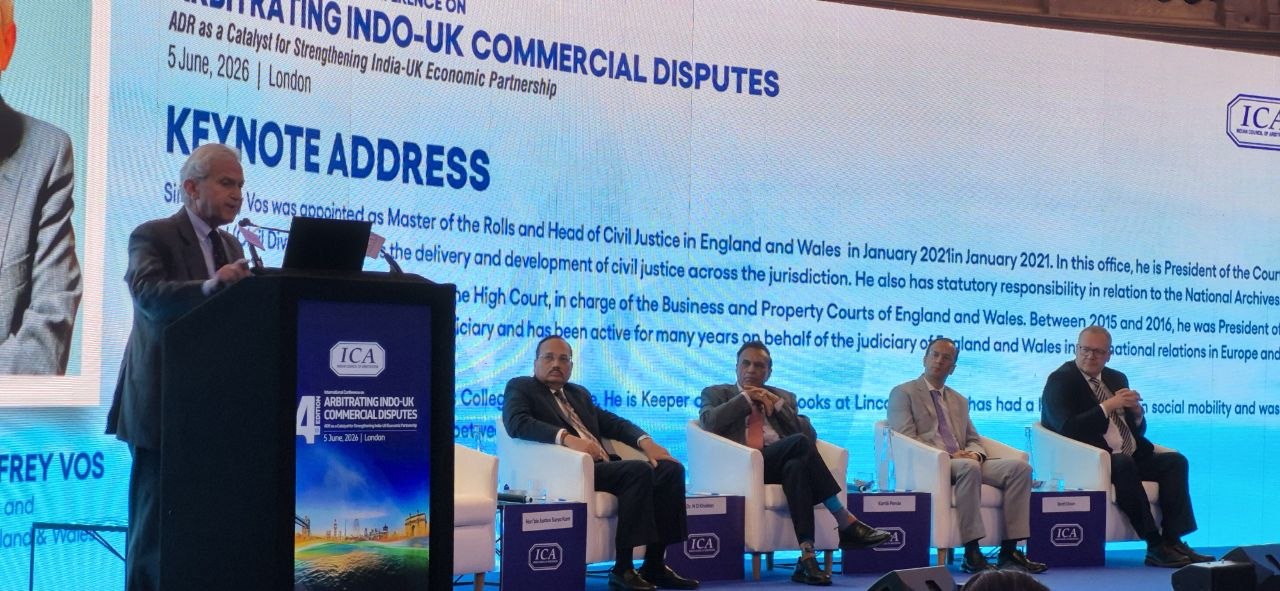
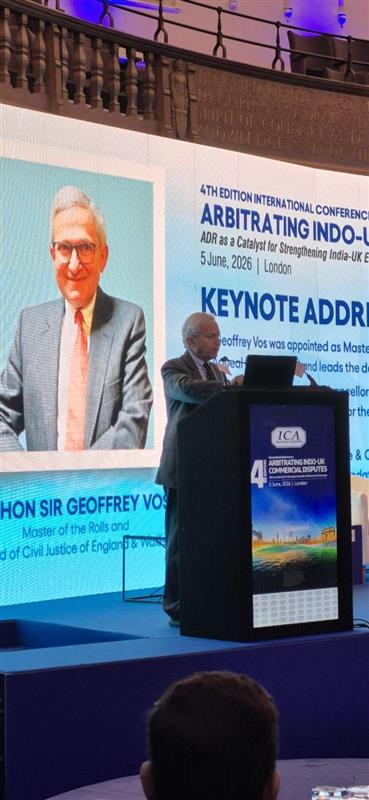
At the 4th International Conference on Arbitrating Indo-UK Commercial Disputes: ADR as a Catalyst for Strengthening India-UK Economic Partnership, Rt. Hon. Sir Geoffrey Vos, Master of the Rolls and Head of Civil Justice of England and Wales, delivered a keynote address on the role of alternative dispute resolution in strengthening the India-UK economic corridor. Reflecting on his longstanding engagement with India and his own work on judicial digitisation, Sir Geoffrey explored the growing relationship between artificial intelligence, dispute resolution, digital sovereignty and cross-border investment.
Digitisation of Justice and Growing Judicial Cooperation
Beginning his address, Sir Geoffrey noted that he had visited India on numerous occasions over the past twenty-five years and had closely observed efforts to modernise and digitise the Indian judiciary.
He recalled spending time at the Supreme Court of India in 2024 and witnessing the increasing use of technology by the judiciary.
As he observed:
“I observed the extensive usage of AI by the Indian judiciary, including in producing simultaneous transcripts of the proceedings.”
He also highlighted his own involvement in digitising the justice system of England and Wales, including the development of digital dispute resolution mechanisms designed to resolve disputes without lengthy and costly traditional proceedings.
According to Sir Geoffrey, close cooperation between major common law jurisdictions is becoming increasingly important in a rapidly evolving digital world.
Digital Sovereignty and the New Global Divide
A central theme of Sir Geoffrey’s address was the concept of digital sovereignty.
Referring to a recent papal encyclical on artificial intelligence, he highlighted concerns regarding unequal access to technology and the concentration of technological power in the hands of a small number of global actors.
According to Sir Geoffrey, modern economies increasingly depend upon knowledge and technology, creating new forms of inequality and exclusion.
He identified two significant risks:
“The exclusion of many nations from their own digital sovereignty and the exclusion of many of the world’s population from the economic advantages afforded by ever more capable AI.”
While noting that the United Kingdom benefits from English-language AI models, he explained that India faces different challenges due to its linguistic diversity. Nevertheless, both countries remain dependent upon technology developed outside their borders.
As he remarked:
“Both countries are dependent on the technological sovereignty of big corporate developers in other countries.”
Rule of Law, Investment and Economic Growth
Sir Geoffrey emphasised that dependable legal systems and effective dispute resolution mechanisms remain fundamental to economic development.
According to him, investors require confidence that disputes will be resolved fairly, efficiently and at proportionate cost.
He explained:
“Unless overseas investors are confident that a commercial dispute with the government of the home country will be resolved fairly within a reasonable time and at proportionate cost, such investors will go elsewhere.”
He stressed that this principle applies equally to arbitration and court-based dispute resolution and becomes even more important as economies become increasingly dependent on artificial intelligence and digital infrastructure.
AI Arbitrators and the Future of ADR
Turning specifically to arbitration, Sir Geoffrey referred to developments in the United States, where the American Arbitration Association’s International Centre for Dispute Resolution launched an AI-assisted arbitrator for certain construction disputes.
The system involves machine-generated outcomes and draft awards that are subsequently reviewed by a human arbitrator. According to Sir Geoffrey, AI-driven dispute resolution offers clear advantages.
As he observed:
“Those advantages of course are cost and speed.”
He suggested that arbitration may prove particularly suited to AI adoption because parties already possess significant autonomy in choosing how disputes will be resolved.
Why Courts Face Different Constitutional Challenges
While AI may be adopted more readily within arbitration, Sir Geoffrey cautioned that judicial decision-making presents fundamentally different constitutional concerns. He explained that courts derive their legitimacy from the state’s obligation to provide independent and impartial adjudication. Accordingly, the use of AI within judicial systems raises questions concerning constitutional rights and democratic legitimacy.
As he stated:
“It would not, as it seems to me, be possible for the judiciary in any democratic country to use AI to make its decisions of its own volition.”
He further observed that it has not yet been established whether a machine can satisfy the requirements of an independent and impartial tribunal under applicable human rights standards. By contrast, arbitration operates on party consent.
According to Sir Geoffrey:
“The parties can consent to resolve their disputes in any way they choose.”
This distinction may make AI-assisted arbitration more acceptable than AI-generated judicial decisions.
The Need for Domestic Legal Foundations
Despite recognising the potential benefits of AI-driven dispute resolution, Sir Geoffrey repeatedly emphasised the importance of preserving legal and digital sovereignty. According to him, if artificial intelligence is to assist arbitral decision-making, the systems involved must reflect the legal traditions and legal materials of the jurisdictions concerned.
He warned:
“If AI systems are to be used in arbitral decision making, the underlying Large Language Models (LLMs) must be trained on materials that are relevant to the home states of the parties involved in the disputes.”
He also stressed the importance of testing such systems for reliability and bias before they are deployed in legal decision-making.
Enforcement Challenges for Machine-Made Awards
Sir Geoffrey suggested that entirely machine-generated arbitral awards could eventually face legal challenges. Referring to enforcement under the New York Convention, he noted that public policy concerns may arise when parties seek recognition of machine-made decisions.
At the same time, he acknowledged that commercial parties may increasingly favour such mechanisms because of the significant savings in cost and time. Accordingly, he argued that the legal profession must ensure that technological innovation remains aligned with legal standards and procedural fairness.
No Turning Back on Technology
Concluding his remarks, Sir Geoffrey urged legal institutions and practitioners to embrace technological change rather than resist it. ’The legal community must move with the times’, he said, warning that none of these changes that he talks about frequently is likely to be reversible.
He added:
“The world will not go backwards.”
While advocating greater adoption of AI solutions within dispute resolution, Sir Geoffrey stressed that such innovation must remain grounded in domestic legal systems and traditions. His concluding message was that artificial intelligence should be embraced, but only in a manner that preserves legal sovereignty, procedural fairness and public confidence.
As he stated:
“Those AI solutions must have their foundations in our own laws.”
Concluding Reflections
Sir Geoffrey Vos’s keynote address highlighted the growing intersection between artificial intelligence, dispute resolution and international commerce. While recognising the efficiencies that AI may bring to arbitration and ADR, he cautioned that legal institutions must ensure that technological advances do not undermine legal sovereignty, constitutional legitimacy or the rule of law. For both India and the United Kingdom, he suggested, the future of cross-border dispute resolution will depend not merely on adopting AI, but on ensuring that AI remains firmly rooted in domestic legal traditions and values.
SCC Times reported the 4th Edition of the International Conference on “Arbitrating Indo-UK Commercial Disputes,” organised by the Indian Council of Arbitration (ICA) on 5 June 2026 at Church House Westminster, London, as part of London International Disputes Week 2026.
Read more LIDW 2026 Coverage:
- Professional Ethics in the Era of Self-Promotion on Social Media: Toby Landau KC Delivers Keynote Address on International Arbitration Day at LIDW 2026
- LIDW 2026 | Arbitration’s Success Must Not Breed Complacency, Says Lord Neuberger in his Keynote Address on the occasion of International Arbitration Day
- Hold Counsels Accountable, Study How Arbitrators Think, and Run Every Case Through AI First: Three Bold Ideas From LIDW26
- Climate Obligations, Supply Chain Uncertainty, & Shifting Regulatory Frameworks: Experts Discuss Energy Arbitrations in a Changing World at LIDW 2026
- Why Lawyers Keep Getting AI Wrong and Why Human Judgment Still Matters: Insights from LIDW 2026
- Who Owns the Risk When AI Gets It Wrong? Confidentiality, Governance and Human Judgment at LIDW 2026
- Disputes in an ‘Unruly World’: Sean West Warns of New Risks at the Intersection of Geopolitics, Law and AI at LIDW26
- Due Process Challenges and Public Policy Review: How Indian Courts Draw the Line in Arbitration — Lessons from LIDW 2026
- Deepfakes, Disclosure and the Privilege Gap: Experts Discuss AI, Authenticity, and the Future of Evidence at LIDW 2026
- Common Heritage or a Free-for-All Regime? LIDW26 Panel Explores Legal Challenges in the Deep Sea, Polar Regions and Outer Space
- LIDW 2026 | The Great Costs Debate: Arbitration, Litigation and the Search for Proportionality
- LIDW 2026 | Rule of Law Under Pressure: Fiona Hill, David Gauke and Dan Feldman on Populism, Democratic Backsliding and Geopolitical Risk
- ‘A Journey Rather Than a Plan’: At LIDW 2026, Clare Wardle Reflects on What It Really Takes to Be a General Counsel in a World of Geopolitical Risk and AI Disruption
- ‘The Last 25 Years Will Be Nothing Compared to the Next 25’: Experts Debate Tradition and Transformation in Dispute Resolution at LIDW 2026
- ‘Adapt or Die’: Master of the Rolls Sir Geoffrey Vos Urges Legal Profession to Embrace AI and Reform Dispute Resolution at LIDW 2026
- ‘If This Industry Wobbles, It Is Not a Contract in Dispute — It Is a Systemic Event’: Inside the Emerging World of Data Centre Disputes at LIDW 2026
- LIDW 2026 | ‘Stable as a Coin or a Black Swan Dive?’: How Crypto Arbitration Is Adapting to Valuation, Enforcement and the Web3 Economy
- LIDW 2026| ‘The Arbitrator Is Dead, Long Live the AiBitrator’: RPC and Stephenson Harwood Debate Whether AI Should Replace Human Arbitrators
- LIDW26 | From the Mahabharata to the Mediation Act, 2023: India and England Compare Notes on Why Mediation Is Winning
- ‘It Is a Great Tool, Not a Master’: Legal Leaders Debate AI’s Growing Influence on the Legal Profession
- LIDW 2026 | Geopolitical Fragmentation and Commercial Disputes: Experts Examine Contractual Risk, Investment Protection and Quantum in an Era of Polycrisis