Disclaimer: This has been reported after the availability of the order of the Court and not on media reports so as to give an accurate report to our readers.
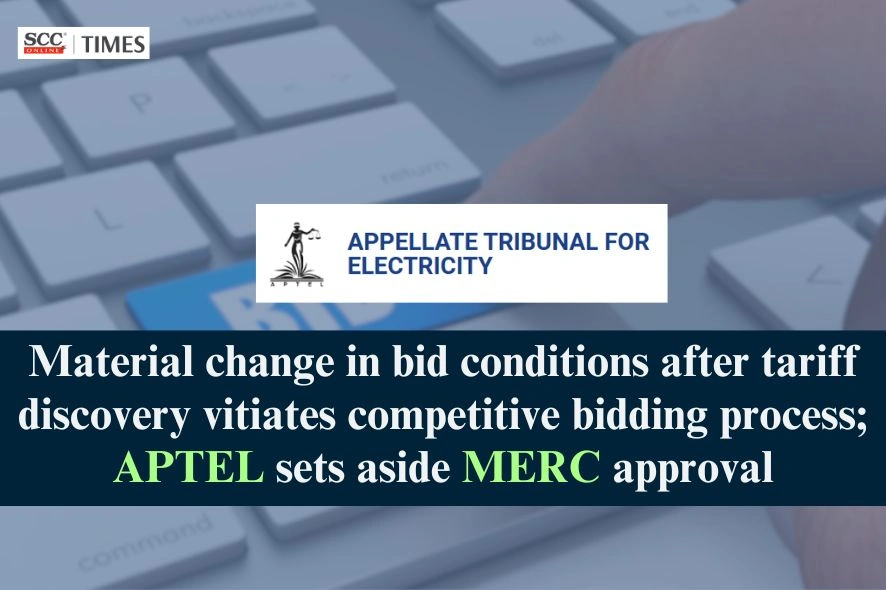
Appellate Tribunal for Electricity (APTEL): In a batch of appeals challenging the Maharashtra Electricity Regulatory Commission’s (MERC) order approving Maharashtra State Electricity Distribution Company Ltd. (MSEDCL) procurement of 2000 MW/4000 MWh Battery Energy Storage System (BESS) capacity through competitive bidding, the Division Bench of Seema Gupta, Officiating Chairperson, and Virender Bhat, Judicial Member, held that the bidding process stood vitiated when the Ministry of Power (MoP), after completion of the bidding process, imposed a condition requiring MSEDCL to retain a contractual right to utilise the BESS for at least 6300 cycles during the contract period. The Tribunal observed a post-bid condition materially altered the basis on which bidders had submitted their financial bids, and set aside MERC’s tariff adoption order and quashed the entire bidding process.
Background
It was on 25 July 2025 when MSEDCL floated a tender for procurement of 2000 MW/4000 MWh BESS capacity with Viability Gap Funding Scheme (VGF) support from the MoP. During the bidding process, MSEDCL revised the project configuration from 2 cycles per day to 1 cycle per day, and the bidders submitted their technical and financial bids on that basis. After the bids were opened and the lowest tariff was discovered, the MoP, by letter dated 31 December 2025, approved operation at one cycle per day but required MSEDCL to retain a contractual right to utilise the BESS for at least 6300 cycles during the contract period without additional cost. Contending that this post-bid condition materially altered the basis on which the bids had been submitted, the appellants challenged MERC’s order dated 6 March 2026 approving the bidding outcome and adopting the discovered tariff.
Also Read: Absence of Restitution Clause Cannot Defeat Change in Law Claim: APTEL Applies “Penta-Test”
Analysis
The Tribunal noted that under the VGF Scheme dated 9 July 2025, BESS developers were eligible for VGF support up to ₹ 18 lakhs per MWh. Clause 2.5 of the Scheme envisaged a battery system with a 2-hour discharge duration and average of 1.5 cycles per day, while also authorising the eligible entity or distribution licensee, namely, MSEDCL, to vary the duration and number of cycles as per its requirements. Pursuant thereto, MSEDCL issued the request for selection (RfS) on 25 July 2025 for procurement of 2000 MW/4000 MWh BESS capacity through competitive bidding with VGF support from Power System Development Fund (PSDF). The RfS contemplated a BESS project with a 2-hour discharge duration and 2 cycles per day, translating to 5475 cycles over the 15-year contract period, upon achievement of which the successful bidders would be entitled to VGF benefits.
The Tribunal noted that, pursuant to Addendum No. 8 dated 25 October 2025, the last date for submission of bids was extended to 31 October 2025, with technical bids scheduled to be opened on 3 November 2025. The appellants participated in the bidding process on the basis of the RfS conditions and furnished the requisite bank guarantees. Upon opening of the technical bids, it was found that 46 entities had submitted bids for an aggregate capacity of 11,110 MW/22,220 MWh, far exceeding the tendered capacity. Financial bids were opened on 4 November 2025, following which 2 bidders were disqualified under the RfS provisions and a reverse e-auction was conducted on 5 November 2025 to discover the lowest tariff. The tariff discovered under Part-A was ₹ 1,65,998 per MW per month, whereas Part-B yielded a higher tariff of ₹ 1,76,100 per MW per month. Since Part-B bidders declined to match Part-A L1 rate, the entire 500 MW capacity under Part-B was merged into Part-A, resulting in a final allocation of 2000 MW/4000 MWh at the discovered tariff of ₹ 1,65,998 per MW per month.
For MSEDCL’s petition seeking approval of the discovered tariff and adoption of the competitive bidding outcome for procurement of BESS capacity, MERC, by its order dated 6 March 2026, approved the procurement of 2000 MW/4000 MWh BESS (one cycle per day) through the competitive bidding process at a tariff of ₹ 1,65,998 per MW per month for a period of 15 years. The Commission further directed MSEDCL to execute the Battery Energy Storage Purchase Agreement (BESPA) with the successful bidders within 15 days from the date of the order.
The Tribunal noted that, during the pendency of the proceedings before MERC, MSEDCL sought the MoP approval to operate the BESS project at one cycle per day instead of 1.5 cycles per day. By letter dated 31 December 2025, the Ministry approved the deviation, subject to the condition that MSEDCL should retain the contractual right to use the BESS for at least 6300 cycles during the contract period without additional cost. It was also noted that this communication of the MoP came after the last date for submission of technical/financial bids dated 3 November 2025.
The Tribunal found it evident that the bidders were under the impression that they would neither be required nor be asked to schedule charging of BESS for more than one cycle per day aggregating to 5475 cycles during the contract period of 15 years. It was further found that the approval MoP by the letter was a conditional approval and in case MSEDCL violates the condition, the approval given by for revision of cycles would become otiose. The new condition requiring the successful bidders to cater for at least 6300 cycles during the contract period, was contrary to both the terms of the RfS and the draft BESPA. Such a stipulation amounted to a material deviation from obligations contemplated under the bidding documents and therefore is not permissible.
“It is a trite law that goal post cannot be re-arranged are asked to be re-arranged after the bidding process is complete to the prejudice of the rights of the bidders.”
The Tribunal found the appellants concerns to be justified, as failure to achieve 6300 cycles could result in consequences such as loss or recovery of VGF support. The Ministry’s letter alters the substantial as well as essential requirement under the RfS document which the bidders could not have factored in at all at the time of submitting the bids. The Tribunal further found that MSEDCL’s offer to compensate the bidders in case of denial of VGF support to be unenforceable, as it lacked both Board approval and regulatory sanction.
The Tribunal observed that although the RfS was not expressly amended, incorporation of a new clause in the BESPA granting MSEDCL the right to utilise the BESS for at least 6300 cycles would effectively alter the basis of the tender, which contemplated operation at one cycle per day. Such a clause could place the successful bidders in a disadvantageous position and would amount to changing the rules of the game after the bidding process had commenced, which is impermissible.
The Tribunal noted that the Ministry’s subsequent clarifications did not support MSEDCL’s case rather, they reinforced the appellants’ concerns as the clarifications expressly required MSEDCL and Uttar Pradesh Power Corporation Limited (UPPCL) to retain the contractual right to utilise the BESS for atleast 6300 cycles to avoid under utilisation of the asset. This indicated that the right could be enforced during the project tenure, potentially compelling the developers to achieve the stipulated cycles without additional compensation and exposing them to adverse consequences, including loss of VGF support, in the event of non-compliance. The Tribunal observed that the MERC had failed to consider these consequences which was not only prejudicial to the appellants but also contrary to the terms of the RfS.
Decision
The Tribunal held that the tariff discovered through the bidding process could not have been approved by MERC, as the bidding process itself stood vitiated by the introduction of a new condition after completion of the bidding process. Accordingly, the Tribunal set aside the impugned order, quashed the entire bidding process and the letters of intent if issued pursuant thereto, and directed MSEDCL to return the appellants’ security deposit and bank guarantees within 4 weeks and all the appeals were allowed.
[Diwakar Renewable & Infra (P) Ltd. v. Maharashtra Electricity Regulatory Commission, 2026 SCC OnLine APTEL 54, decided on 5-6-2026]
Advocates who appeared in this case:
For the appellant: Manish Priyadarshi, Hemant Singh, Mridul Chakravarty, Biju Mattam, Sourav Roy, Supriya Rastogi Agarwal, Lakshyajit Singh Bagdwal, Ankita Bafna, Harshit Singh, Nehul Sharma, Alchi Thapliyal, Lavanya Panwar, Indrayudh Chowdhury, Devansh Pundir, Sindhuja Rastogi, Mahima Srivastava, Devyanshu Sharma, Vishrov Mukerjee, Janmali Gopal Rao Manikala, Girik Bhalla, Ameya Vikram Mishra, Priyanka Vyas, Deepak Thakur, Sai Snigdha Nittala, Snehal Upadhyay, Yashaswi Kant, Pratyush Singh, Damodar Solanki, Juhi Senguttuvan, Anumeha Smiti, Garima Adlakha, Vijayendra Pratap Singh, Aditya Vikram Jalan, Ankitesh Ojha, Kshitij Pandey.
For the respondent: Ramanuj Kumar, Vishal Binod, Sagnik Maitra, Aditya Dubey, Swadha Sharma, Simranjeet Singh, Gautam Talukdar, Neha Gupta, Rishabh Pant, Arpita Singh, Abhijeet Kumar Pandey, Siddharth Singh Chouhan, Apurbaa Dutta, Osheen Verma.