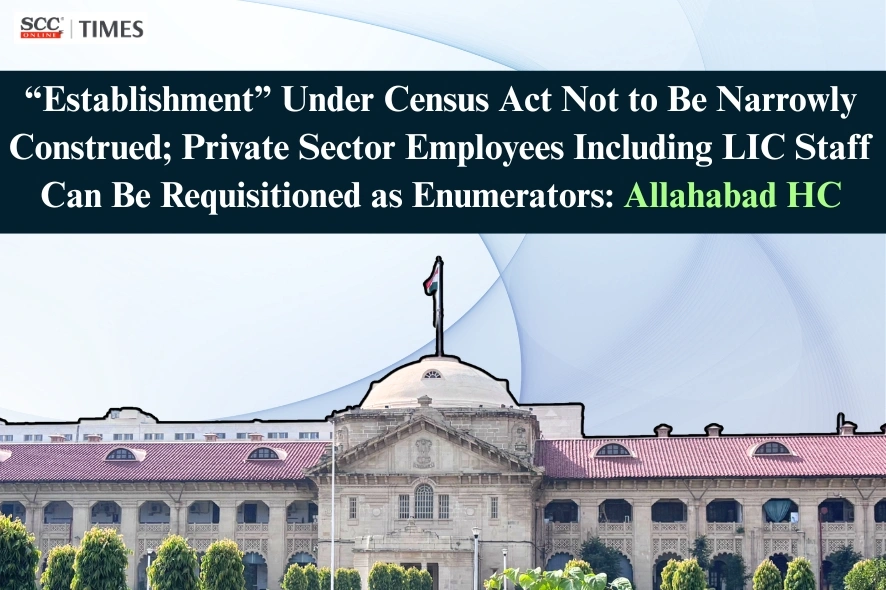
Allahabad High Court: In a writ petition filed by the North Central Zone Insurance Employees, challenging the entrustment of census duties upon Life Insurance Company (LIC) employees as enumerators/supervisors, the Single Judge Bench of Dinesh Pathak, J., held that the authorised authority had not committed any error in issuing orders to the LIC employees in exercise of delegated powers under Section 4(4), Census Act, 1948 (Census Act) read with Rule 3, Census Rules, 1990 (Census Rules). Thus, the Court upheld the appointment of LIC employees as enumerators for census operations, and accordingly dismissed the petition as misconceived and devoid of merits.
Background
The petitioner, North Central Zone Insurance Employees, challenged the entrustment of census duties upon LIC employees as enumerators/supervisors, contending that under Section 4-A, Census Act, only employees of local authorities could be requisitioned for such duties. That, LIC employees did not fall within the definition of “local authorities” under Section 3(31), General Clauses Act, 1897. Per contra, the Union of India submitted that LIC qualified as a commercial establishment and Rule 3, Census Rules conferred wide discretion upon the competent authority to appoint suitable persons, including clerks and officials, as enumerators. It was further contended that the specific order passed by the Zonal Officer under Section 4 (4), Census Act had not been challenged in the writ petition.
Analysis
The Court noted that “census” falls under Entry 69, List I of the Seventh Schedule of the Constitution, conferring exclusive legislative competence upon Parliament. The Court observed the conjoint reading of Section 4-A, Census Act which enunciates the availability of local authority staff for taking the census, with Sections 6(1)(e) and 7(c), Census Act. These provisions empower the District Magistrate or any authorised authority to issue a written order directing persons/officials to perform duties of census officers in relation to any institution, firm, factory or establishment, keeping “establishment”. Further, the term “establishment” should not be narrowly restricted as per the Census Act, and that the intent was to leverage the private sector for public duties during census operations.
The Court stated that in the backdrop of statutory scheme, the order issued by the competent authority cannot be said to dehors the provision of Census Act and Rules. Once appointed for census work, such persons are deemed to be public servants and are under a statutory obligation to discharge the assigned duties.
The Court further examined Rule 3, Census Rules and noted Sl. No. 5 of the tabulation appended thereto, pertaining to the designation of enumerator as “teachers, clerks, or any official or any person”. The Court held this expression to have a wider amplitude and could not be restricted to government employees or officials of local authorities, and that non-compliance by persons engaged in census operations attracts penalties.
Thus, the Court opined that the authorised authority had not committed any illegality or error in issuing orders in exercise of delegated power, and accordingly, held that a conjoint reading of Sections 4, 4-A, 6(1)(e), and 7(c), Census Act, with Rule 3, Census Rules, left no room for doubt that an employee of any establishment can legally be engaged for census duties.
[North Central Zone Insurance Employees v. Union of India, 2026 SCC OnLine All 11163, decided on 29-5-2026]
Advocates who appeared in this case:
For Petitioner(s): Raunak Singh, Vikrant Pandey
For Respondent(s): Krishna Deo Rai, A.S.G.I., Ashish Mishra, C.S.C., Siddharth Singhal