



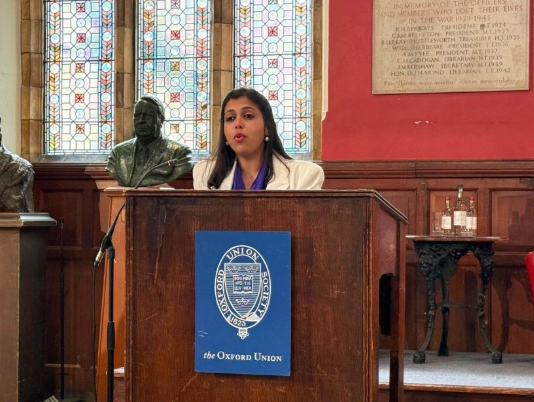
The Chief Justice of India, Justice Surya Kant, delivered an address at the Oxford Union on the theme, “Constitutional Promise to Digital Reality: Safeguarding Justice in the Age of AI and Technological Advancement”. The event was organised by the Oxford Law Society and the Oxford Union along with Ms Tanvi Dubey, Advocate-on-Record, Supreme Court of India.
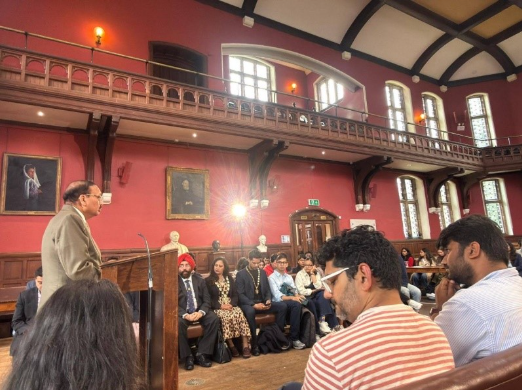
The programme commenced with welcome remarks by Ms Dubey, following which Justice Surya Kant delivered his keynote address and later participated in a moderator-led discussion and audience interaction.
Constitution Must Evolve with Technological Change
Beginning his address, Justice Surya Kant described the Constitution as an organic and living institution that must continuously adapt to changing social and technological realities.
Invoking Justice Oliver Wendell Holmes Jr., Justice Surya Kant observed that while constitutional values such as liberty, equality and justice remain constant, the mechanisms through which they are realised continue to evolve. He underscored that constitutional protections risk becoming ineffective if they fail to keep pace with technological developments.
He cautioned that fundamental rights would become “otiose” if they were not reinterpreted and protected within the context of the digital age.
Article 21 and Digital Access to Justice
Justice Surya Kant highlighted how technological interventions have expanded access to justice in India.
Referring to virtual hearings, electronic filing systems and live-streaming of court proceedings, he stated that such initiatives deepen the constitutional guarantee of access to justice by reducing geographical and financial barriers that often prevent citizens from approaching courts. However, he also warned against the dangers of digital exclusion.
He further observed that the constitutional promise remains unfulfilled if a citizen cannot navigate a virtual court. Emphasising the need for inclusive technological reforms, he stated that the fundamental rights must protect citizens with equal ferocity in both the physical and digital worlds. He highlighted that technological innovation can only succeed when it remains accessible to all sections of society.
Digital Institutionalisation of the Judiciary
Reflecting on the transformation of the judiciary after the COVID-19 pandemic, he noted that many innovations introduced during the pandemic have now become permanent features of the justice delivery system. He described the emergence of a digital-first judicial ecosystem and highlighted several technological initiatives undertaken by the Indian Judiciary.
AI-Driven Accessibility
Justice Surya Kant referred to the Supreme Court Vidhik Anuvaad Software (SUVAS), an AI-powered translation platform that converts judicial decisions written in English into regional languages, thereby making legal information more accessible to citizens. He also highlighted Su Sahay, an AI-powered virtual assistant that provides procedural guidance and facilitates easier access to court-related information.
Efficiency and Transparency
Further, Justice Surya Kant referred to the One Case One Data initiative, which integrates case-management systems with the national e-Courts framework in order to eliminate administrative bottlenecks and improve efficiency.
AI Regulatory Consultations
He also informed the audience that consultations concerning draft artificial intelligence (AI) regulations are presently underway, reflecting efforts to create an appropriate governance framework for emerging technologies.
AI as an Aid, Not a Replacement
Speaking about the growing role of AI in legal systems worldwide, Justice Surya Kant observed that AI is creating opportunities for greater interaction between courts across jurisdictions. He stated that while courts remain rooted in their own constitutional traditions, technological tools now allow judges and legal systems to learn from comparative experiences more effectively than ever before.

Referring to judicial platforms such as Supreme Court Portal for Assistance in Court Efficiency (SUPACE) and SUVAS, he clarified that India’s approach to AI remains centred on augmenting judicial functioning rather than replacing human decision-making. According to him, technology should preserve and enhance human intellect, not substitute it.
Privacy, Surveillance and Misinformation
Addressing concerns associated with rapid technological growth, Justice Surya Kant called for strong ethical safeguards and institutional accountability. He stressed that data collected for judicial administration must remain protected under the constitutional right to privacy and should never become part of surveillance infrastructure.
Justice Surya Kant also expressed concern regarding the circulation of out-of-context clips from live-streamed court proceedings on social media. He pointed out that appropriate regulatory safeguards are necessary to prevent judicial discussions from being misrepresented or misunderstood.
“AI Cannot Replicate Human Sentiment”
Concluding his address, Justice Surya Kant underscored the limitations of artificial intelligence. He firmly stated that AI cannot replicate human sentiment, empathy and contextual understanding. He remarked that the technological integration must complement rather than substitute judicial decision-making, ensuring that progress remains guided by constitutional discipline and human values.
Moderator Discussion and Audience Q&A
Following the keynote address, Justice Surya Kant participated in an extensive discussion covering judicial administration, case pendency, sentencing reforms, gender representation, judicial transparency and constitutional values.
8. On the responsibilities of serving as Chief Justice of India
Responding to a question regarding the responsibilities of serving within one of the world’s most complex legal systems, Justice Surya Kant reflected upon the different perspectives that accompany various stages of a legal career.
He explained that lawyers are naturally focused on advancing their clients’ interests, whereas judges must focus on society at large. He observed that judges of the Supreme Court are required to develop jurisprudence capable of addressing challenges arising from different parts of the country.
Speaking about his present role, he stated that as a Chief Justice of India his perspective changed again and he had to think of affording cost-effective and time-effective mechanisms of justice. Emphasising public confidence in institutions, he added that it is his responsibility to see that trust of Indian people in the judiciary remains intact.
9. On pendency and judicial reforms
Responding to concerns regarding the Supreme Court’s backlog, Justice Surya Kant stated that the pendency in Supreme Court is around 80,000 and he does not think it will take such a long journey to finish the pending disputes.
Justice Surya Kant expressed confidence that meaningful progress would be achieved during the year through targeted reforms. He identified the appointment of additional judges to improve the judge-case ratio as one of the key measures already implemented.
He also highlighted the growing contribution of young lawyers to constitutional litigation, referring to arguments advanced by young advocates in significant matters, including proceedings before a nine-Judge Bench in Kantaru Rajeevaru (Right to Religion, In re-9 J.) (2) v. Indian Young Lawyers Assn., (2020) 9 SCC 121. He emphasised that the coordinated efforts between the Bar and the Bench, along with greater emphasis on mediation, would play an important role in reducing pendency.
He further clarified that not every filed matter contributes to the pendency statistics and noted that only cases where notice has been issued and pleadings have been completed are counted as pending matters.
10. On sentencing guidelines and judicial discretion
Responding to a question concerning sentencing consistency, Justice Surya Kant acknowledged the need for a more structured approach. He observed that there should be a guideline for sentencing. At the same time, he cautioned against excessive standardisation.
According to him, human equity, empathy, victim perspective and accused perspective will always need human touch. His remarks highlighted the continuing importance of judicial discretion even within any future framework of sentencing guidelines.
11. On women in the legal profession
Justice Surya Kant also addressed the issue of gender representation within the judiciary and the legal profession.
He noted significant progress in the representation of women in district courts, High Courts and the Supreme Court. However, he acknowledged that sustaining long-term careers in litigation remains a challenge for many women lawyers. Referring to his earlier proposals, Justice Surya Kant stated that he had advocated for 50 per cent representation of women among law officers.
He further informed the audience that steps have already been taken to reserve 30 per cent seats for women in State Bar Council elections, District Bar Associations and other representative bodies. He highlighted that the efforts are underway to create more robust institutional mechanisms to ensure meaningful participation of women in the legal profession over the long term.
12. On the “master of the roster’ debate
Addressing a question regarding the Chief Justice’s role as master of the roster, Justice Surya Kant stated that the concept is frequently misunderstood.
He clarified that the concept of master of roster has been misinterpreted. He explained that roster allocation represents only one aspect of the broader constitutional responsibilities entrusted to the Chief Justice. He further stated that substantive matters are listed through an automated system designed to promote transparency and ensure that roster information remains publicly available.
According to him, expertise-based allocation and optimum utilisation of judicial resources remain the central considerations while assigning matters.
13. On the values that guide his tenure
In response to a concluding question regarding the values he considers most important, Justice Surya Kant identified the protection and enforcement of Fundamental Rights under Part III of the Constitution as his foremost commitment.
He observed that even suo motu proceedings initiated by constitutional courts are often guided by the objective of ensuring the enforcement of fundamental rights.
Emphasising equal access to justice, he concluded that no one should be deprived of the ability to approach the court because of their social issues circumstances.
Concluding Reflections
Justice Surya Kant’s address at the Oxford Union offered a comprehensive reflection on the future of constitutional governance in an era increasingly shaped by artificial intelligence and digital technologies. While welcoming technological innovation and judicial modernisation, he repeatedly emphasised that constitutional rights, human dignity, privacy protections and judicial accountability must remain at the centre of every reform.
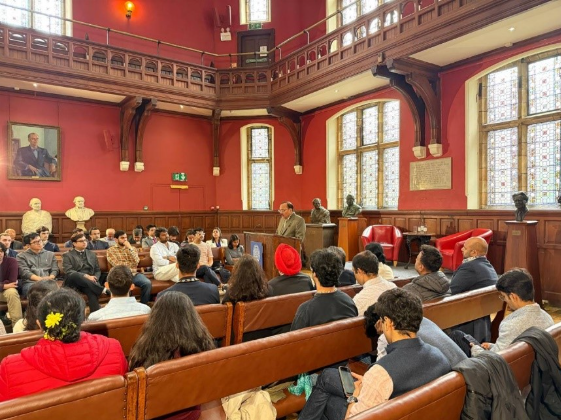
Whether discussing AI-assisted judicial tools, case pendency, sentencing policy, gender representation or institutional transparency, Justice Surya Kant returned to a common theme — technology may transform the methods through which justice is delivered, but the values that define justice itself must remain unchanged.
Honourable Chief Justice of India, Justice Surya Kant is well-known for his progressive, compassionate, humanitarian and justice-oriented approaches. In a thought-provoking address to the curious audience at the event organised by the Oxford Law Society and Oxford Union at the prestigious University of Oxford, Justice Surya Kant eloquently stated that although technology has an undisputed potential to democratise justice dispensation system, the principles of adjudication ought to remain embedded in cherished constitutional values and an indispensable human judgment. He rightly pointed out that technological inventions and/or innovations are there only to complement and supplement human endeavours rather than supplant, substitute or replace the human heart of justice. These comments assume a great deal of significance because AI-enthusiasts as well as AI-sceptics must realise that AI has no ethics, morality, empathy, sympathy and/or conscience. But like any other technology, AI too has several inherent advantages that aid and assist the human beings in expeditiously carrying out clerical, arithmetical, administrative, managerial, mechanical, repetitive, tedious and boring tasks. Of course, every such tool has to be used by human beings judiciously and carefully. The learned Chief Justice of India covered a wide range of topics in his address. Besides highlighting AI-assisted judicial tools, he also dwelt upon crucial issues of case arrears, sentencing policy, gender representation, master of roster and institutional transparency among others. Justice Surya Kant reiterated that while technology may transform the methods of justice delivery, it cannot alter or modify the very philosophical and jurisprudential values that define justice. The Hon. CJI also rightly underlined the enormous contribution of young lawyers to constitutional litigation as is often reflected in their rich arguments in important cases, including the recent proceedings before a nine-judge Constitution Bench in Kantaru Rajeevaru v. Indian Young Lawyers Association. He pointed out that coordination between the Bar and the Bench as well as efficient use of mediation would help curb backlog of cases in courts. These remarks by the Hon. CJI inspire confidence of people in judiciary.