


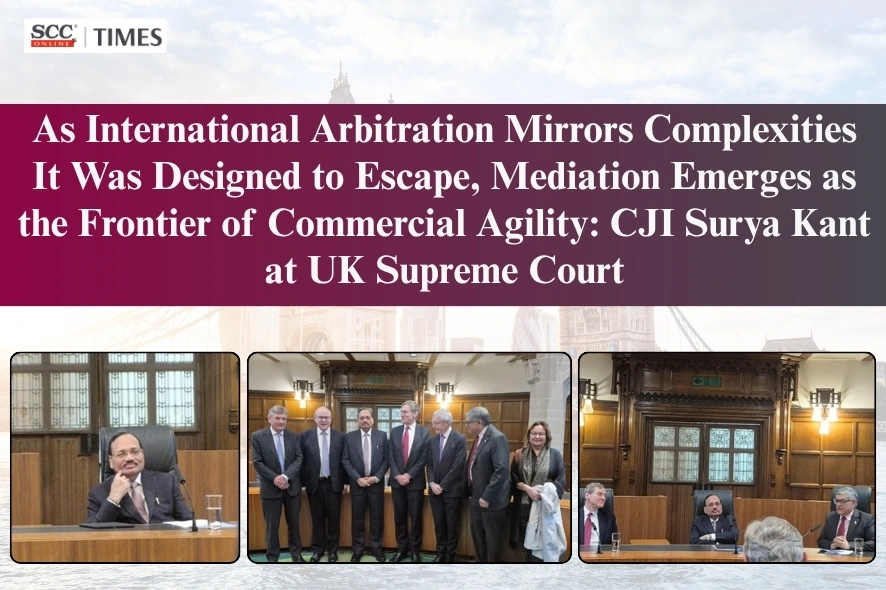
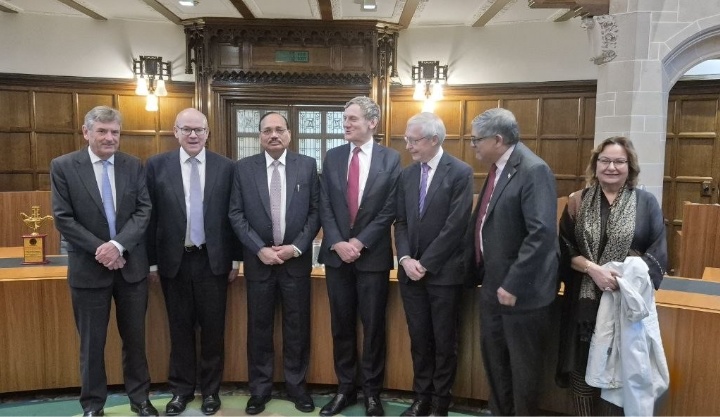
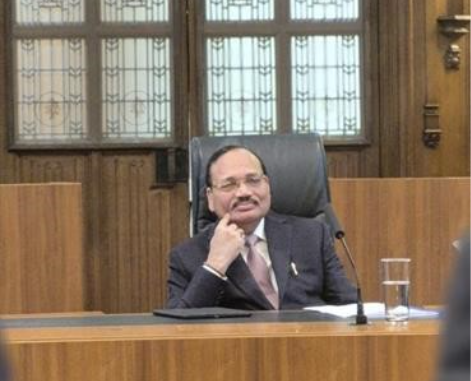
Speaking at the UK Supreme Court, Chief Justice of India Justice Surya Kant delivered an address on “Mediation, Arbitration and the Courts: Converging Trends in the Indian and English Approaches to Commercial Dispute Resolution”. The event was hosted by Mr Gourab Banerji, Senior Advocate, Supreme Court of India, and commenced with welcome remarks by Lord George Leggatt, Justice, UK Supreme Court, who introduced Justice Surya Kant and reflected on his distinguished judicial career and the remarkable scale of the Indian Judiciary.
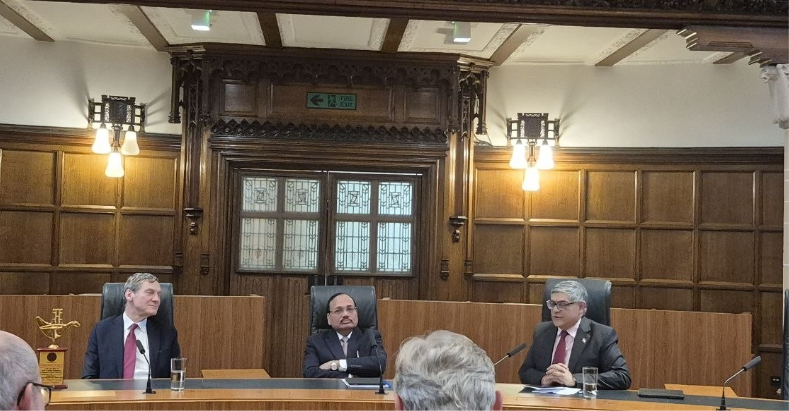
Introducing Justice Surya Kant, Mr Banerji noted that he became the youngest Advocate General of Haryana in 2000 before serving as a Judge of the Punjab and Haryana High Court, the Chief Justice of the Himachal Pradesh High Court, a Judge of the Supreme Court of India, and ultimately became the Chief Justice of India in November 2025. Mr Banerji also highlighted the extraordinary workload of the Supreme Court of India, noting that while the UK Supreme Court disposes of approximately 250 matters annually, the Supreme Court of India disposed of nearly 75,000 cases in the previous year.
From Court-centric Justice to a Multi-door Dispute Resolution Framework
Commencing his address Justice Surya Kant observed that commercial disputes have existed throughout history, but their scale and complexity have evolved significantly in modern times. He emphasised that contemporary dispute resolution can no longer be viewed solely through the traditional lens of litigation.
Rejecting what he described as an outdated understanding of commercial justice, Justice Surya Kant stated that litigation, arbitration and mediation must be viewed as performing distinct functions, each with its own institutional strength and responding to different parties’ expectations.
According to him, courts today function not merely as adjudicators but as facilitators and supervisors within a broader ecosystem of justice designed to restore commercial certainty, institutional confidence and economic stability.
India’s Arbitration Journey and the Growing Proceduralisation of Arbitration
Tracing the evolution of arbitration in India, Justice Surya Kant noted that economic liberalisation, increasing international commerce, and the need for efficient dispute resolution mechanisms led to the enactment of the Arbitration and Conciliation Act, 1996.
He highlighted that Indian Courts have consistently adopted a pro-arbitration approach through principles such as minimum judicial intervention, while ensuring harmony with internationally accepted standards governing commercial arbitration.
However, he cautioned that arbitration is increasingly encountering the very difficulties it was originally designed to avoid.
In one of the most significant observations of the evening, he remarked:
“Arbitration seems to be on the verge of derailing some of the very procedural burdens from which it originally sought to depart.”
Referring to disputes relating to arbitral appointments, jurisdictional objections, determination of seat and venue, and challenges to arbitral awards, he observed that arbitration proceedings are increasingly generating parallel litigation before courts. Justice Surya Kant also referred to recent reforms in the United Kingdom through the Arbitration Act, 2025, aimed at reducing arbitration-related litigation and reinforcing procedural efficiency.
Mediation as the New Frontier of Commercial Agility
Having outlined the growing challenges confronting arbitration, Justice Surya Kant turned to mediation which he described as the emerging future of commercial dispute resolution. The Chief Justice noted:
“As international arbitration has increasingly mirrored the very procedural complexities it was designed to escape, it is mediation that now emerges as the frontier of commercial agility.”
Justice Surya Kant emphasised that mediation is not a foreign concept within India. Rather, it has deep roots in India’s civilisational and legal traditions. Long before the emergence of formal courts, disputes were frequently resolved through consensual mechanisms involving family councils, merchant guilds and territorial assemblies.
He noted that these institutions prioritised the restoration of social harmony and preservation of relationships rather than adversarial determination of rights.
The Rohini River Story and India’s Mediation Heritage
Illustrating the philosophical foundations of mediation, Justice Surya Kant narrated the ancient story of the Rohini River dispute between two rival communities.
As tensions escalated into the possibility of armed conflict over access to water, a sage intervened and posed a simple but profound question; What is more valuable — the water of the Rohini or the blood of your own people? The question transformed the dispute and led both sides to recognise that preserving human life and social harmony was more important than winning a resource conflict.
Justice Surya Kant explained that the significance of mediation lies not merely in resolving disputes, but in transforming relationships and preventing future conflicts. According to him, India’s traditional dispute resolution mechanisms were rooted in precisely this philosophy.
Mediation Act, 2023: A Jurisprudential Repatriation
Discussing contemporary reforms, Justice Surya Kant devoted significant attention to the Mediation Act, 2023.
Rejecting the perception that mediation reforms in India are merely borrowed from Western legal systems, he stated:
“This statutory milestone is frequently mischaracterised as a mere imitation of Western corporate trends. In truth, it represents an act of jurisprudential repatriation.”
According to Justice Surya Kant, the legislation restores India’s long-standing culture of consensual dispute resolution while adapting it to the needs of modern commerce.
He highlighted several significant features of the legislation, including:
-
mandatory pre-litigation mediation;
-
strong confidentiality protections;
-
enforceability of mediated settlement agreements as civil court decrees; and
-
promotion of online mediation for domestic and international disputes.
Justice Surya Kant further observed that mediation has gradually moved from the margins of dispute resolution into a central position within India’s justice delivery system.
Learning from the English Experience
Comparing developments in India and England, Justice Surya Kant described the English legal system as a “masterclass in procedural discipline and strategic deployment of economic incentives”.
Referring to the evolution of English mediation jurisprudence, he observed that courts in England increasingly encourage consensual dispute resolution through active case management and procedural mechanisms.
According to him, both jurisdictions are moving towards a greater recognition of mediation as a meaningful and effective instrument of commercial justice.
From Forum Convenience to Process Convenience
Justice Surya Kant also introduced what he described as the doctrine of “process convenience”.
Historically, commercial entities focused on selecting the most advantageous jurisdiction to litigate disputes. However, he argued that modern commercial strategy requires a different approach.
As he observed:
“The primary question for important corporations should no longer be where to litigate, but rather how to resolve.”
According to Justice Surya Kant, legal advisers must carefully determine whether a dispute requires judicial determination, arbitral adjudication, or the interest-based reconciliation uniquely offered by mediation.
Building Institutional Trust in Mediation
While expressing optimism regarding the future of mediation, Justice Surya Kant acknowledged that important structural challenges remain. According to him, mediation requires greater professionalisation, credibility and institutional support to gain wider acceptance within the commercial community.
In his words:
“Commercial mediation is not an exercise in soft diplomacy or unstructured splitting of differences.”
He emphasised the need for highly trained mediators possessing expertise not only in law but also in negotiation strategy, behavioural psychology and conflict management. Justice Surya Kant further argued that mediation should be viewed as a sign of financial wisdom and strategic maturity rather than weakness.
As he remarked:
“Opting for mediation should be recognised as a hallmark of commercial sophistication, financial wisdom and strategic maturity.”
Courts and Mediation Are Not Competitors
Towards the conclusion of his address, Justice Surya Kant rejected the notion that mediation and courts operate in opposition to one another. Instead, he described them as complementary institutions serving different functions within a unified justice ecosystem.
According to him:
“The two systems do not diminish one another. They sustain each other.”
While courts continue to provide legal certainty, constitutional accountability, and public standards, mediation offers a mechanism for preserving relationships and achieving durable, consensual outcomes.
Concluding Reflections
Concluding his address, Justice Surya Kant invoked a proverb comparing legal institutions to rivers that nourish the communities around them rather than serving themselves.
Reflecting on the future of commercial dispute resolution, he observed:
“The true measure of a nation’s legal maturity is not found in how many thousands of disputes its courts can command and regulate; rather, it is found in how effectively its systems empower its citizens to sustain their own relationships and reconcile their differences consensually.”
Justice Surya Kant’s address ultimately presented mediation, arbitration and litigation not as competing institutions, but as interconnected components of a modern commercial justice framework. While reaffirming the continuing importance of courts and arbitration, he suggested that the future of commercial dispute resolution may increasingly lie in processes that preserve relationships, reduce procedural complexity and facilitate consensual outcomes. For both India and England, the challenge ahead is not choosing between institutions, but ensuring that each mechanism is used for the purpose it serves best.

Pacific dispute resolution at home and abroad is always a cherished goal of non-violent, peace-loving and justice-oriented societies. Litigation, arbitration, mediation, conciliation and negotiation are different methods of dispute resolution. Honourable Chief Justice of India, Justice Surya Kant in his address at the UK Supreme Court eloquently stated that mediation, arbitration and litigation are not competitors or rivals but integral parts of a modern commercial justice ecosystem. Without denying the relevance of litigation in courts and arbitration, he averred that the future of commercial dispute resolution could lie in processes that value and preserve relationships, substantially simplify procedural barriers and pave the way for consensus-based settlement agreements. He stressed that the contemporary challenge is not in terms of making the choice between this or that institution but in making it sure that each method of dispute resolution is deployed precisely for the purpose it suits the best. The Hon. CJI rightly underlined the problems being encountered by arbitration that it was supposed to resolve that haunted litigation. He cautioned that commercial mediation should not be mistaken for being an exercise in “soft diplomacy” or “unstructured splitting of differences”. In his valuable opinion, choosing mediation should be considered as a sign of “commercial sophistication, financial wisdom and strategic maturity”. These remarks by the CJI can help dispel the popular mis-perception among disputants that opting for mediation is a tacit recognition of the party’s weakness.