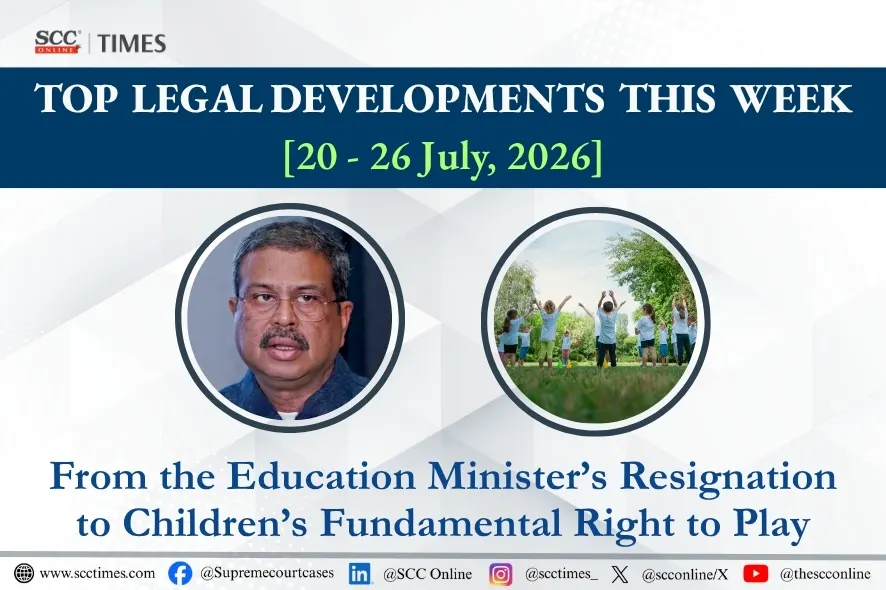
Catch up on the top legal developments this week (20-26 July 2026), including student protests, pre-trial incarceration, sexual assault of minor daughter, social audit, community service, taarikh pe taarikh, Zara trade mark, children’s fundamental right to play, freedom of press, and more.
STORY OF THE WEEK
Dharmendra Pradhan Steps Down as Education Minister Amid Mass Student Protests; Pralhad Joshi Takes Additional Charge
Union Education Minister Dharmendra Pradhan has stepped down from his post following intense nationwide student demonstrations and agitations at Jantar Mantar over examination irregularities. Acting on the Prime Minister’s advice, the President of India accepted his resignation under Article 75, while Cabinet Minister Pralhad Joshi has been given additional charge of the Ministry of Education.
Read more HERE
Delhi High Court appoints Anu Grover Baliga as Special Judge of Fast Track Court for Paper Leak matters, following PM’s announcement
On 23 July 2026, the Chief Justice of the Delhi High Court, Justice D.K. Upadhyaya by a notification, has appointed Anu Grover Baliga1 as the Special Judge of the newly designated Fast Track Court to exclusively try offences under the Public Examinations (Prevention of Unfair Means) Act, 2024, along with connected offences. The newly designated Fast Track Court will function at the Rouse Avenue District Court, Delhi, where all matters under the Act and connected offences will be listed and heard by Judge Baliga.
Read more HERE
Also Read
Government Announces Fast-Track Courts for Examination Paper Leak Cases
SUPREME COURT HIGHLIGHTS
BAIL | Pre-Trial Incarceration Beyond 11 Months Unwarranted Where Strict Bail Conditions Can Adequately Safeguard Prosecution’s Interests; Bail Granted
In Raju Prasad v. State of Rajasthan, 2026 SCC OnLine SC 1353, the Supreme Court granted bail to an attesting witness accused in a forged Power of Attorney case, holding that prolonged pre-trial incarceration was unnecessary where strict bail conditions could safeguard the prosecution’s interests.
Read more HERE
DEBT AND MONETARY LAWS | Pre-2016 DRT Recovery Certificate Is Not “Decree or Order” u/S. 9(2) Presidency-Towns Insolvency Act; Cannot Trigger Insolvency Proceedings
The appeal concerned with the interpretation of Section 9(2), Presidency-Towns Insolvency Act, 1909 (Presidency-Towns Insolvency Act), and whether a recovery certificate issued by the Debts Recovery Tribunal (DRT) can be treated as a “decree or order” for initiating insolvency proceedings. Reaffirming the principle that insolvency laws must be strictly construed due to their serious civil consequences, the Supreme Court in H.D.F.C. Bank Ltd. v. Kishore K. Mehta, 2026 SCC OnLine SC 1320 ,held that a recovery certificate issued by the DRT before the before the insertion of Section 19(22-A), Recovery of Debts and Bankruptcy Act, 1993 (Recovery of Debts and Bankruptcy Act), i.e., 2016 Amendment, could not be treated as a “decree or order” under Section 9(2), Presidency-Towns Insolvency Act and, therefore, could not form the basis of an insolvency notice under Section 9(2), Presidency-Towns Insolvency Act.
Read more HERE
RAILWAYS | The Ticket Was in the Bag That Was Never Found: ₹8 Lakh granted to Widow, Said Absence of Ticket Alone Cannot Defeat a Bona Fide Passenger’s Claim
In Lata v. Union of India, 2026 SCC OnLine SC 1350, wherein the wife of a deceased train passenger challenged the concurrent dismissal of her compensation claim by the Railway Claims Tribunal, Bhopal Bench, and the Madhya Pradesh High Court, the Supreme Court allowed the appeal, holding that compensation under Section 124-A, Railways Act, 1989 cannot be denied merely because the deceased’s railway ticket was not recovered after an untoward incident. The Court held that while the claimant must initially establish the foundational facts of the journey and occurrence of the incident, such burden can be discharged through relevant evidence, including an affidavit, after which the burden shifts to the Railways to rebut the claim.
Read more HERE
RAILWAYS | Railways not liable for shortage of goods booked at “owner’s risk” unless negligence or misconduct is proved under Section 97 Railways Act
In Bajaj Trading Co. v. Union of India, 2026 SCC OnLine SC 1343, the Supreme Court held that where goods are booked at “owner’s risk”, liability of the Railway Authorities can be fastened only upon proof of negligence or misconduct under Section 97, Railways Act, 1989. The Court observed that in cases where the consignment is not verified by Railway employees, the burden of proving the quantity of goods lies upon the consignor, consignee or endorsee under Section 65(2) of the Act. Finding that the goods were loaded without railway supervision, the sender’s weight was accepted, and the railway receipt contained a “said to contain” endorsement, the Court held that the appellant failed to establish negligence on the part of the Railways and dismissed the appeal.
Read more HERE
CRIMINAL LAW | Sentencing Must Strike Judicious Balance Between Interests of Victim, Society and Accused; Gang Rape Sentence modified to 20 Years of Rigorous Imprisonment
In an appeal titled Ehsaan v. State (NCT of Delhi), 2026 SCC OnLine SC 1356, filed for examining the scope of the doctrine of proportionality in sentencing while considering whether imprisonment for the remainder of the convict’s natural life under Section 376-D, Penal Code, 1860 was justified, the Supreme Court affirmed the conviction of the appellant under Section 376-D IPC, but modified the sentence from imprisonment for the remainder of natural life to rigorous imprisonment for 20 years with benefit of remission, if otherwise admissible in law, holding that while the statute mandates at least the minimum punishment, it does not require that every conviction must necessarily result in imprisonment for the remainder of natural life. Sentencing must conform to the doctrine of proportionality, thereby, “striking a judicious balance between the interest of the victim, society and the accused, after following the due process of law”.
Read more HERE
JUVENILE JUSTICE | Murder is “Heinous Offence” under JJ Act; JJ Board Must Holistically Evaluate All Relevant Material During Preliminary Assessment
The appeal titled X4 v. State of Bihar, 2026 SCC OnLine SC 1363, arose from the Patna High Court’s judgment dated 24 July 2025 affirming the order of the Additional District and Sessions Judge, Chapra, directing that the appellant, a child in conflict with law aged above 16 years, be tried as an adult for offences punishable under Sections 302, 201 and 34, Penal Code, 1860 (IPC). The Court examined the legality of the preliminary assessment under the Juvenile Justice (Care and Protection of Children) Act, 2015 (JJ Act), the classification of murder as a “heinous offence” the scope of appellate powers under Section 101(2), JJ Act, and the principles governing preliminary assessment under Section 15. The Supreme Court upheld the High Court’s judgment, the trial court’s order directing trial before the Children’s Court and the classification of murder under Section 302 IPC as a “heinous offence” under the JJ Act.
Read more HERE
HIGH COURT HIGHLIGHTS
POCSO | Betrayed Her Trust, Destroyed Her Life, Degraded Her Very Soul: Life Sentence of man convicted of impregnating 12-year-old daughter, upheld
In an appeal titled Bandu Vishwanath Matte v. State of Maharashtra, 2026 SCC OnLine Bom 6366, challenging the sentence for sexually assault of a minor daughter by her father, the Bombay High Court held that the victim, who was a minor at the time of the incident, was subjected to forceful sexual assault by her father and the DNA report established the facts; thus, no reason found to interfere with the impugned judgment or the sentence.
Read more HERE
SOCIAL AUDIT | “Evolution and implementation of Social Audit need of hour”: Advocate directed to visit and spend time at old age home instead of paying cost
In P.S. Mandeliya v. State of M.P., 2026 SCC OnLine MP 21826, the Madhya Pradesh High Court directed the applicant’s counsel to visit an Old Age Home with food supplies and spend an hour with the residents instead of paying the cost. The Court remarked that this was a test case to give the concept of “Social Audit” a chance to gain ground.
Read more HERE
DELAY AND LATCHES| 25 Years, No Conclusion: Warned Against “Taarikh pe Taarikh” Becoming the Hallmark of Criminal Justice, Grants Anticipatory Bail in 2001 Kidnapping Case
In an anticipatory bail application titled Ajay Kumar v. State of U.P., 2026 SCC OnLine All 22408, filed by 2 accused persons in a 2001 kidnapping case, the Allahabad High Court allowed the application, holding that it would be expedient in the interest of justice that the liberty of the accused be protected. The Court expressed that it was deeply disturbing that the present criminal case revealed a disquieting state of affairs, wherein an FIR registered in 2001 remained pending for over 2 decades without reaching its logical conclusion, thereby reducing the criminal trial to a mere formality.
Read more HERE
TRADE MARK | Prior declaration as “well-known trade mark” not mandatory to invoke Section 11(2); cancels “ZORA” trade mark for similarity with “ZARA”
In Industria De Diseno Textil v. Registrar of Trade Marks, 2026 SCC OnLine Del 5181, the Delhi High Court held that Section 11(2) does not require an earlier trade mark to be formally declared a “well-known trade mark” before its proprietor can oppose registration of a similar or identical mark. The Court held that the Registrar had erred in dissecting the rival marks “ZARA” and “ZORA” instead of comparing them as a whole, contrary to the settled anti-dissection principle, and further failed to examine whether “ZARA” was entitled to protection as a well-known trade mark on the touchstone of Sections 2(1)(zg), 11(6) and (7) of the Act. Holding that “ZORA” was deceptively similar to “ZARA”, and that its adoption would take unfair advantage of and be detrimental to the distinctive character and repute of the earlier mark, the Court allowed the appeal.
Read more HERE
PRISON AND PRISONERS | Fractured Hand, No Treatment, and a Demand for Protection Money: CCTV ordered to be preserved and independent medical examination to be held in Tihar Assault Allegations
In a criminal appeal titled Ashish v. State (NCT of Delhi), 2026 SCC OnLine Del 5184, seeking the appellant’s immediate medical examination after allegations of custodial assault inside Tihar Jail, the Delhi High Court observed that the allegations, if true, were “extremely disconcerting”, particularly as they were levelled against the Head Warden himself. Considering the seriousness of the allegations that the appellant had sustained injuries, was denied medical treatment, and had also been subjected to an alleged demand for illegal protection money, the Court directed preservation of the relevant CCTV footage, ordered an independent medical examination of the appellant and 2 other injured inmates at Deen Dayal Upadhyay Hospital, and called for comprehensive reports from the Head Warden, the Jail Medical Officer and the Jail Superintendent to ascertain the true factual position.
Read more HERE
CHILD RIGHTS | Common Areas Must Be Obstruction-Free, and Children Have a Fundamental Right to Play: Trial Court order set aside, Association directed to act within 3 Months
In Sangeetha Agrawal v. Esteem Gardenia Apartment Owners Assn., 2026 SCC OnLine Kar 7971, the Karnataka High Court held that common areas of the apartment must remain obstruction-free, affecting safe movement. The Court held that it is a fundamental right of the children to play and prohibiting them takes away their overall health. The restrictions on children’s recreation require reasonable justification.
Read more HERE
FREEDOM OF PRESS | Freedom of the Press Must Be Protected, But ‘Cannot become a shield for irresponsible journalism, intimidation’; Media regulation called for
In Abid Ali v. State (NCT of Delhi), 2026 SCC OnLine Del 5173, the Delhi High Court granted bail, holding that continued incarceration of the applicants was unwarranted in view of the doubtful identification, deficiencies in the investigation, and the fact that the trial had not yet commenced. Recognising the growing phenomenon of unregulated digital journalism, where anyone with a mobile phone and microphone can present themselves as a reporter without professional accountability, the Court urged the legislature to consider an appropriate regulatory framework balancing press freedom with professional accountability.
Read more HERE
SERVICE LAW | Blood and Urine Tests Not Mandatory in Departmental Proceedings to Prove Police Officer’s Drunkenness; Medical Certificate and Magistrate’s Observations Sufficient
In an appeal titled Tamil Nadu Police v. V. Arumuram,1 wherein police personnel was found in a drunken state while deposing before a Judicial Magistrate, the Madras High Court underscored that the absence of blood and urine tests does not invalidate disciplinary proceedings. The Court observed that the incident occurred inside the court hall in the presence of the Magistrate, who immediately directed medical examination, and highlighted that the drunkenness certificate issued by the Medical Officer, together with the Magistrate’s observations, was sufficient to establish misconduct.
Read more HERE
EDUCATION LAW | KG Admission Cannot be Declared Void After a Decade Due to Parents’ Incorrect Declaration: DOB Correction allowed in CBSE Records Based on Public Documents
In Aarav Giri v. St. Columbas School, 2026 SCC OnLine Del 5182, the Delhi High Court allowed the writ petition and held that authentic public documents, including the Birth Certificate, Aadhaar Card, and Passport, which carry a presumption of correctness, can form the basis for correction of educational records when their genuineness is undisputed. Thus, a student’s educational records may be corrected on the basis of reliable statutory public documents, even where the school and CBSE records are consistent with each other, as a court’s power to order correction is not restricted by the limitations applicable to the CBSE under its bye-laws.
Read more HERE
EDUCATION LAW | Repeating Class Does Not Violate Right to Education: Detention of EWS student in Class V, upheld
While Master Sorabh Rathor Through His Guardian Savitri v. North Delhi Public School2, the Delhi High Court interpreted Section 16, Right of Children to Free and Compulsory Education Act, 2009 (RTE Act), and held that the prohibition against holding back children in elementary education must be construed in light of the legislative intent of providing children, particularly those from vulnerable sections, adequate opportunities for academic progression. The Court held that where a child is unable to comprehend basic concepts despite repeated opportunities, additional classes, and re-examinations, requiring the child to repeat a class would not amount to removal from education but would facilitate better learning outcomes.
Read more HERE
MAINTENANCE | Wife who obtained custody asserting financial capacity cannot burden husband alone with minor’s maintenance
In a revision petition titled Roji Bano v. State of U.P., 2026 SCC OnLine All 22081, filed by a wife seeking maintenance, the Allahabad High Court dismissed the petition, holding that in the absence of any cogent material showing a substantial increase in the actual and reasonable expenses of the minor daughter, any material enhancement in the income of the husband, or any subsequent deterioration in the financial condition of the wife, no sufficient ground was made out either to grant interim maintenance to the wife in her individual capacity or to enhance the maintenance already awarded to the minor daughter. Thus, the Court denied maintenance to the wife and refused to enhance the minor daughter’s maintenance.
Read more HERE
TRADE MARK | Distinctiveness, Not Uniqueness, Governs Registrability Under Section 9(1)(a); Registrar directed to Reconsider “OFFER” Mark Registration Application
In an appeal titled ADS Spirits (P) Ltd. v. Registrar of Trade Marks3, challenging the Registrar of Trade Marks’s order refusing to register the word mark “OFFER” in Class 33 for alcoholic beverages on the ground that the mark lacked distinctiveness, the Delhi High Court held that for determining registrability under Section 9(1)(a) of the Act, the relevant enquiry is whether the applied mark possesses distinctive character capable of distinguishing one trader’s goods from those of others. The statute does not require a mark to be unique, and distinctiveness must always be assessed with reference to the goods or services for which registration is sought. Consequently, the Court quashed the impugned order and directed the Registrar to reconsider appellant’s trade mark application afresh, in light of parameters of Section 9(1)(a) and testing the distinctiveness of the mark “OFFER” in relation to the alcoholic beverages for which the registration was sought.
Read more HERE
COVID-19 | ‘Knowledge’ is the hinge on which the offence turns: FIR against man booked over movement on a public road during COVID-19 lockdown, quashed
In a petition seeking quashing of a First Information Report (FIR) registered during the COVID-19 lockdown, the Delhi High Court held that mere movement on a public road during the lockdown, without proof of knowledge of a duly promulgated prohibitory order or satisfaction of the essential statutory ingredients of the offences alleged, cannot attract criminal liability under Sections 188, 269, 270 and 336, Penal Code, 1860 (IPC). The Court observed that knowledge of the order is the sine qua non for an offence under Section 188 IPC, while prosecution under Sections 269 and 270 IPC necessarily requires material showing that the accused was infected with, or had reason to believe that he was carrying, a disease dangerous to life. Finding that the prosecution had failed to establish these foundational requirements, the Court quashed the FIR and all consequential proceedings as an abuse of the process of law.
Read more HERE
TRIBUNALS AND COMMISSIONS HIGHLIGHTS
CENTRAL CONSUMER PROTECTION AUTHORITY | Trick Question, Forced Action, Interface Interference: Three Dark Patterns on SpiceJet’s Booking Platform identified, Imposes ₹1 Lakh Penalty
In a suo motu case titled In the matter of: Use of dark patterns resulting in unfair trade practices, misleading advertisements, and violation of consumer rights by SpiceJet Ltd4., filed against SpiceJet for “use of dark patterns resulting in unfair trade practices, misleading advertisements, and violation of consumer rights”, the Central Consumer Protection Authority held that the impugned interface deployed multiple prohibited dark patterns, resulting in unfair trade practices, misleading representations and impairment of consumer choice and informed decision-making.
Read more HERE
CENTRAL CONSUMER PROTECTION AUTHORITY | Chaayos Said the Service Charge Was Voluntary but Its Own Billing Software Said Otherwise: ₹50,000 Penalty imposed
In a suo motu case titled In the matter of Chaayos (Sunshine Teahouse Pvt. Ltd.) regarding alleged levying of service charge, violation of Consumer Rights and Unfair Trade Practices5, lodged against Chaayos for charging a mandatory “service tax”1 separately in addition to CGST and SGST, the Central Consumer Protection Authority held that the restaurant had demonstrated a pattern of deliberate non-compliance with the “Guidelines to Prevent Unfair Trade Practices and Protection of Consumer Interest with Regard to Levy of Service Charge in Hotels and Restaurants”; directed the restaurant to reimburse to the aggrieved customer and payment of ₹50,000 penalty.
Read more HERE
STATE CONSUMER DISPUTES REDRESSAL COMMISSION | Fresh arrest warrants issued against Angle Infrastructure Directors after interim protection declined
In Sahendra Pal Singh v. Angle Infrastructure (P) Ltd.6, the SCDRC directed the issuance of fresh arrest warrants against the Directors of Angle Infrastructure Pvt. Ltd., after noting that the judgment-debtors have failed to satisfy the decretal amount despite repeated opportunities. The Commission observed that although the previously issued warrants were returned unexecuted by the police authorities, the decree remains unsatisfied. Consequently, fresh warrants of arrest have been directed to be issued and executed through the Station House Officers.
Read more HERE
ELECTRONICS, INFORMATION TECHNOLOGY AND ARTIFICIAL INTELLIGENCE DEPARTMENT | Vodafone Held Liable for Negligent Duplicate SIM Issuance in SIM-Swap Fraud; Central Bank Directed to Pay Interest for Delayed Fund Release
In Ajaz Lal Attar v. ICICI Bank Ltd.,7 regarding cyber fraud where complainant’s bank account credentials were hacked siphoning money to another account, the EITAI Department held the telecommunication services provider, i.e. Vodafone liable for negligent issuance of duplicate SIM leading to SIM-Swap fraud and directed to pay damages of ₹1,00,000 to the complainant on account of its structural negligence and deficient internal controls, and directed Respondent 3, i.e. Central Bank of India, to pay the complainant 12 per cent annual interest on the blocked principal amount as they failed to perform the physical release and remittance of the contractually frozen amount even after an interim order dated 9 May 2022, thereby unlawfully disrupting the velocity of the complainant’s capital despite the judicial intervention causing an unjustifiable operational delay in the final remittance of the tracked funds.
Read more HERE
FOREIGN COURTS HIGHLIGHTS
UK HIGH COURT | JKM-TTF Pricing Clause in US$29 Million LNG Charterparty Dispute, interpreted
In a US$29 million LNG charterparty dispute concerning the proper interpretation of a “JKM-TTF Spread” pricing clause titled Briety Shipping Inc. v. Trafigura Maritime Logistics Pte Ltd8, UK High Court, held that the contractual expression “JKM-TTF Spread” required TTF to be deducted from JKM in accordance with the calculation methodology set out in the charterparty and did not permit negative values to be converted into positive ones. The Court further held that the mechanism was intended to reflect the LNG arbitrage opportunity arising where JKM exceeded TTF and was not designed to operate as a “two-way” pricing formula whenever the differential moved in either direction. Thus, finding no basis for the owner’s alternative claims for rectification based on common or unilateral mistake, the Court dismissed claims exceeding US$29 million for alleged underpayment of hire.
Read more HERE
United States District Court, New York| Publishers, Author Scott Turow File Class Action Against Google Over Gemini AI Training on Copyrighted Works
In Hachette Book Group, Inc. v. Google LLC9, Hachette Book Group Inc., Cengage Learning Inc., Elsevier Inc., bestselling author Scott Turow, and S.C.R.I.B.E., Inc. have filed a proposed class action against Google LLC alleging large-scale copyright infringement in connection with the development and training of Google’s Gemini artificial intelligence models. The plaintiffs allege violations of the US Copyright Act, 1976 and the Digital Millennium Copyright Act, 1998 and seek damages, injunctive relief and other remedies.
Read more HERE
OTHER UPDATES
LEGISLATIONS
BCI Updates:
- BCI Declares AIBE XXI Result; 65.92% Candidates Qualify, AIBE XXII Scheduled for 29 November
- BCI Calls on Intellectuals to Safeguard National Unity, Alleges Attempts to Exploit Student Protests
- BCI Releases Draft Advocates (Amendment) Bill, 2026; Invites Suggestions Till 31 July
Other Updates:
- Green Card Applicants Take Note: US Rescinds 2022 Public Charge Rule; USCIS to Evaluate All Public Benefits on Case-by-Case Basis from 18 September 2026
- Central Government announces new Merchant Shipping Rules, 2026: Prescribes Revised Limits for Maritime Claims
- ASG Archana Pathak Dave Nominated Member of Supreme Court Legal Services Committee
- 28 Bills Pending as Parliament’s Monsoon Session Begins on 20 July; Supreme Court Judges, Higher Education Reforms Among Key Measures
- Have Views on Aravalli Conservation and Mining? SC-Appointed High-Powered Committee Opens 21-Days Public Inputs Ahead of Its 31 August Report
- Maharashtra extends Ban on Gutkha, Pan Masala and Similar Products for Another Year
-
CBDT Expands Scope of ‘Specified Fund’ to Cover SEBI and IFSCA-Regulated Funds
ALSO READ
- Top Legal Developments [13-19 July]: Samay Raina case, Sonam Wangchuk hunger strike, DHJS Examination 2026 eligibility judgment & Other Key Verdicts & Policy Updates
- Legal luminaries to deliberate on ‘Judicial Independence in a Digital & Globalised World’ at the 5th Justice H. R. Khanna Memorial Symposium on August 1
- AI and the future of the billable hour: What Experts from across the World are saying as legal value moves beyond time
-
SIAC opens Delhi Liaison Office, strengthening engagement with India’s arbitration ecosystem
1. W.A. No. 1850 of 2026
2. W.P.(C) 6451 of 2026
3. C.A.(COMM.IPD-TM) 8/2026
4. Case No. CCPA-2/19/2024-CCPA
5. Case No. CCPA- 2/16/2025-CCPA
6. Execution Application No. SC/7/EA/104/202 in SC/7/CC/302/2020
7. Complaint Case No. 59 of 2014
8. [2026] EWHC 1714 (Comm)
9. Case No. 26-cv-5870