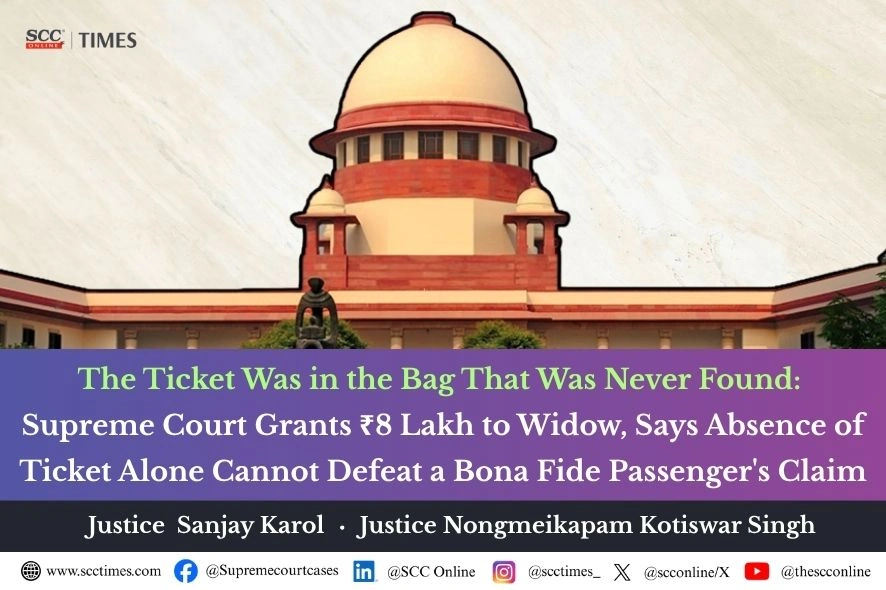
Supreme Court: In an appeal filed by the wife of a deceased train passenger, challenging the concurrent dismissal of her compensation claim by the Railway Claims Tribunal, Bhopal Bench, and the Madhya Pradesh High Court, the Division Bench of Sanjay Karol* and Nongmeikapam Kotiswar Singh, JJ. allowed the appeal, holding that compensation under Section 124-A, Railways Act, 1989 cannot be denied merely because the deceased’s railway ticket was not recovered after an untoward incident. The Court reiterated that the provision embodies a no-fault liability regime and is intended to provide expeditious relief to victims and their dependants. It held that while the claimant must initially establish the foundational facts of the journey and occurrence of the incident, such burden can be discharged through relevant evidence, including an affidavit, after which the burden shifts to the Railways to rebut the claim. The Court emphasised that a technical approach cannot defeat the beneficial purpose of the legislation and that the absence of a ticket on the deceased’s person, particularly where the ticket may have been lost along with belongings during the accident, is not by itself sufficient to deny compensation.
Accordingly, the Court set aside the judgments of the Railway Claims Tribunal and the High Court and directed the Railways to pay ₹8,00,000 to the appellant under the Railway Accidents and Untoward Incidents (Compensation) Rules. 1990 within 4 weeks of receiving her bank account details, failing which the amount would carry interest at 8 per cent per annum from the date of filing of the claim petition.
The Court also advised the Indian Railways to adopt effective measures to address overcrowding in trains, observing that overcrowding frequently results in passengers falling from moving trains and suffering fatal injuries. It also recommended that the Railways discontinue the use of the expression “second class passenger” in its manuals, observing that the class distinction should attach to the coach rather than the passenger, in recognition of India’s history of class divisions and in keeping with the spirit of the Constitution.
Background
The deceased was travelling from Raipur to Ahmedabad on Train Ahmedabad-Howrah Mail on 28 November 2015. During the journey, he fell from the running train in the Khandbara-Khatgaon section and died due to the injuries sustained.
The appellant, being the wife and dependant of the deceased, filed a claim before the Railway Claims Tribunal under the Railway Claims Tribunal Act, 1987, seeking compensation of ₹4,00,000 along with interest. She contended that the deceased was a bona fide passenger and had purchased a valid railway ticket, which was lost along with his luggage during the incident.
The Railway Claims Tribunal rejected the claim on the ground that the appellant failed to establish that the deceased was a bona fide passenger, as the railway ticket was not recovered. The High Court upheld the Tribunal’s decision, observing that in the absence of recovery of the ticket or belongings, the claim could not be sustained.
The appellant approached the Supreme Court against these findings.
Analysis and Decision
The Court examined Sections 123 and 124-A, Railways Act, 1989, which provide compensation for death or injury caused due to “untoward incidents”, including the accidental falling of passengers from trains.
The Court observed that Section 124-A imposes a no-fault liability on the Railways, meaning compensation is payable irrespective of any wrongful act, neglect, or default on the part of the Railway Administration, subject to statutory exceptions.
Relying on earlier judgments, including Union of India v. Prabhakaran Vijaya Kumar, (2008) 9 SCC 527 and Union of India v. Rina Devi, (2019) 3 SCC 572, the Court reiterated that provisions intended to provide social welfare and compensation must receive a liberal and purposive interpretation.
The Court held that technical objections should not defeat the humanitarian purpose of the legislation.
The Court noted that the primary issue was whether the deceased was a bona fide passenger. Relying on Rina Devi, the Court reiterated that:
-
The mere presence of a body on railway premises does not conclusively establish that the deceased was a bona fide passenger.
-
However, the mere absence of a ticket from the deceased’s possession does not automatically disprove passenger status.
-
The claimant’s initial burden can be discharged through an affidavit containing relevant facts, after which the burden shifts to the Railways to rebut the claim.
The Court observed that in the present case, the appellant had consistently stated that the deceased possessed a valid ticket, which was lost along with his luggage during the accident. The Railways did not dispute the occurrence of the accident or the deceased’s presence in the train.
The Court held that the claim could not be rejected merely because the ticket was not recovered.
“Technical approaches and lapses in procedure should not defeat the welfare aim of the statute as it does not befit the Railways, as an instrumentality of the State, to take such restrictive, pigeonhole view.”
The Court also examined the duties imposed upon Railway Authorities under various Railway manuals and regulations.
It observed that Railway procedures require ticket checks at multiple stages and place responsibilities on railway staff to ensure passenger safety, prevent overcrowding, and verify travelling authority.
The Court noted that had these procedures been effectively implemented, there would have been records regarding ticket verification, which could have resolved disputes regarding passenger status.
The Court observed that effective implementation of several provisions contained in the Railway manuals would require a substantial increase in manpower deployed at railway stations and on trains. In the era of modernisation, the Court suggested that the Railways should consider employing more young people, observing that such recruitment would not only generate stable employment but also strengthen passenger safety and help preserve human lives.
The Court emphasised that the expression “second class passenger”, used in the Railway manuals, warrants reconsideration. While acknowledging that the term is ostensibly linked to the fare paid for travel, the Court suggested that the classification should instead refer to the coach rather than the passenger, noting that attaching class-based terminology to individuals is inconsistent with the constitutional ethos, particularly in light of India’s historical experience with social class divisions.
The Court further emphasised that while passengers also have a responsibility to avoid unsafe practices, including travelling on footboards or overcrowded coaches, the Railways, being a public institution, must ensure effective implementation of safety measures.
“It would be entirely unfair to cast sole responsibility upon the Railways. The passengers themselves have equal responsibility. Incidents such as these are not hidden from the public and despite the painful ends that most of these people meet, there has not been a reform in habit and people still insist on being daredevils in catching trains and making their way from one place to another.”
Referring to Schedule I of the Railway Accidents and Untoward Incidents (Compensation) Rules, 1990, as amended and read with Notification No. GSR 1165(E) dated 22-12-2016, the Court held that the appellant was entitled to compensation of ₹8,00,000. Accordingly, it directed the Railways to pay the said amount within 4 weeks from the date of receipt of the appellant’s bank account details, failing which the amount would carry interest at the rate of 8 per cent per annum from the date of filing of the claim petition.
Accordingly, the Court allowed the appeal and set aside the judgments of the Railway Claims Tribunal, Bhopal Bench; and the High Court.
[Lata v. Union of India, 2026 SCC OnLine SC 1350, decided on 17-7-2026]
*Judgment Authored by: Justice Sanjay Karol
Advocates who appeared in this case:
For Petitioner(s): Ms. Shweta Priyadarshini , AOR
For Respondent(s): Mr. Brijender Chahar, A.S.G. Ms. Seema Bengani, Adv. Mr. Prashant Singh-ii, Adv. Ms. Sweksha, Adv. Ms. Radhika Mishra, Adv. Mr. Amrish Kumar, AOR