Disclaimer: This has been reported after the availability of the order of the Court and not on media reports so as to give an accurate report to our readers.
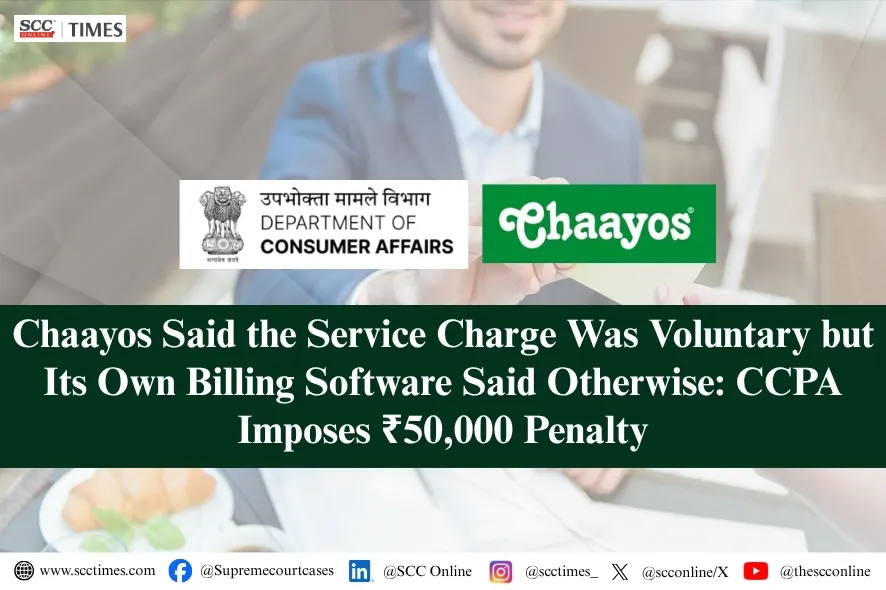
Central Consumer Protection Authority: In a suo motu case against Chaayos for charging a mandatory “service tax”1 separately in addition to CGST and SGST, the Chief Commissioner Nidhi Khare and Commissioner Anupam Mishra held that the restaurant had demonstrated a pattern of deliberate non-compliance with the “Guidelines to Prevent Unfair Trade Practices and Protection of Consumer Interest with Regard to Levy of Service Charge in Hotels and Restaurants”; directed the restaurant to reimburse to the aggrieved customer and payment of ₹50,000 penalty.
Background
The Central Consumer Protection Authority (CCPA) took suo motu cognizance of a complaint lodged on the National Consumer Helpline against Chaayos (Sunshine Teahouse Pvt. Ltd.), alleging that the restaurant had levied a service charge in addition to GST and refused to refund it, claiming that the charge was mandatory under company policy.
The CCPA noted that shortly before the incident, the Delhi High Court in National Restaurant Assn. of India v. Union of India, 2025 SCC OnLine Del 1975, had upheld the CCPA’s Guidelines to Prevent Unfair Trade Practices and Protection of Consumer Interest with Regard to Levy of Service Charge in Hotels and Restaurants, 2022, holding that mandatory levy of service charge was contrary to law and that any payment towards service charge must remain voluntary and at the customer’s discretion.
Upon conducting a preliminary inquiry under Sections 18 and 19, Consumer Protection Act, 2019 (CPA), the CCPA found a prima facie case that Chaayos had continued to levy service charge by default despite the High Court judgment and the 2022 Guidelines. Observing that the software-generated billing practice could potentially affect a wider class of consumers, the CCPA issued a notice to the restaurant and, after finding its response unsatisfactory, referred the matter to the Director General (Investigation) for a detailed investigation.
The Director General found that Chaayos had
-
levied a service charge by default even after the Delhi High Court’s judgment;
-
failed to redress the consumer’s grievance despite repeated communications from the National Consumer Helpline; and
-
subsequently, relabelled the charge as “Optional Service Charge”, a measure which did not cure the earlier violation.
The investigation concluded that the restaurant had continued to levy service charge without leaving the decision to the customer’s discretion, failed to provide timely grievance redressal, and engaged in billing practices contrary to the CCPA Guidelines, amounting to violations of Section 2(47) and (9) CPA.
Also Read: Delhi HC upholds CCPA guidelines prohibiting mandatory service charges in restaurants | SCC Times
Analysis, Findings and Decision
At the outset, the CCPA deemed it appropriate to examine the legal framework governing the levy of service charge in restaurants.
Referring to Section 2(9)(ii) and (v) CPA, the CCPA observed that consumers have a right to be informed about the price of goods and services so as to be protected against unfair trade practices and a corresponding right to seek redressal against such practices.
The CCPA further observed that where a restaurant displays a menu specifying the prices of food items but subsequently adds a mandatory service charge, it conceals the actual price payable by the consumer. Such conduct, it held, amounts to an unfair trade practice under CPA.
Referring to the Guidelines to Prevent Unfair Trade Practices and Protection of Consumer Interest with Regard to Levy of Service Charge in Hotels and Restaurants, 2022, the CCPA reiterated that:
-
no hotel or restaurant can add service charge automatically or by default in the bill;
-
service charge cannot be collected under any other name;
-
consumers cannot be compelled to pay service charge, which must remain voluntary and entirely at the consumer’s discretion;
-
no restriction can be imposed on consumers for refusing to pay service charge; and
-
service charge cannot be added to the food bill for the purpose of levying GST.
Also Read: CCPA declares mandatory service charge illegal | SCC Times
The Authority also relied upon the Delhi High Court’s decision in National Restaurant Assn. of India case wherein the Court held that:
-
service charge or tip is voluntary and cannot be compulsory;
-
mandatory levy of service charge constitutes an unfair trade practice under CPA;
-
the 2022 Guidelines issued by the CCPA are valid and binding;
-
consumers remain free to pay a voluntary tip, but such amount cannot be added by default to the bill and must be left to the customer’s discretion; and
-
restaurants are required to comply with the CCPA Guidelines, which the CCPA is entitled to enforce.
Applying the above principles, the CCPA held that the service charge originated from commands embedded in the restaurant’s billing software, resulting in its automatic addition to every bill. The CCPA observed that this completely negated the restaurant’s contention that the levy was voluntary. The material on record established that service charge had been mandatorily levied upon all consumers until 1 May 2025, in contravention of the 2022 Guidelines as well as the Delhi High Court’s judgment dated 28 March 2025.
The CCPA further found that the restaurant had demonstrated a pattern of deliberate non-compliance with the 2022 Guidelines and had failed to update its software-generated billing system despite the legal position having been settled. The continued use of the automated billing system resulted in unauthorised collection of service charge and rendered the restaurant liable for violation of consumer rights.
Accordingly, the CCPA held that the restaurant had violated:
-
consumer rights under Section 2(9)(ii) and (v) CPA;
-
Section 2(47) read with Section 2(46)(vi), relating to unfair trade practices and unfair contracts;
-
Section 2(28)(i) and (iii) relating to misleading advertisements; and
-
the Guidelines to Prevent Unfair Trade Practices and Protection of Consumer Interest with Regard to Levy of Service Charge in Hotels and Restaurants, 2022.
On the question of penalty, the CCPA observed that, under Sections 20 and 21 CPA, factors such as the extent of impact, duration of the contravention, the class of consumers affected, and the revenue generated through the impugned practice are relevant considerations. CCPA noted that Chaayos operates more than 180+ outlets across India and that the default levy of service charge had the potential to affect a large number of consumers. The CCPA also noted that the restaurant discontinued the levy only after the CCPA had taken cognisance of the matter.
Accordingly, the CCPA directed the restaurant to:
-
reimburse the service charge collected from the complainant;
-
immediately modify its software-generated billing system by removing the default addition of service charge or any similar charge;
-
pay a penalty of ₹50,000; and
-
submit a compliance report within 15 days.
Also Read: Tipping the Balance: Delhi High Court Bans Mandatory Service Charges in Restaurants | SCC Times
[In the matter of Chaayos (Sunshine Teahouse Pvt. Ltd.) regarding alleged levying of service charge, violation of Consumer Rights and Unfair Trade Practices, 2026 SCC OnLine CCPA 2, issued on 14-7-2026]
Appearance for Chaayos: Nikhil Mandhotra, Advocate
1. Ed. Note: The term “service tax” as used in the order refers to the restaurant service charge, a discretionary amount added to food bills, which is governed by the CCPA’s Guidelines to Prevent Unfair Trade Practices and Protection of Consumer Interest with Regard to Levy of Service Charge in Hotels and Restaurants, 2022.