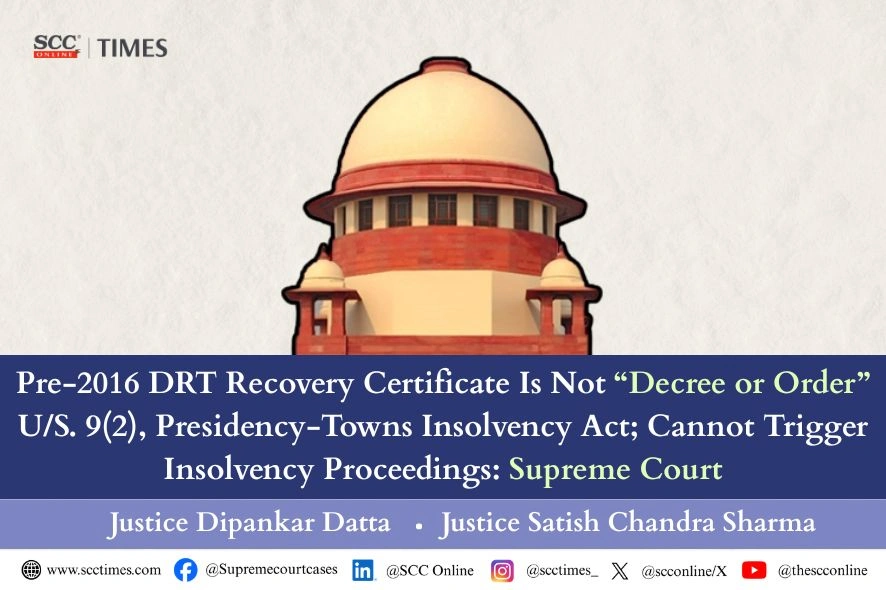
Supreme Court: The appeal concerned with the interpretation of Section 9(2), Presidency-Towns Insolvency Act, 1909 (Presidency-Towns Insolvency Act), and whether a recovery certificate issued by the Debts Recovery Tribunal (DRT) can be treated as a “decree or order” for initiating insolvency proceedings. Reaffirming the principle that insolvency laws must be strictly construed due to their serious civil consequences, the Division Bench of Dipankar Datta* and Satish Chandra Sharma, JJ., held that a recovery certificate issued by the DRT before the before the insertion of Section 19(22-A), Recovery of Debts and Bankruptcy Act, 1993 (Recovery of Debts and Bankruptcy Act), i.e., 2016 Amendment, could not be treated as a “decree or order” under Section 9(2), Presidency-Towns Insolvency Act and, therefore, could not form the basis of an insolvency notice under Section 9(2), Presidency-Towns Insolvency Act.
Factual Matrix
Beautiful Diamonds Ltd. (the Company) had availed credit facilities from a consortium of 15 banks, including appellant-HDFC Bank. The facilities were secured by mortgage through deposit of title deeds, and the Company’s directors, including respondent, executed personal guarantees. Upon default by the Company and failure of the guarantors to discharge their obligations, appellant Bank instituted proceedings before the DRT.
On 26 October 2004, the DRT directed issuance of a recovery certificate for ₹14,74,51,929.35 against the respondent, followed by the recovery certificate dated 30 November 2004. Relying on this recovery certificate, appellant Bank obtained an insolvency notice under Section 9(2), Presidency-Towns Insolvency Act.
The respondent challenged the insolvency notice before the Bombay High Court, contending that a recovery certificate was not a “decree or order” capable of supporting an insolvency notice. The Single Judge accepted this contention and quashed the notice. The Division Bench affirmed the decision.
Aggrieved thereby, appellant Bank approached the Supreme Court. During the pendency of the appeal, the respondent died, and his legal representatives were substituted.
Issues for Determination
-
Whether a recovery certificate issued by the DRT under the Recovery of Debts and Bankruptcy Act constitutes a “decree or order” within the meaning of Section 9(2), Presidency-Towns Insolvency Act?
-
Whether an insolvency notice under Section 9(2) can validly be issued on the basis of such a recovery certificate issued before the insertion of Section 19(22-A), Recovery of Debts and Bankruptcy Act in 2016?
Analysis
The Court reiterated that the Presidency-Towns Insolvency Act is a statute carrying grave civil consequences because adjudication as an insolvent result in what Paramjeet Singh Patheja v. ICDS Ltd., (2006) 13 SCC 322, described as “civil death”. Consequently, its provisions require strict construction.
Relying upon Paramjeet Singh Patheja, the Court observed that the expressions “decree” and “order” must be understood in the sense assigned to them under the Civil Procedure Code, 1908 (CPC). A decree is the formal expression of an adjudication by a court in a suit, while an order likewise emanates from a court. An insolvency notice is “not a mode of enforcing a debt”; enforcement must proceed through ordinary execution proceedings.
The Court rejected the appellant’s attempt to distinguish Paramjeet Singh Patheja on the ground that it dealt with arbitral awards. It held that although the factual context differed, the ratio of the decision rested upon broader principles governing the interpretation of Section 9(2), which equally applied to recovery certificates.
The Court opined that amendment to Section 19(22-A), Recovery of Debts and Bankruptcy Act had instead of supporting the appellant Bank demolished its case. Parliament’s decision to enact a deeming provision in 2016 clearly indicated that no such legal equivalence existed before the amendment and hold otherwise would amount to supplying a casus omissus. Since the amendment was not retrospective, it could not govern proceedings initiated years earlier.
The Court further reaffirmed the settled principle that rights and liabilities are ordinarily determined according to the law existing on the date the litigation commences. It referred to Rameshwar v. Jot Ram, (1976) 1 SCC 194, and Pasupuleti Venkateswarlu v. Motor and General Traders, (1975) 1 SCC 770, and observed that “the right to relief must be judged to exist as on the date a suitor institutes the legal proceeding” and that “the lis must be decided on the basis of rights and liabilities as they stood on the date of institution, unless the statute or equity of the case otherwise requires”. Accordingly, it held that the subsequent statutory amendment could not validate an insolvency notice that was legally unsustainable when issued.
Decision
The Court dismissed the appeal and affirmed the judgments of the Bombay High Court, holding that a recovery certificate issued by the DRT before the 2016 Amendment could not be treated as a “decree or order” under Section 9(2), Presidency-Towns Insolvency Act and, therefore, could not sustain an insolvency notice.
The Court clarified that the proceedings pending before the Single Judge stood closed insofar as the deceased respondent was concerned. It further stated that appellant Bank remained free to pursue any other remedies available against the respondent’s sons in accordance with law, subject to limitation and other legal defences.
[HDFC Bank Ltd. v. Kishore K. Mehta, 2026 SCC OnLine SC 1320, decided on 13-7-2026]
*Judgment Authored by Justice Dipankar Datta
Advocates who appeared in this case:
For the Appellant: Mr. Gopal Jain, Sr. Adv. with Mr. Alok Tripathi, AOR, Mr. Sanjay Gupta, Ms. Aditi Pundhir and Mr. Raghu Aggarwal, Advs.
For the Respondent: M/S. Chambers of Kartik Seth, AOR Mr. Tarun Mehra, Adv. Mr. Dakshesh Vyas, Adv. Mr. Shivendra Singh, AOR Ms. Aryama Singh Rajput, Adv. Mr. Devdatt Kamat, Sr. Adv. Mr. Utsav Trivedi, Adv. Mr. Arpit Gupta, Adv. Ms. Manini Roy, Adv. Mr. Girish Bhardwaj, AOR Mr. Varun Singh, AOR Mr. Gaurav Nair, Adv. Ms. Nishtha Kumar, Adv. Ms. Veera Mathai, Adv. Ms. Bhairavi Sn, Adv. Mr. Shrom Sethi, Adv. Mrs. Archana Singh, Adv. Mr. Imran Khan, Adv. Mr. Inam Ul Haq, Adv. Mr. Varun Agarwal, Adv. Mr. Ashish Wad, Adv. Mr. Manoj Wad, Adv. Ms. Swati Arya, Adv. Mr. Deepanshu Verma, Adv. M/s J S Wad And Co, AOR Mrs. Bina Gupta, AOR Mr. Nishe Rajen Shonker, AOR Mrs. Anu K Joy, Adv. Mr. Alim Anvar, Adv. Mr. Santhosh K, Adv.