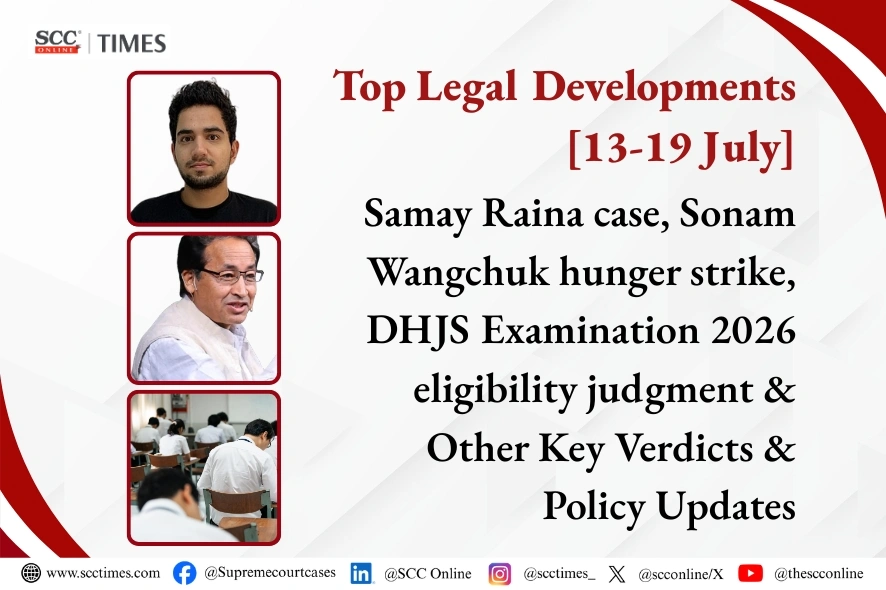
The week saw significant judicial developments across constitutional, criminal, commercial and arbitration law, with the Supreme Court’s observations in the Samay Raina case, the Sonam Wangchuk hunger strike Delhi High Court proceedings, and the DHJS Examination 2026 eligibility judgment among the top headlines.
TOP STORIES OF THE WEEK
Supreme Court imposes ₹3 lakh costs on Samay Raina and other comedians over alleged brazen violation of undertakings
In Ranveer Gautam Allahabadia v. Union of India1, while considering compliance in proceedings arising out of W.P. (C) No. 460 of 2025, a three-Judge Bench. observed that it had “no reason to doubt” that Respondents 6—10, including comedians Samay Raina, Vipul Goyal, Balraj Paramjeet Singh Ghai, Sonali Thakkar alias Sonali Aditya Desai, and Nishant Jagdish Tanwar, had acted in brazen violation of the undertakings and statements made before the Court. Read more about Samay Raina Case HERE
Sonam Wangchuk Shifted to Safdarjung Hospital Amid Hunger Strike: Here is What Delhi High Court Directed in its Medical Monitoring Order
In Rakesh Kumar Saini v. Union of India2, a public interest litigation (PIL) expressing concern over the deteriorating health of Shri Sonam Wangchuk, who had allegedly been observing a fast at Jantar Mantar, New Delhi, for approximately 17—18 days at the time of the order, seeking Court’s intervention to ensure that adequate medical attention was provided to him, the Division Bench while emphasising that “life of every citizen is precious and all medical efforts ought to be made by the Government authorities to save the same”, directed regular clinical monitoring and timely medical treatment. Read more about Delhi High Court’s Medical Monitoring Order HERE
Delhi High Court Upholds DHJS Exam 2026 Eligibility Criteria; Rejects Age Relaxation Claim Due to Non-Conduct of Examination in 2025
In Ajay Kumar Sharma v. High Court of Delhi, 2026 SCC OnLine Del 5030, a writ petition challenging the validity of the eligibility criteria prescribed for the Delhi Higher Judicial Service (DHJS) Examination, 2026. particularly the upper age-limit introduced after the amendment to the Delhi Higher Judicial Service Rules, 1970 (DHJS Rules), the Division Bench of V. Kameswar Rao and Manmeet Pritam Singh Arora, JJ., dismissed the writ petition holding that the recruitment Notification dated 1 July 2026 and the eligibility criteria prescribed therein were valid. Read more about DHJS Examination criteria HERE
SUPREME COURT HIGHLIGHTS OF THE WEEK
Arbitration| Article 227 cannot be invoked to challenge Arbitral Tribunal’s rejection of Section 16 application; Remedy lies under Section 34 after final award
In Manash Kamal Bezboruah v. Bokahola Tea Company (P) Ltd., 2026 SCC OnLine SC 1330, while hearing a batch of appeals against the interim order and the order passed by the Gauhati High Court , whereby the High Court stayed the notice issued by the Arbitral Tribunal to respondents and rejected the appellant’s preliminary objection regarding the maintainability of a revision petition under Article 227 of the Constitution, the Division Bench held that the High Court was not justified in entertaining the challenge under Article 227 to an order of the Arbitral Tribunal rejecting jurisdictional objections under Section 16 Arbitration and Conciliation Act, 1996 (1996 Act). The Court set aside the impugned orders, observing that interference under Article 227 is permissible only in exceptional cases involving a patent lack of inherent jurisdiction, and that the appropriate remedy against rejection of a Section 16 application lies under Section 34 of the Act, 1996 after the pronouncement of final arbitral award. Read more about challenge under Article 227 to an order of the Arbitral Tribunal HERE
Commercial Contract| No-Interest Clause is Enforceable, but Delay in Refund Attracts Interest
In State of Haryana v. Jai Durgaa Finvest (P) Ltd., 2026 SCC OnLine SC 1323, after travelling through multiple rounds of litigation before the High Court and the Supreme Court with regards to enforceability of a contractual clause providing that a contractor’s security deposit shall not carry interest under a government mining contract, the ultimate question culminated in the present appeal was whether such an express contractual term could be invalidated on equitable grounds and whether the State becomes liable to pay interest if it retains the security deposit beyond the period stipulated for its refund. Reaffirming the principle that a court cannot rewrite or modify clear terms of a commercial contract merely on considerations of equity or perceived unfairness, the Division Bench held that while the no-interest clause on security deposit is valid and binding, however, it does not authorise the State to retain the security deposit indefinitely without incurring liability to pay interest. Accordingly, the Court upheld the validity of Clause 19 and set aside the High Court’s declaration that the clause was contrary to law or public policy. Read more about Commercial Contract Terms HERE
Criminal Justice System| 5,393 Elderly and Terminally Ill Prisoners Identified by NALSA. Supreme Court Says the Needs Systemic Recalibration; Issues Comprehensive Directions
In National Legal Services Authority v. Union of India, 2026 SCC OnLine SC 1341, while considering this writ petition bringing forth before the Court systemic concerns regarding continued incarceration of convicted prisoners who are of advanced age (above 70 years) or are terminally ill, the Division Bench directed the Central Government, States and Union Territories to formulate and notify a comprehensive policy for early or premature release of prisoners who are of advanced age and/or are terminally ill. The Court further directed that the policy so framed, must clearly define the eligibility criteria and procedural framework for consideration of release. In particular, the policy must expressly provide a clear and uniform definition of “terminal illness” and mandate constitution of independent Medical Boards at the Divisional and State levels for objective medical assessment and certification of terminal illness or advanced medical vulnerability. Read more about SC’s Comprehensive directions for Elderly and Terminally Ill Prisoners HERE
Hindu Succession Act| Preferential Right of Class I Heirs under Section 22, Hindu Succession Act Extends to Agricultural Property
In Mahinder v. Puran Singh, 2026 SCC OnLine SC 1335, while hearing an appeal, revolving around long-standing question of whether the preferential right conferred upon Class I heirs under Section 22, Hindu Succession Act, 1956 (Hindu Succession Act) extends to inherited agricultural land, wherein the First Appellate Court upheld the plaintiff’s preferential right and the High Court affirmed the First Appellate Court’s judgment, the Division Bench upheld the impugned judgments, holding that Section 22, Hindu Succession Act applies to inherited agricultural land. Read more about Preferential Right of Class I Heirs under Section 22, Hindu Succession Act HERE
Inheritance Rights| Uncle-in-law cannot make niece’s husband a “Ghardamad” to claim inheritance rights under Oraon customary law
In Bejla Oraon v. Kali Das Oraon, 2026 SCC OnLine SC 1302, while hearing a matter on the proof of customary law governing Oraon tribal succession, the Division Bench held that an uncle-in-law cannot induct his niece’s husband as a ghardamad (resident son-in-law) under the recognised customary law of the Oraon tribal community to confer inheritance rights over ancestral property. Read more about inheritance rights under Oraon customary law HERE
MAJOR HIGH COURT RULINGS THIS WEEK
Arbitration| Manipur HC Sets Aside Arbitral Award by Consent, Appoints Former Chief Justice as New Arbitrator for Thoubal Project Dispute
In Progressive Construction Ltd. v. State of Manipur, 2026 SCC OnLine Mani 347, the Single Judge Bench set aside an arbitral award and recommence the arbitration through a fresh, de novo proceeding before a mutually acceptable sole arbitrator by the parties. The Court directed the proceedings would resume from the stage which has been already completed by the previous arbitrator. Read more about Thoubal Project Dispute HERE
Bail| Mansoor Asghar Peerbhoy’s Bail Under UAPA rejected
In Mansoor Asghar Peerbhoy v. State (NCT of Delhi), 2026 SCC OnLine Del 4984, while hearing an appeal filed under Section 21, National Investigation Agency Act, 2008 (NIA Act), challenging the rejection of 3rd bail application of appellant, alleged Indian Mujahideen operative Mansoor Asghar Peerbhoy accused in 2008 Delhi Bomb blasts case, the Division Bench dismissed the appeal and upheld the rejection of bail. The Court held that while considering the prayer for bail, the Court had to bear in mind not merely the right to life of the appellant, but also the adverse impact that appellant’s release might have on “the right to life and safety of common citizens, having regard to the role attributed to him in the heinous crimes with which he has been charged”. Thus, while recognising the seriousness of 17 years of pre-trial custody, the Court held that the trial’s advanced stage, the gravity of the offence, the appellant’s attributed role and the prima facie material did not justify bail. Read more about Mansoor Asghar Peerbhoy’s Bail HERE
Judicial Safety| Ensuring judicial safety is the prime duty of State
In reference Suo Motu Judicial officers of the State of M.P. v. State of M.P., 2026 SCC OnLine MP 20200, while hearing a PIL registered regarding security facilities of District Judges, the Division Bench of took note of the recent alleged threats being given to Justice Tabassum Khan, Additional Judge, Seonimalva, Narmadapuram, due to an order passed by her. Noting that many Judges did not have official accommodations, which impacted their security, the Court directed the Additional Chief Secretary (Home) to file an affidavit mentioning the steps likely to be taken by the State and a detailed plan for this issue. Read more about Safety of Judges and judicial accommodation HERE
Medical Practitioners| “Practitioner without knowledge is a quack”: Allahabad HC denies relief to homeopathic doctor whose clinic was sealed for practicing allopathy
In Santosh Kumar Sharma v. State of U.P., 2026 SCC OnLine All 21982, a writ petition filed by a homeopathic doctor against the sealing of his clinic, the Division Bench rejected the petition, holding that the doctor was not entitled to practice modern medicine (allopathy) on the strength of his electro homeopathy certificate. Additionally, his clinic/hospital also failed to meet the standards prescribed by various government orders and the National Commission for Indian System of Medicine Act, 2020 (NCISM Act). Read more HERE
Medical Termination of Pregnancy| Termination of pregnancy cases are urgent. MP HC allows 10-week pregnant minor rape victim’s plea
In Prosecutrix X v. State of M.P., 2026 SCC OnLine MP 19624, while hearing a writ petition filed seeking medical termination of a 17-year-old rape victim’s 10-week-old pregnancy, the Single Judge Bench allowed the termination with certain directions. The Court also noted that, in several cases, despite having the authority to initiate the termination process, the authorities were shifting their burden to one another, and thereafter the matters travelled up to this Court, and the procedure was carried out after the Court’s permission. For a minor victim with a pregnancy of less than 24 weeks, there was no need to seek court permission for termination if the victim or her guardian had given written consent. Read more Termination of pregnancy cases for minor rape victims HERE
POCSO| Silence Is Not Institutional Prudence, It Is Statutory Delinquency
In Shivprasad Bhat v. State of Karnataka3, while hearing a petition seeking quashing of FIR registered for offences under Sections 4, 8 and 21, Protection of Children from Sexual Offences Act, 2012 (POCSO Act), the Single Judge Bench held that the allegations against the petitioners prima facie disclosed an offence under Section 21, POCSO Act for failure to report a child sexual abuse complaint. Observing that the complaint alleged deliberate suppression of the incident by treating it as consensual, compelling the victim to alter his complaint, and withholding the matter from the police and the victim’s parents, the Court reiterated that educational institutions cannot substitute the mandatory reporting obligation under Sections 19 and 21, POCSO Act with an internal inquiry. Accordingly, finding no ground to interfere at the threshold, the Court dismissed the petition and permitted the investigation to proceed in accordance with law. Read more about failure to report a child sexual abuse complaint under POCSO HERE
Police Security| “Traitor” Posters Outside Harbhajan Singh’s Residence Did Not Establish a Threat to Life, Security Cover declined
In Harbhajan Singh v. State of Punjab4, while hearing a writ petition challenging the withdrawal of Punjab Police security cover, the Single Judge Bench disposed of the petition, holding that the withdrawal of the petitioner’s security cover was based on an earlier threat assessment conducted by the Security Review Committee and not on his decision to leave the ruling political party. The Court observed that peaceful protests and posters branding the petitioner as a “traitor” did not, by themselves, establish any threat to his life and liberty, particularly when he had already been granted “Y+” category security by the Central Reserve Police Force (CRPF) and the State had undertaken to provide local security deployment whenever required. Read more about Punjab and Haryana HC Declines Security Cover to Harbhajan Singh HERE
Prevention of Corruption Act| Whether NSE MD Is a ‘Public Servant’ Under Prevention of Corruption Act
In Chitra Ramkrishna v. Union of India, 2026 SCC OnLine Del 5031, while hearing a writ petition challenging the constitutional validity of Section 2(c)(viii) and b), Prevention of Corruption Act, 1988, the sanction orders issued for the petitioner’s prosecution, and the order taking cognizance in the alleged National Stock Exchange (NSE) co-location scam, a Division Bench of dismissed the petition. The Court held that the definition of “public servant” under the Prevention of Corruption Act is intentionally broad and is neither vague nor arbitrary, requiring only that a person hold an “office” by virtue of which he or she performs a “public duty”. Observing that a recognised stock exchange performs vital public functions under the Securities Contracts (Regulation) Act, 1956, the Court held that the petitioner, as the Managing Director and Chief Executive Officer of NSE, could not be divorced from the public duties discharged by the Exchange. Read more about ‘Public Servant’ Under Prevention of Corruption Act HERE
Right to Education| Directions compelling minority schools to provide free education to journalists’ children quashed
In Brothers of St. Gabriel Educational Society v. State of Telangana, 2026 SCC OnLine TS 7117, while deciding 2 writ petitions challenging proceedings issued by educational authorities directing private recognised schools to provide free education to children of journalists, Single Judge Bench held that the provisions of the Right of Children to Free and Compulsory Education Act, 2009 (RTE Act) cannot be enforced against minority educational institutions protected under Article 30(1) of the Constitution. The Court further held that educational authorities cannot impose such obligations through administrative instructions issued without statutory authority, particularly without affording the affected institutions an opportunity of hearing, and accordingly set aside the impugned proceedings. Read more HERE
Right to choose Residence| Parents or State Cannot Compel Adult Woman to Return Home or Marry; Right to Choose Residence, Education Protected Under Article 21
In Safia Sultana v. State of Maharashtra, 2026 SCC OnLine Bom 5211, while hearing a writ petition filed by a 21-year-old woman seeking protection against coercion from her parents and the State, the Division Bench observed that the petitioner, being an adult, is legally competent to decide her residence, marriage, and education. The Court noted that she had voluntarily left her parental home as she was unwilling to marry against her wishes and expressed her desire to pursue higher education. The Court held that neither her parents nor the State could compel her to return home and further emphasised that such matters of personal choice are protected under Article 21 of the Constitution. Read more about right to choose residence HERE
Trademark| Atyati-Cognizant trademark dispute
In Atyati Technologies (P) Ltd. v. Cognizant Technology Solutions US Corpn, 2026 SCC OnLine Bom 5210, while considering an interim application in a commercial intellectual property suit alleging copyright infringement and passing-off in respect of a logo device mark, a Single Judge Bench held that the defendants had prima facie established independent creation of the impugned logo and that the plaintiff had failed to demonstrate reasonable opportunity of access, copying, goodwill in the standalone logo, or likelihood of confusion. Consequently, the Court dismissed the interim application and allowed Cognizant to continue using its logo. Read more about Atyati-Cognizant dispute HERE
Writ Jurisdiction| Delhi HC Dismisses Passport DOB Correction Writ for Lack of Jurisdiction
In Chintan Agrawal v. Union of India, 2026 SCC OnLine Del 5028, a writ petition seeking correction of the petitioner’s date of birth in his passport and removal of the Emigration Check Required (ECR) status, a Single Judge Bench dismissed the petition as not maintainable for want of territorial jurisdiction. The Court held that the mere location of the Ministry of External Affairs in Delhi does not, by itself, confer territorial jurisdiction under Article 226(2) of the Constitution when the entire cause of action has arisen outside Delhi. Read more about Passport DOB Correction Jurisdiction HERE
TRIBUNAL UPDATES OF THE WEEK
RERA| Delayed delivery of Possession
In Sanjeet Singh v. AKG Affordable Housing (P) Ltd.5, while deciding a complaint under Section 31, Real Estate (Regulation and Development) Act, 2016 (RERA Act), the Single Bench of R.S. Kulhari, Adjudicating Officer, held that an allottee whose project was declared lapsed after the promoter failed to deliver possession within the agreed timeline was entitled to compensation in addition to the refund with interest already granted by the RERA. Read more HERE
NGT| NGT Assesses Over ₹2.65 crores Environmental Compensation for Illegal Felling of 33 Trees in BHU Campus
In Saurabh Tiwari v. Union of India6, while hearing an execution application seeking compliance with the direction to the Banaras Hindu University (BHU) to plant compensatory plantation for illegal cutting of 33 trees, and direction to the Uttar Pradesh Pollution Control Board (UP PCB) to assess and recover environmental compensation from the University, the Bench of Justice Prakash Shrivastava (Chairperson) and Dr Afroz Ahmad (Expert Member) noted that environmental compensation was assessed at ₹2,65,26,877.08 and granted further time to the UP PCB to complete the levying of the compensation. Read more ABOUT NGT directions HERE
FOREIGN COURT UPDATES
UK Court of Appeal| Does Ratification of New York Convention Amount to Waiver of Sovereign Immunity
In CC/Devas (Mauritius) Limited v. Republic of India7, an appeal concerning Devas Award Enforcement Dispute rendered under the India—Mauritius Bilateral Investment Treaty, Lewson, Newey, and Phillips, LJJ., considered whether India’s ratification of the Convention on the Recognition and Enforcement of Foreign Arbitral Awards, 1958 (New York Convention) amounted to a submission to the jurisdiction of English courts. The Court held that Article III of the Convention does not waive sovereign immunity, as recognition and enforcement of arbitral awards remain subject to the procedural law of the enforcing State, within which State immunity is a recognised procedural bar. Consequently, ratification of the New York Convention does not constitute a clear and unequivocal consent by a State to enforcement proceedings before English courts under the State Immunity Act, 1978 (SIA), and accordingly dismissed the present appeal. Read more about Devas Award Enforcement Dispute HERE
United States Court of Appeals| Buying Finished Gold Bars from Russian Nationals Is “Procuring Geological Materials” Under US Sanctions Law
In Axel Diegelmann v. Scott Bessent8, an appeal challenging sanctions imposed under the Russian Harmful Foreign Activities sanctions regime, Katsas and Childs, Circuit Judges, and Edwards, Senior Circuit Judge, considered whether German precious-metals traders who purchased precious metals, including finished gold bars, from Russian nationals could be regarded as operating in the “metals and mining sector of the Russian Federation economy”. The Court held that the term “procuring” under the applicable regulations includes obtaining or acquiring geological materials through special effort and is not limited to acquiring equipment used in mining operations. Finding no error in OFAC’s interpretation of the sanctions framework or its determination that the appellants’ activities fell within the Russian metals and mining sector, the Court upheld the sanctions. Read more about OFAC Sanctions on Diegelmann Traders HERE
THIS WEEK’S KEY LEGISLATIVE UPDATE
-
Mandatory e-KYC for IP Attorneys: IP India Directs Compliance Within One Month
-
Centre Notifies Procedure for Determining Core Activities under OSHWC Rules, 2026
-
Delhi HC Orders Suspension of DHJS Officer with Immediate Effect
-
Centre Nominates New Chairperson, Vice-Chairperson and Member to National Commission for Minorities
OTHER DEVELOPMENTS OF THIS WEEK
LAW MADE EASY
OP.ED.
-
World Day for International Justice 2026: Is International Criminal Justice at a Turning Point? by Malika Bhola
-
When Anti-Corruption Agencies Answer to the Executive: Nigeria, India, and the Independence Problem by Obongodu Paul Unanam
-
Legal Vetting in Indian Property Transactions by Shweta Chaturvedi
-
The New Definition of Fair Value: Can Reforming Fair Value Fix Creditor Recoveries? by Swarnendu Chatterjee and Anushka Bhatt
-
Capital Gains Taxation of Share Buybacks: A Critical Analysis of the 2026 Reform by Arbind Singh
-
The Price of Incoherence: Enforcement Discretion, Regulatory Design, and the Future of India’s Overseas Investment Framework by Ipsita Agarwal
KNOW THY JUDGE
Also Read:
1. Writ Petition(s)(Criminal) No(s). 83 of 2025
2. W.P.(C) 9498 of 2026
3. CRL.P No. 9422 of 2026
4. CWP-13471-2026
5. RAJ-RERA-C-O-2024-7330
6. EA No. 15 of 2026
7. [2026] EWCA Civ 797
8. No. 24-5277