Disclaimer: This has been reported after the availability of the order of the Court and not on media reports so as to give an accurate report to our readers.
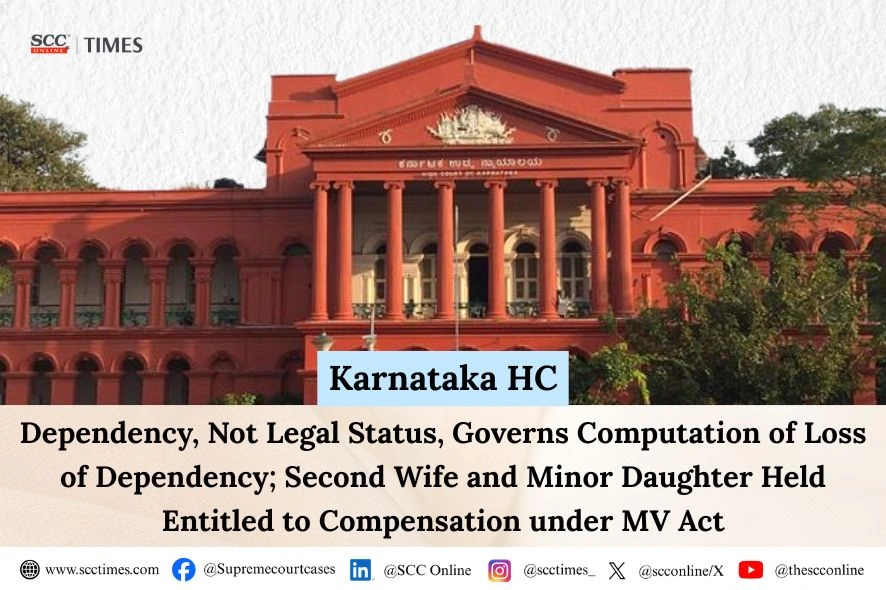
Karnataka High Court: In a first appeal under Section 173(1), Motor Vehicles Act, 1988 (MV Act), against the award of the Motor Accident Claims Tribunal, the Division Bench of Jayant Banerji and Tara Vitasta Ganju, JJ., partly allowed the appeal and held that all dependents of the deceased are required to be considered while computing loss of dependency under the Motor Vehicles Act, irrespective of their strict legal status. Observing that the deceased’s second wife and minor daughter were also dependent on his income, the Court enhanced the compensation from ₹15.10 lakhs to ₹30.12 lakhs.
Background
The appeal arose from the award passed by the Motor Accident Claims Tribunal granting compensation of ₹15,10,000 to the appellants for the death of a 34-year-old man in a motor vehicle accident. The claim petition had been instituted by the deceased’s first wife and mother, while the deceased’s alleged second wife and minor daughter were impleaded as respondents, claiming to be his dependents. Although the Tribunal held that it lacked jurisdiction to adjudicate the disputed marital status between the 2 women, the Tribunal treated all 4 claimants as dependents for the purpose of computing loss of dependency. However, the Tribunal declined to apportion the compensation and assessed the deceased’s notional monthly income at ₹10,000, awarding compensation with interest at 9 per cent per annum. Aggrieved by the quantum of compensation, the appellants preferred the present appeal, contending that the Tribunal ought to have adopted the notional income of ₹14,000 for the year 2019 in terms of the Karnataka State Legal Services Authority guidelines.
Issue
Whether Respondents 3 and 4 could be considered dependents for determining loss of dependency and whether the Tribunal had correctly awarded compensation.
Analysis
The Court noted that while the appellants were the deceased’s wife and mother, it was undisputed that the deceased was also survived by his second wife and minor daughter, who were dependent on him. The Tribunal had, therefore, treated all 4 persons as dependents for computing the loss of dependency.
The Court observed that the issue regarding who can be treated as a dependent under the MV Act is no longer res integra. Referring to Gujarat SRTC v. Ramanbhai Prabhatbhai, (1987) 3 SCC 234, the Court reiterated that the expression “legal representative” under the MV Act is of wider meaning and is not confined to the spouse, parents or children of the deceased. Every person representing the estate of the deceased and suffering on account of the death in a motor vehicle accident is entitled to seek compensation. Referring to N. Jayasree v. Cholamandalam MS General Insurance Co. Ltd., (2022) 14 SCC 712, the Court found that, for maintaining a claim under Section 166, MV Act, it is sufficient to establish loss of dependency, and that the deduction towards personal expenses depends on the facts of each case rather than the claimant’s relationship with the deceased. The Court reiterated that dependency, and not strict legal status or heirship, is the determinative factor for awarding compensation.
The Court noted that the notional income of the deceased for the year 2019 was ₹14,000 per month, and that the age of the deceased was 34, the applicable multiplier was 16, and 40 per cent was liable to be added towards future prospects. Applying the settled principles of law, the Court observed that since Respondents 3 and 4 were also dependents of the deceased, they were required to be included while computing the loss of dependency.
Allowing the appeal in part, the Court modified the Tribunal’s award by enhancing the compensation by ₹15,02,400, thereby increasing the total compensation to ₹ 30,12,400, together with interest at 9 per cent per annum from the date of the claim petition till realisation. The Insurance Company was directed to deposit the enhanced compensation with interest within 8 weeks, while the remaining portions of the Tribunal’s award were left undisturbed. The Court further directed that, upon deposit, the enhanced amount be released to the claimants in accordance with law.
[Asha v. Ramakrishna S. Ghatge, 2026 SCC OnLine Kar 6968, decided on 16-6-2026]
Advocates who appeared in this case:
For the appellants: G.J. Sunkapur, Advocate
For the respondent: H.S. Lingaraj, Advocate