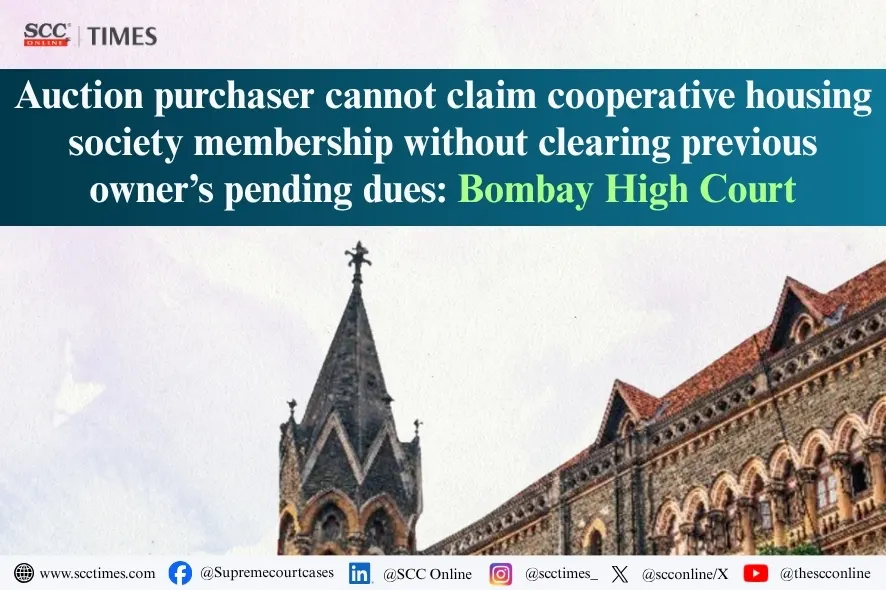
Bombay High Court: In a petition pertaining to non-grant of membership of society due to non-payment of previous owner’s pending dues, the Single Bench of Sandeep V. Marne, J., held that Assistant Registrar and Joint Registrar have grossly erred in ignoring specific stipulations of sale Certificate, wherein the sale was subject to condition of payment of past dues in respect of the auctioned flat, as well as the provisions of Section 154-B–7, Maharashtra Co-operative Societies Act, 1960 (MCS Act).
Background
The petitioner, a cooperative housing society registered under the MCS Act, challenged the orders of the Assistant Registrar and the Joint Registrar directing it to admit the auction- purchasers of a flat as members of the Society and issue them a share certificate.
The dispute arose after the original flat owners, who had purchased the flat by availing a loan from the North Kanara Goud Saraswat Brahmin Co-operative Bank Ltd., defaulted in repayment of both the housing loan and the Society’s maintenance charges. While the maintenance arrears continued to accumulate, the bank-initiated proceedings under the Securitisation and Reconstruction of Financial Assets and Enforcement of Security Interest Act, 2002 (SARFAESI), took possession of the flat and sold it through an e-auction on 17 March 2023. Respondents 4 and 5 emerged as the successful bidders or the auction- purchasers, and a registered sale certificate was issued in their favour.
Following the auction, the auction-purchasers requested the Society to waive the outstanding maintenance dues. The Society, however, called upon the Bank not to hand over possession of the flat until the arrears were cleared. The Bank informed the Society that, under the e-auction terms, the auction-purchasers had undertaken to pay the pending and future maintenance dues. The auction-purchasers, on the other hand, asserted that they were liable to pay maintenance charges only from the date they were put in possession of the flat. The Society thereafter demanded payment of the outstanding maintenance dues.
As the Society declined to admit the auction-purchasers as members, they filed an application under Section 23(2), MCS Act before the Assistant Registrar seeking membership. The Assistant Registrar allowed the application and directed the Society to admit them as members, make the requisite entries in its records and issue a share certificate. The Society’s revision application was dismissed by the Joint Registrar, leading to the present writ petition.
During the pendency of the proceedings, the Society also instituted a dispute under Section 91, MCS Act for recovery of maintenance dues before the Cooperative Court, which was initially rejected under Order 7 Rule 11, Civil Procedure Code, 1908, but was subsequently restored by the Cooperative Appellate Court.
Also Read: Bom HC: No urgent relief against property auction under SARFAESI Act| SCC Times
Issue
Whether a purchaser can be made liable to pay the maintenance dues unpaid by the previous owner and whether clearance of such maintenance dues can be made a pre-condition for grant of membership by the Society.
Analysis and Findings
At the outset, the Court observed that, in the present case, the successful bidders had purchased the flat through an e-auction conducted by the Bank, with full knowledge of past dues payable by the previous owners. The Court noted that the previous owners had mortgaged the flat with the Bank, which sold the same through an e-auction to recover the loan amount.
The Court stated that the successful bidders were fully aware of pending maintenance dues of the previous owner towards the Society, as they wrote to the Society asking for waiver of unpaid society charges of the previous owner. The Society had also requested the Bank to direct the successful bidders to clear the dues. The Court observed that the certificate of sale executed by the Bank in favour of the successful bidders indicated that the same was made subject to the auction-purchaser’s undertaking to pay pending and future dues of maintenance to the Society.
Accordingly, the Court noted that the flat was bought by the successful bidder not only with full knowledge of the previous dues but was also under the condition of clearance of pending dues. The Court further noted that the auction-purchasers refused to pay the said dues of the previous owner to the Society and communicated that they would only pay the charges applicable post their purchase of the flat.
Analysis of Assistant Registrar’s Findings
The Court noted that the findings of the Assistant Registrar pertaining to the Bank not communicating to auction-purchasers about pending maintenance dues of the previous owner of the auctioned flat were virtually incorrect. The Court stated that it was more than apparent that auction-purchasers were fully aware of past maintenance dues in respect of the flat and, in any case, became aware of the same on the auction day. Therefore, it cannot be assumed that auction-purchasers were not aware of the past maintenance dues when they decided to purchase the flat in the e-auction.
The Court found the Assistant Registrar’s observation that the Society had failed to perform its statutory duty by not initiating recovery proceedings against the original flat owners to be factually incorrect. It noted that the Society had repeatedly demanded payment of maintenance dues by issuing communications and demand notices between November 2017 and March 2020. The Court further observed that the COVID-19 Pandemic may have impeded further recovery proceedings, following which the Bank initiated action under the SARFAESI Act and took possession of the flat. In these circumstances, the Court held that it was unfair to fault the Society for not performing its statutory duty.
The Court held that the Assistant Registrar erred in treating the maintenance dues as a disputed claim beyond his jurisdiction under Section 23(2), MCS Act. It observed that there was no dispute regarding the quantum of maintenance dues; the only issue was whether the auction- purchasers were liable to pay them. The Court further noted that, despite repeatedly referring to the sale certificate, the Assistant Registrar had ignored its specific condition making the sale subject to payment of the pending maintenance dues to the Society. The Assistant Registrar had also failed to consider the provisions of Section 154-B–7, MCS Act, rendering his order erroneous.
Analysis of Joint Registrar’s Order
The Court observed that the Joint Registrar, instead of setting aside the Assistant Registrar’s order, dismissed the revision application after narrating the facts of the case, recording the parties’ submissions and making certain observations. It further observed that the Joint Registrar referred to the Society having filed a dispute under Section 91, MCS Act before the Cooperative Court and upheld the Assistant Registrar’s order on that basis. The Court held that the order passed by the Joint Registrar was erroneous and deserved to be set aside.
Analysis of provisions of Maharashtra Co-operative Societies Act, 1960
The Court examined the statutory scheme of the MCS Act, andAct and noted that Chapter XIII-B contains special provisions governing cooperative housing societies. The Court observed that Section 154-B-7 specifically regulates the transfer of a member’s share or interest by restricting such transfer until the dues of the housing society are paid. The Court further noted that the provision is couched in negative terms, ensuring that the transfer of a member’s share or interest does not become effective unless the Society’s dues are cleared. The Court stated that the provision was introduced keeping in view the special circumstances of housing societies, where non-payment of maintenance charges by a member adversely affects the other members of the Society.
Role of Cooperative Societies
The Court observed that cooperative housing societies have evolved beyond being collective bodies managing the common needs of a building and now function as democratic, financial and legal entities providing a range of services and amenities to their members. The Court noted that modern housing societies maintain facilities such as clubhouses, swimming pools, gardens, high-speed elevators and sustainable infrastructure, besides employing staff and maintaining statutory funds, all of which require substantial expenditure. The Court further observed that housing societies primarily depend on maintenance contributions from their members to meet these expenses.
The Court stated that defaults in payment of maintenance charges place a financial strain on the Society, hamper maintenance of the building and its facilities, and often compel other members to contribute additional amounts. The Court held that it was in view of these special circumstances relating to cooperative housing societies that the legislature consciously incorporated Section 154-B-7 into the MCS Act.
Precedents considered
The Court referred to Tanvi’s Diamoda Coop. Housing Society Ltd. v. State of Maharashtra, 2025 SCC OnLine Bom 4617, wherein it had considered the object of Section 154-B–7 MCS Act in the context of an auction-purchaser’s liability to pay past maintenance dues. It noted that the decision also examined the interplay between Sections 154-B–7 and 154-B–12, MCS Act governing transfer of a member’s share, right, title and interest in a cooperative housing society.
The Court also referred to Brightland Coop. Housing Society Ltd. v. Registrar, Coop. Societies, 2025 SCC OnLine Bom 2795, where Section 154-B-7 was considered in a case involving a serious dispute regarding maintenance dues. It noted that the Court had rejected the contention that sale of a flat by a secured creditor on an “as is where is” and “whatever there is” basis referred only to the physical condition of the property. Instead, it was held that an auction- purchaser was required to undertake due diligence not only regarding the condition of the property but also the title and obligations attached to it.
The Court further noted that, although Brightland rejected the auction-purchaser’s contention that they were not liable to pay maintenance dues for the period prior to purchase, membership was directed to be granted in the peculiar facts of that case, as there was a dispute regarding the exact amount of dues, the Society had not demanded the past dues from the purchasers, and it had not refused to admit them as members.
Referring again to Tanvi’s Diamoda, the Court observed that it involved an almost similar case where a flat had been purchased in an auction and there were outstanding maintenance dues of the previous member. The Court noted that Tanvi’s Diamoda held that an auction-purchaser cannot seek membership without paying the outstanding maintenance dues and that proceedings under the SARFAESI Act do not dilute the obligation to clear such dues.
The Court also considered Banganga Anurag Coop. Housing Society Ltd. v. Registrar, Coop. Societies, 2025 SCC OnLine Bom 5224, which examined the ratio of both Brightland and Tanvi’s Diamoda. It noted that Banganga Anurag held that where the purchaser does not dispute the outstanding dues, the case would fall within the ratio of Tanvi’s Diamoda, whereas cases involving a serious dispute regarding the dues and lack of clarity from the Society would be governed by Brightland. The Court further noted that Banganga Anurag ultimately held that the facts before it fell within the framework laid down in Tanvi’s Diamoda.
Application to the present case
Applying the above decisions, the Court held that Brightland, Tanvi’s Diamoda and Banganga Anurag provided a direct answer to the issue involved in the present case. The Court observed that, as in those cases, the flat had been purchased on an “as is where is” and “whatever there is” basis. Consequently, the auction-purchasers inherited the liability attached to the flat, and the charge created under Section 154-B–14, MCS Act also attached to them. The Court held that Section 154-B-14 did not assist the auction-purchasers’ case and that, once the dues payable by a member became a charge on the flat, the liability stood transferred to the purchasers upon purchase.
Accordingly, the Court held that the auction-purchasers could not escape liability to pay the maintenance dues relating to the period prior to taking possession of the flat. The Court further held that the Assistant Registrar and the Joint Registrar erred in appreciating the statutory scheme of the MCS Act and in overlooking the stipulations contained in the sale certificate as well as Section 154-B–7, MCS Act. Consequently, the impugned orders were held to be unsustainable and liable to be set aside.
Society can simultaneously oppose membership and recover maintenance dues
The Court rejected the contention that, by instituting proceedings under Section 91, MCS Act for recovery of maintenance dues, the Society had disentitled itself from relying on Section 154-B–7, MCS Act. The Court held that the Society could simultaneously oppose grant of membership and initiate proceedings for recovery of the dues in respect of the flat. The Court observed that accepting the contrary contention would lead to an absurd situation where an auction-purchaser could continue to occupy the flat without obtaining membership while the Society would be precluded from recovering its dues. The Court further held that unpaid maintenance dues constitute a charge on the flat under Section 154-B–14, MCS Act and that merely because the Society had chosen to pursue the remedy under Section 91, the dues did not become “disputed” so as to render Section 154-B-7 inapplicable.
Proceedings under Section 91 do not confer membership
The Court also rejected the submission that filing a dispute under Section 91, MCS Act amounted to an implied admission that the auction-purchasers had become members of the Society. The Court held that admission to membership must be a conscious act and cannot be inferred merely because the Society invoked the remedy under Section 91. The Court noted that Section 91(1)(b) itself contemplates disputes against “a person who claims to be a member of the society”. The Court further observed that the auction-purchasers had been impleaded in the recovery proceedings because they were in occupation of the flat against which the Society sought to recover its dues, and such impleadment did not automatically confer the status of members upon them.
Non-disclosure of proceedings under Section 91 not fatal
The Court declined to dismiss the writ petition on the ground that the Society had not disclosed the pendency of the dispute under Section 91 in the writ petition. While observing that the Society ought to have disclosed the fact, the Court held that suppression disentitles a litigant to relief only where the suppressed fact is material and has a bearing on the merits of the case. Referring to S.J.S. Business Enterprises (P) Ltd. v. State of Bihar, (2004) 7 SCC 166, and State (NCT of Delhi) v. BSK Realtors LLP, (2024) 7 SCC 370, the Court held that the pendency of the dispute under Section 91 had no bearing on the issue of membership and, therefore, its non-disclosure was not fatal to the Society’s case. Accordingly, the Court declined to refuse relief under Article 227 of the Constitution on that ground.
Decision
The Court held that the decision in Garment Craft v. Prakash Chand Goel, (2022) 4 SCC 181, did not assist the respondents, as it had found errors of fact and law in the orders passed by the Assistant Registrar and the Joint Registrar. The Court reiterated that the auction-purchasers were not entitled to membership without first clearing the outstanding maintenance dues, and held that exercise of jurisdiction under Article 227 was warranted.
Before parting, the Court took note of the Society’s offer to waive the interest component on maintenance dues accrued up to the date of purchase of the flat and to accept only the principal amount for that period, while charging interest thereafter. Although the auction-purchasers declined the proposal during the hearing, the Court directed that the offer should remain open for them to consider.
Accordingly, the Court
-
set aside the orders of the Assistant Registrar and the Joint Registrar;
-
directed that, if the auction-purchasers paid the principal amount of the outstanding maintenance dues, without interest up to the date of purchase but with interest thereafter, within 6 weeks, the Society shall admit them as its members; and
-
directed that the proceedings for recovery of the Society’s dues shall be decided independently and without being influenced by the observations made in the judgment.
The writ petition was allowed.
Also Read: Bombay HC dismisses writ on cooperative housing society’s Airbnb ban | SCC Times
[Monarch Orchid Coop. Housing Ltd. v. State of Maharashtra, 2026 SCC OnLine Bom 5944, decided on 14-7-2026]
Advocates who appeared in this case:
For the petitioner: Vaibhav Ugle with Kalpana Pandey i/b. Vikas Somawanshi, Advocates
For the respondent: P.V. Nelson Rajan, AGP for Respondent-State
S.A. Jabbar with Yash Bangar i/b. Akash Tayade for Respondent 4 and 5 and for Applicants in IAST/32945/2025 & 36725/2025