This roundup of weekly legal developments in India covers significant Supreme Court and High Court rulings, such as Shariat law cannot override child marriage prohibition; State liability to pay compensation in custodial death; child’s right to know their biological parentage; bail denied to Athar Khan in Delhi Riots Case; and Ravi Kishan’s personality rights protected.
It also highlights important legislative and regulatory developments such as the upholding of laws prohibiting online gaming, Bihar replacing decades-old wage rules, revised wage rates for unskilled manual workers, and other key legal updates from across India.
STORY OF THE WEEK
From Blacklisting to Reform: Indian Banks’ Association Caution List Ruling Opens Door to Mandatory Continuing Legal Education and National Legal Academy for Advocates
The Supreme Court held that professional negligence or misconduct by an advocate falls within the exclusive disciplinary jurisdiction created under the Advocates Act, 1961, and the Bar Councils have exclusive jurisdiction to deal with them.
[Ajay Vijh v. Indian Banks Assn., 2026 SCC OnLine SC 1295]
Read more HERE
SUPREME COURT HIGHLIGHTS OF THE WEEK
ADVOCATES | Whether An Advocate Can Be Placed on the IBA Caution List for Alleged Negligence in Providing a Legal Opinion?
The Supreme Court set aside the impugned order, holding that the writ petition was maintainable as the operation of the IBA Caution List had a public-law character and directly affected the appellant’s right to practise his profession.
[Ajay Vijh v. Indian Banks Assn., 2026 SCC OnLine SC 1295]
Read more HERE
CYBER LAW | Betting on games of skill is gambling, not business: Here’s why Tamil Nadu and Karnataka laws prohibiting online gaming with stakes were upheld
The Supreme Court upheld the legislative competence of the States to prohibit online games played with stakes, holding that once the element of staking money on an uncertain outcome enters the picture, the nature of the underlying game, whether of skill or chance, ceases to be relevant and the activity falls within the ambit of “betting and gambling” under Entry 34, List II of the Seventh Schedule.
[State of T.N. v. Junglee Games India (P) Ltd., 2026 SCC OnLine SC 1014]
Read more HERE
EVIDENCE LAW | Hash value is an electronic fingerprint; Section 63(4) BSA certificate requirement is valid
The Supreme Court upheld the validity of Section 63(4) BSA against the challenge of manifest arbitrariness. However, the Court clarified that the Madras High Court’s view in R. v. B., (2024) 1 HCC (Mad) 531, requiring Part B to be signed exclusively by Section 79-A-notified Examiner of Electronic Evidence shall not operate as a binding precedent, and kept the question regarding the scope of expert certification under Part B open for consideration in an appropriate case.
[Pune Bar Assn. v. Union of India, Writ Petition (Civil) No. 599 of 2026, decided on 22-5-2026]
Read more HERE
FAMILY LAW | Delhi HC’s Order Allowing Wife to Obtain Husband’s Hotel and Call Records to Prove Adultery in Divorce Proceeding, Upheld
In a civil appeal challenging Delhi High Court’s judgment dated 10 May 2023, wherein it upheld the Family Court’s directions for preservation and production of the hotel records and call detail records in sealed cover, holding that seeking hotel stay and call record details to prove the charge of adultery would not violate the right to privacy, the Supreme Court upheld the impugned judgment.
[Sachin Arora v. Manju Arora, Civil Appeal No. 400 of 2024, decided on 2-7-2026]
Read more HERE
HIGH COURT HIGHLIGHTS OF THIS WEEK
ALLAHABAD HIGH COURT
FAMILY AND PERSONAL LAW | Senior Citizens Act Cannot Be Invoked To Adjudicate Property Disputes Beyond Section 23
The Allahabad High Court held that the Senior Citizens Act cannot be invoked to adjudicate disputed questions of title or the validity of property documents. The Court observed that the jurisdiction of the authorities and Tribunal under the Act is limited to matters falling within Section 23, Senior Citizens Act, and that property disputes outside its scope must be decided by competent civil courts, and accordingly dismissed the present petition.
[Satish Chandra Gupta v. State of U.P., 2026 SCC OnLine All 20665]
Read more HERE
FAMILY AND PERSONAL LAW | Shariat Law Cannot Override Child Marriage Prohibition: FIR Quashment Bid by Family That Attacked Police While Stopping 16-Year-Old’s Marriage, Dismissed
Allahabad High Court dismissed the petition, holding that the nature of the allegations and the corpus delicti were such that it was not a fit case to injunct he investigation at an initial stage by quashing the FIR and disregarding the process of investigation. The Court also held that the Muslim Personal Law (Shariat) Application Act, 1937 (Shariat Law) providing for puberty as the competent age under the law, permissible for a girl to marry or be married, violates the Prohibition of Child Marriage Act, 2006 (PCMA) and the Protection of Children from Sexual Offences Act, 2012 (POCSO), i.e., child marriage could not be permitted under Shariat Law.
[Rubi v. State of U.P., Criminal Misc. Writ Petition No. 4846 of 2026, decided on 1-7-2026]
Read more HERE
HUMAN AND CIVIL RIGHTS | Religious properties not beyond State’s eminent domain; Places of Worship Act bars only conversion
The Allahabad High Court held that the petitioners, being tenants, had no right to challenge acquisition proceedings concerning the owners’ property or to seek protection of Waqf properties and that the Places of Worship (Special Provisions) Act, 1991 (Act of 1991), does not curtail the State’s power to acquire places of worship for a public purpose in accordance with law. The Court clarified that the Act of 1991 preserves only the religious character of places of worship as it existed on 15 August 1947 and does not curtail the State’s power of eminent domain. Observing that the petitioners had no enforceable right to seek the reliefs claimed, the Court, dismissed the writ petition.
[Syed Rashad Ali v. State of U.P., WRIC No. 16649 of 2026, decided on 2-7-2026]
Read more HERE
BOMBAY HIGH COURT
FAMILY AND PERSONAL LAW | Maternal aunt’s emotional bond cannot override biological father’s right as natural guardian; Custody granted to father
The Bombay High Court held that the maternal aunt’s emotional bond cannot override biological father’s right as natural guardian and that the father was entitled to custody in the absence of any material demonstrating his inability to care for the child or any detriment to the child’s welfare.
[Nikhil v. State of Maharashtra, 2026 SCC OnLine Bom 4849]
Read more HERE
CALCUTTA HIGH COURT
FAMILY AND PERSONAL LAW | Will Dispute: Held attending witness’s evidence sufficient to prove execution of will; Grants probate
The Calcutta High Court, while considering the admissibility of evidence under Sections 69 and 71 of the Evidence Act, 1872, in relation to the proof of execution of a Will, observed that the evidence of the attending witness had been overlooked by the Single Judge; held that the evidence of the attending witness, along with the other material placed on record, sufficiently proved the execution of the will in accordance with law. The Division Bench allowed the appeal and set aside the impugned judgment and order refusing probate
[Rama Datta Gupta v. Gopal Das, IA No. GA/3/2026, decided on 24-6-2026]
Read more HERE
GST | Multiple Tax Years Cannot be Clubbed in One GST Show-Cause Notice: ₹10.97 Crore GST Notice Against SBI Covering Six Financial Years Quashed
The Calcutta High Court allowed the writ petition and set aside the composite show-cause notice with a penalty of ₹10.97 crores issued by the respondent-GST Authorities. The Court held that the show-cause notice was impermissible and beyond jurisdiction under Section 74, Central Goods and Services Tax Act, 2017 (CGST Act). The Court emphasised that taxing statutes must be strictly construed, and limitation cannot be extended beyond statutory prescription.
[SBI v. Union of India, WPA 433 of 2026, decided on 30-6-2026]
Read more HERE
Also Read: Calcutta HC Allows Review Over Overlooked Supreme Court Precedent | SCC Times
DELHI HIGH COURT
BAIL | Bail Denied to Athar Khan in Delhi Riots Conspiracy Case; Held He Cannot Claim Parity with Co-Accused Granted Bail by SC
The Delhi High Court declined to grant bail to Athar Khan, who is arraigned as Accused 15 in FIR No. 59 of 2020 registered by the Crime Branch, Delhi, under various provisions of the Penal Code, 1860, the Unlawful Activities (Prevention) Act, 1967 (UAPA), the Arms Act, 1959, and the Prevention of Damage to Public Property Act, 1984. Holding that the material on record prima facie established the appellant’s role as one of the main conspirators and not merely a local-level operator, the Court ruled that he was not entitled to parity with the co-accused who had been granted bail by the Supreme Court in Gulfisha Fatima v. State (NCT of Delhi). The Court further held that the appellant failed to satisfy the test under Section 43-D (5) UAPA, observing that his release on bail could result in influencing witnesses and disrupting the trial and thus denied bail.
[Athar Khan v. State (NCT of Delhi), decided on 7-7-2026]
Read more HERE
CRIMINAL LAW | DCP directed to inquire into IO’s request to arrest accused despite interim protection in anticipatory bail case
The Delhi High Court directed the Deputy Commissioner of Police to inquire into the circumstances in which the investigating officer sought permission to travel to Mumbai for the purpose of “investigation (search and arrest of the accused)” despite the applicant being protected from arrest under an interim order. Taking note of a document obtained by the applicant under the Right to Information Act, 2005, the Court observed that the request, which had been forwarded and approved by the superior officers, also contained apparent errors and discrepancies, including with regard to the destination for which permission had been sought. The Court further directed the investigating officer to furnish the applicant with a list of additional documents required for the investigation and permitted the complainant to place further documents on record.
[Amit Jain v. State (NCT of Delhi), 2026 SCC OnLine Del 4960]
Read more HERE
CUSTODIAL DEATH | Custodial suicide is an unnatural death; State liable to pay compensation under Article 21: ₹18.44 lakhs awarded to father of 19-year-old deceased son
The Delhi High Court held that an unnatural death in State custody, including one caused by suicide, constitutes a violation of the fundamental right to life under Article 21 of the Constitution, thereby attracting the State’s public law liability to compensate the deceased’s next of kin. The Court held that such constitutional compensation is independent of and in addition to the statutory compensation available under Section 357-A, Criminal Procedure Code, 1973 and the Delhi Victim Compensation Scheme. Accordingly, the Court directed the respondents to pay a total compensation of ₹18,44,400 to the petitioner within 8 weeks.
[Shyam Sundar v. State (NCT of Delhi), 2026 SCC OnLine Del 4886]
Read more HERE
CYBER LAW | Crypto Exchange Fraud Is Not a Public Law Issue Just Because Many Investors Are Affected: Told BitBNS Users Their Crypto Dispute Must Be Settled in Civil Court
The Delhi High Court held that disputes arising out of an alleged cyber incident, withdrawal restrictions, and fund mismanagement by a private cryptocurrency exchange are in the nature of private commercial disputes and do not warrant the exercise of writ jurisdiction.
[Amit Ranjan v. Union of India, LPA 393 of 2026, decided on 2-7-2026]
Read more HERE
FAMILY AND PERSONAL LAW | Earning husband entitled to ‘loss of dependency’ compensation for death of earning wife; dependency not confined to financial dependence
The Delhi High Court held that an earning husband is entitled to claim compensation under the head of loss of dependency for the death of his earning wife and that there is no legal basis to confine such a claim to loss of estate merely because the husband is financially independent. Rejecting the insurer’s contention that an earning spouse cannot be treated as a dependant, the Court held that dependency must be understood in a broader sense, encompassing the deceased spouse’s contribution to the corpus of the household through both pecuniary earnings and non-pecuniary services. Finding the MACT’s assessment to be consistent with the principles laid down in National Insurance Co. Ltd. v. Pranay Sethi, (2017) 16 SCC 680, and Sarla Verma v. DTC, (2009) 6 SCC 121, the Court upheld the award and dismissed the insurer’s appeal.
[Oriental Insurance Co Ltd. v. Vinay Jain, 2026 SCC OnLine Del 4909]
Read more HERE
FAMILY AND PERSONAL LAW | Reputational Discomfort Can’t Outweigh Child’s Right to Know Their Biological Parentage, Dignity, and Future; Order Upheld Directing DNA Testing
The Delhi High Court dismissed the petition and upheld the DNA-test direction in maintenance disputes, holding that where a serious and bona fide paternity dispute arises, and prima facie material exists, a scientific examination cannot be foreclosed merely because the relationship between the adults may not amount to a valid marriage in law. The Court further held that the alleged father’s concern for his and his first wife’s reputation cannot override the children’s right to know their biological parentage, secure their identity, and protect their future. Social discomfort of adults must yield where necessary to the constitutional and legal interests of innocent children.
[Ravi Kumar v. Geeta Devi, 2026 SCC OnLine Del 4944]
Read more HERE
HUMAN AND CIVIL RIGHTS | 70-Year-Old Turned Away from ICU Despite Portal Showing 2 Beds Available: Surprise Audit of 38 Hospitals Ordered, ₹15.42 Crore Idle Machine Called “Gross Waste”
The Delhi High Court took serious note of a case where a 70-year-old patient was denied an ICU bed despite the online portal reflecting its availability. Observing that the incident exposed significant deficiencies in the implementation of the HMIS, the accuracy of ICU bed availability data, and the functioning of hospital emergency helplines, the Court directed the National Informatics Centre (NIC) to conduct surprise audits of all 38 Delhi Government hospitals. The Court also directed the Government of National Capital Territory of Delhi (GNCTD) to consider establishing a dedicated toll-free emergency helpline, evolve an effective inter-hospital referral mechanism, and ordered an audit of unused medical equipment across all Delhi Government hospitals after finding that a Positron Emission Tomography (PET) Cyclotron machine worth ₹15.42 crores had remained non-functional for several years, terming it a gross waste of public resources.
[Court on its own Motion v. Union of India, W.P.(C) 3903 of 2017, decided on 3-7-2026]
Read more HERE
HUMAN AND CIVIL RIGHTS | Valid Certificate of Vending Not a Licence to Sell Tobacco Near Schools: Street Vendor’s Livelihood Protected but MCD Directed to Find Alternate Vending Spot
The Delhi High Court held that a valid CoV protects a street vendor’s right to carry on vending activity, but the same does not mean that a street vendor would be permitted to sell pan masala, gutka and other similar products close to the school, where young children would be studying. Thus, the Court while protecting the petitioner’s entitlement to vend, issued conditional directions.
[Noor Alam v. MCD, W.P.(C) 8409/2026 and CM APPL. 39412/2026, decided on 1-7-2026]
Read more HERE
HUMAN AND CIVIL RIGHTS | ZEE asked to make ZEE5 accessible for persons with disabilities
The Delhi High Court directed expeditious steps to ensure that the platform complies with the prescribed accessibility standards. Pending adjudication of the writ petition, the Court requested ZEE to take immediate steps towards compliance with the BIS Standard and directed the authorities concerned to act expeditiously, with the objective of ensuring that ZEE5’s streaming services are accessible to and can be enjoyed by everyone, including persons with disabilities.
[Rahul Bajaj v. Zee Entertainment Enterprises Ltd., 2026 SCC OnLine Del 4931]
Read more HERE
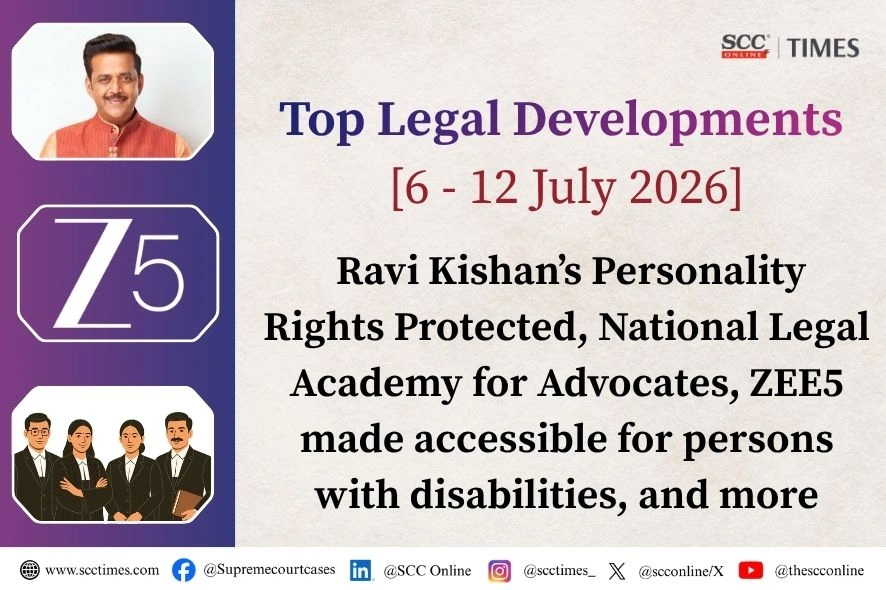
PERSONALITY RIGHTS | Ravi Kishan’s Personality Rights Protected; AI-Generated Deepfakes and Unauthorised Online Exploitation Restrained
The Delhi High Court granted an ex parte ad interim injunction in his favour. The Court restrained the unauthorised use and commercial exploitation of Ravi Kishan’s name, image, likeness, voice, and other personality attributes. Recognising the increasing misuse of celebrity identities through artificial intelligence and digital platforms, the Court also directed the removal of objectionable online content, including AI-generated and deepfake material, holding that such acts were prima facie unlawful and likely to cause irreparable harm to Ravi Kishan’s reputation, dignity, and privacy.
[Ravindra Shukla v. Ashok Kumar (John Doe), CS(COMM) 680/2026, decided on 2-7-2026]
Read more HERE
GUJARAT HIGH COURT
PIL | PIL on Somnath Temple archaeological survey dismissed, Rs 2 lakh cost imposed
The Gujarat High Court dismissed the petition with exemplary costs of ₹2 lakhs holding that the petitioner had abused the process of the Court by filing a PIL based on misleading, incomplete and distorted facts.
[Vilas Tukaram Kharat v. Union of India, W.P. (PIL) No. 25 of 2026, decided on 25-6-2026]
Read more HERE
JHARKHAND HIGH COURT
LIMITATION | Bureaucratic Inaction Cannot Excuse Limitation Delay: Condonation plea dismissed
The Jharkhand High Court dismissed the appeal sought for the condonation of delay con the grounds that the appellants failed to provide specific, cogent, and satisfactory reasons for claiming the relaxation specified under Section 5, Limitation Act, 1963.
[Zila Parisad, Deoghar v. Sukhdeo Rao, 2026 SCC OnLine Jhar 822]
Read more HERE
KERALA HIGH COURT
CONTEMPT | Moment of Anger, Years of Proceedings: Kerala HC Closes 7-Year-Old Criminal Contempt Case Against Congress MP Kumbakudi Sudhakaran After Apology
The Kerala High Court held that a genuine, unconditional and unqualified apology, coupled with an admission of contempt and an assurance of future restraint, warranted acceptance under Rule 14(a), Contempt of Courts (High Court of Kerala) Rules, 1988. The Court accepted the apology tendered by him, discharged him, and closed the contempt proceedings.
[Janardhana Shenoy K. v. Kumbakudi Sudhakaran, CONT.CAS.(CRL.) NO. 2 OF 2024, decided on 8-7-2026]
Read more HERE
LABOUR LAW | Retired employee cannot invoke consumer jurisdiction for gratuity claim; Consumer Commission lacks jurisdiction
The Kerala High Court held that a retired employee cannot invoke consumer jurisdiction for a gratuity claim as he cannot be treated as a “consumer” under Section 2(7), Consumer Protection Act, 2019 (CP Act) and that the District Commission lacked jurisdiction to entertain such a complaint.
[Tirur Service Coop. Bank Ltd. No. 10094 v. Moideen M., 2026 SCC OnLine Ker 6280]
Read more HERE
MADHYA PRADESH HIGH COURT
CYBER LAW | Cyber Cell cannot freeze bank account without informing Magistrate: Unfreezing directed; Disputed Amount to be kept in Fixed Deposits pending Magistrate’s Order
The Madhya Pradesh High Court directed to unfreeze the account of the petitioner and keep the disputed amount in separate fixed deposit, to be liquidated only after the Judicial Magistrate finally decides the matter of cybercrime or cyber fraud in 3 months’ time.
[Dekain Perfect Tech Ksolution (P) Ltd. v. IDFC First Bank, 2026 SCC OnLine MP 17717]
Read more HERE
Also Read: MP HC Challenges Rule 18 MP Mineral Rules 2022 as Ultra Vires; Grants Interim Relief | SCC Times
PUNJAB AND HARYANA HIGH COURT
FIR | “Constitutional tolerance must override hypersensitivity”: FIR quashed against bank manager for dressing her dog as Lord Krishna
The Punjab & Haryana High Court held that “constitutional tolerance must override hypersensitivity which leads innocent acts to be construed as desecration.”
[Ranjanni Gaur v. State of Punjab, 2026 SCC OnLine P&H 19377]
Read more HERE
PROPERTY LAW | Sale deed prior in time prevails under Section 48 TPA: Appeal challenging declaration of title dismissed
The Punjab & Haryana High Court held that a prior registered sale deed prevails over subsequent transfers and that a suit seeking declaration of title based on an earlier sale deed is not barred by limitation merely because it also challenges a subsequent sale deed
[Swaraj Pal Singh v. Arun Kumar, RSA No. 2793 of 2013 (O&M), decided on 6-7-2026]
Read more HERE
TRIPURA HIGH COURT
RECRUITMENT | Gender cannot be a ground to deny promotion where Recruitment Rules make no distinction
The Tripura High Court allowed the writ petition and held that, in the absence of any gender-based distinction in the recruitment rules, a woman employee could not be denied promotion on the ground of gender. The Court further held that the rejection of the petitioner’s candidature was contrary to the recruitment rules and the principles of natural justice. The Court quashed the communication dated 1 May 2025, rejecting the petitioner’s claim and directed the authorities to reconsider her case for promotion to the post of Deputy Superintendent (Home) Jail within 3 months.
[Bela Dutta v. State of Tripura, 2026 SCC OnLine Tri 247]
Read more HERE
UTTARANCHAL HIGH COURT
FAMILY AND PERSONAL LAW | Protection granted to young couple; directs SHO to counsel family inimical towards marriage
The Uttaranchal High Court granted them protection and directed the Station House Officer (SHO) to summon the respondents and counsel them.
[Vanshika Tomar v. State of Uttarakhand, 2026 SCC OnLine Utt 1554]
Read more HERE
TRIBUNALS/COMMISSIONS/REGULATORY BODIES UPDATES OF THE WEEK
NCLAT | Section 99 IBC Resolution Professional’s report not mandatory where guarantor status admitted: Section 95 IBC application upheld
NCLAT Chennai dismissed the appeal, holding that the Appellant, having admitted his signature on the loan sanction letter and letter of guarantee describing him as a personal guarantor, could not resile from that liability. It further held that the absence of a report by the Resolution Professional under Section 99 IBC did not vitiate the admission of the application.
[Dr. Badri Prasad v. Tata Capital Financial Services Ltd., 2026 SCC OnLine NCLAT 863]
Read more HERE
Stolen Leads, Fake Booking IDs, ₹66 Lakh Revenue Loss: How a Spreadsheet Led to an Ex-Parte Injunction in Cordelia Cruises’ Data Theft Case
In a complaint filed under Section 43(b), Information Technology Act, 2000, seeking statutory compensation, damages and strict injunctive reliefs against the respondents on the ground of data theft, the Electronics, Information Technology and Artificial Intelligence Department, Mumbai, passed an ex-parte ad interim injunction against the respondents to protect the complainant’s proprietary customer database, upon perusing the forensic audit reports and prohibited the respondents from accessing, printing, copying, formatting, distributing, utilising, disseminating, or exploiting the complainant’s proprietary customer databases, lead lists, electronic charts, or operational records, stolen or exfiltrated and from utilising the registered trademarks, copyrighted logos, vessel imagery or brand designations of Cordelia Cruises under any frontend configuration to pretend affiliation.
[Waterways Leisure Tourism Ltd. v. Sanaullha Saifula Sheikh, Complaint Case No. 1 of 2026, decided on 23-6-2026]
Read more HERE
OTHER DEVELOPMENTS OF THIS WEEK
LEGISLATION UPDATES
New TReDS Mandate for CPSEs: Key Changes for MSME Payments
On 30 June 2026, the Ministry of Micro, Small and Medium Enterprises (MSMEs) issued a mandate requiring all operational Central Public Sector Enterprises (CPSEs) to use Trade Receivables Discounting System (TReDS) platforms for the settlement of MSME invoices. The notification came into effect on 30 June 2026.
Read more HERE
New Wage Rates for Unskilled Manual Workers Effective from 1 July 2026
On 30 June 2026, the Ministry of Rural Development notified revised State-wise wage rates for unskilled manual workers under the Viksit Bharat-Guarantee for Rozgar and Ajeevika Mission (Gramin): VB-G RAM G Act, 2025. The revised wage rates came into effect from 1 July 2026.
Read more HERE
Drugs (Prices Control) Amendment Order, 2026: Key Changes in Drug Pricing, Price Revision, New Drug Launch and Compliance
On 30 June 2026, the Ministry of Chemicals and Fertilizers (Department of Pharmaceuticals) notified the Drugs (Prices Control) Amendment Order, 2026 under Section 3 of the Essential Commodities Act, 1955. The Amendment modifies the Drugs (Prices Control) Order, 2013 (DPCO, 2013) and the changes mainly relate to drug pricing, launch of new drugs, recovery of overcharged amounts, dissemination of revised prices and maintenance of digital records The Order came into force on 30 June 2026.
Read more HERE
Employers Take Note: Labour Ministry Notifies Contribution Rates Under EPF, EPS and EDLI Schemes, 2026
On 1 July 2026, the Ministry of Labour and Employment issued three notifications specifying the contribution rates.
Read more HERE
Bihar Notifies Code on Wages (Bihar) Rules, 2026; Replaces Decades-Old Wage Rules
On 30 June 2026, the Bihar Government notified the Code on Wages (Bihar) Rules, 2026, laying down the framework for minimum wages, wage payments, working hours, claims, appeals and compliance under the Code on Wages, 2019. The Rules came into effect on 1 July 2026.
Read more HERE
Govt. Retains 7.1% Interest Rate on Special Deposit Scheme for Non-Government Provident, Superannuation and Gratuity Funds
On 3 July 2026, the Ministry of Finance (Department of Economic Affairs) notified that deposits made under the Special Deposit Scheme (SDS) for Non-Government Provident, Superannuation and Gratuity Funds will earn interest at 7.1% per annum for the quarter from 1 July 2026 to 30 September 2026.
Read more HERE
CDSCO Examines Risks of Brand Name Extensions Across Different Drug Formulations
On 6 July 2026, the Central Drugs Standard Control Organisation (CDSCO) invited feedback and suggestions from stakeholders on the use of brand name extensions by pharmaceutical firms, signalling the regulator’s intent to examine concerns surrounding the practice and its potential implications for patient safety and the rational use of medicines.
Read more HERE
Drugs (Ninth Amendment) Rules, 2026: Navi Mumbai Airport Added as Drug Import Port
On 2 July 2026, the Ministry of Health and Family Welfare notified the Drugs (Ninth Amendment) Rules, 2026, under which Navi Mumbai Airport, Maharashtra, has been included in the list of airports through which drugs may be imported into India. The Amendment came into effect on 3 July 2026.
Read more HERE
BCI to Constitute Committees, Establish National Legal Academy Following SC Directions
On 8 July 2026, the Bar Council of India (BCI) announced a series of measures to implement the Supreme Court’s judgment in Ajay Vijh v. Indian Banks Association, while welcoming the ruling as a reaffirmation of the independence and institutional role of the legal profession.
Read more HERE
Companies Get More Time for Statutory Filings as MCA Extends CCFS-2026
On 8 July 2026, the Ministry of Corporate Affairs (MCA) announced the extension of the Companies Compliance Facilitation Scheme, 2026 (CCFS-2026) till 31 August 2026, providing companies with additional time to complete pending statutory filings.
Read more HERE
Government Expands NPS Investment Choices for CAB Employees
On 7 July 2026, the Ministry of Finance announced the extension of additional investment choices under the National Pension System (NPS) to employees of Central Autonomous Bodies (CABs), providing eligible subscribers with greater flexibility in managing their pension investments.
Read more HERE
OP.ED.
-
Battle of Statutes: PMLA-Income Tax-Benami-IBC-SARFAESI Part 1 of 4 — When PMLA Meets the IBC May 2026 by Namisha Jain and Rahul Yadav
-
Paving the Way for Transnational Issue Estoppel: Decision of the Supreme Court of India in Nagaraj V. Mylandla v. PI Opportunities Fund-I by Revanth Ashok
-
Tenets and Contours of Judicial Recusal and Restatement of Judicial Life by Nishant Verma
-
The Debt-Centric Moratorium Under Section 96, IBC: SARFAESI Enforcement, Secured Assets and Doctrinal Fault Lines by Nihareeka Ghadage
-
Crossing the Lakshman Rekha: A Judicial Critique of the Referral Court’s Powers in MIOT Hospitals by Arjun Suresh and K. Shiva
-
From Tax Dispute to Jurisprudential Shift: Examining Gameskraft and Junglee Games by Somesh Jain
KNOW THY JUDGE
Also Read: