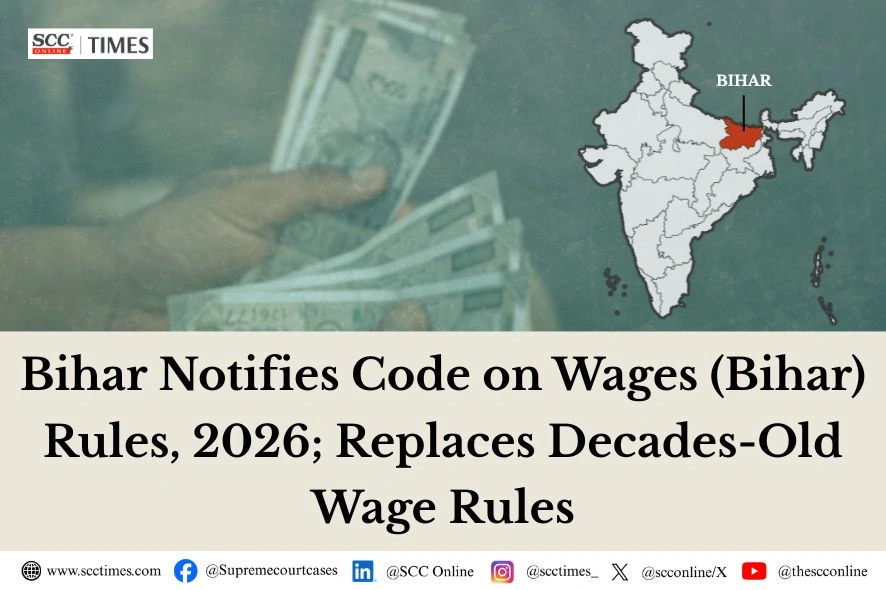
On 30 June 2026, the Bihar Government notified the Code on Wages (Bihar) Rules, 2026, laying down the framework for minimum wages, wage payments, working hours, claims, appeals and compliance under the Code on Wages, 2019.
The Rules came into effect on 1 July 2026.
Key Highlights
-
The Rules have been framed under Section 67 of the Code on Wages, 2019 and supersede:
-
Bihar Payment of Wages Rules, 1937, and
-
Bihar Minimum Wages Rules, 1951.
-
-
Rule 3 prescribes the methodology for fixation of minimum wages. The State Government is required to consider factors such as:
-
Standard working-class family consisting of the earning worker, spouse and two children;
-
Net intake of 2,700 calories per day per consumption unit;
-
66 metres of cloth per year per family;
-
Housing expenditure at 10% of food and clothing expenditure;
-
Fuel, electricity, digital communication and miscellaneous expenses at 20% of minimum wages; and
-
Expenditure on education, medical needs, recreation and contingencies at 25% of minimum wages.
-
-
Rule 4 lays down the norms for fixation of minimum wages, requiring the State Government to consider geographical areas (metropolitan, non-metropolitan and rural), employment-related experience, and the skill level of workers while determining minimum wage rates.
-
Under Rule 4, occupations are classified into four skill categories:
-
Unskilled;
-
Semi-skilled;
-
Skilled; and
-
Highly skilled.
-
-
Variable Dearness Allowance (VDA) will be revised twice every year, under Rule 5, before 1 April and 1 October, based on the Consumer Price Index published by the Labour Bureau.
-
The Rules expressly prohibit the State Government from fixing minimum wages below the floor wage notified by the Central Government under the Code on Wages, 2019.
-
Rules 6 to 9 prescribe working-hour norms, including:
-
Maximum of 48 working hours per week;
-
Overtime for work beyond prescribed daily or weekly limits;
-
Mandatory rest intervals;
-
Flexibility in working hours with employee or negotiating union consent;
-
Weekly rest-day entitlements; and
-
A quarterly overtime ceiling of 144 hours, subject to written consent of the employee.
-
-
Rule 10 prescribes one month as the wage period for the purposes of minimum wage payments.
-
Rules 11 to 19 establish a comprehensive framework governing wage deductions, fines, advances and recovery of loans, to regulate recovery of advances, deductions for damage or loss, limits on deductions, and procedural safeguards for employees.
-
Rule 13 designates the Deputy Labour Commissioner as the authority for wage-related claims, while Rule 42(4) provides an appellate mechanism before the Labour Commissioner or an officer not below the rank of Joint Labour Commissioner.
-
Rules 20 to 37 establish and regulate a State Advisory Board comprising representatives of employers, employees, government departments, labour experts and civil society to advise the State Government on wage-related matters.
-
Rules 41 and 42 prescribe the procedure for filing wage claims and appeals and provide the statutory forms for applications, notices and appeals.
-
Rules 43 and 44 require employers to comply with prescribed record-keeping obligations.
-
Employers are required to maintain:
-
Employee Register (Form I);
-
Register of Wages, Overtime, Advances, Fines and Deductions (Form IV);
-
Attendance Register-cum-Muster Roll (Form IX); and
-
Wage Slips (Form V).
-
-
Rule 45 provides for the compounding of offences under Section 56 of the Code on Wages, 2019, permitting settlement of compoundable offences upon payment of 50% of the maximum prescribed fine.
Read more: A Complete Guide to Four Labour Codes
[Code on Wages (Bihar) Rules, 2026, dt 1-7-2026]