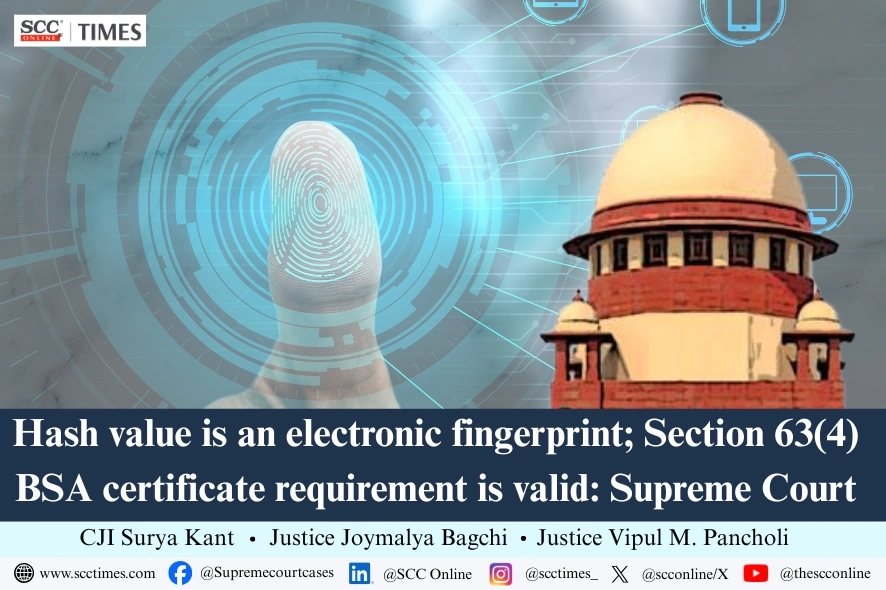
Supreme Court: In a writ petition challenging the constitutional validity of Section 63(4), Sakshya Adhiniyam, 2023 (BSA), read with the Schedule appended to it, which requires electronic records tendered as evidence to be accompanied by a prescribed certificate, the three-Judge Bench of Surya Kant, CJ., Joymalya Bagchi and Vipul M. Pancholi, JJ., upheld the validity of Section 63(4) BSA against the challenge of manifest arbitrariness.
However, the Court clarified that the Madras High Court’s view in R. v. B., (2024) 1 HCC (Mad) 531, requiring Part B to be signed exclusively by Section 79-A-notified Examiner of Electronic Evidence shall not operate as a binding precedent, and kept the question regarding the scope of expert certification under Part B open for consideration in an appropriate case.
Background
The petitioner argued that the certificate requirement imposed an excessive burden on litigants. Part A of the Schedule requires disclosure of the hash value of the electronic record, while Part B requires certification by an expert. According to the petitioner, these requirements make the admissibility of electronic evidence unduly difficult and render the provision arbitrary and unjust.
The petitioner relied on R. v. B., which had observed that Part B must be completed by an Examiner of Electronic Evidence notified under Section 79-A, Information Technology Act, 2000 (IT Act). It was argued that only a handful of entities are authorised by the Central/State Government to examine electronic evidence under Section 79-A, thereby causing undue hardship and rendering its implementation illusory.
Issues for Determination
-
Whether Section 63(4) BSA and the Schedule thereto are unconstitutional for being arbitrary, unreasonable, and excessively burdensome on litigants?
-
Whether Part B of the prescribed certificate can be signed only by an Examiner of Electronic Evidence notified under Section 79-A, IT Act?
Also Read: Electronic Evidence & Video Conferencing: Delhi High Court’s 2025 Rules redefine Digital Justice
Analysis
The Court noted that electronic records are particularly vulnerable to alteration, mutation, and modification, which may affect their authenticity, integrity, and evidentiary value. These concerns have become more significant with developments such as artificial intelligence and deepfake technology.
The Court observed that “hash value of an electronic data is synonymous with an electronic fingerprint and provides a sure way of identifying and verifying digital data”. Requiring disclosure of the hash value directly serves the purpose of verifying the authenticity and integrity of electronic records. The Court further held that the expert certification required under Part B provides “an additional layer of authenticity” to secondary electronic evidence. It concluded that Section 63(4) has a “clear and rational nexus with the object of the law” and cannot be regarded as arbitrary or unreasonable.
On the second issue, the Court examined Section 39 BSA and noted that Section 39(1) recognises the relevance of opinions of persons having special skill in fields such as science, art, or any other field and Section 39(2) specifically provides that the opinion of an Examiner of Electronic Evidence under Section 79-A, IT Act is to be treated as expert opinion in matters concerning electronic or digital information.
The Court observed that Section 39(2) BSA is not prefaced by a non-obstante clause. Reading both sub-sections harmoniously, the Court stated that, apart from a notified Examiner of Electronic Evidence, a person possessing special skill and expertise in computer science and cyber forensics may also be treated as an expert if the Court is satisfied on the basis of unimpeachable material. Such a person may sign Part B of the Schedule.
However, since the Court was not inclined to admit the petition or issue notice to the Union of India, it declined to give a conclusive ruling on this question. It clarified that the Madras High Court’s finding in R. v. B. that Part B must necessarily be filled by an expert notified under Section 79-A “shall not be treated as a binding precedent”.
Decision
The Court upheld the constitutional validity of Section 63(4) BSA, disposed of the writ petition, clarified that the relevant observation of the Madras High Court shall not operate as a binding precedent, and kept the question regarding the scope of expert certification under Part B open for consideration in an appropriate case.
Also Read: From Form to Substance: Reinterpreting Electronic Evidence under Section 138-C, Customs Act, 1962
[Pune Bar Assn. v. Union of India, 2026 SCC OnLine SC 1297, decided on 22-5-2026]