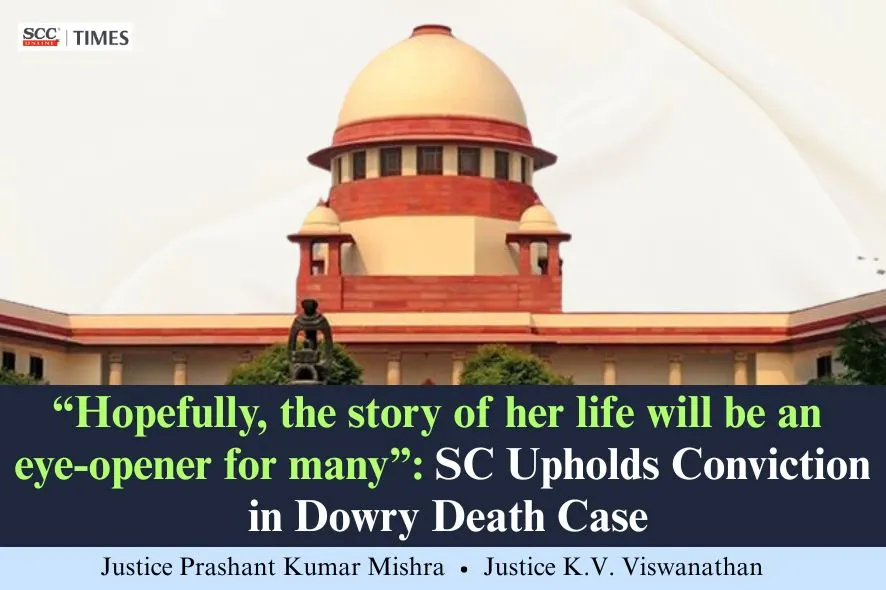
Supreme Court: In a criminal appeal concerning the death of a woman found hanging in her matrimonial home within 15 months of marriage, a Division Bench of Prashant Kumar Mishra and K.V. Viswanathan*, JJ., upheld the conviction of the husband under Sections 302 and 498-A, Penal Code, 1860 (IPC), holding that the case was not one of suicidal hanging but of “simulated hanging or homicidal hanging”. Relying on medical evidence, post-mortem findings and authoritative texts on medical jurisprudence, the Court observed that the absence of a typical ligature mark and the presence of multiple ante-mortem injuries on the body of the deceased clearly negated the theory of suicide. Reiterating that where an offence occurs within the privacy of a house, the inmates owe a corresponding duty to explain the circumstances leading to the victim’s death, the Court held that the appellant had failed to discharge the burden cast upon him under the facts of the case. Finding no reason to interfere with the concurrent findings of the trial court and the High Court, the Court dismissed the appeal and directed the Director General of Police, Tripura, to immediately take steps to apprehend the absconding convict.
“Could the life of the young, deceased victim have been saved? Did the fear of societal opprobrium result in the deceased victim being thrown to the wolves? These questions will remain hypothetical…
… Deceased victim’s near and dear naively believed that somehow-somehow-the situation will turn for the good. A false sense of optimism engulfed them. Their hopes were betrayed when the victim met with a tragic end at her matrimonial home. Hopefully, the story of her life will be an eye-opener for many.”
Also Read: SC: Young girls don’t get married to be killed for dowry | SCC Times
Background
The appeal before the Supreme Court arose from the judgment dated 24 August 2012 passed by the Gauhati High Court, Agartala Bench, affirming the conviction and sentence imposed upon the appellant by the Additional Sessions Judge, Sonamura, West Tripura. The appellant was convicted under Sections 302 and 498-A IPC and sentenced to rigorous imprisonment for life along with fine for the offence of murder and rigorous imprisonment for 3 years for cruelty to wife. The appellant’s mother, brother and father were also tried in connection with the case; however, while the trial court had acquitted the father and convicted the mother and brother along with the appellant, the High Court subsequently acquitted the mother and brother, leaving the appellant as the sole convict.
The prosecution case stemmed from the death of the appellant’s wife, on 16 June 2007, barely 15 months after her marriage. A first information report (FIR) was lodged on the same day by the deceased’s father, alleging that the deceased victim had been subjected to persistent cruelty, torture and dowry demands by her husband and in-laws. According to the complainant, village panchayat members had intervened on several occasions to resolve matrimonial disputes and send the deceased back to her matrimonial home. On the date of the incident, the complainant received information that his daughter had allegedly committed suicide by hanging herself. Suspecting foul play at the hands of her in-laws, he lodged the FIR, on the basis of which offences under Sections 498-A, 304-B and 34 IPC were initially registered.
During trial, charges were framed against the accused persons under Sections 498-A and 302 read with Section 34 IPC. The prosecution examined 15 witnesses and relied upon documentary evidence in support of its case, while the accused were examined under Section 313, Criminal Procedure Code, 1973 (CrPC) and did not lead any defence evidence. Upon appreciation of the evidence on record, the trial court convicted the appellant and certain co-accused, which ultimately led to the present appeal before the Supreme Court challenging the correctness of the concurrent findings against the appellant.
Analysis
The Supreme Court concurred with the findings of the trial court and the High Court that the deceased, had not died a suicidal death but a homicidal one. Relying upon the testimony of PW 13 and the post-mortem report, the Court observed that the medical evidence did not disclose the “typical ligature mark” ordinarily found in cases of suicidal hanging. The doctor had noticed injuries on the chest, jaw and head of the deceased, while there were no signs such as tongue protrusion, congestion in the conjunctiva or inflammatory marks around the neck.
Referring to authoritative texts including Modi’s Medical Jurisprudence and Toxicology and Dr C.K. Parikh’s Text Book of Medical Jurisprudence and Toxicology, the Court held that the injuries found on the body were inconsistent with an ordinary case of suicidal hanging and strongly indicated a case of “simulated hanging or homicidal hanging”. The Court noted that the ante-mortem injuries on different parts of the body were not ordinarily capable of being self-inflicted and clearly suggested that the deceased had been subjected to violence prior to her death.
While considering the culpability of the appellant, the Court observed that though the father-in-law had been acquitted by the trial court and the mother-in-law and brother-in-law were acquitted by the High Court, both courts were categorical that the appellant alone was residing in the dwelling unit with the deceased at the relevant time. The Court reiterated the settled principle that where an offence takes place within the privacy of a house, there is a corresponding burden upon the inmates to furnish a cogent explanation regarding the circumstances in which the victim died.
In the present case, evidence established the presence of the appellant in the house when the deceased was found hanging, and it was the appellant himself who informed the deceased’s father about the incident. However, when examined under Section 313 CrPC, the appellant failed to offer any explanation regarding the injuries sustained by the deceased or the circumstances leading to her death. His plea that the deceased had committed suicide stood completely belied by the overwhelming medical evidence on record.
Decision
Accordingly, the Supreme Court found no reason to interfere with the concurrent findings of the courts below and upheld the conviction of the appellant under Sections 302 and 498-A IPC. Dismissing the appeal, the Court further recorded that the appellant was absconding and directed the Director General of Police, Tripura, to immediately constitute a team to trace and apprehend the convict and take him into custody.
Also Read: MP HC issues notice to mother-in-law in Bhopal Dowry Death Case | SCC Times
Also Read: Bhopal Dowry Death Case: SC Notes case transfer to CBI, Warns over Media Statements
[Gour Acharjee v. State of Tripura, 2026 SCC OnLine SC 931, decided on 25-5-2026]
*Judgment authored by: Justice K. V. Viswanathan
Buy Penal Code, 1860 HERE
Buy Code of Criminal Procedure, 1973 HERE