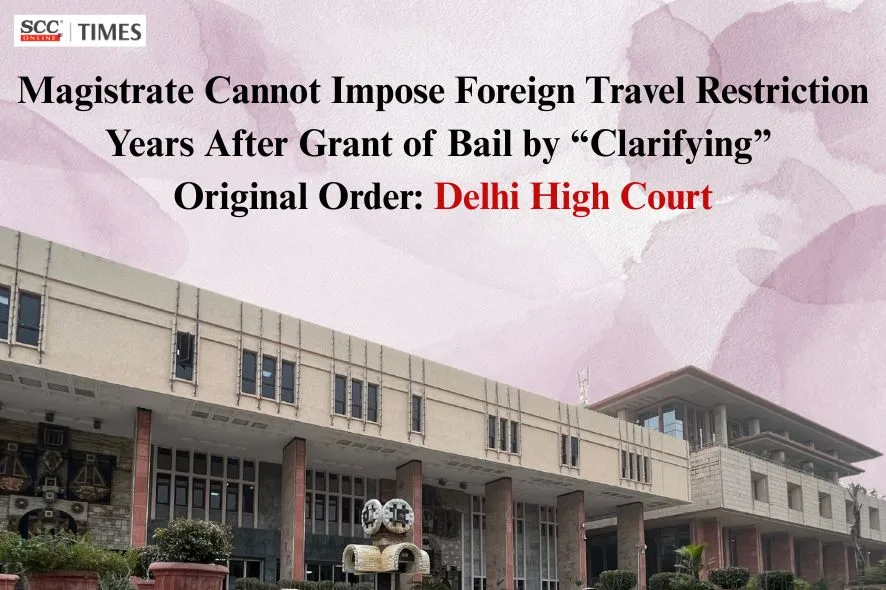
Delhi High Court: In a petition challenging an order of the Chief Judicial Magistrate (CJM), Patiala House Courts, imposing a condition requiring accused persons already on bail to obtain prior permission of the Court before travelling abroad, a Single Judge Bench of Anup Jairam Bhambhani, J., set aside the impugned order and reiterated that a Magistrate has no jurisdiction to review or modify a bail order once passed, except as permitted by law. The Court held that the introduction of a foreign travel restriction several years after grant of bail amounted to an impermissible review of the original bail order, which was barred under Section 362, Criminal Procedure Code, 1973 (CrPC).
The Court further held that a condition which did not form part of the original bail order could not be introduced subsequently under the guise of a “clarification”, particularly after a Revisional Court had already set aside an earlier order imposing the same restriction. Observing that the impugned order was passed without jurisdiction and was therefore non est in law, the Court quashed the travel restriction, while directing the petitioners to pay costs as a measure of atonement for having travelled abroad without permission during the period when the impugned order remained in force.
Background
The petitioners were granted bail by the Chief Metropolitan Magistrate (CMM), Patiala House Courts, New Delhi, on 23 March 2021 in connection with FIR No. 337 of 2016 registered at Police Station Vasant Kunj South for offences under Sections 420, 406, 422, 424, 409 and 120-B, Penal Code, 1860 (IPC). Upon completion of investigation, the charge-sheet was filed only for offences under Sections 420 and 120-B IPC. In September 2024, apprehending that the petitioners might abscond, the complainant company moved an application before the Chief Judicial Magistrate (CJM) seeking imposition of a condition requiring the petitioners to obtain prior permission of the Court before travelling abroad. Accepting the application, the CJM, by order dated 15 February 2025, introduced the said travel restriction as an additional condition of bail.
Aggrieved thereby, the petitioners preferred revision petitions before the Sessions Court, which stayed the operation of the order qua Petitioner 2 on 28 February 2025 and subsequently qua Petitioner 1 on 5 April 2025. Thereafter, by judgment dated 24 July 2025, the Sessions Court set aside the order dated 15 February 2025 and remanded the matter to the CJM for fresh consideration of the complainant’s application in light of the entire factual background. Upon reconsideration, the CJM acknowledged that the condition requiring prior permission for foreign travel did not form part of the original bail order and further observed that the Court had become functus officio insofar as the bail order was concerned and could not revisit the same. Nevertheless, the CJM passed the impugned order dated 6 November 2025. Challenging the legality and propriety of the said order, the petitioners have approached the Court seeking its quashing and setting aside.
Analysis
The Court held that the original bail order dated 23 March 2021 did not contain any condition requiring the petitioners to obtain prior permission before travelling abroad and, therefore, such a restriction could not subsequently be introduced by the Magistrate. Reiterating the settled principle that criminal courts possess no power of review in the absence of an express statutory provision, the Court observed that the order dated 15 February 2025 imposing travel restrictions amounted to a review or modification of the original bail order, which was barred by Section 362 CrPC. The Court further held that once the Sessions Court had set aside the said order and remanded the matter, the order ceased to exist in law and the learned CJM was required to consider the matter afresh in accordance with law. The impugned order dated 6 November 2025, which purported to “clarify” the original bail order by introducing a travel restriction, was found to be a misnomer since there was nothing in the original order requiring clarification. The Court observed that the insertion of a new bail condition under the guise of clarification effectively reinstated a condition already set aside by the Revisional Court and amounted to a circumvention of the remand order. Emphasising that the power to modify or vary bail conditions imposed by a Magistrate is vested exclusively in the High Court or the Court of Session under Section 439(1)(b) CrPC, the Court held that the learned CJM lacked jurisdiction to pass the impugned order, rendering it non est in law.
While noting that the petitioners had travelled abroad on several occasions without obtaining permission during the subsistence of the impugned order, the Court took into account their subsequent conduct, including obtaining permission from the Court whenever required, returning to India after every foreign visit, and maintaining a fair record of appearance throughout the proceedings. Considering that the impugned order itself was jurisdictionally flawed and non est, and that no prejudice had been caused to the trial, the Court condoned the infraction and held that no punitive action was warranted.
Decision
Consequently, the petition was allowed, the impugned order dated 6 November 2025 was set aside, and it was directed that the petitioners would remain bound only by the conditions contained in the original bail order dated 23 March 2021, without any requirement to seek prior permission for foreign travel. However, by way of atonement for the infraction committed, the Court directed the petitioners to pay costs of ₹2,00,000 each to Friendicoes SECA within 2 weeks and to place proof of payment on record thereafter.
Also Read: Sharing live location with Investigating Officer cannot be imposed as bail condition: Kar HC
[Shabir Momin v. State (NCT of Delhi), 2026 SCC OnLine Del 4287, decided on 29-5-2026]
Advocates who appeared in this case :
For the Petitioners: Jayant K. Sud, Sr. Advocate with Samarjit G. Pattnaik, Sahib Kochhar, Kashish Seth, Gaurav Vutts, Aryan Mishra, Ujjawal Anand Sharma, Prashant Sivarajan, Tushar Saigal and Shweta Divedi, Advocates
For the Respondents: Amol Sinha, ASC for State with Kshitiz Garg, Ashvini Kumar, Manan Wadhwa and Nitish Dhawan, Hrishikesh Baruah, Kumar Kshitij, Sundeep Goel, Utkarsh Dwivedi, Pragya Agarwal, Nishtha Sachan, Yashaswy Ghosh and Simran Dhingra, Advocate