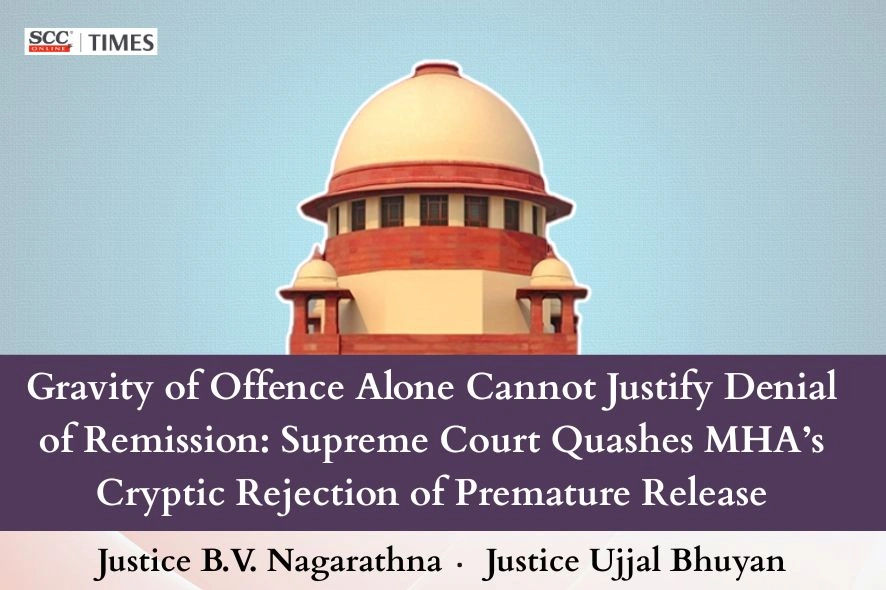
Supreme Court: In a writ petition challenging the Ministry of Home Affairs’ letter dated 9 July 2025 rejecting the petitioner’s plea for premature release, a Division Bench of B.V. Nagarathna* and Ujjal Bhuyan, JJ., quashed the impugned communication as a non-speaking and cryptic order reflecting complete non-application of mind. The Court held that any decision affecting the liberty of a person must disclose reasons and demonstrate due application of mind, as recording of reasons is an indispensable safeguard against arbitrariness and ensures transparency, fairness and accountability in executive decision-making.
The Court reiterated that remission is a reformative executive function concerned with the prisoner’s conduct, evidence of reformation and prospects of reintegration into society, and cannot be denied solely on the ground of the heinous nature of the offence. Observing that the gravity of the offence stands exhausted at the stage of sentencing, the Court held that continued incarceration merely on account of the seriousness of the crime would amount to retrospective reaffirmation of guilt contrary to constitutional values and the reformative theory underlying remission policies. Taking note of the petitioner’s more than 22 years of incarceration, his satisfactory conduct in custody, the recommendation of the State of Uttarakhand in favour of his premature release, and the fact that a co-accused had already been granted remission, the Court concluded that continued imprisonment would serve no useful purpose and directed that the petitioner be treated as prematurely released/remitted without requiring his surrender.
Background
The present writ petition concerns the petitioner’s challenge to the letter dated 9 July 2025 issued by the Ministry of Home Affairs (MHA), whereby the recommendation of the State of Uttarakhand for his premature release was rejected. The petitioner has been incarcerated for approximately 22 years following his conviction in a murder case.
The case originated from FIR No. 162 of 2003 registered at Mahanagar Police Station, Lucknow, Uttar Pradesh, under Section 302, Penal Code, 1860 (IPC) on the complaint of the deceased’s elder sister. After investigation by the U.P. Police and CBCID, the matter was transferred to the CBI in June 2003. Pursuant to the Supreme Court’s order dated 8 February 2007, the trial was shifted from Lucknow to Dehradun, Uttarakhand, where a Special Court convicted the petitioner and co-accused under Sections 120-B and 302 IPC and sentenced them to life imprisonment by judgment dated 24 October 2007. The conviction and sentence were subsequently affirmed by the Uttarakhand High Court and the Supreme Court dismissed the petitioner’s SLP in 2013.
Thereafter, the petitioner sought premature release through a representation dated 6 September 2022 addressed to the Office of the President of India. Since no action was taken, he approached the Uttarakhand High Court seeking consideration of his remission plea. The High Court directed the State Government to decide the matter within a week, failing which the petitioner was to be released on bail. As no decision was taken within the stipulated time, the petitioner was granted bail by the Special Judge, Dehradun on 30 January 2023. Subsequently, the State Government rejected his application for premature release on the ground that his case fell within a prohibited category under the Uttarakhand Premature Release Policy, 2022, as the case had been investigated by the CBI under the Delhi Special Police Establishment Act, 1946. The petitioner thereafter surrendered before the District Jail, Haridwar on 17 June 2023.
The petitioner again approached the High Court seeking disclosure of the grounds for rejection of his remission plea and later challenged the decision before the Supreme Court. Initially, the Supreme Court, relying on Radheshyam Bhagwandas Shah v. State of Gujarat, (2022) 8 SCC 552, observed that the Government of Uttar Pradesh would be the appropriate authority to consider the remission plea as the offence had occurred there. However, following the decision in Bilkis Yakub Rasool v. Union of India, (2024) 5 SCC 481 wherein Radheshyam Bhagwandas Shah (supra) was held to be per incuriam, the Court recalled its earlier order on 2 December 2024 and held that the appropriate Government under Section 432(7), Criminal Procedure Code, 1973 (CrPC) was the State where the trial and conviction had taken place, namely, Uttarakhand. Consequently, the State of Uttarakhand was directed to reconsider the petitioner’s case in accordance with the applicable remission policy.
Subsequently, on 31 January 2025, the Supreme Court noted that since the case had been investigated by the CBI, concurrence of the Central Government under Section 477(1), Nagarik Suraksha Sanhita, 2023, was necessary before granting remission. The Court directed the State Government to forward its recommendation to the Central Government for consideration. Considering the petitioner’s prolonged incarceration and the delay in decision-making, the Court granted interim bail on 21 May 2025. Thereafter, on 28 July 2025, the Court was informed that the MHA, by its impugned letter dated 9 July 2025, had disallowed the recommendation made by the State Government for premature release of the petitioner. Upon communication of the said decision, the petitioner amended the writ petition to seek quashing of the impugned letter through a writ of certiorari. A counter-affidavit on behalf of the Union of India/MHA has also been filed in the matter.
Analysis
The Supreme Court held that the impugned letter dated 9 July 2025 issued by the Ministry of Home Affairs rejecting the petitioner’s plea for premature release was ex facie a non-speaking and cryptic order, liable to be quashed for complete non-application of mind. The Court observed that any order affecting the liberty of a person must disclose reasons and reflect due application of mind, as recording of reasons is a safeguard against arbitrariness and ensures transparency, fairness and accountability in decision-making.
In the present case, the competent authority merely stated that it “does not concur” with the proposal for remission without indicating any basis for disagreement, discussion on the petitioner’s conduct, applicability of remission policy, or existence of any adverse material. The Court reiterated that executive discretion in matters of remission cannot be exercised on irrelevant or extraneous considerations and relied on Laxman Naskar v. State of W.B., (2000) 7 SCC 626, wherein factors governing remission such as likelihood of recurrence of crime, reformation of the convict, and usefulness of continued incarceration were emphasised.
Declining to remand the matter to the same authority, the Court observed that such a course would be an empty formality since the Union of India had already fully articulated its stand on merits before the Court. The Court thereafter examined the matter on merits and reiterated the settled distinction between remission, pardon, reprieve, respite and commutation as explained in State (NCT of Delhi) v. Prem Raj, (2003) 7 SCC 121. It held that remission is a reformative executive function concerned with the prisoner’s conduct, reformation and prospects of reintegration into society, and cannot be denied solely on the ground of the heinous nature of the offence. The Court observed that the gravity of the offence stands exhausted at the stage of sentencing and that continued incarceration merely on account of the seriousness of the crime would amount to retrospective reaffirmation of guilt contrary to constitutional values and the reformative theory of punishment.
Applying these principles, the Court noted that the State of Uttarakhand had itself recommended the petitioner’s premature release after assessing his conduct and rehabilitation; the petitioner had already undergone more than 22 years of incarceration with good conduct in custody; and a co-accused in the same case had already been granted premature release after undergoing a lesser period of imprisonment. The Court held that in the absence of any cogent distinguishing circumstances, denial of similar treatment to the petitioner was arbitrary and violative of fairness and non-arbitrariness. Emphasising the reformative philosophy underlying remission policies, the Court concluded that continued incarceration of the petitioner would serve no useful purpose.
Decision
Consequently, the impugned order was quashed, and the petitioner was held entitled to premature release/remission, with the Court directing that, since he was already on interim bail, his surrender would not be required.
Also Read: Bombay HC on multiple life sentences to run concurrently not consecutively | SCC Times
Also Read: Del HC quashes denial of Bangladeshi convict’s premature release| SCC Times
[Rohit Chaturvedi v. State of Uttarakhand, 2026 SCC OnLine SC 865, decided on 15-5-2026]
*Judgment authored by: Justice B.V. Nagarathna