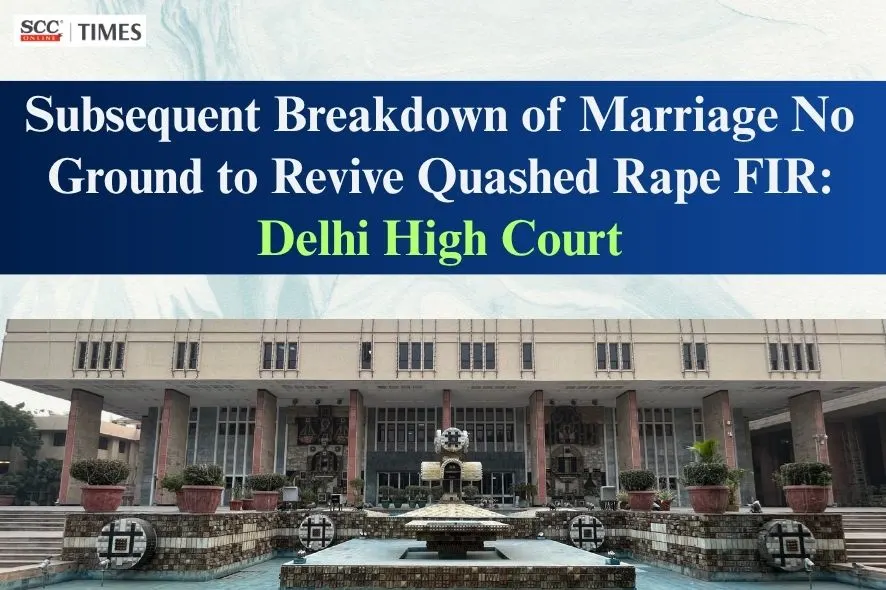
Delhi High Court: In an application filed by applicant-wife (hereinafter “applicant”) seeking to recall the order dated 3 December 2024, whereby the High Court had quashed a FIR against the original petitioner-husband (hereinafter “respondent”) registered under Sections 376(2)(n), 313 and 506, Penal Code, 1860 (IPC) as the parties had amicably resolved the dispute and had entered into a marriage, on allegations that the settlement and marriage between the parties had been procured by fraud and coercion, the Single Judge Bench of Amit Mahajan, J., refused to recall the impugned quashing order, holding that the impugned order had not been procured by fraud and that the present application merely sought reopening of a concluded criminal proceeding on the basis of subsequent matrimonial discord. The Court held that
“A subsequent breakdown of the relationship, reluctance to marry, or failure of the relationship by itself cannot convert an otherwise consensual relationship into an offence of rape.”
The Court also held that a criminal court, after signing a final order disposing of proceedings under Section 482, Criminal Procedure Code, 1973 (CrPC) or Section 528, Nagarik Suraksha Sanhita, 2023 (BNSS), becomes functus officio and cannot recall or review such order except for clerical or arithmetical corrections in view of the statutory bar under Section 362 CrPC/Section 403 BNSS.
Factual Matrix
The FIR in question was registered on 29 May 2024 on the complaint of the applicant against the respondent, who was then her live-in partner. The allegations in the FIR were that during the subsistence of their relationship, respondent had established physical relations with her on the assurance of marriage and had also caused termination of her pregnancy against her will by administering abortion pills. It was further alleged that the respondent later refused to marry her, resulting in registration of the FIR.
Subsequently, the parties solemnised their marriage on 31 May 2024 according to Hindu rites and ceremonies. Thereafter, the respondent approached the High Court seeking quashing of the FIR on the ground that disputes had been amicably resolved and the parties had entered into marriage.
By order dated 3 December 2024, the High Court quashed the FIR after recording the statements of both parties. The applicant had categorically stated before the Court that she had been in a consensual relationship with the respondent; that the complaint had been lodged due to misunderstandings arising when the respondent had refused to marry her; that the marriage had subsequently been solemnised; and that she was happily residing with the respondent and did not wish to continue the criminal proceedings. The petition was also supported by her sworn affidavit giving no objection to the quashing of the FIR.
While quashing the FIR, the Court had noted that offences under Sections 376(2)(n) and 313 IPC are grave offences ordinarily not liable to be quashed merely on settlement, but considering the peculiar facts, the consensual nature of the relationship, the subsequent marriage and the applicant’s unwillingness to prosecute the matter, it was exercising jurisdiction under Section 528 BNSS and quashing the proceedings.
Approximately 6 months later, the present application for recall was filed on allegations that the settlement and marriage between the parties had been procured by fraud and coercion.
Parties’ Contentions
The applicant contended that the order dated 3 December 2024 had been obtained through fraud, coercion and misrepresentation practised by the respondent upon both the applicant and the Court. It was submitted that she had consented to quashing only because the respondent and his family had assured her that the marriage would be honoured sincerely and that she would be treated with dignity in matrimonial life. However, subsequent events including subjecting to physical violence, emotional abuse, financial exploitation and repeated threats, allegedly demonstrated that the marriage itself was merely a device employed to escape criminal prosecution. Reliance was placed upon audio recordings and transcripts in support of these allegations.
The respondent opposed the application primarily on the ground of maintainability. It was argued that the impugned order was a final judicial order passed after due consideration of the matter and after recording voluntary statements of the parties. Once the order attained finality, the Court became functus officio and could not reopen or review the matter in view of the embargo contained under Section 362 CrPC corresponding to Section 403 BNSS. It was also argued that once the parties had admittedly married, the allegation that consent had been obtained on a false promise to marry lost all force in law. It was further contended that a legally wedded husband could not retrospectively be prosecuted for rape on the basis of a promise that had already culminated in marriage.
The respondent submitted that the allegations now raised pertained entirely to post-quashing matrimonial disputes and even if accepted as true, they would at best constitute fresh causes of action for which independent remedies existed under law. It was emphasised that no material had been placed on record to demonstrate that any statement made before the Court at the time of quashing was false or fabricated. The respondent also disputed the admissibility and correctness of the electronic evidence relied upon by the applicant and contended that the same could not furnish a basis for recalling a final judicial order.
Issues for Determination
Whether a final quashing order passed on the basis of compromise and marriage between the parties could subsequently be recalled on allegations that the marriage itself was a fraudulent device adopted to escape criminal prosecution and that the prosecutrix was thereafter subjected to cruelty and abuse?
Analysis
Scope of Review and Recall in Criminal Proceedings
The Court reproduced Section 362 CrPC, corresponding to Section 403 BNSS, which bars alteration or review of a final judgment except for correcting clerical or arithmetical errors. The Court reiterated the settled principle that once a criminal court pronounces and signs its final order, it becomes functus officio and lacks jurisdiction to undertake substantive review or reconsideration except where specifically authorised by statute.
The Court extensively relied on Hari Singh Mann v. Harbhajan Singh Bajwa, (2001) 1 SCC 169 wherein it was held that “court becomes functus officio the moment the final order disposing of the case is signed and such order cannot thereafter be altered except for correcting clerical or arithmetical errors”; and Raghunath Sharma v. State of Haryana, 2025 SCC OnLine SC 1148; Sooraj Devi v. Pyare Lal, (1981) 1 SCC 500 and State of Kerala v. M.M. Manikantan Nair, (2001) 4 SCC 752; wherein it was reiterated that inherent powers under Section 482 CrPC or Section 528 BNSS cannot be exercised in a manner that defeats the express statutory prohibition contained under Section 362 CrPC. Recall of a judgment would amount to alteration or review, which is impermissible in criminal law.
The Court observed that criminal courts do not possess any inherent power of substantive review akin to civil jurisdiction and that once an order has been passed under Section 482 CrPC or Section 528 BNSS, courts should exercise extreme restraint in entertaining attempts to reopen such orders to prevent abuse of process of law, on account of any alleged breach of conditions agreed to by the parties.
Whether Fraud Was Practised Upon the Court
The Court rejected the applicant’s argument that fraud vitiates all judicial acts and therefore an order obtained by fraud could be recalled notwithstanding Section 362 CrPC. It noted that the FIR had not been quashed merely because of a future assurance of matrimonial harmony. The order was based upon several contemporaneous and material circumstances, such as the applicant had personally appeared before the Court; she had categorically stated that the relationship was consensual; she admitted that the FIR had been lodged due to misunderstandings after refusal of marriage; she acknowledged that the marriage had already taken place; and she clearly stated that she did not wish to pursue the proceedings. Additionally, the petition had been supported by her sworn affidavit.
The Court held that the order was not founded merely on a speculative expectation of future marital harmony but on contemporaneous voluntary statements and the admitted fact of marriage.
Promise to Marry and Consent
The Court further observed that while quashing the FIR, the court had also remained conscious of the settled legal position that “every breach of promise to marry would not ipso facto amount to rape.” To attract Section 376 IPC on the allegation of false promise to marry, it must prima facie appear that the promise itself was false from inception and made without any intention of being honoured. A subsequent breakdown of the relationship cannot convert a consensual relationship into rape. Reliance was again placed upon Pramod Suryabhan Pawar v. State of Maharashtra, (2019) 9 SCC 608, wherein the court had drawn a clear distinction between a false promise made in bad faith and a mere breach of promise arising subsequently due to changed circumstances or failure of the relationship.
The Court emphasised that the marriage between the parties had taken place on 31 May 2024 whereas the FIR was quashed much later on 3 December 2024. Therefore, the marriage was not a last-minute event brought into existence solely for securing quashing immediately before the order.
Effect of Subsequent Matrimonial Discord
The Court noted that the applicant’s allegations essentially related to subsequent conduct and matrimonial discord arising after the quashing order. It noted that even if such allegations were assumed to be true, they did not inevitably establish that the statements made before the Court on 3 December 2024 were false to the knowledge of the parties or that the judicial order had been procured by fraud.
The Court held that even commission of fresh offences after quashing could not automatically justify the inference that the earlier settlement or judicial order stood vitiated ab initio by fraud. Matrimonial relationships may deteriorate due to a multitude of circumstances and the allegations at best reflected a subsequent breakdown of matrimonial harmony.
The Court also observed that the applicant had voluntarily appeared before the Court at the time of quashing and there was no allegation that she had been prevented from freely expressing herself or that her statements had been inaccurately recorded. The subsequent plea that she had been “tutored” could not be accepted merely on later assertions.
Finality of Settlements Under Section 528 BNSS
The Court cautioned that permitting concluded criminal proceedings to be reopened every time subsequent matrimonial disputes arose would fundamentally defeat the object underlying the exercise of jurisdiction under Section 528 BNSS in matrimonial and private disputes. If every later disagreement or breakdown of marriage were allowed to revive criminal proceedings, no settlement-based quashing order would ever attain finality. The jurisdiction under Section 528 BNSS exists precisely to secure such finality and prevent continuation of criminal proceedings where parties have voluntarily buried their disputes.
“If every subsequent matrimonial disagreement, breakdown of marriage, or allegation arising after quashing were permitted to revive concluded criminal proceedings, no order passed on the basis of settlement or reconciliation would ever attain finality. The jurisdiction under Section 528 BNSS is intended to secure finality to such settlements and prevent continuation of criminal proceedings where parties themselves choose to bury their disputes.”
Decision
The Court held that no case for recall of the impugned order had been made out. Accordingly, the application was dismissed along with all pending applications.
The Court clarified that it was expressing no opinion on the veracity of allegations regarding cruelty, domestic violence or subsequent criminal conduct and that the applicant remained free to pursue remedies available under law independently on their own merits.
Also Read: Decoding Promise to Marry
[Ashwini Pal v. State, 2026 SCC OnLine Del 4058, decided on 22-5-2026]
Advocates who appeared in this case:
Mr. Nandan Kumar Rai & Mr. Gajendra Mohan Thakur, Advs., Counsel for the Petitioner
SI Prashant Malik, PS Laxmi Nagar, Counsel for the Respondent/State
Buy Penal Code, 1860 HERE

Buy Code of Criminal Procedure, 1973 HERE