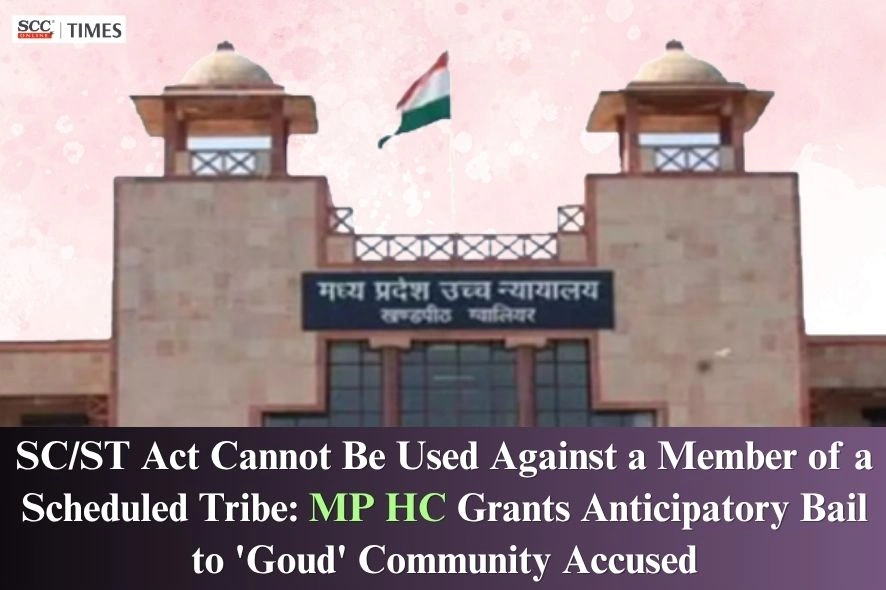
Madhya Pradesh HC: In a criminal appeal filed under Section 14-A(2), Scheduled Castes and Scheduled Tribes (Prevention of Atrocities) Act, 1989, against an order where appellant’s anticipatory bail application was rejected under Section 482, Nagarik Suraksha Sanhita, 2023 (BNSS), a Single Judge Bench of Ramkumar Choubey, J., allowed the appeal and granted anticipatory bail to the appellant considering the fact that the only allegation against the appellant was that he was driving the car when the prosecutrix was being taken by the co-accused, for which he made a representation to police but they could not examine and verify the CCTV footage, and since appellant was a government employee and co-operated with the investigation, there was no apprehension of absconding or tampering with the evidence.
The Court observed that,
“The provisions of SC/ST Act are not applicable to the appellant, as he himself is a member of the scheduled tribe community “Goud”, as indicated by the caste certificate attached by the appellant.”
Background
The appellant was apprehending arrest in connection with FIR No. 52/2026, registered at Police Station Kesali, Sagar, Madhya Pradesh (M.P.) for offences punishable under Sections 87 and 64(2), Nyaya Sanhita, 2023 (BNS) and Section 3(1)(w)(i), (2)(v), SC/ST Act.
A missing person report was lodged at the same police station on 30 March 2026 by the mother of the prosecutrix. The statement of the prosecutrix was recorded under Section 180 BNSS, on 4 April 2026, where it was stated that the appellant was driving the car in which the prosecutrix was taken by the accused and eventually her privacy was violated. On the basis of the missing person report and such statement, the above referred FIR was registered. The appellant filed an application for anticipatory bail before the Special Judge, Sagar, which was rejected.
Challenging the same, this appeal was filed.
The contentions of the appellant revealed that he made a representation on 31 March 2026 before Station House Officer, Kesali and Superintendent of Police, Sagar stating that he had been falsely implicated and this can be verified through CCTV footage from relevant places, where the car passed from. He was on examination and tabulation duty as he is a government employee. Moreover, the appellant himself belongs to the Scheduled Tribe community, so the SC/ST Act is not applicable to him. The appellant was willing to co-operate with the investigation and apprehending arrest he filed the anticipatory bail application.
Analysis & Decision
It was the finding of the Court that the respondent was directed by the Court to verify the documents submitted by the appellant and the CCTV footage, through order dated 8 May 2026 and time was given to comply with such order. But no verification report was produced by the respondent with respect to CCTV footage and documents including caste certificate of the appellant.
The Court observed that the caste certificate placed on record by the appellant indicates that the appellant belongs to the Scheduled Tribe community “Goud”. Therefore, the provisions of the SC/ST Act are not applicable on the appellant.
The Court noted that the only allegation against the appellant was that he was driving the car at the time when the prosecutrix was being taken by co-accused. The CCTV footage mentioned by the appellant, stating that it can used to examine that he was not driving the car but got implicated only because he was the owner of the car, could not be examined and verified by the police. And since the appellant is a government servant, there is no apprehension of his absconding or tampering with the evidence.
Therefore, the Court held that the appellant is entitled to pre-arrest bail and allowed the application for anticipatory bail. The Court directed to enlarge the appellant on bail on furnishing a personal bond in the sum of ₹50,000 with one surety for his appearance before the arresting officer during the course of investigation or before the trial Court. The appellant was directed to comply with all the conditions enumerated under Section 438(2), Criminal Procedure Code, 1973.
[Mulam Singh Gond v. State of M.P., 2026 SCC OnLine MP 12495, decided on 18-5-2026]
*Judgment authored by: Justice Ramkumar Choubey
Advocates who appeared in this case:
For Appellants: Manan Agrawal
For Respondents: Rakesh Kesharwani
For Objector: Shubham Mishra