
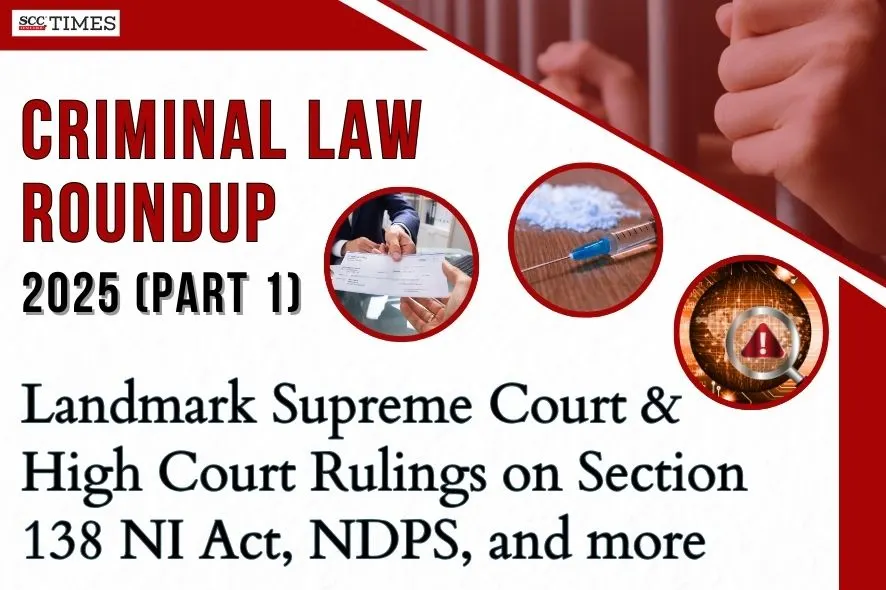
The first part of our comprehensive roundup of Criminal Law Judgments 2025 brings together some of the most significant decisions delivered by the Supreme Court of India and various High Courts over the year. From bail jurisprudence and arrest safeguards to cases involving, suicide, corruption, cybercrime, and national security, Courts across the country dealt with criminal cases.
The judgments covered herein reflect a consistent judicial emphasis on due process, proportionality of punishment, evidentiary rigor, and constitutional guarantees under Articles 14 and 21. At the same time, the courts have demonstrated zero tolerance for procedural abuse, investigative excesses, and offences that undermine public trust.
TOP STORIES
-
Supreme Court of India Expresses Deep Condolences Over Delhi Car Blast Tragedy
-
Recycling Section 295-AA: Punjab’s Misguided Attempt to Recriminalise Sacrilege
-
Surrender to Safeguard Study of Judicial Discretion of Pre-Arrest Bail to a Proclaimed Offender
-
Section 138 of NI Act Explained: Cheque Bounce Notice, Procedure & Landmark Rulings
-
Explainer on Digital Arrests and Cyber Frauds within India’s evolving Cyber Law Framework
ABETMENT TO SUICIDE/ SUICIDE
SUPREME COURT | Heated neighbourhood quarrels cannot constitute abetment to suicide under Section 306 IPC
In a criminal appeal challenging the judgment of the Karnataka High Court, wherein the Court confirmed the conviction of the appellant under Section 306 of the Penal Code, 1860 (‘IPC’), the Division Bench of BV Nagarathna and KV Viswanathan*, JJ. held that the evidence did not establish the ingredients of abetment to suicide. The Court observed that the quarrels between the appellant’s family and the victim’s family were in the nature of heated exchanges that occur in everyday life and could not be construed as instigation to such an extent that the victim was left with no option but to commit suicide. Read More HERE
SUPREME COURT | Hyperboles employed in exchanges should not be glorified as an instigation to commit suicide
The Division Bench of Abhay S. Oka and K.V. Viswanathan*, JJ., took strict note of casual resorting of Section 306 by the Police. The Court said that while the persons involved in genuine cases where the high threshold under Section 306 is met should not be spared; the provision should not be deployed against individuals, only to assuage the immediate feelings of the distraught family of the deceased. Hyperboles employed in exchanges should not, without anything more, be glorified as an instigation to commit suicide. Read More HERE
ORISSA HIGH COURT | Balasore Student self-immolation case | Judicial SIT probe decline; ICC held accountable
The present Public Interest Litigation (‘PIL’) raising concerns over an unprecedented incident, in which the victim of sexual harassment committed self-immolation by pouring petrol in front of the Principal’s office. The Division Bench of Harish Tandon, CJ., and Manash Ranjan Pathak, J., declined the prayer for constitution of a Special Investigation Team (‘SIT’), noting that SIT had already been constituted by the State. Read More HERE
DELHI HIGH COURT | Emotional/mental vulnerability due to depression, & other psychiatric problems to be considered in abetment of suicide cases; Higher proof of instigation required
A Single-Judge bench of Ravinder Dudeja, J., stated that a person’s emotional or mental vulnerability due to depression and other psychiatric problems is a big factor to be considered in the case of abetment of suicide. Therefore, in such cases, higher proof of instigation is required. The Court directed that in the event of the arrest of the accused persons, they should be released on bail. Read More HERE
Also Read:
KERALA HIGH COURT | ‘Ought to have complied with Section 115 of Mental Healthcare Act’; Conviction of a mother who killed her infant son and then attempted suicide, set aside — Read More HERE
DELHI HIGH COURT | Mere suspicion of extra-marital affair, however morally reprehensible, does not per se amount to abetment of suicide; Bail granted to a man accused u/s 498A, 304-B IPC — Read More HERE
DELHI HIGH COURT | ‘Maybe a case of unhappy/dejected marriage; but not abetment’: Acquittal of wife, and her brothers accused of abetting husband’s suicide, upheld – Read More HERE
KARNATAKA HIGH COURT | Writing ‘wife needs his death’ and that ‘she tortured him’ in suicide note not enough; abetment to suicide case against wife quashed — Read More HERE
ACQUITTAL
SUPREME COURT | Surendra Koli’s acquittal in the 13th criminal case connected to Nithari Killings
While considering this petition filed by Surendra Koli, whose conviction in Rimpa Haldar case was affirmed by the Supreme Court whilst his acquittal in 12 companion prosecutions connected to Nithari Killings was upheld; the 3-Judge Bench of B.R. Gavai, CJI, Surya Kant and Vikram Nath*, JJ., allowed the curative petition and acquitted Surendra Koli of the charges under Sections 302, 364, 376 and 201 of the IPC, thereby allowing him to go free in the 13th criminal case related to the horrific Nithari Killings. Read More HERE
GUJARAT HIGH COURT | ‘Conviction not based on corroborative evidence’: Gujarat HC acquits three accused in 2002 post Godhra riots case
In a criminal appeal by appellant/accused was filed against the Fast Track Court’s order of conviction and sentence, where the trial was conducted against nine accused persons in which four of them were convicted under Sections 143, 147, and 436 read with 148 of the IPC and rest five were acquitted. Considering all the material on record, a Single Judge Bench of Gita Gopi, J., set aside the judgment of conviction and accordingly, acquitted the three accused persons in 2002 post Godhra riots case. Read more HERE
DELHI HIGH COURT | DNA report merely proves paternity, and it cannot by itself establish absence of consent; Man convicted of rape, acquitted
A Single Judge Bench of Amit Mahajan, J., stated that the DNA report merely proves paternity and it did not and could not, by itself, established the absence of consent. Mere proof of sexual relations, even if resulting in pregnancy, was insufficient to prove rape unless it was also shown that the act was non-consensual. Accordingly, the Court set aside the impugned judgment and order of sentence and acquitted accused of all the charges. Read more HERE
Also Read:
SUPREME COURT | ‘Circumstantial evidence chain broken’; Acquits two, including death row convict, in rape and murder of 7-year-old girl — Read More HERE
SUPREME COURT | Trial Court’s decision acquitting 3 Constables in 20-year-old Murder case, upheld — Read more HERE
SUPREME COURT | Two acquitted in 43-year-old murder case as suppression of evidence and unfair probe slammed — Read more HERE
ARREST
SUPREME COURT | Communicating the grounds of arrest mandatory; Non-compliance would render the arrest and subsequent remand as illegal
While considering these criminal appeals wherein the appellants raised concerns over violation of their rights Article 22(1) of the Constitution and Section 50 of the CrPC (Section 47 of BNSS asserting that they were not informed of grounds of their arrest in writing, the Division Bench of B.R. Gavai, CJI., and Augustine George Masih*, J., issued direction on communicating the grounds of arrest to the arrested person. Read More HERE
BOMBAY HIGH COURT | ‘Whether Section 50 CrPC mandates furnishing grounds of arrest in writing to accused, other than PMLA/UAPA cases?’; Matter referred to Larger Bench
In a case wherein, the petitioner-accused was apprehended for carrying the contraband and FIR under the provisions of the Narcotic Drugs and Psychotropic Substances Act, 1985 (‘the NDPS Act’) was lodged, the Division Bench of Sarang V. Kotwal* and S.M. Modak, JJ., referred the question “whether Section 50 of CrPC mandated the furnishing of the grounds of arrest in writing to the accused” for consideration to a Larger Bench. Read more HERE
DELHI HIGH COURT | Precise definition of the word “forthwith” in Section 50 CrPC, analysed; Set aside arrest due to non-compliance
A Single-Judge Bench of Anup Jairam Bhambhani, J., set aside the arrest of the petitioner on the grounds of non-compliance of the mandatory requirements of section 50 of the CrPC and Article 22(1) of the Constitution. Read more HERE
BAIL, PAROLE AND FURLOUGH
SUPREME COURT | Parity cannot be the sole ground for bail; emphasized on Role Differentiation among Co-Accused
In a case where the Court was called upon to decide whether parity with co-accused can be the sole ground for granting bail, the bench of Sanjay Karol* and N. Kotiswar Singh, JJ., held that parity with co-accused cannot be the sole ground for granting bail, especially in cases involving serious offences. The Court made clear that bail orders must consider the gravity of the offence, the accused’s role, potential risk to justice, and other relevant factors. Read More HERE
SUPREME COURT| High Courts must dispose of pending bail applications within 2 months from date of filing; Avoid indefinite adjournments.
While considering the instant appeal against common judgment of Bombay High Court dismissing appellants’ bail applications, the Division Bench of J.B. Pardiwala and R. Mahadevan,* JJ., opined that applications concerning personal liberty cannot be kept pending for years while the applicants remain under a cloud of uncertainty. Read more HERE
SUPREME COURT | Interim bail in POCSO case granted; Orders housing, employment, and counselling support to facilitate convict’s reunion with prosecutrix and minor child
The division bench of Ahsanuddin Amanullah and S.V.N. Bhatti, JJ. granted interim bail to the convict to enable him to reunite with the prosecutrix (now his wife) and their minor child, after both expressed their desire to live together as a family. Read More HERE
SUPREME COURT | Inside SC decision to cancel bail granted to actor Darshan & other accused persons in Renukaswamy murder case
While considering the appeal filed by State of Karnataka challenging the grant of bail to actor Darshan and other accused persons in Renukaswamy murder case; the Division Bench of J.B. Pardiwala** and R. Mahadevan,* JJ., finding that Karnataka High Court order granting bail suffers from serious legal infirmities, cancelled the bail granted to the accused persons. Read More HERE
SUPREME COURT | Bail granting procedure, rules out undertakings as basis for regular or anticipatory bail clarified
The division bench of JB Pardiwala* and R. Mahadevan, JJ. made it unequivocally clear through explicit directions that henceforth, no Trial Court or High Court shall grant regular bail or anticipatory bail based on any undertaking furnished by the accused solely for the purpose of obtaining such relief. Read More HERE
SUPREME COURT | Explained | Split verdict on AIMIM member Tahir Hussain’s interim bail plea to contest Delhi Assembly Elections
The Division Bench of Pankaj Mithal* and Ahsanuddin Amanullah**, JJ., delivered a split verdict in this regard. While Mithal, J., opined that interim bail is not permissible for the purposes of contesting elections, much less for campaigning; Amanullah, J., on the other hand deemed the petitioner eligible to be enlarged on conditional bail for limited period. Read more HERE
SUPREME COURT | [Foreigners Act] SC says no to impleading Registration Officer in foreigner’s bail plea; Directs for informing Registration Officer, if bail is granted
In a set of two criminal appeals, the Division Bench of Abhay S. Oka* and Ujjal Bhuyan, JJ., opined that while releasing a foreigner on bail, the Court should direct the investigating agency or the State, as the case may be, to immediately inform the concerned Registration Officer appointed under Rule 3 of the Registration of Foreigners Rules, 1992 about the grant of bail so that the Registration Officer can bring the fact of the grant of bail to the notice of Civil Authority concerned. Read more HERE
J&K AND LADAKH HIGH COURT | Criminal Courts to “remain sensitive” and avoid “Copy-Paste Syndrome” while deciding Bail matters
While deciding a bail application, a single-judge bench of Sanjay Dhar, J., highlighted the need for sensitivity and accuracy in judicial proceedings, thereby ensuring justice aligns with the fundamental rights of individuals. Read more HERE
BOMBAY HIGH COURT | Magistrate not bound by Investigating Officer’s opinion; bail application of police officials accused of abduction and extortion rejected
A Single Judge Bench of Neela Gokhale, J., held that the Magistrate is not bound by the analysis of the Investigating Officer in the charge sheet and can independently take cognizance of non-bailable offences. Observing that prima facie offences of abduction and extortion were made out, the Court rejected the bail application. Read More HERE
ALLAHABAD HIGH COURT | Bar on grant of anticipatory bail under S. 18 SC/ST Act not applicable when application filed under S. 482 of BNSS
A Single Judge Bench of Pankaj Bhatia, J., held that Section 18 of the SC/ST Act imposes a bar on grant of anticipatory bail, however, this objection does not apply on the present case as the application for anticipatory bail was filed under Section 482 of the BNSS and not under Section 438 of the CrPC. Accordingly, the Court allowed the application and granted anticipatory bail to the applicant. Read More HERE
PUNJAB AND HARYANA HIGH COURT| ‘Once released on bail, prisoner’s custody beyond necessary period is illegal’; Punjab & Haryana HC grants bail to an alleged undocumented Bangladeshi migrant
While granting bail to accused, who was allegedly an undocumented migrant from Bangladesh, a Single Judge Bench of Anoop Chitkara J., stated that once an accused was released on bail, any custody of the prisoner concerned beyond the period necessary to complete the procedures for a formal release from prison, would be illegal, if delayed on flimsy grounds, systemic mediocrity, or bureaucratic red tape. Read more HERE
MADHYA PRADESH HIGH COURT | Bail granted to rape accused with condition to handover documents, electronic gadgets, social media access for investigation
In an anticipatory bail application, a single-judge bench of Devnarayan Mishra, J., granted anticipatory bail to the applicant with strict conditions, including cooperation with the investigation and submission of digital evidence. Read more HERE
Also Read:
SUPREME COURT | ‘Attending meetings of organisation not banned under UAPA isn’t prima facie offence’; SC affirms Karnataka HC’s order granting bail — Read More HERE
SUPREME COURT | ‘Case of Saviour turning into a devil’; Superintendent’s bail in Patna’s Uttar Raksha Grih women inmates trafficking case cancelled – Read more HERE
SUPREME COURT | SC urges High Courts to encourage filing of anticipatory bail applications first before Sessions Court; discourage direct interference — Read More HERE
ALLAHABAD HIGH COURT | Interim bail granted to Vibhor Rana accused in Codeine Cough Syrup Case — Read More HERE
ALLAHABAD HIGH COURT | ‘Can’t ignore India-China relationship & Lack of extradition treaty’; Bail to Chinese national for illegally staying in India denied — Read More HERE
CONTEMPT OF COURT
GUJARAT HIGH COURT | Rs 1 lakh fine on man caught relieving himself during virtual court proceedings
In a suo motu contempt case, the Division Bench of AS Supehia* and RT Vachhani, JJ., slapped a fine of Rs. 1 lakh on a man who was caught relieving himself during virtual court proceedings. Read more HERE
PUNJAB AND HARYANA HIGH COURT | “Reckless allegations intended to bring disrepute to justice system”; Contempt notice issued against advocate threatening to take HC judges to SC
In a preponement application filed by an advocate under Section 482 of the CrPC, read with Section 15(6(b) of the SC/ST Act and Article 14 and 21 of Constitution, the Single Judge Bench of Harpreet Singh Brar, J., allowed the application, despite holding that there was no justification for the same. The Court also issued a show cause notice to the petitioner under the Contempt of Courts Act, 1971, holding that the allegations levelled by the petitioner in the present application were intended to bring disrepute to the justice administration system and such action amounted to interference in the judicial process. Read more HERE
MADRAS HIGH COURT | ‘Rather than viewing judicial criticism defensively, State embraced institutional reform’; Contempt case closed over non-implementation of TNPID Act
In a petition filed under Section 11 of the Contempt of Courts Act, 1971 alleging non-compliance with the directions issued by the Court, wherein the Court, apart from directing the Monitoring Committee to take further steps for refunding the amount to the depositors, also highlighted serious lapses in the implementation of the Tamil Nadu Protection of Interests of Depositors (in Financial Establishments) Act, 1997 (‘TNPID Act’), the Single Judge Bench of B. Pugalendhi, J., held that the Contempt Petition stands closed, recording the compliance shown. Read more HERE
Also Read:
SUPREME COURT | Calcutta High Court’s suo motu contempt proceedings against police officials in 2019 Howrah Court assault case, stayed — Read more HERE
PUNJAB AND HARYANA HIGH COURT | Remarrying during pendency of first wife’s appeal amounts to Contempt; sentences Man to 3 months jail and fine – Read Mote HERE
MADRAS HIGH COURT | Issue of alleged caste bias by a Judge placed before the Chief Justice for initiation of contempt case – Read more HERE
CONVICTION
SUPREME COURT | Supreme Court upholds jail official’s conviction for facilitating undertrial prisoner’s escape attempt
In a case wherein an appeal was filed against conviction and sentence of the appellant, Assistant Superintendent of Central Jail, Ludhiana, for facilitating undertrial prisoner’s escape attempt from custody, the Division Bench of Pamidighantam Sri Narasimha and R. Mahadevan,* JJ., upheld the conviction and stated that circumstances of the case formed a continuous chain of incriminating circumstances pointing toward his complicity in the conspiracy. Read More HERE
Also Read:
SUPREME COURT | Conviction of two brothers turned from S. 302 to S. 304 Part I of IPC in 23-year-old co-villager’s murder case – Read more HERE
SUPREME COURT | Man’s conviction under S. 498-A IPC and S. 4 of DP Act in 19-year-old dowry case, confirmed; sentence reduced to time served in custody – Read more HERE
CORRUPTION
DELHI HIGH COURT | ‘Hearing accused public servant before directing investigation mandatory under Sec. 20 of Lokpal Act’
Explaining the scope of the procedural safeguards under the Lokpal and Lokayuktas Act, 2013 (the Act), the Division Bench of Anil Kshetarpal and Harish Vaidyanathan Shankar,* JJ., held that requirement of considering the explanation of the accused public servant under Section 20(3) of the Act is mandatory in nature and leaves no scope for discretion. Accordingly, the Court allowed the instant writ petition and quashed the impugned orders. Read more HERE
CRIMINAL TRIAL
SUPREME COURT | Police & Courts must be circumspect in filing chargesheet and framing charges where there is pending civil dispute between parties
A Division Bench of N. Kotiswar Singh and Manmohan*, JJ., emphasised that where there is a pending civil dispute between the parties, the Police and the Criminal Courts must be circumspect in filing a chargesheet and framing charges respectively. The Court stated that, “In a society governed by rule of law, the decision to file a chargesheet should be based on the Investigating Officer’s determination of whether the evidence collected provides a reasonable prospect of conviction”. The Police at the stage of filing of Chargesheet and the Criminal Court at the stage of framing of Charge must act as initial filters ensuring that only cases with a strong suspicion should proceed to the formal trial stage to maintain the efficiency and integrity of the judicial system. Read More HERE
Also Read:
DELHI HIGH COURT | ‘Expedition of trial cannot be at cost of fairness’; Cross examination of Head Constable permitted in Delhi riots case – Read more HERE
KERALA HIGH COURT | Path cleared for remote cross-examination via video conferencing to streamline court proceedings — Read more HERE
KERALA HIGH COURT | S. 198-B CrPC bars Magistrate from taking cognizance of rape under S. 376-B IPC without complaint by separated wife – Read more HERE
CUSTODIAL DEATHS AND VIOLENCE
SUPREME COURT | Rs 50 Lakhs compensation awarded to J&K Police Constable who was victim of brutal custodial torture
While considering an appeal challenging J&K and Ladakh High Court’s decision to dismiss appellant’s petitions seeking FIR against police personnel, the Division Bench of Vikram Nath and Sandeep Mehta*, JJ., exercised the extraordinary jurisdiction of the Court under Article 136 read with Article 142 of the Constitution and directed the Union Territory of Jammu & Kashmir to pay compensation of Rs 50 Lakhs to the appellant so as to provide some solace to the appellant and his family for the barbaric acts of custodial torture leading to complete castration. The Court further directed the CBI to take over the investigation in the matter. Read more HERE
BOMBAY HIGH COURT | FIR ordered in Dalit law student’s custodial death after arrest in 2024 protest over atrocities on Hindus in Bangladesh
A writ petition was filed by the mother of the deceased (‘petitioner’) seeking registration of a FIR under the relevant provisions of the BNS and Scheduled Castes and Scheduled Tribes (Prevention of Atrocities) Act, 1989 against the police officers allegedly responsible for the custodial death of her son (‘deceased’), who was arrested for protesting against the alleged atrocities committed against Hindus in Bangladesh in 2024. The Division Bench of Vibha Kankanwadi* and Sanjay A. Deshmukh, JJ., held that the police failed in their duty by not filing an FIR even after a complaint was submitted by the petitioner. Accordingly, the Court directed the registration of the FIR. Read more HERE
CALCUTTA HIGH COURT | ‘Lady Constable seen smacking on her head’; SIT probe directed into alleged custodial torture of student protester by West Bengal police
In a petition filed by a student of the Mathematics Department of Midnapore College, (petitioner) seeking intervention regarding the alleged custodial torture and police excesses including directions for registration of FIR and appropriate investigation against the errant police officials, Tirthankar Ghosh, J., directed that the petitioner’s complaints to the National and State Human Rights Commissions be treated as an FIR and forwarded to the Human Rights Court (Sessions Judge, Paschim Midnapore) under the Protection of Human Rights Act, 1993. It was further directed that Special Investigation Team (SIT) to be constituted under the leadership of IGP Muralidhar Sharma to conduct a thorough probe, with full logistical support from the Home Secretary, Government of West Bengal. Read more HERE
PUNJAB AND HARYANA HIGH COURT | Response sought from SSP regarding man allegedly tortured, given electric shocks, recorded naked in police custody
A Single Judge Bench of Kirti Singh, J., noted that there were allegations of gross misconduct of the acting officials and opined that it required a detailed response qua the actual chain of events and qua the alleged custodial torture that the accused was subjected to. The Court also directed the Senior Superintendent of Police (‘SSP’) to submit a response in this regard. Read more HERE
CYBER CRIME
BOMBAY HIGH COURT | Investigating Agency cannot debit freeze bank accounts involved in cyber fraud under S. 106 BNSS
In a case wherein the issue was whether an Investigating Agency (‘IA’) has the power to debit freeze a bank account under Section 106 of the BNSS, the Division Bench of Anil L. Pansare and Raj D. Wakode, JJ., quashed and set aside the orders passed by the IA and held that debit freezing of accounts is not permissible under Section 106, however, it can be done in terms of Section 107 BNSS, and that the banks should act in terms of the Citizen Financial Cyber Frauds Reporting and Management System (‘Management System’). Read More HERE
RAJASTHAN HIGH COURT | ‘Present machinery can’t handle traditional cybercrimes, AI/ Deep fake challenges’; Detailed directions to curb cybercrimes issued
In an application filed by petitioner-accused seeking bail in a case where he was accused of extorting Rs. 2,02,00,000 from an elderly couple by putting them under digital arrest, a Single Judge Bench of Ravi Chirania, J., held that present machinery in the State is not well equipped to handle not only the traditional cybercrimes but also the upcoming serious future challenges of artificial intelligence and deep fake and other such technological challenges and issued directions. Read More HERE
RAJASTHAN HIGH COURT | 19-year-old cybercrime accused restrained from using Telegram and WhatsApp during trial
A Single Judge Bench of Sameer Jain, J., considered the age of accuse, a 19-year-old, allowed him to be released on bail. However, it restrained him from using any social media application, apps like telegram and WhatsApp during the continuation of the present matter and trial. Read more HERE
PATNA HIGH COURT| Stall circulation of AI generated video of PM Narendra Modi and his late mother
In a civil writ petition filed by petitioner seeking removal of AI generated video clipping of PM Narendra Modi and his late mother, a Division Bench of the P.B. Bajanthri, ACJ*, and Alok Kumar Sinha, J., while directing the respondents not to circulate the video clipping until further orders held that, prima facie, humiliating a sizeable class of persons in exhibiting video clip cannot be countenanced in a constitutional democracy governed by the principles of dignity, liberty, and fraternity. Read more HERE
Also Read:
DELHI HIGH COURT | Indiscriminate freezing of bank accounts slammed; Policy reform called for in cyber-crime investigations – Read more HERE
DELHI HIGH COURT | ‘Cyberbullying can be as traumatic as physical abuse’; upholds POCSO conviction; Bats for safer digital spaces for children – Read More HERE
KARNATAKA HIGH COURT| Direction for robust implementation of Cyber Command Centre to tackle burgeoning menace of cybercrime — Read more HERE
DEFAMATION
CALCUTTA HIGH COURT | Lawyer’s plea to quash defamation case over sharing book extracts on Mamata Banerjee’s personal life rejected
In a revisional application filed by the petitioner, an advocate and politician, challenging the summons issued in a defamation case for sharing pages from a 2015 book containing personal allegations and a letter about the Chief Minister of West Bengal, which he claimed was publicly available and not subject to any ban, a Single Judge Bench of Apurba Sinha Ray, J., while dismissing the application held that republication of defamatory imputations makes the person liable in the same manner as the original author. Read more HERE
ALLAHABAD HIGH COURT | Quashed summoning order against Journalists in defamation case over publication of former MP Brij Bhushan’s letters to CM
In a case concerning a summoning order issued against two journalists in a defamation case filed by a lawyer, related to the alleged publication of a letter written by former BJP MP Brij Bhushan Sharan Singh to Uttar Pradesh Chief Minister Yogi Adityanath, the Single Judge Bench of Saurabh Lavania, J. held that the Special Chief Judicial Magistrate (Custom), Lucknow, had failed to consider all relevant aspects of the case before passing the impugned order. Read more HERE
PUNJAB AND HARYANA HIGH COURT | No Relief for Kangana Ranaut; dismisses plea in defamation case linked to farmers’ protest tweet
In a petition filed by Kangana Ranaut under Section 482 of the CrPC seeking quashing of criminal complaint filed by the complainant under Sections 499 and 500 of the IPC, a Single Judge Bench of Tribhuvan Dahiya J. dismissed the same and stated that she failed to demonstrate how her retweet was made in good faith. Read More HERE
BOMBAY HIGH COURT | Videos allegedly defaming State’s Cabinet Minister Girish Dattatray Mahajan directed to be taken down
In a case wherein, a suit was filed by the applicant for defamation on account of false, reckless, and unsubstantiated allegations made by Respondent 1 in videos uploaded by him on his YouTube channel in respect of the applicant, a Single Judge Bench of Arif S. Doctor, J., opined that the statements made by Respondent 1 as discerned from the transcripts were per se defamatory. Thus, the Court directed taking down of the defamatory videos. Read more HERE
DELHI HIGH COURT | No early hearing of RSS Member’s plea for quashing proceedings; Malviya undertakes to seek adjournment of Trial
In an application for speedy hearing filed by Santanu Sinha, a Rashtriya Swayamsevak Sangh (‘RSS’) member, who was being prosecuted for criminal defamation against Amit Malviya (‘respondent 2’), a BJP politician, a Single Judge Bench of Manmeet Pritam Singh Arora, J., dismissed the plea for early hearing. Read more HERE
DISCHARGE
MADHYA PRADESH HIGH COURT | “Marital Rape is not recognised under IPC”; Husband’s discharge from Section 377 IPC charge, upheld
In a criminal revision petition filed under Section 397 read with Section 401 of the CrPC challenging the discharge of husband from the charge under Section 377 IPC, a single-judge bench of Binod Kumar Dwivedi, J., reaffirmed the existing legal position that marital rape is not recognised as a criminal offence under IPC and dismissed the revision petition. Read more HERE
DELHI HIGH COURT | Mere threats not with intention to cause alarm would not constitute criminal intimidation; Discharge of accused in sexual assault case, upheld — Read more HERE
ECONOMIC OFFENCES
SUPREME COURT | Notice issued in petition seeking ban on online gambling/betting games operating in the guise of e-sports games
While considering a petition filed by Centre for Accountability Systemic Change (CASC) seeking issuance of appropriate writ directing the Respondents to prohibit online gambling and betting games operating in the guise of social and e-sports games; the Division Bench of J.B. Pardiwala and K.V. Viswanathan, JJ., issued notice in the matter. Read more HERE
SUPREME COURT | Discharge order based on defence material held impermissible in Rs. 21 Crore MSP fraud case involving Cotton Corporation of India officer
In a batch of civil appeals by the CBI against Andhra Pradesh High Court’s decision, the Division Bench of Pankaj Mithal and SVN Bhatti delineated the contours of a magistrate’s discretion under Section 239 of the CrPC, and set aside concurrent findings of discharge by the Special Court and High Court, reiterated that reliance on material produced by the accused at the stage of discharge is impermissible in law. The Court emphasised that the threshold under Section 239 must be assessed solely on the basis of the police report and accompanying documents filed under Section 173 CrPC. Read more HERE
DELHI HIGH COURT | Profits earned from illegal cricket betting can be attached as ‘proceeds of crime’ under PMLA
While hearing a batch of six writ petitions challenging the proceedings initiated by the Directorate of Enforcement (ED) in connection with large scale hawala transactions and illegal international cricket betting operations , the Division Bench of Anil Kshetrapal,* and Harish Vaidyanathan Shankar, JJ., held that profits earned from cricket betting could be attached as ‘proceeds of crime’ under the Prevention of Money Laundering Act, 2002.Thus, the Court declined to interfere with the Provisional Attachment Orders and Show Cause Notices issued by the ED. Read More HERE
BOMBAY HIGH COURT | SEBI consent settlement does not absolve accused of criminal liability in IPO fraud
While hearing writ petitions under Article 226 of the Constitution, wherein the petitioners were seeking quashing of criminal prosecutions initiated by the CBI in relation to alleged irregularities in the in the Initial Public Offerings of Yes Bank and Infrastructure Development Finance Corporation, the Division Bench of A. S. Gadkari and Ranjitsinha Raja Bhonsale,* JJ., held that the Consent Order passed by SEBI in December 2009 was only in respect of administrative and civil proceeding and did not refer to or deal with the pending criminal proceedings. Read more HERE
BOMBAY HIGH COURT | Maharashtra Minister and Senior NCP Leader Chhagan Bhujbal’s CA discharged in money laundering case
A Single Judge Bench of R.N. Laddha, J., opined that it would be unreasonable to expect the applicant, merely by virtue of being an auditor to assume the role of investigator or to be under an obligation to examine and investigate the genuineness of the documents provided to him by the companies’ authorised persons. The Court held that there was no substantive proof to establish the applicant’s involvement in the said scam, thus quashed the impugned order dated 17-3-2021. Read more HERE
Also Read:
BOMBAY HIGH COURT | Former stockbroker Ketan Parekh’s liberty to travel abroad, protected, Replaced Rs 27 crore bail condition with Rs 5 lakh in each case — Read more HERE
BOMBAY HIGH COURT | Bail granted to woman alleged to have cheated of Rs. 2.45 crores; Highlighted well-being of her children and non-violent nature of crime — Read more HERE
EVIDENCE
SUPREME COURT | Supreme Court: Imminence of death not a pre-requisite under Section 32(1) Evidence Act for dying declaration admissibility
The Division Bench of Sanjay Karol* and Nongmeikapam Kotiswar Singh, JJ., opined that the High Court erred in holding that the statements made by the deceased herein on two different days, cannot be treated as dying declaration(s) merely because the death of the deceased occurred after a substantial lapse of time from their recordings. The Supreme Court stated that such approach is untenable since the law does not require that a declarant, at the time of making the statement, to be under the shadow of death or the expectation that death is imminent. Read More HERE
SUPREME COURT| Directions issued to Trial Courts for ensuring systematic presentation of evidence for efficient appreciation of record
While considering this matter revolving around sexual assault of a 4-year-old-girl (child victim) which was found to be “enveloped in layers of investigative apathy and procedural infirmities”, the Division Bench of Vikram Nath and Sandeep Mehta*, JJ., opined that a more structured and uniform practice must be adopted to enhance the legibility of criminal judgments. Accordingly, to ensure a systematic presentation of evidence that enables efficient appreciation of the record, the Court issued the directions to all Trial Courts. Read More HERE
SUPREME COURT | ‘Fact Thereby Discovered’ under Section 27 of the Evidence Act, interpreted
Determining the scope of Section 27 of the Evidence Act, 1872 that deals with how much of the information as received from the accused, in Police custody may be proved, the bench of JK Maheshwari* and Vijay Bishnoi, JJ interpreted the phrase ‘fact thereby discovered’ and held that only that much information as is clearly connected with the fact discovered can be treated as relevant under the phrase ‘facts discovered’. Read more HERE
SUPREME COURT | No DNA Test unless Section 112 Presumption of Legitimacy is rebutted and paternity question linked to offence
In a case where the central question was whether to direct DNA testing to establish paternity in a criminal investigation predicated on allegations of an extra-marital relationship between a doctor and his patient’s wife, which purportedly led to the birth of a child, the bench of Prashant Kumar Mishra and Vipul M. Pancholi, JJ., held that a DNA test to challenge paternity cannot be directed as a matter of routine unless the presumption of legitimacy under Section 112 of the Evidence Act, 1872 has been rebutted. Read more HERE
SUPREME COURT | Private complaint allowed for offence of false evidence before a Tribunal, considered as the only remedy
In a criminal appeal against the Calcutta High Court’s decision, declining to grant relief to the appellant for allowing his private complaint for alleged offences under Section 193, 199 and 200 of the IPC before a Tribunal, the Division Bench of Sudhanshu Dhulia and Ahsanuddin Amanullah, JJ. allowed the appeal and held that the only way out available for the appellant was to file a private complaint with direction to the Tribunal to entertain the private complaint. Read more HERE
SUPREME COURT | Legitimacy determines paternity under Section 112 Evidence Act, until the presumption is rebutted by proving ‘non-access’
While considering the instant appeal challenging the decision of Kerala High Court wherein it had held that the legitimacy of birth was irrelevant when considering the right of the child to receive maintenance from their biological father; the Division Bench of Surya Kant* and Ujjal Bhuyan, JJ., set aside the impugned decision of the High Court and held that legitimacy determines paternity under Section 112 of the Evidence Act, 1872, until the presumption is successfully rebutted by proving ‘non-access’. Read more HERE
SUPREME COURT | Section 319 CrPC | Person can be summoned to face trial even if police does not name him as an accused in chargesheet
The Division Bench of JB Pardiwala and R. Mahadevan, JJ., dismissed the petition and held that the Trial Court has undoubted jurisdiction to add any person not being the accused before it to face the trial along with other accused persons, if the Court is satisfied at any stage of the proceedings on the evidence adduced that the persons who have not been arrayed as accused should face the trial. Read more HERE
SUPREME COURT | Guidelines for handling of DNA evidence issued; Implores legislature to consider compensation for acquittal after long incarceration
In an appeal challenging conviction and sentence of death penalty; the 3 Judge Bench of Vikram Nath, Sanjay Karol* and Sandeep Mehta, JJ., emphasised need of a legislative framework to compensate accused persons who have been suffering long incarcerations only for them to be cleanly acquitted. The Court further took strict note of the faulty investigation and especially the treatment of the DNA evidence in ways that rendered the samples useless for the purposes of the case. Hence, the Court issued certain guidelines which must be followed in all cases where DNA Evidence is involved. Read more HERE
SUPREME COURT | Circumstantial Evidence: Inability to explain certain situations can’t be made a basis to relieve prosecution from discharging its primary burden
The Division Bench of B.V. Nagarathna and Satish Chandra Sharma,* JJ., took note of the inconsistent version of events presented by the prosecution and opined that accused person’s inability to explain certain circumstances, could not be made the basis to relieve the prosecution from discharging its primary burden of proving the case against the accused beyond reasonable doubt. Read more HERE
KERALA HIGH COURT | ‘Expert’s report under S. 293 CrPC not a substitute for certificate under S. 65-B of Evidence Act’; Conviction in rape and murder case, set aside
The division bench of Raja Vijayaraghavan V and P. V. Balakrishnan,* JJ., held that the report of an expert obtained under Section 2934 of the CrPC cannot be considered as a substitute for a certificate under Section 65-B of the Evidence Act, 1872 which is used to prove the validity of electronic evidence. The admissibility of a Section 293 CrPC report simply means that the report can be read as evidence of its contents, but it does not automatically validate any attached electronic media. Read more HERE
PUNJAB AND HARYANA HIGH COURT | Production of Call Details in Criminal Trial prevails over Police Privacy Rights; Accused to prove necessity
In a petition challenging the dismissal of application seeking call data records (‘CDRs’) and mobile location data in FIR under NDPS Act, a Single Judge Bench of Yashvir Singh Rathor, J., held that the denial of an adequate opportunity to the accused by non-production of the electronic record, which stood admissible under Section 62 and 63 of the BSA in criminal trial, would amount to miscarriage of justice. Read more HERE
Also Read:
KERALA HIGH COURT | Photograph of place of occurrence revealing impossibility of rape is relevant to the trial proceedings — Read More HERE
DELHI HIGH COURT | Recording of evidence of US-based witness allowed through Video Conferencing in an Official Secrets Act case – Read more HERE
RAJASTHAN HIGH COURT| Who must submit the Section 65-B Evidence Act certificate? Reiterates requirements – Read more HERE
FAIR AND SPEEDY TRIAL
ALLAHABAD HOGH COURT | “More than 16 years have passed but this project is still slow in progress”: Directions for implementation of Inter-Operable Criminal Justice System issued
In a bail application, the Single Judge Bench of Arun Kumar Singh Deshwal, J., took note of the poor enforcement of the Inter-Operable Criminal Justice System (“ICJS”) and issued detailed directions for its implementation. Read More HERE
DELHI HIGH COURT | Right to speedy trial not an abstract or illusory safeguard, cannot be whittled down in MCOCA cases
In a bail application for offence under the Maharashtra Control of Organised Crime Act, 1999 (‘MCOCA’), Sanjeev Narula, J.*, granted bail on the ground that as of today, the accused had been in custody for nearly nine years, and despite the prolonged detention, the trial remained far from its conclusion. Moreover, the inordinate delay and excessive period of detention violate the accused’s fundamental rights under Article 21 of Constitution. Read more HERE
Also Read:
DELHI HIGH COURT | ‘Against speedy trial’s mandate’; Delhi HC grants relief to a 90-year-old man convicted for demanding Rs. 15000 bribe in 1984 — Read more HERE
MEGHALAYA HIGH COURT | ‘Deficiency in conduct of legal aid counsel defeats right to fair trial’; Retrial ordered in POCSO case — Read more HERE
FIR
SUPREME COURT | CBI doesn’t require State Govt’s consent to register FIR under Central Law against Central Govt employee posted within State
The Division Bench of CT Ravikumar* and Rajesh Bindal, JJ. allowed the appeals and set aside the impugned decision reiterating that the CBI does not require permission from the State Government to register an FIR under the Central Legislation against a Central Government employee. Read more HERE
ALLAHABAD HIGH COURT | Magistrate’s order directing police to register FIR and investigate not open to revision at instance of proposed accused
A Single Judge Bench of Chawan Prakash*, J., held that Magistrate’s order under Section 156(3) of the CrPC, directing the police to register FIR and investigate, is not open to revision at the instance of proposed accused against whom neither cognizance has been taken, nor any process got issued. Read More HERE
Also Read:
DELHI HIGH COURT | ‘Transferring case to another State reflected mechanical approach’; Registration of regular FIR directed instead of Zero FIR as offence occurred within jurisdiction — Read more HERE
GAMBLING, LOTTERIES AND PRIZE COMPETITIONS
MADRAS HIGH COURT | Verdict on State’s power to regulate online real money games
In a writ petition filed under Article 226 of the Constitution of India, declaring Section 5(2) read with Section 14(1)(c) of Tamil Nadu Prohibition of Online Gambling and Regulation of Online Games Act, 2022 (‘Act, 2022’) along with Regulation 4(iii) and Regulation (viii) of Tamil Nadu Online Gaming Authority (Real Money Games) Regulation, 2025 as arbitrary, void, illegal and unconstitutional, the division bench of S.M. Subramaniam* and K. Rajasekar, JJ. upheld the validity of the impugned Act and the Regulations introduced by the State of Tamil Nadu, which provide reasonable restrictions relating to time limits, age restrictions, and other regulatory measures concerning the playing of online games. Read more HERE
HATE SPEECH
ALLAHABAD HIGH COURT | Even “unsaid words” in WhatsApp message are likely to promote enmity, hatred between religious communities
In a writ petition filed seeking quashing of an FIR for allegedly sending inflammatory messages regarding religious conversion of women and his brother’s arrest, the Division Bench of J.J. Munir And Pramod Kumar Srivastava, JJ., dismissed the petition, holding that the matter required investigation as the message sent by the accused conveyed an underlying and subtle message that his brother had been targeted in a false case because he belonged to a particular religious community. Read More HERE
ALLAHABAD HIGH COURT | “Being MLA, he should’ve restrained, but refusing to stay conviction is injustice to him, his electorate”; stays Abbas Ansari’s conviction in hate speech case
In a criminal revision petition filed by politician Abbas Ansari seeking quashing of Appellate Court’s order refusing to stay/suspend the conviction, the Single Judge Bench of Sameer Jain, J., allowed the petition, holding that it was not a case where the prayer to suspend the conviction should be refused. Read More HERE
MADRAS HIGH COURT | ‘Spoke what was written in Manusmriti & in general parlance’; Hate speech complaint against VCK president & MP Thol. Thirumavalavan for comments on Hindu women, quashed
In a petition seeking quashment of private complaint filed for a speech he gave regarding Hindu women, a Single Judge Bench of P. Velmurugan, J., while quashing the complaint, held that Thirumavalavan only spoke what was written in the book Manusmriti and in general parlance, thus, prima facie no case was made out against him under the alleged offences. Read more HERE
Also Read:
MADHYA PRADESH HIGH COURT | Col. Sofiya Qureshi Remark Case | State criticised for the manner of registration of FIR against BJP Minister Vijay Shah — Read more HERE
DELHI HIGH COURT | Saket Gokhale directed to publish apology to Lakshmi Murdeshwar Puri; Sealed cover apology, rejected – Read more HERE
CHHATTISGARH HIGH COURT | “Reliefs sought amount to micromanagement of investigation”: Inside order rejecting petition against politician Amit Baghel for hate speech — Read more HERE
INVESTIGATION
SUPREME COURT | “Investigation cannot continue endlessly”: Directions issued
In a significant exposition of criminal procedure, the bench of Sanjay Karol and N. Kotiswar Singh, JJ acknowledged the practical complexities of investigation but made clear that investigations cannot continue endlessly and hence, issued the following directions in this regard. Read more HERE
SUPREME COURT | Investigating Agencies’ authority to summon Lawyers under scrutiny, as issue referred to CJI for detailed consideration
In a special leave petition raising a question of grave public importance, namely, whether and under what circumstances Investigating Agencies can directly summon a counsel representing a party in an ongoing case, the Division Bench of K.V. Viswanathan and N.K. Singh, JJ. observed that the issue, along with other related questions that may arise, required comprehensive consideration, as it directly impacts the efficacy of the administration of justice and the ability of lawyers to discharge their professional duties conscientiously and without fear. Read more HERE
SUPREME COURT | ‘Under no circumstances, is an involuntary or forced narco-analysis test permissible under law’; Patna High Court’s order permitting involuntary test, set aside
The Division Bench of Sanjay Karol and Prasanna B. Varale, JJ., held that compelling an accused to undergo such a test without free consent violates their fundamental rights under Articles 20(3) and 21 of the Constitution. Reaffirming its decision in Selvi v. State of Karnataka, (2010) 7 SCC 263, the Court reiterated that involuntary administration of narco-analysis tests is unconstitutional and any information obtained therefrom cannot be used as evidence. Read more HERE
GAUHATI HIGH COURT | “S. 482 of BNSS is pari materia with S. 438 of CrPC”; Anticipatory bail pleas of four accused in minor girl’s rape & abduction case, partly allowed
In a batch of anticipatory bail applications, Mridul Kumar Kalita, J., allowed three out of four applications, holding that though the custodial interrogation of the accused persons was not required, there was prima facie material against petitioner 1/ main accused under Section 65(1) of the BNS. Further, the Court discussed the interpretation of the word “and” appearing in Section 482(4) of the BNSS rather than “or” appearing in the same place in Section 438(4) of the CrPC. Read more HERE
BOMBAY HIGH COURT | “Whether Law enacted by Parliament binding and mandatory on Maharashtra Police?”; DGP questioned after a lousy investigation
In the present writ petition, attention of the Court was drawn towards a lousy probe in an economic offence, wherein the Investigating Officer did not complete even the basics of the investigation even though the FIR was lodged a long time before. The Division Bench of A.S. Gadkari and Rajesh S. Patil, JJ., ordered the DGP to explain on oath whether the provisions of the law enacted by the Parliament were binding on the State police force and why the subordinate officers were not following the Circulars issued by the topmost authority of the police department. Read more HERE
PUNJAB AND HARYANA HIGH COURT | Detailed directions issued for Investigating Authorities & Judicial Officers on Gang Violence and Organised Crime
In a writ petition filed by a man, who was being harassed by a gangster, seeking protection of his and his family’s life and liberty, the Single Judge Bench of Harpreet Singh Brar, J., allowed the petition, directing that the department concerned to take swift action towards providing protection to the petitioner and his family. The Court also provided detailed directions for the establishment of a criminal justice and legal response mechanism to counter gang violence and organised crime. Read more HERE
BOMBAY HIGH COURT | ‘Culture of copy pasting statements is dangerous’; State directed to make guidelines for investigating officers on how to record the statements
The Division Bench of Vibha Kankanwadi* and Sanjay A. Deshmukh, JJ., after considering the issue of statements being copy pasted by the investigating officers even in serious offences, directed the State to come out with specific guidelines for the investigating officers and also in respect of, how to record the statements. Read more HERE
DELHI HIGH COURT | ‘Does not affect investigative prerogatives’; Order to preserve Call Detail Records, location data of CBI officials and independent witnesses, upheld
The present petition challenging Trial Curt’s order directing to preserve Call Detail Records and location data of CBI officials and independent witnesses in connection with FIR registered under Section 120-B3 of the IPC and Section 7 of the Prevention of Corruption Act, 1988. Chandra Dhari Singh, J., found no reason to interfere with the impugned order passed by the Trial Court, as it merely directed the preservation of potential evidence without affecting the prosecution’s case or investigative prerogatives. Read more HERE
MADHYA PRADESH HIGH COURT | Direction for Mandatory photography of injuries in all criminal cases by police and doctors
In an anticipatory bail application, the Single Judge Bench of Subodh Abhyankar, J., noted the disturbing trend being adopted by police wherein cases of serious injuries were recorded under petty sections. Accordingly, the Court directed that in all the cases of injuries, the Police Officer concerned and the doctors treating the injured shall take photographs of the injured person(s), highlighting the injuries, so that the Court could decide as to the nature of injuries and foul play of the parties, if any. Read more HERE
MEDICAL NEGLIGENCE
RAJASTHAN HIGH COURT | Prosecution against anaesthetist posing as gynaecologist for medical negligence and cheating, upheld
In a criminal miscellaneous petition filed by the accused, seeking to quash the FIR and subsequent proceeding for a case of medical negligence and cheating, the Single-Judge Bench of Anand Sharma, J., dismissed the petition, holding that the prosecution was valid. The Court held that the investigating agency was not barred from conducting further investigation and filing a charge sheet even after submitting a negative final report under Section 173(8) of the CrPC, and the subsequent prosecution for medical negligence was rightly initiated as it was supported by expert medical opinion, thereby complying with the Supreme Court’s guidelines in Jacob Mathew v. State of Punjab, (2005) 6 SCC 1. Read more HERE
KERALA HIGH COURT | Reopening of Cosmetiq Hospital allowed after closure over alleged medical negligence in Liposuction Case
In a plea filed by a doctor, the proprietor and plastic surgeon at Cosmetiq Hospital, claiming that the closure of the hospital had made it impossible to continue post-surgical treatment for patients, a Single Judge Bench of V.G. Arun, J., permitted the reopening of Cosmetiq Hospital in Kazhakkuttam. Read more HERE
NARCOTICS, INTOXICANTS AND LIQUOR
SUPREME COURT| Mere non-production of seized contraband during trial may not be fatal if there is reliable evidence in respect of its seizure — Read more HERE
SUPREME COURT | ‘No bar under NDPS Act on interim release of seized vehicle’; Truck ordered to be released from seizure for transporting 24.8 gm heroin — Read more HERE
BOMBAY HIGH COURT| Amid NDPS probe, HC directs UIDAI to reveal demographic information of Israeli national who obtained Aadhaar card despite ineligibility
In the present application, the State sought disclosure of the demographic information under Section 33(1) of the Aadhaar Act (‘the Act’), 2016 of the respondent, an Israeli national, who was found residing in Goa without valid travel documents and alleged to have obtained an Aadhaar card despite being ineligible. A Single Judge Bench of Valmiki Menezes, J., while allowing the application, held that the respondent admittedly had no passport or valid visa at the time the Aadhaar card was issued, or his demographic information was collected. Read more HERE
RAJASTHAN HIGH COURT | FSL report must be obtained on priority, preferably within 60 days
In an application for bail under NDPS Act on the ground that the quantity of contraband recovered is below the commercial threshold, a single-judge bench of Anil Kumar Upman, J., granted the bail and directed the Director General of Police, Jaipur, to ensure that the FSL reports is obtained from the FSL on priority basis preferably within 60 days, as life and liberty are priceless and they can’t be compromises except with the sanction of law. Read more HERE
Also Read:
DELHI HIGH COURT | ‘Merely receiving package, unaware of its contents, not ‘conscious possession’ under NDPS Act’; Bail granted to man caught with LSD paper blots — Read more HERE
PUNJAB AND HARYANA HIGH COURT | ‘Mere fact that contraband was found in transparent bag cannot alone be evidence of innocence or police malice’: Bail refused to NDPS accused — Read more HERE
POLICE
RAJASTHAN HIGH COURT | Most unfortunate incident; police can’t act strongly with lawyers; directs soft skill training for police officials
In a matter where regarding misbehavior and manhandling of a lawyer by the State House Officer (‘SHO’) came up, the Division Bench of Sanjeev Prakash Sharma, CJ., and Baljinder Singh Sandhu, J., took cognizance of it and directed soft skill training of the police officials and stated that while the police have to sometime act strongly with the accused, the same cannot be expected from them when they are dealing with the lawyers. Read More HERE
KERALA HIGH COURT | Police cannot invade homes of history-sheeters at odd hours under pretext of surveillance
In a criminal miscellaneous case filed by an alleged history sheeter seeking quashing of FIR registered against him for obstructing the police from performing their official duties, punishable under Section 117(e) of the Kerala Police Act, 2011, the Single Judge Bench of V.G. Arun, J. held that under the guise of surveillance, the police cannot engage in late-night visits or forcibly enter the homes of history-sheeters. Read more HERE
PRACTICE AND PROCEDURE
SUPREME COURT | Witness Protection Scheme cannot substitute bail cancellation; rendering provisions of bail cancellation otiose — Read more HERE
SUPREME COURT | 4-step process to determine veracity of quashment prayer raised by an accused under S. 482 CrPC laid down
While deciding this appeal the Division Bench of J.B. Pardiwala and Sandeep Mehta, JJ., laid down certain steps which must be followed to determine the veracity of a prayer for quashing, raised by an accused by invoking the power vested in the High Court under Section 482 of the CrPC. Read more HERE
SUPREME COURT | Article 226 cannot be invoked to quash FIR, once cognizance of offence has been taken; remedy under Section 528 BNSS can be availed
The Division Bench of Dipankar Datta and Prashant Kumar Mishra, JJ., stated that so long the cognizance of the offence was not taken, a writ or order to quash the FIR/charge-sheet could be issued under Article 226 of Constitution. However, once cognizance is taken, power under Section 528 of the BNSS was available to quash the FIR/charge-sheet and the order taking cognizance, provided the same was placed on record along with the requisite pleadings. Read more HERE
SUPREME COURT| Need for HC to timely upload reasoned order after pronouncing operative part of judgment, following a notable delay of almost 2.5 years in a case
The Division Bench of J.B. Pardiwala and Sandeep Mehta, JJ., stated that only because the firearm alleged to have been used and fired by the appellant, was not recovered or discovered, at any point of time during the investigation, would not render the ocular version of the two eyewitnesses, doubtful. The Court opined that the Trial Court and the High Court had well appreciated the oral version of the two eyewitnesses and thus dismissed the appeal. Read more HERE
SUPREME COURT | Police must serve Section 35 BNSS notices physically; WhatsApp and other electronic modes not valid
In an application filed by the State of Haryana seeking modification of the order dated 21-01-2025, passed by the Supreme Court, the Court had directed all States and Union Territories to issue Standing Orders to their respective police departments mandating that notices under Section 41-A of the CrPC, or Section 35 of the BNSS, be issued only through modes of service prescribed by law. The division bench comprising MM Sundresh and NK Singh, JJ., dismissed the application and confirmed the impugned order. Read more HERE
SUPREME COURT | High Courts must consider incorporating provision in their respective Rules, obligating disclosure of criminal antecedents by accused persons
The 3-Judges Bench of Vikram Nath, Sanjay Karol, and Sandeep Mehta*, JJ., opined that the strictures and/or the scathing observations were made to the detriment of the appellant as he was not provided with any opportunity of explanation, thus, the same were set aside. The Court opined that every High Court in the country should consider incorporating a provision in the respective High Court Rules and/or Criminal Side Rules which would impose an obligation on the accused persons to make disclosures regarding his/her involvement in any other criminal case(s) previously registered. Read more here
SUPREME COURT | ‘Fraud is an exception to doctrine of merger’: Judgment obtained by fraud recalled
The three Judge Bench of Surya Kant, Dipankar Datta* and Ujjal Bhuyan, JJ., stated that the doctrine of merger might not automatically apply to every set of related civil appeals made from the same order, and laid down certain exceptions to the doctrine. Further, the Court stated that fraud was an exception to the doctrine of merger, and since fraud vitiated the entire proceedings, the Court set aside the impugned order. Read more HERE
RAJASTHAN HIGH COURT | Can arrest warrants be converted into bailable warrants in economic/heinous offences? Larger Bench to decide
A Single Judge Bench of Anoop Kumar Dhand, J., held that ordinarily the difficulty before this Court in deciding the matter is that there are two conflicting views on the same issue by the different Division Benches of this Court of equal strength. Accordingly, the Court stated that it had no other option but to refer the matter to the Special/Larger Bench so that the controversy was put to rest in accordance with law. Read more HERE
ANDHRA PRADESH HIGH COURT| Section 179(1) BNSS does not empower police with unlimited jurisdiction; notice cannot be issued beyond own or adjoining station
The petitioner filed a writ petition, aggrieved by the repeated notices sent to him, to appear before the investigating officer in Vijayawada, wherein he was not the accused. A Single Judge Bench of Venkata Jyothirmai Pratapa, J., opined that the petitioner being the resident of Noida was territorially restricted from being called at Vijayawada Police Station. Section 179(1) of BNSS does not empower the Police Officer with unlimited jurisdiction to issue such notice to any person, who is residing far away. Read more HERE
JAMMU & KASHMIR AND LADAKH HIGH COURT | Bar of limitation period under S. 468 CrPC applies only to penal proceedings under S. 31 DV Act
A Single Judge Bench of M.A. Chowdhary, J., stated that the bar of the period of limitation under Section 468 of CrPC would be applicable only to the penal proceedings under Section 31 of the DV Act seeking punishment for the breach of the protection order or an interim protection order and held that the husband’s plea of the complaint being barred by limitation was misconceived. Read More HERE
Also Read:
SUPREME COURT| Bailable warrants issued against Advocate to account for FIR in 1971 Forgery Case; Stays arrest of 71-year-old woman — Read more HERE
ORISSA HIGH COURT| Test to invoke S. 319 CrPC is whether unrebutted evidence would reasonably lead to conviction of person sought to be summoned — Read more HERE
BOMBAY HIGH COURT | Recording reasons for non-examination of witness not mandatory under S. 202 CrPC — Read More HERE
PREVENTIVE DETENTION
JHARKHAND HIGH COURT | Advisory Board approval not required for extending detention period in light of SC’s Pesala Nookaraju (2023) ruling
While adjudicating a writ petition challenging successive preventive detention orders passed under the Jharkhand Control of Crimes Act, 2002 (‘2002 Act’), the Division Bench of Sujit Narayan Prasad* and Arun Kumar Rai, JJ., held that once the Advisory Board had opined sufficient cause for detention and the State Government had passed a confirmatory order, no further approval of the Advisory Board is required for extending detention up to the maximum period of twelve months. The Court opined that in light of Pesala Nookaraju v. State of A.P., (2023) 14 SCC 641, no approval of the Advisory Board is required for extending the period of detention. Read more HERE
BOMBAY HIGH COURT | Person already on bail cannot be subjected to preventive detention under MPDA Act
A Division Bench of M.S. Karnik* and Ajit B. Kadethankar, JJ., while quashing the detention order held that the Detaining Authority failed to consider the bail conditions imposed by the jurisdictional court and that preventive detention on the same charges was not the proper remedy. Read more HERE
BOMBAY HIGH COURT | Bombay High Court quashes detention order served after unexplained delay of 11 months; Directs State to pay Rs 2 Lakhs as compensation
In the present petition, the petitioner, who was the original detenue, challenged the detention order passed by the District Magistrate, alleging it was deliberately withheld and served only after his release on bail, nearly 11 months later, despite being in judicial custody at the time of issuance. The Division Bench of Vibha Kankanwadi and Hiten S. Venegavkar,* JJ., while allowing the petition held that the authorities abused the preventive detention law, an extraordinary measure meant to be used sparingly against genuine threats to public order. Read More HERE
PRISONS, PRISONERS AND PROBATION OF OFFENDERS
SUPREME COURT | ‘State bears constitutional and moral obligation to uphold rights of disabled prisoners’; Directions issued for improved accessibility and care
In a civil appeal filed by an Advocate against the order passed by the Madras High Court, the division bench of JB Pardiwala and R. Mahadevan*, JJ. in furtherance of Articles 14 and 21 of the Constitution, the Rights of Persons with Disabilities Act, 2016 and India’s obligations under the United Nations Convention on the Rights of Persons with Disabilities, 2006 issued several important directions. Read more HERE
SUPREME COURT | State of Jharkhand directed to formulate Jail Manual incorporating provisions of Model Prison Manual, 2016
While considering the instant appeal by the State against final order of the High Court quashing the memo issued by Inspector General of Prisons, Ranchi, making intra-State transfer of the respondent from Lok Nayak Jai Prakash Narayan Central Jail, Hazaribagh, to Central Jail, Dumka, within Jharkhand; the Division Bench of J.B. Pardiwala and R. Mahadevan*, JJ., reiterated the call for prison reforms for creating a better environment and prison culture to ensure the prisoners enjoy their right to dignified life under Article 21 of the Constitution. Read more HERE
SUPREME COURT | Section 174-A IPC is an independent and substantive offence that can continue despite extinguishment of proclamation under Section 82 CrPC
In an appeal filed against the judgment and order passed by the Punjab and Haryana High Court, whereby under Section 482 of CrPC the Court refused to quash complaint case, summoning order; and order declaring the accused a proclaimed offender passed by the Judicial Magistrate, the division bench of C.T. Ravikumar and Sanjay Karol*, JJ. while setting aside the impugned judgment held that Section 174A of IPC is an independent, substantive offence, that can continue even if the proclamation under Section 82 CrPC is extinguished. It is a stand-alone offence. Read more HERE
ALLAHABAD HIGH COURT | ‘Undertrial/Convict cannot remain confined due to administrative laxity’; Directions to ensure timely release of undertrials and convicts on bail
In a bail application filed by an accused in an FIR filed against him under Sections 137(2) and 87 of the BNS, by a father who claimed that he allegedly enticed his daughter to leave her home, the Single Judge Bench of Arun Kumar Singh Deshwal, J., allowed the application. Furthermore, the Court provided a set of directions to ensure the timely release of undertrials and convicts on bail after it is granted. Read more HERE
JHARKHAND HIGH COURT | DLSA directed to inspect jails for food quality provided to inmates
While deciding a criminal appeal challenging the management of food supply and canteen facilities within the jail premises, the Division Bench of Sujit Narayan Prasad and Arun Kumar Rai, JJ., upheld the permission to operate the canteen and held that strict responsibility must be placed on the Jailor. The Court further directed that the District Legal Services Authorities (‘DLSA’) conduct frequent inspections to ensure compliance with the jail manual and to assess the quality of prison food to determine whether it is being supplied to the inmates as provided therein. Read more HERE
DELHI HIGH COURT | State directed to reconsider premature release of a prisoner incarcerated for more than 21 years; Reconstitution of Sentence Review Board suggested
In a petition filed by the petitioner seeking premature release from prison, as he had suffered incarceration for more than 21 years with remission after his conviction, Girish Kathpalia, J., stated that the composition of Sentence Review Board (‘SRB’) needs be re-examined by the authorities concerned so as to make the exercise of sentence review meaningful and commensurate to the laudable philosophy of reformation of criminal. Read more HERE
QUASHMENT OF PROCEEDINGS/ FIR
BOMBAY HIGH COURT | FIR against teacher over mocking posts on ‘Operation Sindoor’ in WhatsApp group refused to be quashed
While refusing to quash FIR for posting controversial WhatsApp messages and social media status, and for reacting with a laughing emoji to the phrase “Jai Hind”, the Division Bench of A. S. Gadkari and Rajesh S. Patil*, JJ opined that the accused could have avoided such a reaction when the nation was celebrating the successful mission of the Indian Armed forces , namely “Operation Sindoor”. The Court held that the intention of the accused became an essential ingredient to be assessed in light of the language she had used for India, particularly at a time when the entire nation was expressing pride in the Indian Armed forces. Read more HERE
ALLAHABAD HIGH COURT | ‘Possibility of larger controversy cannot be ruled out’; denies relief to MLA Chandrashekhar Azad in Saharanpur Violence Case
In a batch of four applications filed by Chandrashekhar Azad, a politician and Member of Legislative Assembly (“MLA”), seeking quashing of FIRs filed against him in Saharanpur Violence Case, the Single Judge Bench of Sameer Jain, J., dismissed the applications, holding that the subsequent FIRs filed related to the case had different incidents and ambits, thus they were permissible. Read More HERE
PATNA HIGH COURT | Case against Bihar CM Nitish Kumar over alleged disrespect to National Anthem during ‘Sepak Takraw’ World Cup inauguration, quashed
While quashing the complaint case agsinst Nitish Kumar, Chief Minister, Bihar, for insulting the National Anthem while inaugurating the World Cup event of ‘Sepak takraw’, the Single Judge Bench of Chandra Shekhar Jha, J., held that the allegations were completely baseless and frivolous and filed to gain cheap popularity in politics by tarnishing his image. Read more HERE
CALCUTTA HIGH COURT | ECL order on Mamata Banerjee’s coal controversy set aside; ECL directed to pay ₹25 lakh compensation
An appeal was filed by Mamata Banerjee and her son seeking enforcement of the entitlements due to her late husband Badal Banerjee under the Land Loser Scheme of Eastern Coalfields Limited (ECL), following the acquisition of his land for mining purposes and ECL’s subsequent denial of coal allotment a Division Bench of Tapabrata Chakraborty and Reetobroto Kumar Mitra, JJ., set aside the order of the Single Judge and held that Mr. Banerjee was indeed a beneficiary under the Land Loser Scheme, as evidenced by uncontroverted admissions and official documents of ECL, and directed the company to compensate the appellants with a sum of ₹25 lakhs in lieu of the undelivered coal. Read more HERE
RAJASTHAN HIGH COURT | “Farmers’ protest against Jawai Dam water distribution as democratic dissent stemmed from genuine resentment”; FIR quashed
In a batch of petitions seeking quashment of FIR stemmed from farmers’ protest against Jawai Dam water distribution, a single-judge bench of Farjand Ali, J., quashed the FIR and all consequential proceedings and stated that “every individual has the constitutional right to raise his voice against the actions of a public officer, especially if those actions directly impact their rights or livelihood.” Read more HERE
BOMBAY HIGH COURT | ‘His speech did not give specific direction to damage public property’; 2008 Beed stone pelting case against Raj Shrikant Thackeray, quashed
The Division Bench of Vibha Kankanwadi* and Sanjay A. Deshmukh, JJ., quashed and set aside the proceedings and opined that actual mischief or damage to the public property by pelting stones could not be based on abetment, because the applicant in his speech, could not have given a specific direction to the party workers/followers that they should go and cause damage to public property. The Court opined that it would be an abuse of process of law if the applicant had to face the trial as the charge sheet also did not mention that any statement was ever made by the applicant to provoke its party workers. Read more HERE
BOMBAY HIGH COURT | ‘Every action disliked by a class may not lead to outrage of religious sentiments’; Case against Kailash Kher for hurting religious feelings in Lord Shiva song, quashed
In a writ petition filed by the famous singer Kailash Kher seeking quashing of a complaint registered against him under Sections 295-A and 298 of the IPC for singing in a Lord Shiva song with a specific depiction, the Division Bench of Bharati Dangre* and Shyam C. Chandak, JJ., allowed the petition holding that Kailash Kher was merely singing the song, the ingredients of Sections 295-A and 298 of IPC were not made out. Read more HERE
BOMBAY HIGH COURT | Case against Nestle India Ltd. for allegedly selling ‘sub-standard’ Maggie noodles, quashed
A Single Judge Bench of Urmila Joshi-Phalke, J., opined that the report of the Food Analyst dated 31-12-2015 lost its significance as the samples were not analyzed by the Accredited Laboratory under Section 43 of the FSS Act and, therefore, the report which was the foundation for launching the prosecution against the applicants could not be relied upon. The Court thus quashed the summary criminal case. Read more HERE
Also Read:
SUPREME COURT | Case under UP Gangsters Act quashed; Slammed ‘rubber-stamping’ approval of gang-chart without application of mind — Read more HERE
SUPREME COURT | ‘Non-mentioning of vital facts of assault or criminal force in FIR/ Complaint, would vitiate cognizance taken by CJM’; Proceedings under S. 353 & 186 of IPC, quashed — Read more HERE
SUPREME COURT | ‘Acts of accused were too remote and indirect to constitute offence under S. 306 IPC’; Proceedings against mother accused of abetting suicide of son’s girlfriend, quashed — Read more HERE
SECTION 138 NI ACT
SUPREME COURT | High Court Cannot Conduct Roving Enquiry into Debt or Liability While Quashing Section 138 NI Act Complaint
In a case where the Patna High Court had quashed criminal proceedings under Section 138 of the Negotiable Instruments Act, 1881 (NI Act) at the pre-trial stage, the bench of Manoj Misra* and Ujjal Bhuyan, JJ set aside the said order after observing that the High Court exceeded its jurisdiction by conducting a roving enquiry into disputed questions of fact at the pre-trial stage. Read More HERE
SUPREME COURT | Stretching the Statute? SC’s Bold Take on Section 138 of NI Act
In a significant judgment delivered on 14-7-2025, the Supreme Court in Dhanasingh Prabhu v. Chandrasekar, (2025) 10 SCC 96, has departed from established precedent regarding prosecution of partnership firms and their partners under Section 141 NI Act. The two-Judge Bench of Justices B.V. Nagarathna* and Satish Chandra Sharma has held that complaints under Section 138 NI Act are maintainable even when only partners are arraigned as accused and the partnership firm itself is not made an accused party. Read More HERE
SUPREME COURT | Can Section 138 NI Act proceedings be quashed against former director of company, suspended from his position on appointment of IRP?
In a criminal appeal against Punjab and Haryana High Court’s decision, whereby the accused person’s application under Section 482 of CrPC for quashing of proceedings initiated under Section 138 NI Act was dismissed, the Division Bench of Sudhanshu Dhulia* and Ahsanuddin Amanullah, JJ. allowed the appeal and set aside the impugned decision opining that the High Court erred in denying the relief to the accused- former director of the corporate debtor by placing reliance upon P. Mohan Raj v. Shah Brothers Ispat (P) Ltd., (2021) 6 SCC 258. The Court explained that cause of action under Section 138 of the NI Act arose after the commencement of the insolvency process. Read More HERE
RAJASTHAN HIGH COURT | Cheque for Time-Barred Debt Revives Enforceability Under S. 25(3) Contract Act; Dishonour attracts Section 138 NI Act
In a batch of criminal revision petitions filed by the petitioner challenging the acquittal of the accused in three cases under Section 138 NI Act, a Single-Judge Bench of Pramil Kumar Mathur, J., set aside the order of acquittal and dismissed the accused’s petition against his conviction. The Court held that a time-barred debt becomes a legally enforceable debt or liability for the purpose of Section 138 of the NI Act when a cheque is issued towards its repayment. The Court observed that the cheque constitutes a written promise to pay a time-barred debt under Section 25(3) of the Contract Act, 1872. Read More HERE
DELHI HIGH COURT | Cheque Dishonour due to Frozen Account not Offence Under NI Act: De HC interprets “account maintained” under Section 138 NI Act
In a petition filed under Section 528 of the BNSS seeking to quash summons dated 18-09-2024 and the consequential proceedings arising out of complaint initiated under Section 138 NI Act, Ravinder Dudeja, J., quashed the summoning order as the reason for dishonor as “insufficient funds” was that the petitioners’ account was frozen by the CGST Department, and thus, it could not be said to be “maintained” by them at the relevant time. Read More HERE
SENTENCE
SUPREME COURT | Supreme Court stays Delhi HC’s order suspending Kuldeep Sengar’s sentence in Unnao Rape Case
While considering this application filed by Central Bureau of Investigation (CBI) against Delhi High Court’s decision dated 23-12-2025 (impugned order), wherein it had suspended the sentence of Unnao Rape Case convict Kuldeep Sengar and directing conditional release; the 3-Judge Bench of Surya Kant, CJI., J.K. Maheshwari and Augustine George Masih, JJ., stayed the operation of the impugned order, thereby holding that the convict shall not be released from custody pursuant to the impugned order. Read More HERE
SUPREME COURT | Whether Art. 32 of the Constitution empowers reconsideration of death sentence that has attained finality? Answered
While considering this writ petition challenging the imposition of death sentence on the convict and seeking its reconsideration in the light of subsequent legislative and judicial developments, particularly with reference to the guidelines laid down in Manoj v. State of M.P., (2023) 2 SCC 353, the 3 Judge Bench of Vikram Nath*, Sanjay Karol** and Sandeep Mehta, JJ., held that Article 32 of the Constitution empowers the Supreme Court in cases related to capital punishment, to reopen the sentencing stage where the accused has been condemned to death penalty to ensure that the guidelines mandated in Manoj (supra) were followed. Read More HERE
RAJASTHAN HIGH COURT | “Not just or humane”; Court refuses to send woman back to prison despite sentence reduction over erroneous assumption of time spent in custody
In a petition filed by a tribal woman, rectification of an anomaly arising from an appellate judgment was sought that was passed on the erroneous assumption that she had remained in continuous custody for several years, the Division Bench of Farjand Ali* and Anand Sharma, JJ., held that through the prism of equity and conscience, it does not even seem just or humane to send her back to prison for the unserved portion of the term. Read More HERE
Also Read:
SUPREME COURT | Man who killed family over wife’s alleged infidelity spared death penalty; to remain in prison until natural death — Read More HERE
SUPREME COURT| “Procedure is not supposed to control justice”; SC restores conviction & sentence of men who raped a minor girl in 2016 – Read more HERE
SUPREME COURT | Constitutional bar against retrospectively imposing harsher penalty is clear and absolute: Sentence modified in POCSO case – Read More Here
BOMBAY HIGH COURT | Espionage & cyber terrorism charges against Ex-BrahMos engineer sets aside; reduces life sentence to 3 years imprisonment — Read More HERE
STAY OF PROCEEDINGS
MADHYA PRADESH HIGH COURT | Proceeding under Section 307 IPC against BJP leader Akshay Kantilal Bam stayed till next date of hearing
In a petition filed by petitioners, including BJP leader Akshay Kantilal Bam seeking stay of proceedings before the Sessions Court, a single-judge bench of Sanjeev S. Kalgaonkar, J., stayed further proceedings till next date of hearing and directed the State to submit the case diary and relevant documents. Read more HERE
ORISSA HIGH COURT | Nepal Student’s Death at KIIT | Interim relief granted, NHRC proceedings stayed
In a criminal writ petition by Kalinga Institute of Industrial Technology, Bhubaneswar (‘KIIT’) challenging National Human Rights Commission’s (‘NHRC’) order taking cognizance of the matter alleged suicidal death of a female under-graduate student from Nepal, the Single Judge Bench of Dr. SK Panigrahi, J. allowed the plea and granting interim relief to KIIT, stayed the impugned decision and all further proceedings against KIIT. KIIT also impugned the direction for the constitution of Spot Inquiry Team in the said matter. Read more HERE
BOMBAY HIGH COURT | Order directing registration of FIR against former SEBI Chairperson Madhabi Puri Buch and other SEBI, BSE officials, stayed
A Single Judge Bench of Shivkumar Dige, J., stayed the order of a special court to register FIR against former SEBI Chairperson Madhabi Puri Buch and other SEBI and Bombay Stock Exchange officials in connection with a listing fraud case. The Court stayed the order for four weeks and stated that the order by the special court was passed mechanically without going into the details and without attributing any specific role to the accused persons. Read more HERE
RAJASTHAN HIGH COURT | “FIR against Arnab Goswami a tool for intimidating & silencing independent journalism”; Stay application allowed
In a petition filed by journalist Arnab Goswami, seeking stay and later quashment of FIR registered at Police Station Ambamata, Udaipur, under Section 153-A IPC (promoting enmity between different groups), in response to news concerning the demolition of a temple in Rajgarh, a single-judge bench of Farjand Ali, J., allowed the stay application and directed to not take coercive measures against the petitioner in connection with FIR until the disposal of the main petition. Read more HERE
TERRORISM AND NATIONAL SECURITY
SUPREME COURT | What prompted Supreme Court to direct day-to-day hearing in Ajmer Sharif blast case
In a batch of petitions raising issues concerning dismissal of criminal appeals in Ajmer Sharif bomb blast case on the ground of delay and the slow progress of trial despite Court’s earlier directions, a Division Bench of M.M. Sundresh and Satish Chandra Sharma, JJ., directed the Rajasthan High Court to decide the impugned criminal appeals on merits notwithstanding delay and expedite the trial with day-to-day hearing. Read More HERE
SUPREME COURT | Request to HC Chief Justices to examine number of pending cases under UAPA like laws that pose reverse burden of proof
While considering an appeal preferred by CBI challenging Calcutta High Court’s decision of releasing the 6 Respondents (accused persons) on bail in connection to offences concerning the derailment of Jnaneswari Express on 28-5-2010; the Division Bench of Sanjay Karol* and N. Kotiswar Singh, JJ., emphasised Court’s responsibility in aiding an accused to prove their innocence given that Section 43-E UAPA imposes a reverse burden for poof on the accused and thus issued the sets of directions to be followed. Read More HERE
SUPREME COURT| 2023 Akola City communal riots assault case | Direction to constitute SIT & sensitisation drive for Police Dept.
While considering this matter whereby the appellant was aggrieved at the dismissal of his complaint regarding police inaction apropos the attack and assault on him during communal riots in Akola City, Maharashtra on 13-05-2023 by Bombay High Court after expressing suspicions on the appellant’s bonafides; the Division Bench of Sanjay Kumar* and Satish Chandra Sharma, JJ., directed the Secretary, Home Ministry, Government of Maharashtra, to constitute a special investigation team (SIT), comprising senior police officers of both Hindu and Muslim communities, to undertake an investigation into all the allegations made by the appellant, by registering an FIR in connection with the assault upon him, and take appropriate action thereon as warranted. Read more HERE
ORISSA HIGH COURT | Bail denied to alleged Al-Qaeda operative recruiting youths to terror groups
A Single Judge Bench of G. Satapathy, J., held that prolonged detention in custody could not entitle the petitioner to bail in view of the serious allegations of indulging in unlawful activities and propagating anti-national ideology. Thus, the Court held that the petitioner did not satisfy the conditions of Section 43-D(5) of the UAPA and did not consider it proper to grant bail, especially when the petitioner was already convicted in another case and sentenced to undergo rigorous imprisonment for seven years. Read more HERE
JAMMU & KASHMIR AND LADAKH HIGH COURT | Participating in conspiracy to disturb peace and communal harmony; J&K and Ladakh HC reinstates charges against two accused in cross-border terror plot
In the present appeal, challenging Trial Court’s order whereby the accused were discharged regarding the accusation of preparation to commit terrorist acts, as the prosecution’s evidence was not admissible, a Division Bench of Sanjeev Kumar and Sanjay Parihar*, JJ., while setting aside the order, observed that the Trial Court’s finding of no evidence was incorrect and at the charge stage it should not have probed the evidence exhaustively, but only determined whether the record disclosed a grave suspicion which justified framing charges and directed the parties to appear before the Trial Court for it to return a finding whether charges could be framed. Read More HERE
ALLAHABAD HIGH COURT | ‘Glorification of anti-national ideology’; denied bail to man arrested for making Facebook posts mocking PM Modi, supporting Pakistan
In a bail application filed by an accused in a FIR for making allegedly derogatory posts about Prime Minister Narendra Modi (‘PM Modi’) and supporting Pakistan, the Single Judge Bench of Sanjay Kumar Singh, J., rejected the application, holding that that the said content appeared to be aimed at ridiculing the Indian leadership and promoting a narrative contrary to the interest of national sovereignty, unity and integrity. Read more HERE
HIMACHAL PRADESH HIGH COURT | Posting ‘Pakistan Zindabad’ on social media without denouncing India, not sedition: Himachal Pradesh High Court
A street vendor (‘petitioner’) was accused of sedition under Section 152 of the BNS for allegedly sharing a content on Facebook with the words ‘Pakistan Zindabad’, and thus, he filed the present petition seeking regular bail. A Single Judge Bench of Rakesh Kainthla, while observing that the complaint had no averment as to bringing hatred or discontent towards the government established by law in India and that merely posting ‘Pakistan Zindabad’, without denouncing India, was not seditious, and therefore, directed the petitioner’s release on bail. Read More HERE
Also Read:
SUPREME COURT | [MCOCA] Bail granted without considering embargo placed by special statute, set aside; remands matter to HC for fresh consideration – Read more HERE
BOMBAY HIGH COURT | All accused persons in 2006 Mumbai Train Blasts acquitted – Read more HERE
ALLAHABAD HIGH COURT | Sambhal Violence| “Only bald and verbal allegations, no admissible evidence”: Bail granted to Jama Masjid Committee Chairman — Read more HERE
JAMMU & KASHMIR AND LADAKH HIGH COURT | Return ordered of 63-year-old woman deported to Pakistan after Pahalgam terror attack – Read more HERE
BOMBAY HIGH COURT | BAIL granted to accused in 2012 Pune serial blasts case, citing 12.5 years of pre-trial custody and remote chance of trial completion — Read More HERE
ALLAHABAD HIGH COURT| “Posts indicate glorification of anti-national ideology”; denied bail to man accused of insulting national flag by making a dog pee on it – Read more HERE
UNLAWFUL ASSEMBLY
SUPREME COURT | ‘Members of unlawful assembly vicariously liable once common object and participation are proved, regardless of individual acts’; SC upholds conviction of 3 in murder case
In two criminal appeals filed against the judgment of Bombay High Court, which set aside the acquittal of the appellants-accused persons in a premeditated assault resulting in the death of one person and grievous injury to two others, the Division Bench of Prashant Kumar Mishra and Vipul M. Pancholi*, JJ. noting that the appellants were not passive spectators but integral participants in a premeditated and violent assault, upheld their conviction. The Court held that, irrespective of their individual actions, once the accused shared a common object and actively participated as members of an unlawful assembly, they were vicariously liable under Section 149 of the IPC. Read More HERE
WRONGFUL RESTRAINT
BOMBAY HIGH COURT | Stopping Stray Dog feeding at Society access points & School Bus Stops a child-safety measure, not wrongful restraint
In an application filed for quashing and setting aside of the FIR for the offences punishable under Sections 126(2), 351(1), 351(2) of the BNS and the consequential criminal proceedings pending before the Judicial Magistrate First Class, Pune, a Division Bench of Revati Mohite Dere and Sandesh D. Patil,* JJ., quashed the FIR and the consequential criminal proceedings and held that stopping someone from feeding stray dogs near footpaths, society entry—exit points and school bus stops is a child-safety measure and restriction thereon is not “voluntary obstruction” under Section 126 of the BNS. Read More HERE
CONCLUSION
The Criminal Law Judgments 2025 collectively underscore that judiciary takes its constitutional role as the guardian of personal liberty and procedural fairness, very seriously. Across jurisdictions, courts have reiterated that criminal law cannot operate on presumptions, public sentiment, or investigative shortcuts, but must rest on strict adherence to statutory requirements and settled legal principles. Whether in cases of abetment to suicide, grant or cancellation of bail, arrest irregularities, or long-pending trials, the emphasis has consistently remained on fairness, proportionality, and reasoned adjudication.
Frequently Asked Questions (FAQs)
1. Can ordinary family or neighbourhood quarrels amount to abetment to suicide?
No. The Supreme Court held that ordinary family or neighbourhood quarrels, even if heated, are part of everyday human interaction and cannot, by themselves, amount to abetment to suicide under Section 306 IPC. The Court emphasised that abetment requires a clear element of instigation or intentional aid, proximate in time and nature to the act of suicide, which was absent where disputes were routine and lacked any deliberate attempt to push the deceased into a situation of no return.
2. Is a suicide note alone sufficient to establish abetment to suicide?
No. Courts reiterated that a suicide note is not conclusive proof of abetment and must be evaluated in conjunction with surrounding circumstances. Mere allegations or expressions of anguish recorded by the deceased do not establish instigation unless supported by evidence of a direct, intentional act by the accused that left the deceased with no alternative but to commit suicide.
3. Does an unhappy or dejected marriage automatically lead to criminal liability for abetment?
No. The Delhi High Court clarified that marital discord or an unhappy marriage, without evidence of active provocation or incitement, does not attract criminal liability for abetment to suicide. The Court held that emotional dissatisfaction or domestic strain cannot be equated with instigation in the absence of conduct that directly triggers the suicide.
4. Does mental health of the deceased matter in abetment cases?
Yes. Courts held that the emotional and psychological condition of the deceased is a crucial factor in abetment cases. Where the deceased was suffering from depression or mental vulnerability, courts required a higher degree of proof to establish that the accused’s conduct, rather than the deceased’s mental state, led to the suicide.
5. Can mere suspicion of an extra-marital affair amount to abetment of suicide?
No. The Delhi High Court ruled that mere suspicion or allegation of an extra-marital relationship, however morally objectionable, does not amount to abetment to suicide. Criminal liability cannot be fastened in the absence of evidence showing intentional provocation or cruelty directly linked to the suicide.
6. Is communication of grounds of arrest mandatory?
Yes. The Supreme Court held that communicating the grounds of arrest is a constitutional mandate under Article 22(1). Non-communication, or defective communication, renders the arrest and subsequent remand illegal, irrespective of the seriousness of the offence.
The Court clarified that while oral communication of arrest grounds may be permissible in exceptional situations, written communication must follow within a reasonable time and in any case before remand proceedings, failing which the arrest is vitiated.
7. Can a Magistrate disagree with the Investigating Officer’s opinion while taking cognizance?
Yes. The Bombay High Court reaffirmed that a Magistrate is not bound by the Investigating Officer’s opinion in the charge-sheet. The Magistrate is empowered to independently apply judicial mind while taking cognizance.
8. Is mere recovery of tainted money sufficient for conviction under the Prevention of Corruption Act?
No. Courts reiterated that mere recovery of tainted currency is insufficient for conviction under the Prevention of Corruption Act. The prosecution must strictly prove demand and acceptance of illegal gratification.
9. Does non-signing of witness depositions affect a criminal trial?
Yes. The Punjab & Haryana High Court held that non-signing of witness depositions by the Magistrate is a fatal procedural lapse. Such depositions cannot be read in evidence, rendering the prosecution case unsustainable.
10. Can DNA evidence alone establish rape?
No. The Delhi High Court clarified that DNA evidence establishes biological relationship but does not, by itself, prove absence of consent. Conviction for rape requires proof of non-consensual sexual intercourse.
11. Is compromise sufficient to erase criminal liability in cheating cases?
No. Courts held that offences involving cheating which affect public trust cannot be wiped out merely by private compromise. Such offences have societal ramifications and must be prosecuted irrespective of settlement.
12. Can bail be denied solely because the accused lacks a permanent residence?
No. Courts held that denial of bail solely on the ground that the accused lacks a permanent residence amounts to miscarriage of justice. Bail decisions must rest on legal parameters, not socio-economic assumptions.
13. Is mere attendance at meetings of an organisation sufficient to invoke UAPA?
No. The Supreme Court held that mere participation in meetings of an organisation not banned at the relevant time does not constitute a terrorist offence under UAPA.
14. Why do courts insist on strict compliance with procedural provisions during trial?
Courts reiterated that procedural safeguards are not technicalities but substantive protections flowing from Article 21. Non-compliance, such as unsigned depositions or improper remand, directly affects the fairness of trial and can vitiate proceedings irrespective of the gravity of allegations.
15. Can courts overlook investigative lapses in serious offences to secure conviction?
No. Courts consistently held that seriousness of offence cannot dilute the standard of proof. Investigative lapses, missing links in evidence, or unreliable identification cannot be cured by moral outrage or public sentiment.
16. How did courts view the conduct of prison authorities in parole and furlough matters?
Courts criticised rigid and insensitive approaches by prison authorities, holding that parole and furlough serve reformative and humanitarian purposes. Arbitrary refusals, especially without reasoned orders, were held to defeat the object of prison reforms.
17. Why have courts criticised mechanical remand and bail rejections?
Courts observed that mechanical remand orders reflect non-application of mind and reduce judicial oversight to a formality. Such practice was held to undermine the role of courts as protectors of liberty.
18. Can trial courts rely unquestioningly on the investigating agency’s charge-sheet?
No. Courts reiterated that Magistrates are required to independently evaluate the material placed before them. Acceptance of the investigating officer’s conclusions without scrutiny was held contrary to judicial duty.
19. Can prolonged incarceration influence sentence or post-conviction relief?
Yes. Courts recognised that excessive incarceration, especially where appeal or trial is delayed, can justify suspension of sentence or grant of bail, as punishment cannot precede final adjudication.
20. Can mere ideological association attract liability under UAPA?
No. Courts held that ideological sympathy or passive association, without involvement in unlawful or terrorist acts, does not attract UAPA offences.
21. Can absence of past unlawful activity weaken terrorism charges?
Yes. Courts held that where no prior charge-sheets or proven unlawful activities exist, invocation of terrorism-related provisions becomes suspect and warrants closer scrutiny.