Disclaimer: This has been reported after the availability of the order of the Court and not on media reports so as to give an accurate report to our readers.
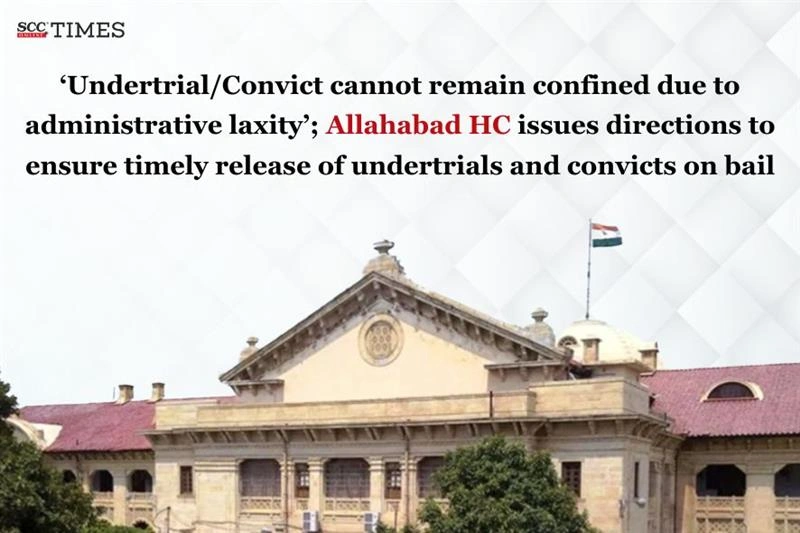
Allahabad High Court: In a bail application filed by an accused in an FIR filed against him under Sections 137(2) and 87 of the Bharatiya Nyaya Sanhita (“BNS”), 2023, by a father who claimed that he allegedly enticed his daughter to leave her home, the Single Judge Bench of Arun Kumar Singh Deshwal, J., allowed the application. Furthermore, the Court provided a set of directions to ensure the timely release of undertrials and convicts on bail after it is granted.
Background
The FIR was lodged by the father of the victim against the accused, claiming that he had enticed his daughter to leave her house.
The accused contended that the victim, in her statement under Section 183 of the Bharatiya Nagarik Suraksha Sanhita, 2023 (“BNSS”), stated that she left her house of her own volition. He further contended that no charge sheet had been filed, and he had been languishing in jail since 25-09-2025.
The complainant opposed the prayer for bail, but could not dispute the aforesaid facts.
Analysis
Considering the facts and circumstances of the case, submissions, nature of the offence, evidence, and complicity of the accused, and without expressing any opinion on the merits of the case, the Court held that the accused was entitled to be enlarged on bail.
Accordingly, the Court granted him bail on the condition that he shall furnish a personal bond and two sureties each in the like amount to the satisfaction of the Court concerned. The Court also imposed several other bail conditions on the accused.
Thereafter, the Court remarked that in several bail matters, the Court had directed the Office/Registrar (Compliance) to send a copy of the bail order to the accused persons through the Jail Superintendent in pursuance of the direction of the Supreme Court in Policy Strategy for Grant of Bail, In re, (2024) 10 SCC 685. However, the Court noted that the Registrar informed that due to a lack of sufficient information in the bail application regarding the jail where the accused were confined, it was difficult to directly send a copy of the bail order to the accused persons through the Jail Superintendent as per Policy Strategy for Grant of Bail (supra). Therefore, he had been sending the bail orders to the Inspector General of Prisons and the Chief Judicial Magistrate concerned to forward them to the accused persons.
While placing reliance on Policy Strategy for Grant of Bail (supra), the Court stated that the Jail Superintendent was required to enter the date of grant of bail in e-prison software immediately after receiving a copy of the bail order, but due to non-availability of the jail details, it had become difficult to directly send a copy of bail order to the accused persons. Therefore, the Court held that it was necessary that counsels in the Allahabad High Court, as well as in the Lucknow Bench of the Court, mention the details of the jail while filing bail applications during trial or during the pendency of an appeal.
The Court was further informed that direct access to the e-prison portal through a dedicated ID had not been provided to the Bail Section and Criminal Appeal Section by the National Informatics Centre (“NIC”) so that the bail orders could be directly sent to the jail concerned through the e-prison portal instead of e-mail.
Noting this, the Court remarked that the personal liberty of a person is a fundamental right under Article 21 of the Constitution. Therefore, a person cannot be deprived of their liberty, except by the procedure established by law.
“Once a Court grants bail to an undertrial or convict, then it is the right of that undertrial or convict to know about the bail order immediately, so that he/she does not remain confined in jail because of the laxity on the part of the judicial system, jail administration, or other instrumentality of the State.”
The Court further noted that there were several cases wherein, due to a lack of verification of sureties, an accused/undertrial or convict remained confined in prison, even after getting bail from the Court concerned.
“This Court is also conscious of the fact that some of the officials of the revenue department, as well as the police department, are involved in corrupt practice in the name of verification of sureties, which is a menace in the administration of justice.”
Thus, the Court directed that the verification of sureties shall be conducted in the Court premises through an electronic process, so that the accused/convict, after getting bail, does not remain in prison even for a single day.
Furthermore, the Court stated that it was aware that despite the initiation of sending the release order through electronic method in the pre-lunch session, the inmates were released in the evening after collecting the release orders, despite no provision in the Jail Manual allowing the authorities to keep the inmates in jail despite receiving the release order from the concerned Court. On the contrary, Rule 91 of the U.P. Jail Manual, 2002, provided for prompt compliance with the release order.
Considering the aforesaid, the Court issued the following directions in the spirit of the directions issued by the Supreme Court in Policy Strategy for Grant of Bail (supra):
-
Advocates shall mention the jail details in the bail application where the accused or convict was under incarceration to enable the Office/Bail Department of the Court to send the bail orders to the undertrial/convict immediately.
-
The Reporting Section of the Court is directed not to clear any bail application filed in the Court or its Bench at Lucknow after 01-12-2025, unless the detail is mentioned in the bail application regarding the jail where the applicant was under incarceration at present. Furthermore, notice of this direction shall also be given to Advocates through the Allahabad High Court Bar Association, and such notice shall also be pasted outside the Reporting Section, apart from notifying the same on the official High Court website.
-
The CPC, Allahabad High Court, shall coordinate with the NIC to get direct access to the e-prison portal through a dedicated ID in the concerned criminal sections so that bail orders from the High Court can be sent to the applicant (undertrial or convict) promptly through the Jail Superintendent, without any outside interference, which was possible in the e-mail mode. NIC was also directed to cooperate with the CPC, High Court, Allahabad, for the aforesaid issue.
-
The Additional Chief Secretary (Home), Secretariat, U.P. Government, shall issue a direction to the officials concerned for ensuring the establishment of electronic verification of sureties in the district Courts’ compound itself in coordination with the District Judge concerned.
-
The Director General (Prison) shall issue necessary directions to all prison authorities to release a jail inmate immediately after receiving the electronic release order through the Bail Order Management System (BOMS), instead of collecting the release orders from the Courts and then releasing the jail inmates in the evening.
Lastly, the Court directed the Registrar (Compliance) to send a copy of this order to the Chief Secretary, Additional Chief Secretary (Home), Director General (Prison), Deputy Director General, NIC (New Delhi), CPC of Allahabad High Court, Registrar (J) (Criminal), Registrar Criminal (D), Stamp Reporter of Allahabad High Court, and its Bench at Lucknow, for necessary compliance.
[Sohrab Alias Sorab Ali v. State of U.P., 2025 SCC OnLine All 7186, decided on 04-11-2025]
Advocates who appeared in this case:
For the petitioner: Satya Priya Dwivedi
For the respondent: Government Advocate
Buy Constitution of India HERE