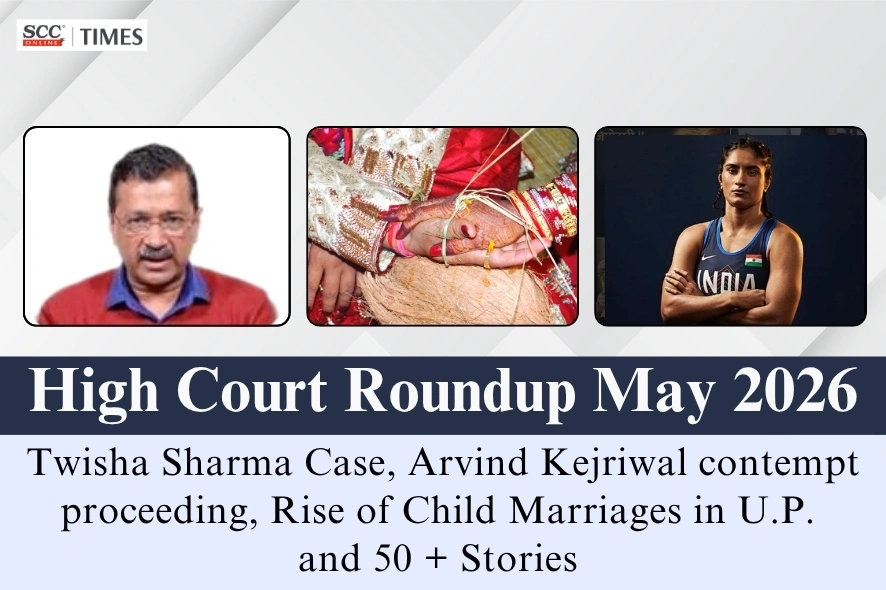
May 2026 was one of the busiest months in India’s High Courts. Contempt proceedings against political leaders for scandalising the judiciary. A YouTuber sentenced to six months for targeting judges on YouTube. Child marriages rising in Uttar Pradesh despite laws prohibiting them. A mother-in-law’s anticipatory bail quashed in a dowry death case with six ante-mortem injuries. Vinesh Phogat permitted to compete despite maternity. And 50 more rulings across criminal law, constitutional law, insolvency, intellectual property, family law, environment and taxation — from High Courts across India.
STORIES OF THE MONTH
Twisha Sharma Case: Six Ante-Mortem Injuries, Forced Abortion Allegations, Non-Cooperation — Why MP HC Quashed Mother-in-Law’s Anticipatory Bail
In State of M.P. v. Giribala Singh, 2026 SCC OnLine MP 12496, the Madhya Pradesh High Court quashed the anticipatory bail granted to mother-in-law (the respondent), considering the facts and the allegations levelled against her.
Read more HERE
Read previous order: MP HC issues notice to mother-in-law in Bhopal Dowry Death Case| SCC Times
Judges Do Not Hold Press Conferences and Have Very Limited Means to Protect Themselves: Judicial Silence in the Age of Social Media
In CBI v. Kuldeep Singh, 2026 SCC OnLine Del 3408, the Delhi High Court initiated the contempt proceeding against the respondents, holding that statements and conduct of the respondents, including Arvind Kejriwal, Manish Sisodia, Durgesh Pathak, Sanjay Singh, Devesh Vishwakarma, Saurabh Bharadwaj and others, prima facie amounted to scandalising the Court, lowering its authority, and obstructing administration of justice and fell within the ambit of criminal contempt under Section 2(c), Contempt of Courts Act, 1971 (the Act).
Read more HERE
Also Read: Del HC Initiates Contempt Proceedings Against Arvind Kejriwal | SCC Times
ALTERNATIVE DISPUTE RESOLUTION
Arbitration
1.08 Crore Decree Stayed in Akasa Air Dispute; Raises Concern Over Prima Facie Impression of AI use in Trial Court Judgment
In SNV Aviation (P) Ltd v. ABS Tour and Travels, 2026 SCC OnLine Del 2640, the Delhi High Court issued notice and stayed the operation of the impugned judgment, prima facie observing that the grant of the entire ticket revenue as loss of profits appeared untenable. The dispute arose out of a transaction wherein the respondent, a tour operator, had booked 640 airline tickets with the appellant, operating under the name “Akasa Air”.
Read more HERE
No Clause, No Deduction: Arbitral Award Set Aside Allowing MGCC Shortfall Deduction as Patently Illegal
In Primetals Technologies India (P) Ltd. v. SAIL, 2026 SCC OnLine Del 713, the Delhi High Court set aside the impugned order, holding that the arbitral award passed by the arbitrator was vitiated by patent illegality. The Court held that an arbitrator cannot permit deduction for MGCC shortfall from the invoices in absence of any clause in the contract permitting so.
Read more HERE
CONSTITUTIONAL LAW
No Right to Conduct Regular Religious Congregation on Public Land; Private Use Also Subject to Regulation
In Aseen v. State of U.P., 2026 SCC OnLine All 3689, the Allahabad High Court, noting the limits on religious practice under Articles 25 and 26, held that no individual can claim a right to use public land as an exclusive or recurring religious space, and even private property cannot be converted into an unregulated congregational venue and finding no enforceable legal right, dismissed the writ petition.
Read more HERE
Can be Evicted but Cannot be Left Without Schools, Buses and Water: Balancing Jhuggi Relocation and Article 21
In Khushnuma Khan v. Union of India, 2026 SCC OnLine Del 3265, while hearing a bunch of petitions arising from the proposed eviction and rehabilitation of residents of “Juggis and JJ Bastis”, the Delhi High Court upheld the Relocation of “Jhuggis and JJ Bastis” Residents to EWS Flats at Savda Ghevra, holding that mere eviction and rehabilitation at alternative accommodation would not violate the petitioners’ fundamental right to shelter and livelihood under Article 21 as long as the their interests were secured as per the mandate of DUSIB Policy and Protocol.
Read more HERE
Right to Information
No “Larger Public Interest”; Wife Cannot Use RTI to Access Husband’s Income Tax Details in Matrimonial Disputes
In Kapil Agarwal v. CPIO Income Tax Officer, Moradabad, 2026 SCC OnLine Del 2276, the Delhi High Court set aside the impugned order, holding that wife cannot use RTI to access husband’s income details. The Court held that personal financial information, including income details and tax returns, constitutes “personal information” under Section 8(1)(j), Right to Information Act, 2005 (RTI Act) and matrimonial disputes do not constitute “larger public interest”, therefore exempted from disclosure under the Act.
Read more HERE
Penalty under RTI Act Unsustainable Without Finding of Mala Fide: State Information Commission’s ₹25,000 Order Quashed
In T.A. Khan v. State of Chhattisgarh, 2026 SCC OnLine Chh 8128, the Chhattisgarh High Court held that the order passed by the State Information Commission (SIC) on 9 May 2022 was unsustainable in law. The Court emphasised that penalty under the RTI Act is unsustainable without a clear finding of mala fide denial of information or unreasonable delay without sufficient cause, and stressed that such provisions, being quasi-criminal in nature, cannot be invoked mechanically.
Read more HERE
CONTEMPT OF COURT
YouTuber Gulshan Pahuja sentenced to 6 months’ imprisonment for scandalising judiciary through “Fight 4 Judicial Reforms” videos
In Court on its own Motion v. Shiv Narayan Sharma, 2026 SCC OnLine Del 3863, a criminal contempt proceeding arising out of objectionable videos uploaded on the YouTube channel “Fight 4 Judicial Reforms”, the Delhi High Court sentenced contemnor Gulshan Pahuja to 6 months’ simple imprisonment along with fine after finding him guilty of scandalising the judiciary and lowering the authority of the courts through derogatory and malicious remarks against judicial officers and the judicial system.
Read more HERE
CRIMINAL LAW
FIR quashed over ‘Ya Allah! Rasgulla! Dahi Bhalla!’ remark; No offence under S. 295-A IPC
In Shekhar Suman v. State of Maharashtra, 2026 SCC OnLine Bom 2837, the Bombay High Court examined the content of the television programme “Comedy Circus Ka Jadoo” wherein the complaint alleged that the expressions “Ya Allah! Rasgulla! Dahi Bhalla!” used during the show offended religious sentiments. The Court held that these words, spoken in rhyme and comic effect, did not disclose any deliberate or malicious intent to outrage religious feelings as they are common food items consumed across communities and carry no religious colour. Concluding that the FIR lacked the essential ingredients of the offence and that sanction under Section 196, Criminal Procedure Code, 1973 (CrPC) had not been obtained, the Court quashed the FIR and all consequential proceedings.
Read more HERE
Mere Driving of Vehicle Insufficient to Establish “Constructive Possession” of Passenger’s Contraband; Bail Granted
In Saw Herald v. State of W.B., 2026 SCC OnLine Cal 4607, the Calcutta High Court held that the rigours of Section 37 were not prima facie attracted and granted bail to the petitioner subject to conditions.
Read more HERE
Caught Red-Handed Taking Bribe? No Prior Sanction Required Under S. 17A PC Act; Corruption Not an Act of Official Duty
In Achche Lal v. CBI, 2026 SCC OnLine All 3353, the Allahabad High Court upheld the impugned orders, holding that no additional sanction under Section 218 BNSS [erstwhile Section 197 Criminal Procedure Code, 1973 (CrPC)] is required once sanction under Section 19, Prevention of Corruption Act, 1988 (PC Act) has been granted, as acts of corruption cannot be treated as acts done in discharge of official duty and conspiracy under Section 61(2), Nagarik Suraksha Sanhita, 2023 (BNSS) is not independent of the substantive offence. It was further held that in trap cases where the accused is caught red-handed, prior sanction under Section 17-A, PC Act is not required, and subsequently the Court dismissed the petitions.
Read more HERE
Child Marriages Rising in U.P.: Allahabad HC Flags Systemic Gap, Directs DGP to Issue Guidelines
In Chahat Ansari v. State of U.P., 2026 SCC OnLine All 7655, the Allahabad High Court rejected the petition, holding that prima facie, ingredients of Sections 137(2) and 87, Nyaya Sanhita, 2023 (BNS), were clearly made out and a case has been made out against the accused persons. Remarking that child marriages were increasing in U.P. due to police inaction, the Court directed the Director General of Police, Uttar Pradesh, to issue necessary instructions, guidelines, circular letter, and Director General of Police (DGP) letter to all the Commissioners of Police/Senior Superintendent of Police/Superintendent of Police of Uttar Pradesh to ensure that appropriate action was taken whenever information about a child marriage comes to the knowledge of the police.
Read more HERE
Will Respect Maa Ganga for Life: Allahabad HC Grants Bail to Three More Men Accused of Throwing Non-Veg Food in River Ganga
In Danish Saifi v. State of U.P., 2026 SCC OnLine All 7607, Allahabad High Court allowed the applications, holding that a prima facie case for bail was made out. The Court stated that the accused showed genuine remorse for their actions, and the apology note appeared heartfelt. Furthermore, the Court noted that it had similarly granted bail to the co-accused persons while considering the period of detention, lack of criminal antecedents, and the apology.
Read more HERE
Sushanta Dhalasamanta released on Bail in 2004 Murder Case After a Decade of Incarceration
In Sushanta Dhalasamanta v. State of Orissa, 2026 SCC OnLine Ori 2136, while hearing a bail application filed under Section 483, Nagarik Suraksha Sanhita, 2023 (BNSS), seeking release in connection with a sessions trial involving charges under the Sections 302, 120-B and 34, Penal Code, 1860 (IPC) and Sections 25 and 27, Arms Act, 1959 (Arms Act) provisions, a Single Judge Bench of G. Satapathy, J., held that the petitioner was entitled to bail after spending more than 10 years in custody without conclusion of trial. The Court emphasised that denial of a speedy trial infringes the fundamental right guaranteed under Article 21 of the Constitution, and however grave the offence, an accused cannot be kept in jail indefinitely.
Read more HERE
“Involvement merely based on accused persons’ statements”; Withdrawal of prosecution against MLA Ram Chander in 2012 Riot Case allowed
In Ram Chander Yadav v. State of U.P., 2026 SCC OnLine All 4762, the Allahabad High Court allowed the application, holding that it could not be said that opinion for withdrawal of the prosecution was not taken and, therefore, the trial court wrongly presumed that the opinion of the Public Prosecutor was not obtained. The Court also noted that the withdrawal application filed under Section 321, Criminal Procedure Code, 1973 (CrPC), appeared to be filed by the Public Prosecutor in good faith after careful consideration of the material available on record.
Read more HERE
Magistrate Cannot Impose Foreign Travel Restriction Years After Grant of Bail by “Clarifying” Original Order
In Shabir Momin v. State (NCT of Delhi), 2026 SCC OnLine Del 4287, decided on 29-5-2026, the Delhi High Court set aside the impugned order and reiterated that a Magistrate has no jurisdiction to review or modify a bail order once passed, except as permitted by law. The Court held that the introduction of a foreign travel restriction several years after grant of bail amounted to an impermissible review of the original bail order, which was barred under Section 362, Criminal Procedure Code, 1973 (CrPC).
Read more HERE
Subsequent Breakdown of Marriage No Ground to Revive Quashed Rape FIR
In Ashwini Pal v. State, 2026 SCC OnLine Del 4058, the Delhi High Court refused to recall the impugned quashing order, holding that the impugned order had not been procured by fraud and that the present application merely sought reopening of a concluded criminal proceeding on the basis of subsequent matrimonial discord.
Read more HERE
‘Too Soon to Rule Out Criminality’: Punjab & Haryana HC Rejects Madhu Kishwar’s Anticipatory Bail Plea in PM Modi Video Case
In Madhu Purnima Kishwar v. Union Territory, Chandigarh1, decided on 29-5-2026, the Punjab & Haryana High Court dismissed the petition holding that the investigation was still at a nascent stage and the petitioner had failed to make out a case for grant of the extraordinary relief of pre-arrest bail.
Read more HERE
Shutters Down, ‘Emergency Windows’ Open: Rajasthan HC Takes Suo Motu Cognizance of After-Hours Liquor Sales in Jodhpur; Issues Interim Directions
In Systemic Violations of Liquor Closing Hours and Excise Regulations in Jodhpur City, In re, 2026 SCC OnLine Raj 3475, decided on 22-5-2026, the Rajasthan High Court held that the same directly infringed upon the right to live with dignity and in a safe environment under Article 21 of the Constitution and undermined the State’s obligation under Article 47 to protect public health.
Read more HERE
CUSTOMS, EXCISE AND SERVICE TAX
Customs Broker Not to Be Penalised for Mis-Description While Filing Shipping Bills
In Seaswan Shipping & Logistics v. Commr. of Customs, 2026 SCC OnLine Mad 3627, the Madras High Court set aside the order passed by the Customs, Excise and Service Tax Appellate Tribunal (CESTAT), Chennai, holding that a mere mis-description of the classification will not attribute mens rea to impose penalty under Section 114-AA, Customs Act, 1962 (Customs Act). The Tribunal was wrong in invoking Sections 28 and 28-AAA, Customs Act, and since Merchandise Exports from India Scheme (MEIS) scrips were granted by Directorate General of Foreign Trade (DGFT), the Customs Department did not have jurisdiction to initiate action against the appellant.
Read more HERE
EDUCATION LAW
‘Teach constitutional journey through lives who shaped it’: State directed to include Dr B.R. Ambedkar in TN school curriculum
In G. Rajesh v. State of T.N.2, the Madras High Court on being fully satisfied that the petitioners displayed genuine regret and remorse, stated that the present matter has moved beyond the stage of mere compromise. Thus, the Court quashed the criminal proceedings against the petitioners. Further, the Court emphasised that schools should not teach the Constitution as mere facts, rather, teach the constitutional journey of India through the lives of those who shaped it. Among them, Dr B.R. Ambedkar stands foremost.
Read more HERE
Visa Delays, Expired Deadlines, State Inaction: Rajasthan HC Holds Scholarship Cannot Be Denied to Student Who Never Started His Studies
In Aditya Sharma v. State of Rajasthan, 2026 SCC OnLine Raj 3423, decided on 20-5-2026, the Rajasthan High Court allowed the appeal and set aside the impugned order, holding that the condition related to change of university or course, under Clause 13(xiv) and (xv), Swami Vivekanand Scholarship for Academic Excellence Yojana Guidelines 2025 (Guidelines 2025), that it can be availed only once during the studies, is applicable only if the student has started his studies and scholarship has been granted and utilised in a particular institute and then the student has shifted to another university or upgraded to a higher course. The Court held that the action of the respondents denying the grant to the appellant was a case of the misconception and misunderstanding of the provisions of the Guidelines 2025.
Read more HERE
EVIDENCE LAW
Unreliable DNA, Doubtful Victim Testimony, Contradictions, Delay, No TIP: Bombay HC Acquits Rape Accused as Investigation Lapses Pile Up
In Afzal Khan v. State of Goa, 2026 SCC OnLine Bom 3290, the Bombay High Court held that the prosecution failed to prove the offence of rape beyond reasonable doubt. The Court emphasised that contradictions in the victim’s statements, unexplained delay in lodging the FIR, absence of a Test Identification Parade (TIP), inconsistencies in medical evidence, and lapses in the investigation cumulatively rendered the prosecution case unreliable. The Court noted that DNA evidence failed to corroborate the prosecution’s case and, being neither conclusive nor sufficient on its own, could not sustain conviction. Accordingly, the appellant was acquitted and ordered to be set at liberty forthwith unless required in custody in any other proceeding.
Read more HERE
ENVIRONMENTAL LAW
Wildlife Poaching
“International gang of wildlife poachers & traffickers”: Madhya Pradesh HC denies bail to alleged pangolin poacher, noting prima facie involvement
In Yangchen Lachungpa v. State of M.P., 2026 SCC OnLine MP 9017, the Madhya Pradesh High Court dismissed the application, holding that the record suggested the accused’s prima facie involvement in the crime. Additionally, the apprehension that she might not be available for trial appeared well-founded.
Read more HERE
A Parking Dispute at Yamuna Sur Ghat Brought a Ban on All Commercial and Religious Activities on Flood Plains
In a writ petition titled Suresh Kumar v. DDA, 2026 SCC OnLine Del 3559, the Delhi High Court disposed of the petition with directions that no commercial or parking activity shall be permitted on the Yamuna Flood Plains area in question; DDA should protect the ecologically sensitive land from any such use; and alternative parking arrangements, if required, may be made away from the flood plains.
Read more HERE
FAMILY AND PERSONAL LAW
“Illegal But Not Immoral”: Family Pension Granted to Second Wife, Held Economically Dependent Spouse Cannot Be Left Destitute
In Umawati v. H.P. SEB, 2026 SCC OnLine HP 3298, the Himachal Pradesh High Court held that although the marriage between the appellant and the deceased employee (deceased) was held to be illegal under Section 5(i), Hindu Marriage Act, 1955 (HMA), it could not be treated as immoral. The Court set aside the impugned judgment and granted the family pension despite void marriage, emphasising social justice and economic empowerment of women.
Read more HERE
No Embassy NOC Needed for Marriage with Foreign National
In X v. State of Kerala, 2026 SCC OnLine Ker 4528, a writ petition challenging the refusal of Sub-Registrar (Marriage) to process and solemnise an intended marriage under the Special Marriage Act, 1954 (1954 Act), a Single Judge Bench held that a no-objection certificate (NOC) from the Embassy is not required for solemnising a marriage with a foreign national under the 1954 Act. The Court directed the Sub-Registrar to solemnise the marriage without insisting on an Embassy-issued NOC or any additional documents.
Read more HERE
Daughter-in-Law’s Right of Residence in Shared Household
In Ritu Taneja v. State (NCT of Delhi), 2026 SCC OnLine Del 3199, while hearing a writ petition challenging an eviction order passed under the Maintenance and Welfare of Parents and Senior Citizens Act, 2007 (Senior Citizens Act, 2007), a Single Judge Bench dismissed the plea filed by a widow and her son against eviction from their in-laws’ property, holding that proceedings under the Senior Citizens Act,2007 are intended to secure peaceful residence and dignity of senior citizens and cannot be converted into a forum for adjudication of complex civil disputes relating to inheritance, ancestral property, ownership rights or financial entitlements. The Court reiterated that although a daughter-in-law may possess a right of residence in a “shared household” under the Protection of Women from Domestic Violence Act, 2005, such right is merely protective in nature and does not create any proprietary interest in the property of the in-laws, particularly where continued cohabitation has become unworkable and the senior citizens’ right to peaceful enjoyment of their property stands affected.
Read more HERE
HUMAN AND CIVIL RIGHTS
Bombay HC Directs Maharashtra to Frame Salary Grant Policy for NGO-Run children’s homes
In Yuvraj v. State of Maharashtra, 2026 SCC OnLine Bom 2853, while hearing writ petitions filed by employees of children’s homes managed by unaided NGOs, seeking salary grants and pay scales equivalent to those of government employees, the Division Bench of Bombay High Court held that such employees are entitled to salary support. The Court emphasised that the State cannot evade its constitutional obligations under Articles 14, 21 and 39(f) of the Constitution and directed the Government to frame, within six months, a policy for providing salary grants to deserving NGOs functioning strictly in compliance with the Juvenile Justice (Care and Protection of Children) Act, 2015 (2015 Act).
Read more HERE
INSOLVENCY AND BANKRUPTCY LAW
Section 14 IBC Moratorium a Protective Shield Against Asset Depletion; Statutory Authorities Cannot Recover Leasehold Property During CIRP
In Gujarat Industrial Development Corpn. v. Gujarat Hydrocarbons and Power SEZ Ltd., 2026 SCC OnLine Guj 2517, the Gujarat High Court affirmed the judgment of the Single Judge and dismissed the appeal holding that once a moratorium under Section 14, Insolvency and Bankruptcy Code, 2016 (IBC) comes into force, a lessor, including a statutory authority, cannot terminate a subsisting lease or seek recovery of possession of leased premises occupied by the corporate debtor, even if such an action is based on alleged contractual breaches, non-utilisation of land or non-payment of pre-CIRP dues. The Court further held that, leasehold rights constitute “property” within the meaning of Section 3(27) IBC and are protected under Section 14(1)(d), and further, by virtue of Section 238 IBC, the provisions of the Code would override the PP Act rendering any eviction action during the moratorium legally unsustainable
Read more HERE
Who is a ‘Secured Creditor’ Under IBC? Not the VAT Authority; Attachment of Property Quashed
In Avenue Realty v. Commr., 2026 SCC OnLine Mad 3739, the Madras High Court set aside the impugned order affirming the order of attachment made by the authority under the Tamil Nadu Value Added Tax Act, 2006 (TNVAT Act), for VAT dues by the corporate debtor, holding that the authorities under the TNVAT Act are not secured creditors and VAT dues cannot be recovered as if they were dues payable to a secured creditor. Once the National Company Law Tribunal (NCLT) has ordered liquidation under Section 33, Insolvency and Bankruptcy Code, 2016 (IBC) and a statutory liquidator has been appointed, the assets of the corporate debtor are dealt with as per Section 53 IBC, i.e. “waterfall mechanism”.
Read more HERE
INTELLECTUAL PROPERTY
Plagiarism
Filmmaker Claims Dhurandhar 2 Copied His Script: Here’s Why Dismissed Plea to Revoke CBFC Certification
In Santosh Kumar R.S. v. Aditya Dhar, 2026 SCC OnLine Kar 2943, the Karnataka High Court held that merely because a film was certified under Section 5-A, Cinematograph Act, 1952 (Cinematograph Act), the same could not be interfered with under Article 226 of the Constitution, on the ground of alleged plagiarism, particularly when such allegations pertains to private proprietary rights disputes, which require trial. Accordingly, the Court dismissed the said petition.
Read more HERE
Copyright
Delhi HC Refuses Injunction Over Remixed “Tirchi Topiwale” in Dhurandhar 2
In Trimurti Films (P) Ltd. v. B62 Studios (P) Ltd., 2026 SCC OnLine Del 3452, while hearing an application under Order 39 Rules 1 and 2, Civil Procedure Code, 1908 (CPC) seeking interim injunction in a copyright infringement dispute concerning the iconic song “Tirchi Topiwale” from the film Tridev, a Single Judge Bench declined to restrain the defendants from further use and exploitation of the remixed version of the song in the cinematograph film Dhurandhar: The Revenge. The Court held that a party invoking equitable and discretionary jurisdiction must approach the Court with clean hands and cannot suppress material facts having a bearing on the grant of interim relief.
Read more HERE
Patent
“What Cannot be Done Directly Cannot be Done Indirectly”: Delhi HC Refuses Belated Amendment of Priority Date to Revive Deemed Withdrawn Patent Application
In Neurocentria Inc. v. Controller of Patents & Designs, 2026 SCC OnLine Del 3970, the Delhi High Court upheld the impugned order and reiterated that the timelines prescribed under the Patents Act, 1970 and the Patent Rules, 2003 for filing national phase applications and RFEs are mandatory and non-extendable in nature.
Read more HERE
Trade mark
Toyota’s “ALPHARD” declared a well-known trade mark in India
In Toyota Jidosha Kabushiki Kaisha v. Tech Square Engg. (P) Ltd., 2026 SCC OnLine Del 2617, a Letters Patent Appeal arising from the dismissal of rectification petitions under Section 57, Trade Marks Act, 1999 (TMA), concerning the trade mark “ALPHARD”, the Division Bench reversed the decision of the Single Judge and held that Toyota had successfully established prior adoption, transborder reputation, and spillover goodwill of the mark in India prior to Respondent 1’s registration. The Court further held that the mark “ALPHARD” had acquired the status of a well-known trade mark in India and that Respondent 1’s adoption of an identical mark in relation to allied and cognate goods lacked bona fides and was likely to cause confusion. Consequently, the Court declared the impugned registrations invalid and directed their removal from the Register of Trade Marks.
Read more HERE
LABOUR AND EMPLOYMENT LAW
Corruption Charge Not Proved, Yet Employee Removed: Delhi HC Sets Aside Penalty, Directs Reinstatement
In Rajesh Choudhary v. Union of India, 2026 SCC OnLine Del 2028, the Delhi High Court held that failure of core charge in disciplinary proceedings, i.e., corruption under Article III, vitiated the penalty of removal from service and punishment must be reassessed on surviving minor charges under Article I and limited part of Article II. The Court set aside the disciplinary order dated 29 November 2022 and the appellate decision dated 31 August; quashed the findings of corruption under Article III and the “sleeping on duty” allegation under Article II; directed the reinstatement of the petitioner with continuity of service, while monetary benefits were kept open. It further permitted the respondents to reconsider the penalty only on the surviving charges on the existing record, only after granting an opportunity of hearing to the petitioner.
Read more HERE
LAND AND REVENUE LAW
Government cannot “pick and choose” judgments to accept or assail later as it undermines the principle of finality
In State (UT of J&K) v. Ravinder Kanta, 2026 SCC OnLine J&K 287, the Jammu & Kashmir and Ladakh High Court held that the Government cannot “pick and choose” judgments to accept or assail later as it undermines the principle of finality. The Court observed that the condition of obtaining prior permission for alienation, as stipulated in the GO, stood rendered otiose and could not be insisted upon, and therefore upheld the judgment of the writ court.
Read more HERE
MOTOR VEHICLES
No Medical Certificate, No Disability: 50% Disability Finding Based on Fractured Vertebrae Rejected
In New India Assurance Co. Ltd. v. Gyandup Tshering Lepcha, 2026 SCC OnLine Sikk 28, the Sikkim High Court set aside the order passed by the Motor Accidents Claims Tribunal (MACT), Gangtok, where the compensation of Rs 29,12,887 with interest at 6 per cent per annum was awarded to the respondent citing 50 per cent permanent disability. The Court held that fractured ribs, hip dislocation and vertebral fracture cannot lead to 50 per cent disability, in the absence of any medical or disability certificate.
Read more HERE
Housewife’s Contribution Grows with Age, Future Prospects Cannot be Ignored: Karnataka HC Enhances Motor Accident Compensation
In Arasu N. v. Nagappa, 2026 SCC OnLine Kar 2990, the Karnataka High Court modified the impugned award and judgment by the Motor Accident Claims Tribunal, enhancing the compensation to 10,02,888. The Court took into consideration the future prospects of the family while assessing compensation.
Read more HERE
POCSO
“Not a single whisper of force”: POCSO Case Quashed After Accused Marries Minor Prosecutrix, Now 7 Months Pregnant
In Vijay Laxman Rotke v. State of Maharashtra3, the Bombay High Court quashed the POCSO case citing subsequent marriage, pregnancy and lack of force allegations by the prosecutix and held that the criminal proceedings against the accused and his parents must be ended in the interest of complete justice.
Read more HERE
RESERVATION
Unfilled Reserved Vacancies Must Go to Other Reserved Categories in Proportion, Not on Common Merit List
In Nikhil Ashok Dumane v. Police Recruitment Board, 2026 SCC OnLine Bom 2817, decided on 30-4-2026, the Bombay High Court examined whether vacancies in Vimukta Jatis [VJ(A)] and Nomadic Tribes [NT(D)] categories left unfilled due to non-availability of suitable candidates should be filled by preparing a common merit list of (NT) (B) and NT(C) candidates or by distributing them proportionately according to reservation percentages. The Court held that proportional distribution was the correct method under Section 4(3), Maharashtra State Public Services Reservation for Scheduled Castes, Scheduled Tribes, De-Notified Tribes (Vimukta Jatis), Nomadic Tribes, Special Backward Category and other Backward Classes Act, 2001 (Act of 2001), and dismissed the petitions.
Read more HERE
SCs, STs, OBCs AND MINORITIES
SC/ST Act Cannot Be Used Against a Member of a Scheduled Tribe: MP HC Grants Anticipatory Bail to ‘Goud’ Community Accused
In Mulam Singh Gond v. State of M.P., 2026 SCC OnLine MP 12495, the Madhya Pradesh HC allowed the appeal and granted anticipatory bail to the appellant considering the fact that the only allegation against the appellant was that he was driving the car when the prosecutrix was being taken by the co-accused, for which he made a representation to police but they could not examine and verify the CCTV footage, and since appellant was a government employee and co-operated with the investigation, there was no apprehension of absconding or tampering with the evidence.
Read more HERE
SERVICE LAW
Can a Railway Employee Claim HRA After Building His Own House and Vacating the Railway Quarter?
In Kandarpa Kanta Sarma v. Union of India, 2026 SCC OnLine Gau 3274, the Gauhati High Court held that railway employees are not entitled to HRA where vacant government quarters in the entitled category are available, but failed to apply for allotment as required under the applicable letters/circulars; an illegal grant of HRA to other employees cannot be relied upon to claim parity.
Read more HERE
Pension Withheld Permanently Following Conviction — No Show-Cause Notice, No Opportunity of Being Heard; Unreasoned Order Quashed
In a writ petition titled Ramjilal Jangid v. Rajasthan State Road Transport Corporation Jaipur, 2026 SCC OnLine Raj 3371, where the order, withholding permanently the previously sanctioned pension to the petitioner, passed by the respondents in exercise of powers under Regulation 4, Rajasthan State Road Transport Corporation Employees’ Pension Regulations, 1989, was challenged, the Rajasthan High Court set aside the impugned order holding that that the order suffers from complete non-application of mind and is not a reasoned administrative order and that compliance of principles of natural justice is implicit before passing such an adverse order.
Read more HERE
SPORTS LAW
Challenge to AITA Elections Dismissed; Orders Fresh Polls Under National Sports Governance Act, 2025
In Anil Dhupar v. Chintan N. Parikh, 2026 SCC OnLine Del 1950, the Delhi High Court dismissed the petition as devoid of merit, holding that the petitioner’s disqualification was in accordance with the applicable rules and did not suffer from arbitrariness or illegality.
Read more HERE
Motherhood Can’t Be Ground to Exclude Women Athletes from Competitive Sport; Delhi HC Permits Vinesh Phogat to Participate in 2026 Asian Games Trials
In Vinesh Phogat v. Wrestling Federation of India, 2026 SCC OnLine Del 3925, the Delhi High Court permitted the appellant to participate in the Selection Trials for Asian Games 2026, scheduled for 30 May 2026 and 31 May 2026, thereby reinforcing the constitutional guarantee that maternity cannot become a basis for exclusion or disadvantage in professional or sporting careers.
Read more HERE
TAXATION LAW
“[1] Others” Not a Clear Reason: Non-Speaking GST Registration Cancellation Order Quashed
In Yamang Siram v. Union of India, 2026 SCC OnLine Gau 3151, while hearing a writ petition filed under Article 226 of the Constitution, against the order passed by the Proper Officer, which cancelled the GST Registration of the petitioner under the Goods and Services Tax Act, 2017, was allowed by a Single Judge Bench and the impugned order was set aside on the grounds of not being a speaking order as it was found to be passed arbitrarily, without recording reasons and due application of mind.
Read more HERE
1. CRM-M-30428-2026 (O&M)
2. Crl.OP(MD)No. 22813 of 2025, decided on 30-4-2026
3. Criminal Application (Apl) No. 394 of 2026, decided on 29-4-2026