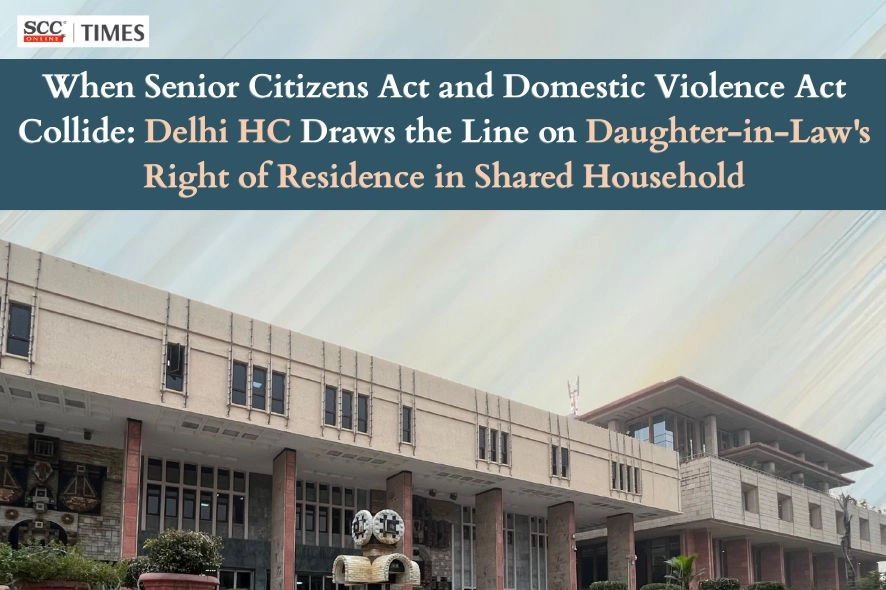
Delhi High Court: In a writ petition challenging an eviction order passed under the Maintenance and Welfare of Parents and Senior Citizens Act, 2007 (Senior Citizens Act, 2007), a Single Judge Bench of Purushaindra Kumar Kaurav, J., dismissed the plea filed by a widow and her son against eviction from their in-laws’ property, holding that proceedings under the Senior Citizens Act,2007 are intended to secure peaceful residence and dignity of senior citizens and cannot be converted into a forum for adjudication of complex civil disputes relating to inheritance, ancestral property, ownership rights or financial entitlements. The Court reiterated that although a daughter-in-law may possess a right of residence in a “shared household” under the Protection of Women from Domestic Violence Act, 2005, such right is merely protective in nature and does not create any proprietary interest in the property of the in-laws, particularly where continued cohabitation has become unworkable and the senior citizens’ right to peaceful enjoyment of their property stands affected.
Background
The present case arose out of a dispute between a widow and her in-laws concerning residence and eviction from property bearing No. B-3/81, Safdarjung Enclave, New Delhi. Petitioner 1 married Late Pankaj Taneja on 11 September 2000 and, after marriage, started residing on the first floor of the subject property along with her husband, who also operated a grocery business from a portion of the ground floor. According to the petitioners, the family business and properties were being managed jointly and assurances had been extended by Respondent 2, the father-in-law, regarding distribution of family assets amongst his sons. The petitioners further relied upon a registered Will dated 29 January 2021 allegedly executed by Respondent 2 in favour of the children of Petitioner 1.
Following the death of Petitioner 1’s husband, disputes arose between the parties. Thereafter, the respondents/in-laws initiated proceedings under the Senior Citizens Act, 2007 by filing a complaint dated 9 November 2020 before the District Magistrate seeking eviction of the petitioners from the property on allegations of ill-treatment and interference with their peaceful living. During the inquiry, the Sub-Divisional Magistrate submitted a report dated 8 December 2021 noting that ownership of the property vested exclusively in Respondent 2. By order dated 12 April 2022, the Maintenance Tribunal partly allowed the complaint and directed the petitioners to vacate the ground floor portion of the property, while observing that although allegations of harassment and neglect were not conclusively proved, the petitioners’ conduct was affecting the senior citizens’ peaceful enjoyment of the premises.
Aggrieved by the said order, both sides preferred appeals before the Divisional Commissioner. While the respondents sought eviction of the petitioners from the entire property, the petitioners challenged the limited eviction order by asserting their right of residence in the shared household and raising claims concerning the estate and assets of the deceased husband. By the impugned common order dated 28 August 2023, the Divisional Commissioner allowed the appeal preferred by the respondents and dismissed the appeal filed by the petitioners, holding that the relationship between the parties had deteriorated beyond repair and that disputes relating to inheritance, property rights and financial entitlements could not be adjudicated within the limited scope of proceedings under the Senior Citizens Act, 2007. Consequently, the petitioners were directed to vacate and hand over peaceful possession of the entire property, including the ground floor shop, to the respondents, which led to the institution of the present writ petition before the High Court.
Analysis
The Court, before examining the merits of the dispute, undertook an analysis of the statutory framework under the Senior Citizens Act, 2007. The Court reiterated that the enactment is a beneficial and welfare-oriented legislation intended to secure dignity, autonomy and peaceful living for senior citizens, particularly in situations involving neglect, abuse or dispossession at the hands of children or relatives. It was observed that the Act, read with the Delhi Maintenance and Welfare of Parents and Senior Citizens Rules, 2009, empowers the District Magistrate and Appellate Authority to pass eviction orders where the right of senior citizens to peacefully reside in and enjoy their property stands threatened. The Court further emphasised that proceedings under the Act are summary in nature and are not intended to adjudicate complex civil disputes relating to title, inheritance, co-ownership, ancestral property or competing proprietary claims, which fall exclusively within the jurisdiction of competent civil courts.
Applying the aforesaid principles, the Court noted that Respondent 2 and 3 were undisputedly senior citizens and recorded owners of the subject property, and the petitioners had failed to place any material on record to dislodge such ownership in proceedings of a summary character. The Court observed that relations between the parties had become irretrievably strained and that continued cohabitation had become wholly unworkable. It was further held that the petitioners’ assertions were essentially founded on alleged rights in LIC policies, family assets and properties purportedly arising out of ancestral business arrangements, thereby revealing the dispute to be substantially civil in nature and beyond the limited scope of inquiry permissible under the Senior Citizens Act,2007.
In dealing with the plea of “shared household” under Section 2(s) of the Protection of Women from Domestic Violence Act, 2005, the Court referred to the decisions in S. Vanitha v. The Deputy Commissioner, Respondents Bengaluru Urban District, (2021) 15 SCC 730, and Satish Chander Ahuja v. Sneha Ahuja, (2021) 1 SCC 414. The Court reiterated that while a daughter-in-law possesses a statutory right of residence in a shared household under the Domestic Violence Act, such right is merely protective in nature and does not create any proprietary or ownership interest in the property belonging to the in-laws. The Court observed that the rights of a daughter-in-law must be balanced harmoniously with the right of senior citizens to live peacefully and with dignity in their own property. However, in the present case, the Court found that Petitioner 1 was neither destitute nor economically vulnerable, being a gainfully employed Government teacher with an independent source of income, and her children were also grown up. The Court further noted that the petitioners were already in possession of alternative accommodation at Khirki Extension and that Respondent 2 had expressed willingness to hand over documents relating to the said property, along with two plots in Faridabad, subject to vacation of the subject property.
The Court further held that disputed questions concerning the alleged ancestral nature of the properties, existence of any coparcenary rights, beneficial interests, or entitlement under LIC policies required detailed examination of documentary and oral evidence and could not be adjudicated in proceedings under the Senior Citizens Act. Such claims, according to the Court, could not constitute a legally sustainable defence against an eviction order passed for securing the peaceful residence of senior citizens.
Considering the limited scope of interference under Article 227 of the Constitution, the Court held that the impugned common order passed by the Divisional Commissioner did not suffer from any patent illegality, perversity or arbitrariness warranting judicial interference. The Court found that the Appellate Authority had duly considered the factual matrix, rival submissions and the object of the statute before directing eviction of the petitioners from the entire property.
Decision
Consequently, the writ petition was dismissed and the Court directed the respondents/in-laws to deposit documents relating to the alternative accommodation at Khirki Extension and the Faridabad properties before the Divisional Commissioner within thirty days. The petitioners were directed to vacate the subject property within forty-five days thereafter. The Court also restrained both parties from creating third-party rights in either the vacated property or the alternative accommodation without permission of the competent court.
Also Read: Bom HC: Eviction under Senior Citizens Act invalid when no maintenance sought | SCC Times
[Ritu Taneja v. State (NCT of Delhi), 2026 SCC OnLine Del 3199, decided on 8-5-2026]
Advocates who appeared in this case:
For the Petitioner: Mouli Bhattacharjee, Advocates
For the Respondent: Avni Singh, Panel Counsel-GNCTD, Archana Gaur, DHCLSC, Ms. Ridhima Gaur, Vaibhav Sharma, Deepu Kumar, Advocates