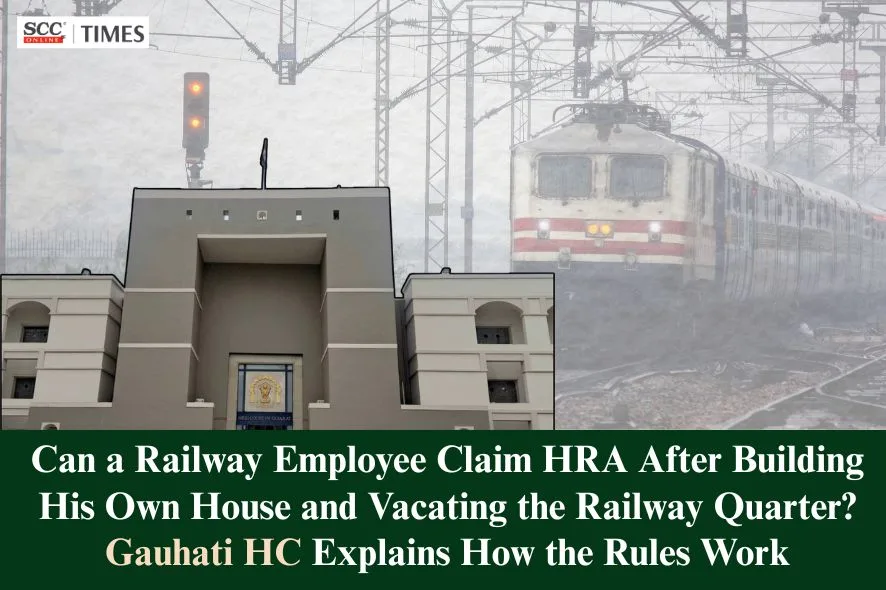
Gauhati High Court: In a petition assailing the Central Administrative Tribunal’s (CAT) order, which held the petitioner ineligible for House Rent Allowance (HRA) on the ground that vacant government quarters were available for allotment, the Division Bench of Michael Zothankhuma and Kaushik Goswami, JJ., held railway employees are not entitled to HRA where vacant government quarters in the entitled category are available, but failed to apply for allotment as required under the applicable letters/circulars; an illegal grant of HRA to other employees cannot be relied upon to claim parity.
Background
The petitioner, an employee of the Northeast Frontier Railway, had been occupying a Class/Type-II railway quarter allotted to him during service. After constructing his own residential house, he vacated the official accommodation and shifted to his private residence. He thereafter claimed HRA from 25 September 2007, i.e., the date on which the vacated quarter was allotted to another railway employee. Though HRA was granted to him from 14 July 2009 onwards, his claim for HRA for the period between 25 September 2007 and 13 July 2009 was rejected on the ground that vacant Class/Type-IV quarters were available for allotment and that he had not applied for such allotment as required under the applicable Railway Circulars.
Aggrieved, he approached the CAT, which rejected his claim, leading to the present writ petition.
Issues
Whether the petitioner was entitled to be granted HRA with effect from 25 September 2007 till 13 July 2009, i.e., from the date the petitioner vacated his official accommodation to move into his own private residence?
Analysis and Decision
At the outset, the Court observed that in the Railway Board Letter/Circular dated 7 June 1988, there was no absolute bar to the grant of HRA merely because a railway employee had not applied for accommodation, refused allotment, or subsequently surrendered the allotted accommodation. However, the Court noted that HRA would not be admissible if vacant residential units remained available for allotment as a result of such refusal, surrender, or non-application.
The Court noted that, as per the letter/circular, HRA upon surrender of accommodation would become payable only from the date on which the Accommodation Controlling Authority certified that no accommodation in the entitled class was available for allotment.
The Court observed that, applying the circular to the facts of the case, the petitioner had voluntarily surrendered the Class/Type-II accommodation after constructing his private residence and had never objected to the class of accommodation allotted to him.
The Court stated that the petitioner could not claim HRA until accommodation in the entitled class became unavailable for allotment. Accordingly, the Court held that the issue of the availability of vacant Class/Type-IV accommodation during the relevant period was crucial in determining the petitioner’s entitlement to HRA.
The Court noted that there was no challenge to the applicability of the Letters/Circulars dated 7 June 1988 (issued by Director, Establishment (P&A), Railway Board) and 9 May 2003 (issued by the Jt. Director, Estt. (P&A) Railway Board) to the petitioner and other Railway Officers. The Court held that if the number of eligible officers exceeded the available Type-IV quarters, the petitioner would be entitled to HRA from the date of eligibility. However, where more Type-IV quarters were available than eligible officers, the petitioner was required to apply for allotment, failing which HRA could be denied. Since the petitioner had admittedly not applied for allotment of a Type-IV quarter, the Court examined the Government communication dated 23 March 2011 to ascertain the number of vacant Type-IV quarters and eligible officers during the relevant period.
The Court observed that the letters/circulars did not distinguish between officers having their own residence and those who did not, and therefore, eligible Railway Officers needed to apply for vacant quarters. The Court noted that under the Letter/Circular dated 7 June 1988, HRA could be granted to officers who did not apply for accommodation, refused allotment, or surrendered accommodation only where the number of available units was less than the number of eligible employees.
The Court, in the present matter, held that since the number of vacant Type-IV quarters exceeded the number of eligible officers, the petitioner, who had admittedly not applied for allotment, was not entitled to HRA for the said period. The Court further held that even on the presumption that certain other officers had wrongly been granted HRA, the petitioner could still not claim parity on the ground of discrimination, as that would amount to perpetuating an illegality.
The Court held that, since there were more vacant Type-IV quarters than eligible officers and the petitioner had not applied for allotment of such quarters, there were no grounds to interfere with the CAT’s order denying HRA for the said period.
Accordingly, the Court dismissed the petition, upholding the CAT’s decision and directed that since the HRA for the disputed period had been paid to the petitioner pursuant to the order dated 30 January 2019 in the Review Petition, which was expressly subject to further orders, there was no justification for the petitioner to retain the said amount. Accordingly, the Court directed the petitioner to return the HRA paid to him for the period 25 September 2007 to 13 July 2009 to the respondents within one month from the date of receipt of the order.
[Kandarpa Kanta Sarma v. Union of India, 2026 SCC OnLine Gau 3274, decided on 15-5-2026]
Advocates who appeared in this case:
For the petitioner: M.P. Sharma, Advocate
For the respondents: S.K. Chakraborty, Advocate