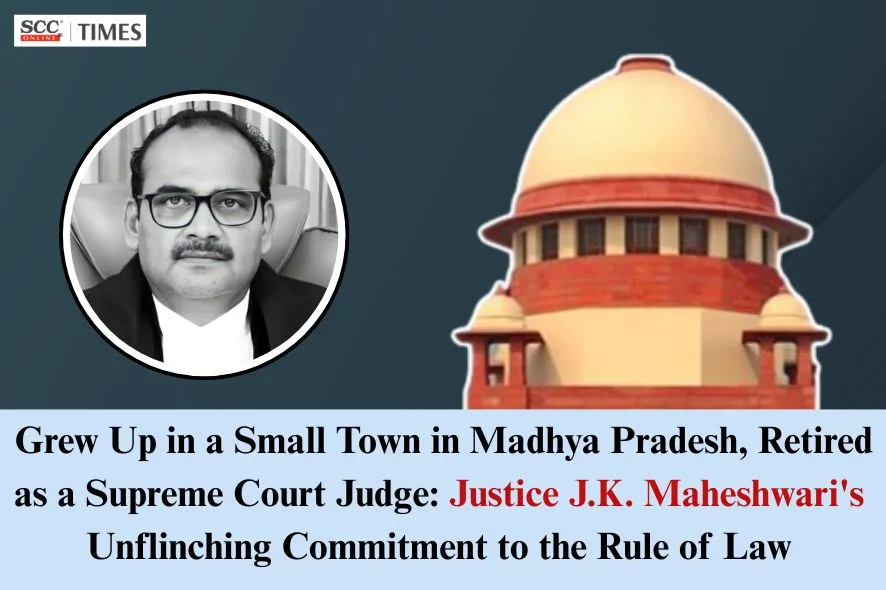
Justice Jitendra Kumar Maheshwari was born on 29-06-1961 in a small town named Joura, in Morena, Madhya Pradesh. He graduated in Arts in 1982 and passed LL.B. in 1985 and completed LL.M in 1991. He enrolled as an Advocate with the State Bar Council of Madhya Pradesh on 22-11-1985 and practiced in Civil, Criminal, Constitutional, Service and Tax matters. He was an elected member of the M.P. State Bar Council1.
Did You know? Justice J.K. Maheshwari completed three degrees- Bachelor of Arts, LL. B and LL. M. from the same Jiwaji University, Gwalior2.
Justice J.K Maheshwari’s journey from Advocacy to Judgeship
Justice Maheshwari practiced in the Supreme Court, Madhya Pradesh High Court (Jabalpur and Gwalior Bench), Central Administrative Tribunal, Jabalpur and M.P. State Administrative Tribunals also.
Later he was appointed as Additional Judge of the High Court of Madhya Pradesh on 25-11-2005 and was appointed as Permanent Judge of the Madhya Pradesh High Court on 25-11-2008. He has been part of various Committees, pertaining to betterment of administration of High Court of Madhya Pradesh and continued in his office till 06-10-2019.
He was elevated as Chief Justice of Andhra Pradesh High Court and assumed office on 07-10-2019.
*Did you Know? Justice J.K. Maheshwari was the First Chief Justice of the newly established Andhra Pradesh High Court at Amravati3.
Later, he was transferred as the Chief Justice of the High Court of Sikkim on 06-01-2021. On 31-08-2021, he was elevated as a Judge of the Supreme Court of India. He is due to retire on 29-06-2026.4
Justice Maheshwari has handled the labour, rent, service, compensation, criminal, ordinary civil and consumer protection matters roasters, with effect from 02-01-2024.5
Did You know? Justice J.K. Maheshwari became the first Chief Justice in the history of Sikkim High Court to be elevated as Supreme Court Judge.6
While speaking at the launch of Jai Anant Dehadrai’s book ‘Prevention of Money Laundering Act, 2002: A Practitioner’s Guide’, Justice J.K. Maheshwari talked about the history of PMLA, the necessity of examining the procedure of implementation from the perspective of courts, and the usefulness of Mr Jai’s book. He stated that PMLA is a cornerstone of India’s legal framework as its provisions empower the state to combat the grave threat of money laundering while aligning with international standards. It is imperative to address its challenges and to ensure that its enforcement remains fair, impartial, and aligned with constitutional principles.
Notable Judgments of Justice J.K. Maheshwari
SUPREME COURT
Constitution/Larger Benches
Justice Maheshwari was part of several Constitution Benches which delivered landmark verdicts on:
-
Union of India v. Union Carbide Corporation, 2023 SCC OnLine SC 264– Dismissal of the curative petition seeking enhancement of compensation for the victims of the Bhopal Gas Tragedy
The Bench comprising of Sanjay Kishan Kaul*, Sanjiv Khanna, Abhay S. Oka, Vikram Nath and J.K. Maheshwari, J.J., dismissed the curative petition seeking enhancement of compensation for the victims of the world’s largest industrial disaster- the Bhopal Gas Tragedy. Read more
-
Central Bureau of Investigation v. Dr RR Kishore, 2023 SCC OnLine SC 1146– Section 6A of DSPE Act unconstitutional from date of insertion
While considering whether declaration made in Subramanian Swamy v. CBI, (2014) 8 SCC 682 regarding unconstitutionality of Section 6-A of Delhi Special Police Establishment Act, 1946 (‘DSPE Act’) could be applied retrospectively in context of Article 20 of Constitution , the Constitution Bench of Sanjay Kishan Kaul, Sanjiv Khanna, Abhay S. Oka, Vikram Nath* and J.K. Maheshwari, JJ. held that its decision in Subramanian Swamy (supra) declaring Section 6-A of DSPE Act unconstitutional, shall have retrospective effect, to be ineffective from the date of its insertion. Read more
-
Shilpa Sailesh v. Varun Sreenivasan, 2023 SCC OnLine SC 544– Supreme Court’s power to grant divorce on grounds of ‘irretrievable breakdown of marriage’ under Article 142 of the Constitution
A Bench comprising of Sanjay Kishan Kaul, Sanjiv Khanna*, A.S. Oka, Vikram Nath, and J.K. Maheshwari, JJ. has held that the Supreme Court has the discretion to dissolve the marriage by passing a decree of divorce by mutual consent, without being bound by the procedural requirement to move the second motion subject to the requirements and conditions laid down under Amardeep Singh v. Harveen Kaur, (2017) 8 SCC 746 and Amit Kumar v. Suman Beniwal, 2021 SCC OnLine SC 1270. It was also held that in exercise of power under Article 142(1) of the Constitution of India, Supreme Court has the discretion to dissolve the marriage on the ground of its irretrievable breakdown. Read more
-
Central Board of Dawoodi Bohra Community v. State of Maharashtra, 2023 SCC OnLine SC 129– Reference of the question of ex-communication of a person from the Dawoodi Bohra community to a larger bench
The 5-judge Constitution Bench of Sanjay Kishan Kaul, Sanjiv Khanna, Abhay S. Oka*, Vikram Nath and JK Maheshwari, JJ, has referred the issue relating to ex-communication of a person from the Dawoodi Bohra community to a larger bench and has observed that the same deserves to be tagged with the review petition of the Sabarimala Temple verdict that is pending for consideration before a 9-judge bench, after noticing similarity of issues in both the matters. Read more
-
Bar Council of India v. Bonnie Foi Law College, 2023 SCC OnLine SC 130
The 5-Judge Constitution Bench of Sanjay Kishan Kaul*, Sanjiv Khanna, Abhay S. Oka, Vikram Nath and J.K Maheshwari, JJ., upheld the Bar Council of India’s (BCI) power to conduct pre-enrolment examination i.e. All India Bar Examination (AIBE). The Court observed that neither the provisions under the Advocates Act, 1961, nor the role of the universities to impart legal education, in any way, prohibit the Bar Council of India from conducting pre-enrolment examination, as the Council is directly concerned with the standard of persons who want to obtain a license to practice law as a profession. Read more.
Other Notable Supreme Court Judgments
*Did you Know? During his 5-year tenure in the Supreme Court, Justice J.K. Maheshwari has been part of over 800 decisions and authored over 80 judgments7.
Yatin Narendra Oza v. Suo Motu, High Court of Gujarat, 2026 SCC OnLine SC 835
The criminal appeal arose from controversy stemmed from a live press conference held on 5 June 2020 during the COVID-19 pandemic, wherein, appellant-senior advocate and former President of the Gujarat High Court Advocates’ Association (GHCAA) made severe allegations against the functioning of the Gujarat High Court and its Registry and the High Court considered the remark “gambling den” made against it as scandalous and damaging to the institution of judiciary and by order dated 6 October 2020 convicted the appellant for criminal contempt under Section 2(c)(i), Contempt of Courts Act, 1971 (Contempt of Courts Act). While holding that the Gujarat High Court’s findings and reasons in convicting the appellant for criminal contempt did not require interference, the Division Bench of J.K. Maheshwari* and Atul S. Chandurkar, JJ., as a final act of forgiveness, exercised its powers under Article 142 of the Constitution to indefinitely suspend Senior Advocate Yatin Oza’s contempt conviction and sentence. Read more
Brihanmumbai Municipal Corpn. v. Vijay Nagar Apartments, 2026 SCC OnLine SC 904
This appeal dealt with the right of a landowner to claim additional amenity transferable development rights (Amenity TDR) under Section 126(1)(b), Maharashtra Regional and Town Planning Act, 1966 (MRTP Act), after surrendering reserved land and developing a public garden thereon at its own cost. While examining the controversy revolving around whether such a statutory right could be defeated by clauses contained in the Letter of Intent (LOI), undertaking and maintenance agreement executed between the parties, and whether the claim was barred on account of delay and laches, the Division Bench of J.K. Maheshwari* and Atul S. Chandurkar, JJ., affirmed the impugned judgment of the Bombay High Court and upheld the entitlement of the landowners to additional Amenity TDR against development of the garden on the surrendered land. The Court held that:
-
Under Section 126(1)(b), MRTP Act, a landowner surrendering land reserved for public purposes and developing an amenity at his own cost acquires a statutory right to additional floor space index (FSI)/TDR equivalent to the area of amenity developed.
-
Such statutory entitlement cannot be waived or contracted away through executive conditions, undertakings or maintenance agreements imposed by the planning authority.
-
Delay and laches do not defeat claims for lawful compensation in the form of TDR/FSI because the State carries a continuing obligation to provide compensation consistent with Article 300-A.
-
Rights crystallised under Development Control Regulations, 1991 (DCR, 1991) at the time of surrender and development cannot be retrospectively extinguished by subsequent regulations such as the Development Control and Promotion Regulations, 2034 (DCPR, 2034). Read more
Fakir Mamad Suleman Sameja v. Adani Ports & Special Economic Zones Ltd., 2026 SCC OnLine SC 842
In this miscellaneous application filed in a disposed of civil appeal seeking clarification and correction of the order dictated in open court vis-à-vis the digitally signed order subsequently uploaded, a Division Bench of J.K. Maheshwari* and Atul S. Chandurkar, JJ., dismissed the application as wholly misconceived and not maintainable, holding that the applicants were in substance seeking a review and rewriting of the final signed order of the Court.
The Court reiterated that the digitally signed order alone constitutes the final and binding expression of the Court’s opinion and that corrections, refinements and enhancements made to a dictated draft order before signing are permissible so long as they do not result in material changes requiring rehearing of parties. Distinguishing earlier decisions in Vinod Kumar Singh v. Banaras Hindu University, (1988) 1 SCC 80, the Court clarified that no conflict arose between the oral dictation and the signed order in the present case, and the alterations complained of were merely corrective and clarificatory in nature. The Court further held that a miscellaneous application in disposed proceedings is maintainable only for correction of clerical or arithmetic errors or where implementation of the order has become impossible due to subsequent events, and cannot be used as a device to challenge the legality or correctness of a final signed order. Read more
Pawan Khera v. State of Assam, 2026 SCC OnLine SC 749
While considering this appeal filed by Congress leader Pawan Khera (appellant), challenging Gauhati High Court’s order dated 24 April 2026 whereby the Court had refused to grant him anticipatory bail in connection with alleged defamatory allegations against Riniki Bhuyan Sarma (complainant), the wife of the Chief Minister of Assam, Himanta Biswa Sarma; the Division Bench of J.K. Maheshwari and Atul S. Chandurkar, JJ., deemed it appropriate to grant anticipatory bail to the appellant albeit with conditions. Read more
Neetu Solvents v. Vineet Nagar, 2026 SCC OnLine SC 811
In a batch of appeals concerning formaldehyde manufacturing units operating in the States of Rajasthan and Haryana without prior environmental clearance (EC) under the Environment Impact Assessment Notification, 2006 (EIA Notification, 2006), a Division Bench of J.K. Maheshwari* and Atul S. Chandurkar, JJ., set aside the closure directions issued by the National Green Tribunal (NGT) and permitted the industries to continue operations. The Court held that the appellant-units, having been established and operated pursuant to valid consent to establish (CTE) and consent to operate (CTO) granted by the respective State Pollution Control Boards (PCBs), could not be shut down merely because the requirement of prior EC had not been earlier appreciated even by the regulatory authorities themselves. Read more
State (UT of J&K) v. Saba Wani, 2026 SCC OnLine SC 752
In a batch of appeals concerning the closure of the Rehbar-e-Taleem (ReT) Scheme in the erstwhile State of Jammu and Kashmir, a Division Bench of J.K. Maheshwari* and Atul S. Chandurkar, JJ., modified the judgment of the High Court which had upheld the validity of Government Order No. 919-Edu of 2018 dated 16 November 2018. While affirming the closure of the scheme, the Court held that denial of engagement to candidates solely on the ground of pendency of litigation as on the date of the closure order is arbitrary and violative of Article 14 of the Constitution. Read more
Himakshi v. Rahul Verma, 2026 SCC OnLine SC 642
In an appeal arising out of a dispute concerning selection and appointment to the post of Computer Hardware Engineer under the Himachal Pradesh Board of School Education, a Division Bench of Atul S. Chandurkar and J.K. Maheshwari*, JJ., dismissed the appeals and upheld the judgment of the Division Bench of the High Court setting aside the appointment of the selected candidate. The Court held that the requirement of minimum five years’ work experience, being an essential eligibility condition under the Recruitment and Promotion Rules (R&P Rules) and the advertisement dated 21 July 2016, could not be diluted on the basis of higher academic qualification or merit.
It was further held that in absence of any conscious exercise of the power of relaxation supported by reasons on record, the selection of an ineligible candidate was unsustainable in law. Rejecting the plea for equitable protection on account of continued service and regularisation, the Court emphasised that equity cannot override statutory rules, and where the selection process itself stands vitiated, no direction for appointment of any candidate can be issued. Read more
Tamilaga Vettri Kazhagam v. P.H. Dinesh, 2025 SCC OnLine SC 2218
While considering this petition challenging Madras High Court’s direction of constituting a Special Investigation Team (SIT) to look into the unfortunate incident of stampede which occurred on 27 September 2025 at about 7.30 P.M. in Velusamypuram, Karur District, Tamil Nadu (Karur stampede); the Division Bench of J.K. Maheshwari and N.V. Anjaria, JJ., taking note of the gravity of the matter, transferred the investigation to the CBI. The Court directed CBI’s director to forthwith appoint a senior officer for taking over the investigation and appoint some other officers for assistance of the said officer. The Court further proposed to set up a three-member Supervisory Committee (the “Committee”) headed by a former Judge of Supreme Court so as to allay the concerns of all parties, in the pursuit of independence and impartiality of the investigation. The Court requested former Supreme Court Judge, Justice Ajay Rastogi, who agreed to head the said Committee. Read more
Govind v. State of Haryana, 2025 SCC OnLine SC 2456
Determining the scope of Section 27 of the Evidence Act, 1872 that deals with how much of the information as received from the accused, in Police custody may be proved, the bench of JK Maheshwari* and Vijay Bishnoi, JJ interpreted the phrase ‘fact thereby discovered’ and held that only that much information as is clearly connected with the fact discovered can be treated as relevant under the phrase ‘facts discovered’. Read more
Partha Das v. State of Tripura, 2025 SCC OnLine SC 1844
While considering the appeals revolving around cancellation of the ongoing recruitment processes by the State on the pretext of a policy decision, the Division Bench of J.K. Maheshwari* and Rajesh Bindal, JJ., held that when recruitment processes are held under strength of the relevant Statutes and Rules framed under such Statutes, then it cannot be left at the whims and fancies of the State to interfere in it through executive orders, without adhering to the principles of consistency and predictability, which are warranted by the rule of law and are pillars of non-arbitrariness. Read more
Mepung Tadar Bage, Member, Arunachal Pradesh Public Service Commission, In re, 2025 SCC OnLine SC 1845
The present matter pertained to a Presidential reference under Article 317(1) vis-a-vis a member (Respondent) of Arunachal Pradesh Public Service Commission (APPSC) facing allegations of misbehaviour, especially related to leakage of the question paper of Assistant Engineer (Civil) Mains Examination conducted by the APPSC on 26/27-8-2022; and whether the Respondent ought to be removed from APPSC on the grounds of the alleged misbehaviour.
The Division Bench of J.K. Maheshwari* and Aravind Kumar, JJ., exercising the Court’s Advisory Jurisdiction, found that the 6 charges against the Respondent made in the reference could not be proved; the charges as alleged were not based on specific allegations against the Respondent in her individual or official capacity. Therefore, the Court recommended that her suspension be revoked forthwith, and that she would be entitled to all consequential and monetary benefits. The Court stated that when there is no evidence linking the present Respondent to the leakage of the question paper of the Mains Examination, summarily holding her responsible and seeking to remove her from office on the pretext of not maintaining confidentiality in the work of the Commission, it would further erode the roots of the Constitutional intent of Article 317 to protect the Members of the Public Service Commission from political pressure. Read more
Seventh Day Adventist Senior Secondary School v. Ismat Ahmed, 2025 SCC OnLine SC 1696
While considering an appeal challenging Calcutta High Court’s rejection of the tenant’s application under Section 5 of the Limitation Act, 1963 seeking condonation of delay in filing application under Section 7(1) of the West Bengal Premises Tenancy Act, 1997 (WBPT Act); the Division Bench of J.K Maheshwari* and Aravind Kumar, JJ., held that applicability of Limitation Act is subject to provisions of the WBPT Act. The compliance as required to be done by the tenant in Section 7(1)(a)(b)(c) and first part of Section 7(2) regarding deposit of rent and filing an application within the same time is mandatory. In default, tenant cannot avail the benefit of the proviso of Section 7(2) which only relates to the payment of determined amount of rent and whereby the Civil Judge may exercise the discretion to grant extension of time. Read more
State of Sikkim v. Mool Raj Kotwal, 2025 SCC OnLine SC 888
In an appeal filed by the State of Sikkim against the order passed by the Sikkim High Court, wherein the Court held that the respondent was entitled to leave encashment for unutilized leave accrued during the period of re-employment, the division bench of JK Maheshwari* and Rajesh Bindal, JJ. concluded that, under Rule 36 of the Sikkim Government Services (Leave) Rules, 1982 (‘Leave Rules’), a regular government servant who retires under the Sikkim Government Service Rules, 1974 (‘Service Rules’) was entitled to leave encashment only up to a maximum of 300 days. If a government servant was re-employed after attaining the age of 58 years and continues in service for an extended period, thereby accumulating additional leave, such re-employment does not entitle him or her to a second leave encashment merely based on leave accrued during the re-employment period. Consequently, the orders passed by the Single Judge and the Division Bench were set aside, and both appeals were allowed. Read more
State of Uttarakhand v. Sarita Singh, 2025 SCC OnLine SC 640
In a matter concerning the non-compliance of the proposal to pay Rs 50 lakhs compensation to the family of a government doctor, who was tragically shot dead while working at a Community Health Centre in April 2016, the division bench comprising Justices JK Maheshwari and Aravind Kumar held that, in light of the gravity of the incident, the sanction for compensation must be honored, and the amount should be paid along with interest. The total amount, including interest for approximately nine years, was quantified at Rs. 1 crore. Out of this, Rs. 11 lakhs had already been paid. The Court directed that the remaining Rs. 89 lakhs be paid within six weeks, and compliance with this order must be reported to the Registry on affidavit by the next date of listing. Read more
Baidya Nath Choudhary v. Surendra Kumar Singh, 2024 SCC OnLine SC 2399
In a contempt petition the division bench of JK Maheshwari and Rajesh Bindal, JJ. directed that in this Court, online presence of only those advocates be furnished and be marked who are appearing or assisting during hearing as indicated above and not of those who are not present in Court but may be associated in office of the advocates. During hearing, on being asked as to who is appearing for the respondent, it is informed by an Advocate, that an Advocate on Record (‘AoR’), is representing them. He made a request to accommodate him because he is out of town and not available. Read more
Parminder Singh v. Honey Goyal, 2025 SCC OnLine SC 567
In a matter concerning the enhancement of motor accident compensation, the division bench of JK Maheshwari and Rajesh Bindal*, JJ. concluded that the appellant is entitled to receive a total compensation of ₹36,84,000/-. As a result, the impugned award of the Punjab & Haryana High Court was modified to reflect this amount. Further, the Court expressed its concern regarding the mode of payment of compensation in motor accident cases. The Court highlighted that the existing process could be streamlined by directly transferring the compensation amount into the bank accounts of the claimants with intimation to the Tribunal. This approach, the Court noted, would help avoid unnecessary hassles for both the Insurance Companies and the claimants, and eliminate the need for cumbersome court processes. Read more
State of Punjab v. Jaswant Singh, (2023) 9 SCC 150
The Division Bench of J.K. Maheshwari and K.V. Viswanathan, JJ. gave a detailed interpretation of Rule 12.21 of Punjab Police Rules, 1934 (‘PPR’) and discussed the discussed the SP and SSP’s power to discharge Constable. Read more
Suman V. Jain v. Marwadi Sammelan, 2024 SCC OnLine SC 161
The division bench of JK Maheshwari* and KV Viswanathan, JJ. reiterated that in the absence of anything contrary in the provisions governing the terms and conditions of the office or post and in the absence of any legal contractual or constitutional bar, a prospective resignation can be withdrawn at any time before it becomes effective. Read more
Navneet Kaur Harbhajansing Kundles v. State of Maharashtra, 2024 SCC OnLine SC 494
The Division Bench of JK Maheshwari and Sanjay Karol, JJ. overturned the Bombay High Court’s judgment cancelling BJP MP Navneet Kaur Rana’s caste certificate, opining that the the Scrutiny Committee had validated her caste certificate after due application of mind and on considering relevant documents. Read more
Ketan Kantilal Seth v. State of Gujarat, 2023 SCC OnLine SC 917
The Division Bench of Surya Kant and JK Maheshwari, JJ. held that the applications filed on the pretext of ‘clarification/addition’ while evading the recourse of review, ought not to be entertained and should be discouraged. The power under the Order XL Rule 3 of the Supreme Court Rules, 2013 is limited and can only be exercised sparingly with due caution while confining itself within the parameters as described only to correct clerical/arithmetical mistakes or otherwise to rectify the accidental slip or omission.
State of W.B. v. Mitul Kumar Jana, 2023 SCC OnLine SC 1070
The Division Bench of JK Maheshwari and KV Viswanathan, JJ. while hearing an appeal against a judgment of the Calcutta High Court, directing the State- appellant to issue the letter of appointment to the respondent as a Police Constable subject to final outcome of the pending criminal case, confirmed the findings of the Tribunal and the High Court on the issue of suppression of material information. However, noting that the respondent was not involved in henious crime, the Court directed the State to consider the respondent’s case and issue order of appointment to the post of constable in West Bengal Police Force.
“Even in case where the information regarding pending criminal case is truthfully furnished and on acquittal therein, an employer has the discretion to consider the antecedents while issuing the letter of appointment. The High Court could not have directed the issuance of the letter of appointment. the issuance of order of appointment is required to be left on the discretion of the employer and the High Court ought not to have taken away the said discretion.”
Union of India v. Manjurani Routray, (2023) 9 SCC 144
The Division Bench of Surya Kant and JK Maheshwari, JJ. reiterated, that for striking down statutory provision or declaring any rule as ultra vires, specific pleading to challenge rules and asking for such relief ought to be made. It was held that, no challenge to vires of R. 4(b) of the Ministry of Information Technology (In-situ promotion under Flexible Complementing Scheme) Rules, 1998 was made in the matter.
L.R. Patil v. Gulbarga University, 2023 SCC OnLine SC 1110
The Division Bench of Surya Kant and JK Maheshwari, JJ. while answering the question that whether on joining the new post, the appellant’s lien on the original/previous post will be continued to be maintained, until he is permanently absorbed in the new department or cadre in which he is subsequently appointed, said that ‘lien’ of a government servant only ceases to exist when he/she is appointed on another post ‘substantively’/confirmed or absorbed permanently.
Sweety Kumari v. State of Bihar, 2023 SCC OnLine SC 1212
In appeals against the Patna High Court’s decisions, wherein the candidature of appellants was rejected by the respondents on account of non-furnishing of original character certificates and law degree, in the matters, respectively, the Division Bench of JK Maheshwari and KV Viswanathan, JJ. granted relief to the three judicial service aspirants and opined that it is clear that the candidate should possess the character certificate and if required, it may be made available at the time of interview. The Rule 9 of the Bihar Civil Service (Judicial Branch) (Recruitment), Rules, 1955 makes it clear that the production of the original certificates at the time of interview is not mandatory but directory.
Jyotirmay Ray v. PNB, 2023 SCC OnLine SC 1452
The Division Bench of JK Maheshwari and KV Viswanathan, JJ. in a plea by appellant who was compulsorily retired as Senior Manager and was denied the benefit of leave encashment, employer’s contribution of provident fund, gratuity and pension by the Punjab National Bank, allowed the appellant’s appeal and observed that the High Court was right in observing that the Board of Directors did not afford an opportunity to the appellant on the issue of causing loss or damage to the Bank, prior to the passing of the resolution of appropriation of the contribution of the Bank from the provident fund account of the appellant.
“An officer of the Bank shall be eligible for gratuity on retirement; death; disablement rendering him unfit as certified by an approved medical officer; resignation after completion of 10 years of continuous service or termination of service after completion of 10 years except in a case if such termination is by way of punishment.”
District Appropriate Authority v. Jashmina Dilip Devda, 2024 SCC OnLine SC 231
Regarding the question of interpretation of power of Section 20(1) & (2) and Section 20(3) of the Preconception and Pre-Natal Diagnostic Techniques (Regulation & Prevention of Misuse) Act, 1994 for cancellation, suspension or suspension in public interest respectively by the appropriate authority specified in Section 17 of the PC&PNDT Act, the Division Bench of JK Maheshwari and KV Viswanathan, JJ. held that the said power can only be exercised when the appropriate authority forms an opinion that it is necessary or expedient in public interest to do so and is incumbent upon the appropriate authority to form its opinion based on reasons expedient or necessary to exercise the power of suspension.
“If the appropriate authority finds breach of provisions of PC&PNDT Act or the Rules it may, after issuing notice and giving a reasonable opportunity of being heard, without prejudice to any criminal action against the licensed entity, suspend its registration for such period as it may think fit or cancel the same as the case maybe.”
Pubi Lombi v. State of Arunachal Pradesh, 2024 SCC OnLine SC 279
The Division Bench of J.K. Maheshwari and Sanjay Karol, JJ. in an appeal against a Division Bench decision wherein, the appellant’s transfer from the Government Higher Secondary School (GHSS) Kanubari, based on a U.O. Note from the Member of Legislative Assembly (MLA) of the Basar(ST) Assembly Constituency, which was upheld by the Single Judge was reversed, set aside the impugned order of the Division Bench and discussed the scope of judicial review of Transfer Orders.
“It is clear that in absence of (i) pleadings regarding malafide, (ii) non-joining the person against whom allegation are made, (iii) violation of any statutory provision (iv) the allegation of the transfer being detrimental to the employee who is holding a transferrable post, judicial interference is not warranted.”
Krishnadatt Awasthy v. State of M.P., 2024 SCC OnLine SC 493
In a challenge to the decision of the Madhya Pradesh High Court, whereby the High Court cancelled the appointment of the Shiksha Karmis based on their relationship with the members of the Selection Committee, the Division Bench of JK Maheshwari and KV Viswanathan, JJ. delivered a split verdict. Justice Maheshwari upheld the High Court’s decision to cancel the appointment, whereas Justice KV Viswanathan reversed the High Court’s order cancelling the appointment.
“First limb of natural justice that is ‘rule against bias’ was proved as reasonable likelihood of bias was fully established irrefutably. The violation of another limb i.e. audi alteram partem, which is procedural, has been prayed by the appellants on the pretext of their non-joinder at the initial stage; in my opinion, without showing prejudice mere nonjoinder even at initial stage does not violate the natural justice doctrine in the case at hand.”
Shilpa Sailesh v. Varun Sreenivasan, 2023 SCC OnLine SC 544
A Constitution Bench comprising of Sanjay Kishan Kaul, Sanjiv Khanna*, A.S. Oka, Vikram Nath, and J.K. Maheshwari, JJ. has held that the Supreme Court has the discretion to dissolve the marriage by passing a decree of divorce by mutual consent, without being bound by the procedural requirement to move the second motion subject to the requirements and conditions laid down under Amardeep Singh v. Harveen Kaur, (2017) 8 SCC 746 and Amit Kumar v. Suman Beniwal, 2021 SCC OnLine SC 1270. It was also held that in exercise of power under Article 142(1) of the Constitution of India, Supreme Court has the discretion to dissolve the marriage on the ground of its irretrievable breakdown. Read More
Commr. of Gift Tax v. BPL Ltd., 2022 SCC OnLine SC 1405
The Division Bench of Sanjiv Khanna* and J.K. Maheshwari, JJ., while answering the appeals relating to the valuation of shares of BPL Sanyo Technologies Ltd. and BPL Sanyo Utilities and Appliances Ltd. gifted by the assessee to Celestial Finance Ltd. in 1993, held that equity shares which are quoted and transferable in the stock exchange are to be valued based on the current transactions and quotations in the open market. Read more.
Kamukayi v. Union of India, 2023 SCC OnLine SC 642
While hearing an appeal against the Judgement of Madras High Court wherein the decision of the Railway Claims Tribunal, Chennai Bench dismissing the claim petition for death compensation was upheld, the Division Bench of Surya Kant and J.K. Maheshwari*, JJ., allowed the appeal and held that deceased was a bonafide passenger and that as per the provisions contained in Section 124-A of Railways Act, 1989 and Railway Accidents and Untoward Incidents (Compensation) Rules, 1990, the appellants were entitled to claim compensation. Read More
Vidarbha Industries Power Ltd. v. Axis Bank Ltd., (2022) 8 SCC 352
The bench of Indira Banerjee* and JK Maheshwari, JJ., rejected the view of NCLT and NCLAT that once it is found that a debt existed, and a Corporate Debtor is in default in payment of the debt there would be no option to the Adjudicating Authority (NCLT) but to admit the petition under Section 7 of the Insolvency and Bankruptcy Code, 2016 (IBC). Read More
Neilan International Co. Ltd. v. Powerica Ltd., 2022 SCC OnLine SC 795
In a case where the single bench of JK Maheshwari, J., was posed with the question as to whether the plea of territorial jurisdiction or the lack thereof can be entertained by the Supreme Court in its jurisdiction under Section 25 of CPC, it was observed that there is limited scope vested in this Court while exercising its jurisdiction under Section 25 of CPC and the same cannot be extended to determine the question of territorial jurisdiction of the proceedings before it as the plea of jurisdiction or the lack of it can be prompted before the Court in which the proceedings are pending. Read More
Abhimanyu Partap Singh v. Namita Sekhon, (2022) 8 SCC 489
In an appeal filed against the Judgment of Punjab and Haryana High Court to enhance the claim of compensation under the Motor Vehicles Act, 1988, the Division Bench of Indira Banerjee and J.K. Maheshwari JJ., allowed the appeal and enhanced the compensation under heads “future loss of earning” and “attendant charges” by applying multiplier method in case of 100% permanent disability.
Union of India v. Methu Meda, (2022) 1 SCC 1
The Division Bench of Indira Banerjee and J.K. Maheshwari JJ., held that if a person is acquitted giving him the benefit of doubt, from the charge of an offence involving moral turpitude or because the witnesses turned hostile, it would not automatically entitle him for the employment, that too in disciplined force. The employer has a right to consider his candidature in terms of the circulars issued by the Screening Committee. The mere disclosure of the offences alleged, and the result of the trial is not sufficient. In the said situation, the employer cannot be compelled to give an appointment to the candidate. Both the Single Bench and the Division Bench of the High Court did not consider the said legal position.
Vasudev v. State of M.P., (2022) 4 SCC 735
The High Court, while convicting the appellant by the impugned judgment [Rajesh v. State of M.P., 2020 SCC OnLine MP 4590], had merely observed that because the accused were prized goons and were absconding and as per the deposition, it could not be said that Appellant 2 was not involved because he was arrested on the spot and taken to police station. The Division Bench of Indira Banerjee and J.K. Maheshwari JJ., observed that the prosecution was required to prove its case beyond reasonable doubt and the conviction cannot be based merely on the basis of presumption to rule out the presence of accused.
Arcelormittal Nippon Steel (India) Ltd. v. Essar Bulk Terminal Ltd., (2022) 1 SCC 712
The Division Bench comprising of Indira Banerjee and J.K. Maheshwari, JJ. held that once an Arbitral Tribunal is constituted, the court would not take up for consideration and apply its mind to an application for an interim measure, unless the remedy of applying to the arbitral tribunal for interim relief is inefficacious. However, this bar does not operate where already the application has been taken up for consideration and the court has applied its mind. Read more
J. Vedhasingh v. R.M. Govindan, 2022 SCC OnLine SC 1010
The bench of SA Nazeer and JK Maheshwari*, JJ., has called upon a larger bench to decide if on similar set of allegations of fact the accused can be tried for an offence under Negotiable Instruments Act, 1881 which is special enactment and also for offences under IPC unaffected by the prior conviction or acquittal or whether the bar of Section 300(1) Cr.P.C. would attract for such trial. Read More
Pahwa Plastics (P) Ltd. v. Dastak NGO, 2022 SCC OnLine SC 362
The Division Bench comprising of Indira Banerjee and J.K. Maheshwari, JJ., held that although to protect future generations and to ensure sustainable development, it is imperative that pollution laws be strictly enforced, were the adverse consequences of denial of ex post facto approval of Environment Clearance outweigh the consequences of regularization of operations by grant of ex post facto approval, and the establishment concerned otherwise conforms to the requisite pollution norms, ex post facto approval should be given in accordance with law, in strict conformity with the applicable Rules, Regulations and/or Notifications. Read more
Gangadhar Narayan Nayak v. State of Karnataka, (2022) 12 SCC 72
The bench of Indira Banerjee and JK Maheshwari, JJ., gave a split verdict on the issue as to whether the Special Court is debarred from taking cognizance of an offence under Section 23 of the Protection of Children from Sexual Offences Act, 2012 (POCSO Act) and obliged to discharge the accused under Section 227 CrPC, only because of want of permission of the jurisdictional Magistrate to the police, to investigate into the offence. Justice JK Maheshwari opined that-
The word used in Section 155(2) be read as “Special Courts” in place of “Magistrate”, which may take cognizance of any offence under POCSO Act. Read More
GPR Power Solutions (P) Ltd. v. Supriyo Chaudhuri, 2021 SCC OnLine SC 1328
In a case relating to Corporate Insolvency, the Division Bench comprising of Indira Banerjee and J.K. Maheshwari, JJ., quashed the order of NCLAT rejecting the application under S. 60(5) of IBC. The Bench held that the NCLAT and NCLT had failed to consider the law laid down by the Court with regard to extension of limitation period due to Covid-19 pandemic. Read more
SIKKIM HIGH COURT
Silajit Guha v. Sikkim University, 2021 SCC OnLine Sikk 80
The Division Bench of J.K. Maheshwari, CJ., and Meenakshi Madan Rai J., observed that in the facts of the case the ambit and scope of the workplace as specified in Section 2(o) of the Act can be decided after appreciation of the evidence brought before ICC, as considered by Single Bench. The Court opined that observation of Single Judge referring to Section 2(o) of the Act i.e., ‘workplace’ its ambit and scope is not proper in particular when the same question is permitted to be decided by the Executive Authority. Therefore, the Court held that the finding on the point of jurisdiction explaining the definition of ‘workplace’ was an inclusive one, stands set aside to such extent and the liberty is granted to the appellant to raise the said question before the Executive Authority who shall decide the same in accordance with the law. Read more
Munni Devi v. Dul Dul Prasad, 2021 SCC OnLine Sikk 82
Jitendra Kumar Maheshwari, CJ. allowed a writ petition which was filed assailing the updated Award passed by the Lok Adalat. The Court held that in place of accepting the plea that the compromise by virtue of collusion and fraud and the Award so passed in the same fashion; but in view of the observation so made it is suffice to observe the Award so passed by the Lok Adalat in view of the pleadings of the suit without joining all the parties and without affording an opportunity is not proper. Writ Petition was allowed, the Award passed by the Lok Adalat was set aside. Read more
Chandu Sherpa v. Sunita Rai, 2021 SCC OnLine Sikk 91
Jitendra Kumar Maheshwari, CJ, allowed the writ petitions which were arising out of the Order passed on 12-11-2019 in different suits allowing the application filed by the defendant under Order VIII Rule 1-A(3) of the Code of Civil Procedure, 1908. The Court allowing all the petitions held that merely by denial of the plaintiffs to the document having transaction with other persons by late Lakey Sherpa cannot be relevant to the merit of the present case setting aside the order passed by the Trial Court. Read more
Discharge of Effluents by Pharma Companies, In re, 2021 SCC OnLine Sikk 101
The Division Bench of Jitendra Kumar Maheshwari, CJ, and Meenakshi Madan Rai, J., heard a Public Interest Litigation relating to the issue of extraction of the groundwater through sufficient surface water was available in the State. The Court went on to find that the Central Ground Water Board and its Authorities had not specified a reason for granting no objection for extracting the ground water and without such reason conditional permissions were granted. The Court stated that this type of functioning of the authority could not be appreciated. Read more
State of Sikkim v. Dipen Subba, 2021 SCC OnLine Sikk 139
The Division Bench of Jitendra Kumar Maheshwari, CJ. and Meenakshi Madan Rai, J., dismissed a criminal leave petition noting that the prosecutrix, being deaf and dumb, who was not able to answer answer any of the questions as put forth to her and her evidence cannot be taken as evidence of an eyewitness. Read more
Tara Prasad Sharma v. State of Sikkim, 2021 SCC OnLine Sikk 56
J.K. Maheshwari, CJ, dismissed a petition considering it to be bereft of merit which had sought to continue on the post of Civil Judge-cum-Judicial Magistrate as he had been acquitted of the charge levelled against him under Section 468 of the IPC. The Court while considering the fact, that the resolution in question has not been challenged either on the basis of mala fide or on extraneous considerations or irrationality of the findings, therefore in the absence of the same considered interfering in it, unwarranted. Read more
ANDHRA PRADESH HIGH COURT
Did you know? During his tenure as the first Chief Justice of the newly formed Andhra Pradesh High Court, Justice Maheshwari took steps for the Establishment of Gram Nyayalayas at various stations in the State of Andhra Pradesh. He also disposed of more than 4500 cases during the short span of 15 months as Chief Justice of Andhra Pradesh High Court.8
Taken UP v. State of A.P., 2020 SCC OnLine AP 137
A Division Bench of Jitendra Kumar Maheshwari, CJ and Lalitha Kanneganti, J., addressed certain PILs that were filed in regard to the LG Polymers poisonous gas leakage incident.
Petition was filed seeking direction or any appropriate writ calling for records relating to leakage of poisonous gas from LG Polymers factory at Visakhapatnam and further directing respondents to save lives of people in around the factory by providing necessary medical facilities.
Court passed the following interim directions:
-
Premises to be completely seized and no one to be allowed, including the Directors of the Company.
-
Committee, if any, appointed wants to inspect premises, they are at liberty but shall put a not on Register maintained at the gate of the Company regarding the said inspection and a note while returning regarding what act done in premises.
-
None of the assets movable or immovable, fixture, machinery and contents shall be allowed to be shifted without the leave of the Court.
-
As stated before, Directors have surrendered their passport and they are in India, however, Court directs that their passports shall not be released without the leave of the Court, and they be not allowed to go outside India without leave.
-
It be also apprised whether, during the lockdown period, any permissions were obtained to restart the operations, if not, action taken report be filed.
-
Grievance regarding appointment of various committees by NGT, Centre and State, Centre and State are at liberty to apprise as to which Committee shall fulfil the purpose. Read more
In re, Corona Virus-COVID-19 Pandemic, 2020 SCC OnLine AP 37
A Division Bench of Jitendra Kumar Maheshwari, CJ and M. Satyanarayana Murthy, J. addressed a Public Interest Litigation with regard to non-cooperation of staff at ASRAM Medical College, Eluru due to non-availability of WHO-approved Personal Protection Equipment.
Court asked the Additional District and Sessions Judge, Eluru and Advocate YMSRN Surya Teja to visit the said hospital and supply the following information:
-
How many patients admitted in the hospital by this time.
-
Details of the ward where such patients have been admitted and whether isolation facility is available
-
Who are the Doctors and Para-medical staff on duty to provide medical and other necessary item
-
Whether the patients have been duly treated specifying the prescription and other precaution
-
Whether the Government and the Dean in-charge is providing due care to those Doctors and Para-medical staff as specified in the WHO guidelines by changing their duties and providing them isolation
-
Whether the Corona-positive patients are maintaining distance
-
While submitting the aforesaid information, it be also clarified as to who are the Doctors and the Para-medical staff who were on duty at the time of admission of Corona-positive patients and suspect patients and also the who are the Doctors and Para-medical staff now on duty and treating them. Read more
Did You Know? There existed no Bungalow for the Chief Justice of newly established High Court of Andhra Pradesh, so Justice J.K Maheshwari identified a site and constructed a new Chief Justice’s Bungalow at Vijayawada, Andhra Pradesh.9
In re, Nandigam Suresh, 2020 SCC OnLine AP 141
The Division Bench of Jitendra Kumar Maheshwari and C. Praveen Kumar, JJ., issued contempt notices to as many as 49 persons, including several law makers. The Court was taking suo motu cognizance of the alleged contemptuous speeches/interviews/postings by these 49 persons against some Judges of the Supreme Court, Judges of the High Court and the High Court itself.
Bench noted that the comments made in the media posts and video clippings are wholly unwarranted and to scandalize or tend to scandalize the institution.
Considering the above Court issued Rule Nisi to the respondents/contemnors, who can be identified from the posts. Read more
M. Janakirama Raju v. State of Andhra Pradesh, 2020 SCC OnLine AP 41
J.K. Maheshwari, CJ while providing an ad interim relief directed the State Authorities to permit vehicles transporting fishes and shrimps and include the same under the category of “essential supplies”. Read more
In re. Corona Virus — COVID-19 Pandemic, 2020 SCC OnLine AP 64
Division Bench of J.K. Maheshwari, CJ and M. Satyanarayana Murthy, J. issued interim measures considering certain aspects in view of the nationwide lockdown due to the outbreak of COVID-19 pandemic. Read more
A.V. Badra Naga Seshayya v. State of A.P., 2020 SCC OnLine AP 509
A Division Bench of J.K. Maheshwari, CJ and B. Krishna Mohan, J., addressed a Public Interest Litigation wherein a direction was sought to declare the proclamation, attempt or conduct of Andhra Pradesh State Election Commission in not conducting any election/poll for any post where there is only a single candidate in the fray for such post in any constituency, during the ensuing elections to be held for the members of local governing bodies in lieu of notifications and thereby depriving the electors’ of their right to vote in the form of NOTA against such single candidate. Read more
Koilagandla Nirajnaj v. Union of India, 2020 SCC OnLine AP 65
A Division Bench of J.K. Maheshwari, CJ and M. Satyanarayana Murthy, J. asked the State Government to ensure provision of all required equipments to Doctors, Nurses, Ward Boys and Paramedical staff to combat COVID-19. Read more
MADHYA PRADESH HIGH COURT
Did You Know? During his tenure as Judge in Madhya Pradesh High Court, Justice Maheswari disposed of more than 65,000 cases while sitting in Indore Bench, Gwalior Bench and Principal Seat at Jabalpur and Lok Adalats held by the High Court from time to time10.
Supa v. Deepa, 2018 SCC OnLine MP 804
The Single Judge Bench of J.K. Maheshwari J. held that Appointment of a person accused in a criminal case was rightly rejected by appointing authority. Read more
Afjal Khan v. State of M.P., 2019 SCC OnLine MP 1672
A Division Bench of J.K. Maheshwari and Anjuli Palo, JJ. partly allowed a criminal petition filed by a person accused of rape and murder of his minor daughter and commuted his death penalty to life imprisonment. The Court drew a balance sheet of aggravating and mitigating circumstances to determine if the death penalty was adequate punishment. Aggravating circumstances: (i) extremely brutal, diabolic and cruel act; (ii) victim being six years was a minor and helpless; (iii) no provocation because the accused was in a dominating position; (iv) injuries were grievous with respect to sexual assault particularly in a case where the victim was the daughter of the appellant. Mitigating circumstances: (i) it was a case of circumstantial evidence; (ii) no evidence that the accused had the propensity of committing further crimes causing continuous threat to the society; (iii) no evidence to show that the accused could not be reformed or rehabilitated; (iv) other punishment options were open; (v) accused was not a professional killer or offender having any criminal antecedent; (vi) accused being a major having family with him, the possibility of reformation could not be ruled out. Read more
Legacy
While Justice J.K. Maheshwari is set to retire on 28 June 2026, however owing to the beginning of partial working days at Supreme Court from 1 June 2026, the Supreme Court Advocates-on- Record Association (SCAORA) organised a farewell ceremony for Justice Maheshwari on 27 May 2026.
Justice J.K. Maheshwari is known for his humility and diligent attitude. During his farewell from Andhra Pradesh High Court, he got very emotional and gave all the credits to his counterparts, colleagues and staff. Justice Maheshwari, in his speech, with utmost humility stated that “I have done nothing, in fact the credit has come to me by those who deserve credit”.11 Throughout his career, Justice J.K. Maheshwari has acknowledged and applauded the role of the Bar in furthering the cause of justice. During the farewell ceremony, CJI Surya Kant also emphasised on Justice Maheshwari’s unflinching commitment towards the professional ethics, saying that, “Justice Maheshwari’s journey carried the imprint of discipline, humility, deep personal integrity, the values shaped by his modest beginnings and people would agree that even after occupying the most important constitutional offices, those values never left him.”12
As Justice J.K. Maheshwari prepares to bid farewell to the Court, we are optimistic that his humility and sense of responsibility will continue to light the way for the legal fraternity and wish him the very best for his future roles.
1. Chief Justice & Judges | SUPREME COURT OF INDIA (sci.gov.in)
2. Hon’ble Mr. Justice Jitendra Kumar Maheshwari | High Court of Sikkim (hcs.gov.in)
3. Hon’ble Mr. Justice Jitendra Kumar Maheshwari | High Court of Sikkim (hcs.gov.in)
4. Chief Justice & Judges | SUPREME COURT OF INDIA (sci.gov.in)
5. https://cdnbbsr.s3waas.gov.in/s3ec0490f1f4972d133619a60c30f3559e/uploads/2024/01/2024011417.pdf.
6. https://www.youtube.com/watch?v=XVbaZORgSZA.
8. Hon’ble Mr. Justice Jitendra Kumar Maheshwari | High Court of Sikkim (hcs.gov.in)
9. Hon’ble Mr. Justice Jitendra Kumar Maheshwari | High Court of Sikkim (hcs.gov.in)
10. Hon’ble Mr. Justice Jitendra Kumar Maheshwari | High Court of Sikkim (hcs.gov.in)
11. https://www.youtube.com/watch?v=n7dw1eqSBII.
12. https://theprint.in/india/cji-surya-kant-lauds-contributions-of-sc-judges-jk-maheshwari-pankaj-mithal/2945491/?amp