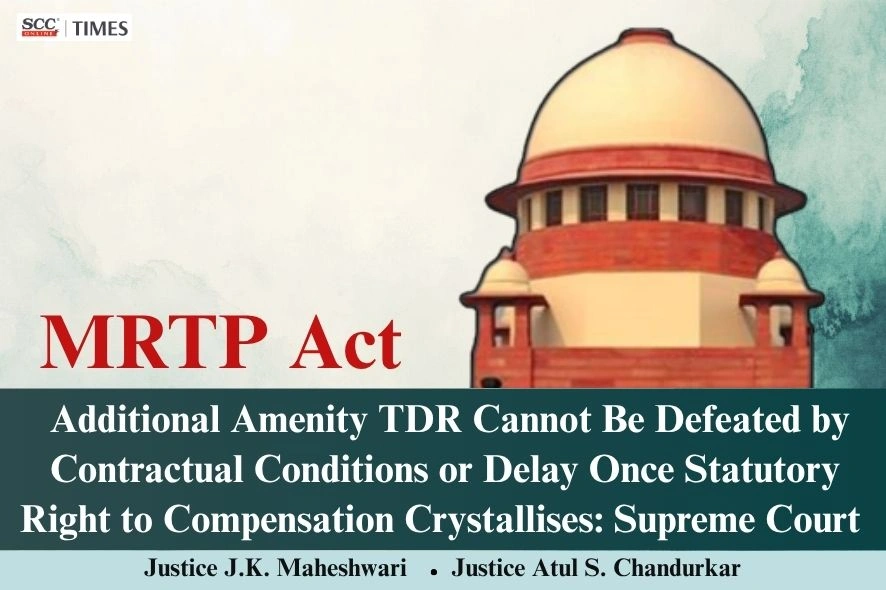
Supreme Court: The present appeal deals with the right of a landowner to claim additional amenity transferable development rights (Amenity TDR) under Section 126(1)(b), Maharashtra Regional and Town Planning Act, 1966 (MRTP Act), after surrendering reserved land and developing a public garden thereon at its own cost. While examining the controversy revolving around whether such a statutory right could be defeated by clauses contained in the Letter of Intent (LOI), undertaking and maintenance agreement executed between the parties, and whether the claim was barred on account of delay and laches, the Division Bench of J.K. Maheshwari* and Atul S. Chandurkar, JJ., affirmed the impugned judgment of the Bombay High Court and upheld the entitlement of the landowners to additional Amenity TDR against development of the garden on the surrendered land. The Court held that:
-
Under Section 126(1)(b), MRTP Act, a landowner surrendering land reserved for public purposes and developing an amenity at his own cost acquires a statutory right to additional floor space index (FSI)/TDR equivalent to the area of amenity developed.
-
Such statutory entitlement cannot be waived or contracted away through executive conditions, undertakings or maintenance agreements imposed by the planning authority.
-
Delay and laches do not defeat claims for lawful compensation in the form of TDR/FSI because the State carries a continuing obligation to provide compensation consistent with Article 300-A.
-
Rights crystallised under Development Control Regulations, 1991 (DCR, 1991) at the time of surrender and development cannot be retrospectively extinguished by subsequent regulations such as the Development Control and Promotion Regulations, 2034 (DCPR, 2034).
Factual Matrix
The Urban Development Department of the Government of Maharashtra reserved lands measuring 98,369.1 sq m situated at Village Anik, Bhakti Park, Chembur, for the purpose of construction of a “garden” under the Development Plan notified on 4 March 1994 under the MRTP Act. The reservation itself stipulated that the landowners would develop the garden and thereafter hand over the same to the appellant, Brihanmumbai Municipal Corporation (Corporation).
The landowners made an application dated 6 July 2001 seeking grant of TDR under Section 126(1)(b) read with Regulation 34 and Appendix VII, DCR, 1991. In the application the landowners stated that the reservation was not proposed to be built upon under sub-regulation 6 of Appendix VII.
Pursuant thereto, the Corporation issued a LOI which stated that the request for grant of Development Rights Certificate (DRC) would be considered after compliance with certain requirements, including the requirement that the landowners would develop the garden, maintain it for 20 years at their own cost and “will not claim any amenity TDR towards development of garden”.
The subject land was thereafter developed as a garden in accordance with the Corporation’s specifications and the Superintendent of Gardens and Tree Officer granted a no-objection for issuance of completion certificate on 21 December 2001.
On 10 January 2002, the constituted attorney of the landowners executed an undertaking agreeing to maintain the garden for 20 years and specifically stating that no Amenity TDR would be claimed towards development of the garden. The undertaking declared itself binding upon the executants, their heirs, executors, administrators and assigns.
Actual possession of the subject land was handed over between January 2002 and October 2002. In exchange, TDR equivalent to the area of the surrendered land was released between February 2002 and February 2003. There was no dispute regarding the grant of this primary TDR.
On 27 November 2002, a maintenance agreement was executed. Under the agreement, the Corporation permitted the landowners to maintain the garden on “adoption basis” from 2002 to 2022 subject to the condition that the garden would be maintained at their own cost “without claiming any Amenity TDR/FSI or any compensation towards the development and maintenance of the said garden”.
Although title had vested in the Corporation, possession remained with the landowners, who continued to maintain the garden uninterrupted till 2016.
Subsequently, proceedings were initiated before the Lokayukta based on complaints that the garden was not accessible to the general public and was being commercially exploited. Acting pursuant to those proceedings, the Corporation demanded possession of the garden vide letter dated 14 March 2016, and possession was handed over on 2 June 2016 without protest or any contemporaneous claim for additional Amenity TDR.
On 3 May 2018, DCR, 1991 stood superseded by the DCPR, 2034. It was only thereafter, on 4 April 2019, that the landowners raised a claim for additional Amenity TDR for development of the garden.
The Corporation rejected the request on 5 November 2019 on 3 grounds of delay of 17 years, absence of any provision for such TDR under DCPR, 2034 and the express conditions contained in the LOI, undertaking and maintenance agreement.
Proceedings Before the High Court
The Bombay High Court allowed the writ petition and directed the Corporation to grant additional Amenity TDR, holding that the claim involved a continuing cause of action and, therefore, could not be defeated on grounds of delay and laches. The Court also held that the restriction against claiming additional Amenity TDR was linked to the right granted to the landowners to maintain the garden on adoption basis. Once the maintenance arrangement was withdrawn by the Corporation, the restriction itself could not survive independently. The Court further observed that the transaction was entirely governed by DCR, 1991 and therefore the later DCPR, 2034 could not be applied to deny rights which had already crystallised.
Issues for Determination
-
Whether the claim for additional Amenity TDR was barred by delay and laches?
-
Whether the landowners had waived their right to claim additional Amenity TDR under Section 126, MRTP Act in view of the LOI, undertaking and maintenance agreement?
Analysis
The Court observed that the present case related to “grant of fair compensation in exchange for land which has been acquired by the State”. The acquisition mechanism under Section 126, MRTP Act permitted acquisition either through agreed monetary compensation, through grant of FSI/TDR, or by acquisition proceedings under the Land Acquisition Act, 1894. It emphasised that Section 126(1)(b) contemplated a unique mode of compensation in kind, namely FSI/TDR, rather than monetary compensation.
The Court examined the statutory definition of “amenity” and held that a “garden” clearly fell within the meaning of amenity both under the MRTP Act and DCR, 1991. Under Section 126(1)(b), compensation was envisaged in 2 distinct parts:
(a) FSI/TDR against the area of land surrendered, and
(b) additional FSI/TDR against the development or construction of amenities on the surrendered land at the owner’s cost.
The Court noted that in Godrej & Boyce Mfg. Co. Ltd. v. State of Maharashtra, (2009) 5 SCC 24 (Godrej & Boyce I), this Court had already rejected the Corporation’s contention that landowners could be denied statutory compensation through executive instructions or negotiated conditions.
Similarly, in Municipal Corpn., Greater Bombay v. Yeshwant Jagannath Vaity, (2011) 11 SCC 88, it was held that even where parties had agreed that the Municipal Commissioner would decide the quantum of TDR, such agreements could not override statutory entitlements.
The Court further referred to Kukreja Construction Co. v. State of Maharashtra, (2024) 14 SCC 594, where it had been held that delay and laches would not defeat claims for compensation in the form of TDR because the obligation to pay compensation flowed directly from Article 300-A and the statute itself.
The Court observed that in a case concerning acquisition of land, grant of FSI/TDR for surrendered land and additional FSI/TDR for development of amenities thereon at the landowner’s own cost operates as compensation under Section 126(1), MRTP Act. Consequently, it was held that the protection under Article 300-A of the Constitution is directly attracted; though no longer a fundamental right, it remains a sacrosanct constitutional right. The Court referred to Indore Vikas Pradhikaran v. Pure Industrial Coke & Chemicals Ltd., (2007) 8 SCC 705, where it was held that right under Article 300-A is not only a legal right under the Constitution, but it is also a human right and therefore, statutes which are expropriatory must be strictly constructed
Rejecting the contention that the landowner had surrendered its right to claim additional Amenity TDR under Section 126(1)(b), MRTP Act, the Court held that once compensation had been prescribed by statute, no extraneous condition could be imposed by executive authorities in derogation of statutory rights.
Section 126(1)(b), MRTP Act is a manifestation of Article 300-A of the Constitution and once fair compensation as against surrender of land is prescribed under statute, in terms of Section 126(1)(b), MRTP Act when read with the relevant regulations, no deprivation of land without strict compliance thereof can be permissible.
Waiver of Rights
The Court rejected the Corporation’s plea of waiver raised in its counter affidavit and held that the facts did not establish “voluntary and intentional waiver of rights” by the landowners.
The Court relied on State of Punjab v. Davinder Pal Singh Bhullar, (2011) 14 SCC 770, where it was stated that waiver involves “conscious abandonment of an existing legal right”. There can be no waiver unless the person is fully informed of the right and intentionally abandons it.
The Court emphasised on the inherent imbalance of bargaining power between the acquiring authority and the landowner once land is reserved for a public purpose. Even though the landowners in the present case were developers, that did not dilute the unequal bargaining position. The reservation itself had a stipulation that the garden on the said land was to be developed by the landowner, and, in such a situation, the landowner was left with limited options under the scope of Section 126(1), MRTP Act.
The Court observed that the Corporation had portrayed the non-claim of Amenity TDR as a “precondition” for grant of DRC against the surrendered land. Such a condition could not legally compel the landowners to “abjure part of the compensation in order to receive the other part”. The Court reproduced the earlier finding in Nazir Ahmad v. King Emperor, 1936 SCC OnLine PC 41, that “what cannot be done directly, also cannot be done indirectly”.
The Court observed that the Corporation itself had admitted in its counter affidavit that grant of maintenance rights and entitlement to TDR were “two separate issues forming parts of two different transactions”. Consequently, the Court held that the right to receive fair compensation under Section 126(1)(b) could not be defeated through such agreements.
Delay and Laches
The Court rejected the Corporation’s contention that the landowners had raised the claim only after seventeen years and even after termination of the maintenance agreement in 2016, the writ petition was filed only in 2019.
The Court relied on Godrej & Boyce Mfg. Co. Ltd. v. Municipal Corpn., Greater Mumbai, (2023) 15 SCC 110 (Godrej & Boyce II), where it had already been held that during the period from 1996 to 2009, the law regarding additional Amenity TDR remained uncertain until clarified by Godrej & Boyce I. The judgment in Godrej & Boyce I ultimately clarified that landowners were entitled to 100 per cent TDR equivalent to the area of the amenity developed. Further, the judgment in Kukreja Construction had already settled that claims for additional Amenity TDR could not be defeated by delay and laches.
The Court reiterated that when compensation is payable in the form of FSI/TDR under the statute, the obligation to grant such compensation exists independently of any formal representation or request.
Therefore, the Court held that neither delay, nor laches, nor abandonment of claim could defeat the statutory entitlement of the landowners.
4. Nature of the amenity
The Court also rejected the Corporation’s contention that the garden was not an amenity because of its alleged misuse for private purposes. It observed that the Corporation itself had certified completion of the garden and had, from the inception, made development of the garden a prerequisite for grant of TDR. Consequently, the Corporation could not now contend that the amenity stood outside Section 126(1)(b). Such an interpretation would “do violence to the statute”.
As regards the proceedings before the Lokayukta and allegations of misuse of the garden, the Court held that remedies under the maintenance agreement could always be pursued separately, but such allegations could not affect the landowner’s independent statutory right to fair compensation under Section 126(1)(b).
Decision
The Court dismissed the appeal and affirmed the impugned judgment of the Bombay High Court. The Court upheld the entitlement of the landowners to additional Amenity TDR against development of the garden on the surrendered land.
[Brihanmumbai Municipal Corpn. v. Vijay Nagar Apartments, 2026 SCC OnLine SC 904, decided on 20-5-2026]
*Judgment by Justice J.K. Maheshwari