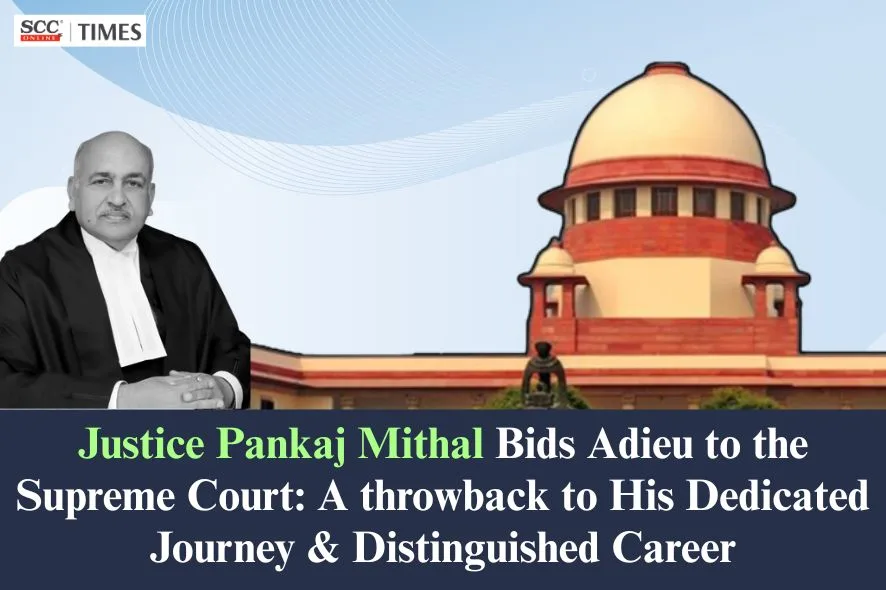
Justice Pankaj Mithal, who was elevated to the Supreme Court in February 2023, began his tryst with law in the 1980s. After 2 decades of legal practice, Justice Mithal entered the next stage of his legal journey when he was appointed as a Judge in the Allahabad High Court, and then as Chief Justice of the High Courts of Jammu & Kashmir and Rajasthan.
EARLY LIFE AND EDUCATION
Justice Pankaj Mithal was born on 17 June 1961, in Meerut, in a family of lawyers. He received his early education at St. Mary’s Academy, Meerut and graduated in B. Com (Honours) in 1982 from the University of Allahabad. Later joined Meerut College Meerut and obtained his law degree from Chaudhary Charan Singh University, Meerut in 1985.1
-
Did you Know? Justice Pankaj Mithal is a third-generation lawyer and a second-generation High Court Judge. His father, Justice Narendra Nath Mithal was also a Judge of the Allahabad High Court from 14 December 1978 to 7 April 1992.2
CAREER AS AN ADVOCATE3
Post graduation, Justice Mithal enrolled with the Bar Council of Uttar Pradesh in 1985 and started practicing under the guidance of Sudhir Chandra Verma who later adorned the bench of Allahabad High Court as a Judge and then became a Lokayukt (U.P.).
Justice Mithal mainly practiced on the civil side and dealt with large number of cases of land acquisition, rent control, education, motor accident, labour and other miscellaneous matters including service and constitutional.
He served as the Standing Counsel for the Uttar Pradesh Awas Evam Vikas Parishad, Lucknow and for Dr. B.R Ambedkar University, Agra.
-
Did you Know? During his days as an advocate, Justice Pankaj Mithal was well-known for his writing. His work ‘The Birth and Life of the High Court of Judicature at Allahabad’4, tracing the history of Allahabad High Court, remains widely read even today.
CAREER AS A JUDGE
Justice Pankaj Mithal was appointed as an Additional Judge of Allahabad High Court on 7 July 2006 and then elevated as Permanent Judge on 2 July 2008. He was also posted as Senior Judge of Lucknow Bench of the Allahabad High Court in the year 20205.
After serving Allahabad High Court as a Judge till 3 January 2021, Justice Mithal was elevated as Chief Justice of Jammu & Kashmir and Ladakh High Court on 4 January 20216. Justice Mithal was later transferred to Rajasthan High Court where on 14 October 2022 he took oath as Chief Justice of Rajasthan High Court7.
Justice Pankaj Mithal’s and 4 other Judges’ elevation to the Supreme Court was recommended by the Collegium in December 2022, consequent to which the Ministry of Law and Justice in a notification issued on 4 February 2023, notified the appointment of Justice Mithal to the Supreme Court. He was elevated to the Supreme Court on 6 February 20238.
Other Responsibilities/ Nominations9
Beyond the courtroom, Justice Mithal remained actively associated with academic and institutional bodies. He served as the Governor’s nominee to the Executive Council of Mahatma Gandhi Kashi Vidyapith, Varanasi for two terms and was also nominated to the Executive Council of Chaudhary Charan Singh University, Meerut. His engagement with legal education and academic administration underscored his belief that the strength of the judiciary ultimately rests upon the quality of legal education and institutional ethics.
He is also a trustee of Etawah Hindi Sewa Nidhi and the founder trustee of the Justice Narendra Nath Mithal Memorial Foundation, a trust established by his mother in memory of his late father. Through these associations, he remained connected with literary, educational and philanthropic activities beyond the sphere of judicial office.
Presently, Justice Mithal serves as a nominee to the Academic Council and the Executive Council of the National Law School of India University, reflecting his continuing engagement with legal scholarship and institutional development.
In recognition of his contribution to law and justice, he was conferred with the degree of Doctor of Laws (LL.D.), Honoris Causa, by Rajiv Gandhi National University of Law at its 7th Convocation held on 23 December, 2025, where the degree was presented by the Chief Justice of India. The honour stood as a fitting acknowledgment of a life devoted to the legal profession and constitutional service.
NOTABLE SUPREME COURT JUDGMENTS10
-
Did you Know? Since his elevation to the Supreme Court in, Justice Pankaj Mithal has been part of 700+ decisions and has also authored 82 judgments.11
Executing Court Bound to Execute Decree as Passed; Can’t Modify Its Terms: Supreme Court
In Maurice W. Innis v. Lily Kazrooni, 2026 SCC OnLine SC 554, an appeal arising out of a special leave petition and concerned the execution of a compromise decree dated 14 July 2017 where the controversy centered on whether the Executing Court could modify the terms of the decree while enforcing it, the Division Bench of Pankaj Mithal* and Prasanna B. Varale, JJ., set aside the impugned orders, holding that an executing court cannot go beyond the decree or vary its terms; it is bound to execute the decree as it stands, unless the decree is a nullity. The Court directed the Executing Court to execute the decree strictly “in its terms and tenor.”
While deciding a custody dispute involving custody of two minor sons in Mohtashem Billah Malik v. Sana Aftab, 2026 SCC OnLine SC 146, the Division Bench of Pankaj Mithal* and SVN Bhatti, JJ., emphasized that while the welfare of the children is undoubtedly the paramount consideration in custody matters, other child custody factors also carry weight in shaping the final order. These include the parents’ financial capacity, the standard of living, the children’s comfort, and their education. Accordingly, the High Court may not have been entirely correct in holding that such factors are of little relevance and that custody must depend solely on child’s welfare. The Court observed that the High Court had overlooked the material and crucial aspects while passing the impugned order. Thus, the Court set aside the order passed by the High Court and remanded the matter for reconsideration.
In Kanchana Rai v. Geeta Sharma, 2026 SCC OnLine SC 59, a case concerning heirs/family members over issues surrounding the registered will of deceased M who died in December 2021, the Division Bench of Pankaj Mithal* and S.V.N. Bhatti, JJ., held that “any widow of the son” of a deceased Hindu is a dependant within the meaning of Section 21(vii), Hindu Adoptions and Maintenance Act, 1956 (the Act) and is entitled to claim maintenance under Section 22 of the Act. The Court pointed out that Section 22 contemplates “maintenance of dependants” including “widowed daughter-in- law” from the estate of her father-in-law meaning thereby that a claim under Section 22 can be raised only after the death of the father-in-law. The Court emphasised that a son or the legal heirs are bound to maintain all the dependant persons out of estate inherited i.e. all persons whom the deceased was legally and morally bound to maintain. Therefore, on the death of son, it is the pious obligation of the father-in-law to maintain widowed daughter-in-law, if she is unable to maintain herself either on her own or through the property left behind by the deceased son. The Hindu Adoptions and Maintenance Act does not envisage to rule out the above obligation of the father-in-law to maintain his widowed daughter-in-law, irrespective of the fact when she became a widow whether prior or after his death.
While considering an application moved by Dr Nirmal Kanti Chakrabarti, former Vice Chancellor, WBNUJS (Respondent) for expunging para Nos. 33 and 34 in X8 v. Nirmal Kanti Chakrabarti, 2025 SCC OnLine SC 1964, but particularly, the sentence beginning from ‘Thus’ and ending with ‘personally’ contained in para 34 of the judgment; the Division Bench of Pankaj Mithal and Prasanna B. Varale, JJ., allowed the application thereby deleting the sentence beginning from ‘Thus’ and ending with ‘personally’ contained in Para 34 of the judgment, which required the Respondent to make Supreme Court’s order dated 12 September 2025, a part of his resume. [X v. Nirmal Kanti Chakrabarti, 2025 SCC OnLine SC 2523]
Inside Supreme Court order affirming SIT clean chit to Reliance Foundation’s Vantara
While considering C.R. Jaya Sukin v. Union of India, 2025 SCC OnLine SC 2007, pertaining to allegations about Greens Zoological Rescue and Rehabilitation Centre and Radhe Krishna Temple Elephant Trust (‘Vantara’); the Division Bench of Pankaj Mithal and Prasanna B. Varale, JJ., upon perusing the report prepared by the Special Investigation Team (SIT) constituted in pursuance of order dated 25-8-2025, took note of the Report’s conclusion that Vantara did not violate any of the relevant laws such as the Wildlife (Protection) Act, 1972, Recognition of Zoo Rules, 2009, CZA guidelines, Customs Act, 1962, Foreign Trade (Regulation and development) Act, 1992, Foreign Exchange Management Act, 1999, Prevention of Money Laundering Act, 2002, Bharatiya Nyaya Sanhita, 2023 or the Convention of International Trade in Endangered Species of wild Fauna and Flora.
The Court accepted the conclusion so drawn in the Report. Since, no contravention of law was reported by the SIT, therefore, the complaints particularly those listed in Schedule A in the summary of the SIT Report, were closed.
In Vinod Kumar Pandey v. Seesh Ram Saini, 2025 SCC OnLine SC 1951, an appeal filed by Vinod Kumar Pandey, former Inspector of CBI and Neeraj Kumar, former Joint Director of the CBI (appellant officers), who challenged the decisions whereby the Delhi High Court directed the registration of FIR with the finding that prima facie cognizable offences under Sections 506, 341, 342 and 166, and Sections 218, 463, 465, 469, 166 and 120-B IPC were made out for investigation against the appellant officers; the Division Bench of Pankaj Mithal* and Prasanna B. Varale, JJ., declined to interfere with the High Court’s order and pointed out that the offences were alleged to have been committed in the year 2000 and till date the matter has not been allowed to be investigated.
‘The very concept of family is being eroded’; SC dismisses appeal seeking eldest son’s eviction
In Samtola Devi v. State of U.P., 2025 SCC OnLine SC 669, while considering the instant dispute wherein the filed an appeal seeking eviction of her son from the house; the Division Bench of Pankaj Mithal* and SVN Bhatti, JJ., grimly remarked that though Indian society believes in “Vasudhaiva Kutumbakam” i.e. the earth, as a whole, is one family; however, today there is an inability to retain the unity in the immediate family.
“The very concept of ‘family’ is being eroded and we are on the brink of one person one family.”
In Mohd. Tahir Hussain v. State (NCT of Delhi), 2025 SCC OnLine SC 135, while deliberating over a petition filed by politician Tahir Hussain had sought interim bail for the purposes of contesting in upcoming Legislative Assembly Elections for NCT of Delhi; the Division Bench of Pankaj Mithal* and Ahsanuddin Amanullah**, JJ., delivered a split verdict in this regard.
While Mithal, J., opined that interim bail is not permissible for the purposes of contesting elections, much less for campaigning; Amanullah, J., on the other hand deemed the petitioner eligible to be enlarged on conditional bail for limited period. Furthermore, since a spilt decision was rendered in the instant case, the Division Bench therefore, directed the Registry to place the matter before the Chief Justice of India for appropriate action.
In an appeal titled Neeraj Sud v. Jaswinder Singh, 2024 SCC OnLine SC 3069, filed against the judgment passed by National Consumer Disputes Redressal Commission (‘NCDRC’), wherein it was held that the doctor was apparently negligent in not giving proper treatment and was also careless in not performing the repeat eye surgery, the division bench of Pamidighantam Sri Narasimha and Pankaj Mithal*, JJ. while setting aside the impugned judgment, held that simply for the reason that the patient has not responded favourably to the surgery or the treatment administered by a doctor or that the surgery has failed, the doctor cannot be held liable for medical negligence straightway by applying the doctrine of Res Ipsa Loquitor unless it is established by evidence that the doctor failed to exercise the due skill possessed by him in discharging of his duties.
In Punjab State Civil Supplies Corpn. Ltd. v. Sanman Rice Mills, 2024 SCC OnLine SC 2632, while considering a challenge to the decision of Punjab and Haryana High Court whereby which it had set aside an Arbitral Award granted in favour of the appellant; the Division Bench of P.S. Narasimha and Pankaj Mithal*, JJ., held that the scope of the intervention of the Court in arbitral matters is virtually prohibited, if not absolutely barred and that the interference is confined only to the extent envisaged under Section 34, Arbitration and Conciliation Act, 1996 (A&C Act). The appellate power of Section 37, A&C Act is limited within the domain of Section 34, A&C Act.
Refusal to marry does not amount to criminal liability for abetment of suicide: Supreme Court
The Division Bench of Pankaj Mithal* and Ujjal Bhuyan, JJ., in Kamaruddin Dastagir Sanadi v. State of Karnataka, 2024 SCC OnLine SC 3541, while considering a criminal appeal filed by the accused against the judgment and order of the Karnataka High Court, wherein the High Court convicted the accused for the offences under Sections 417 (Punishment for cheating) and 306 (Abetment of suicide), Penal Code, 1860 (IPC), setting aside the impugned conviction order, held that simply because the accused refused to marry the deceased did not equate to instigating, inciting, or provoking the deceased to take her own life. Therefore, the refusal by the accused to marry her, under these circumstances, did not amount to criminal liability for abetment of suicide.
In Ramchandra v. State of Rajasthan, 2025 SCC OnLine SC 685, concerning Rajasthan High Court’s refusal to quash FIR; the Division Bench of Pankaj Mithal and SVN Bhatti, JJ., held that whether a statement made in the written statement is incorrect or false must be considered and decided by the Trial Court itself upon the conclusion of the evidence, at the time of the final determination of the suit or if necessary in proceedings under Section 340 CrPC. Unless this exercise is completed, it is difficult to say that the averments made therein are false and constitutes an offence attracting penal action.
The Constitution Bench comprising of Dr. DY Chandrachud, CJI along with Abhay S. Oka*, JB Pardiwala, Pankaj Mithal** and Manoj Misra, JJ., in High Court Bar Assn. v. State of U.P., (2024) 6 SCC 267, reversed its own 2018 ruling of a 3-Judge Bench and held that Constitutional Courts should not fix a timeline for disposal of cases pending in any court while exercising powers under Article 142. The Court further justified the stance that pattern of cases pending in various courts including High Courts is different.
The three-Judge Bench of Supreme Court in Asian Resurfacing of Road Agency (P) Ltd. v. CBI, (2018) 16 SCC 299, had held that interim orders passed by High Courts for stay on trials in civil and criminal matters would expire automatically after 6 months, unless the same was expressly extended by the High Court. The same was reversed in the instant decision. Justice Abhay S. Oka wrote the majority judgment, which was concurred by Justice Pankaj Mithal through a separate judgment.
Inside Supreme Court verdict on easementary rights and powers of Appellate Court
In Manisha Mahendra Gala v. Shalini Bhagwan Avatramani, (2024) 6 SCC 130, concerning easementary rights over a road situated over land, which is presently owned by the respondents, the division bench of Pankaj Mithal* and Prashant Kumar Mishra, JJ. held that the appellants have not acquired easementary right over the disputed ‘rasta’ in any manner much less by prescription, necessity or under an agreement. Therefore, the Appellate Courts and the High Court have not committed any error of law in dismissing suit appellants and in decreeing suit of respondents.
While hearing Babanna Machched v. Union of India, (2024) 5 SCC 306, under Section 31, Armed Forces Tribunal Act, 2007 against the Armed Forces Tribunal’s order, whereby the Appellants were dismissed from their service for adopting fraudulent means by producing false relationship certificate for recruitment under the Unit Headquarters Quota, the Division Bench of Bela M. Trivedi and Pankaj Mithal*, JJ. allowed the appeal and set aside the impugned orders.
In a suo motu cognizance of the Calcutta High Court’s decision, whereby the High Court issued a slew of advisories to the male and female adolescents regarding the respect of a woman, protection of self-worth, dignity and privacy, and right to autonomy of the female’s body, the Division Bench of Abhay S Oka and Pankaj Mithal, JJ., Right to Privacy of Adolescent, In re, 2023 SCC OnLine SC 1877, frowned upon the High Court’s suggestion to adolescent girls to control their sexual urge.
A “shocking case of gross abuse of process of law” wherein, the respondents’ failure to get interim relief for quashment of First Information Reports (‘FIRs’) and proceeding with filing of civil writ petition prompted the Division Bench of Abhay S. Oka* and Pankaj Mithal, JJ., in Ambalal Parihar v. State of Rajasthan, (2024) 19 SCC 520, to slam the respondents with costs and reprimand the Judge concerned for not converting the writ petition to criminal writ petition for roster Judge taking up criminal writ petitions.
In Dani Wooltex Corpn. v. Sheil Properties (P) Ltd., 2024 7 SCC 1, concerning the issue about the legality and validity of the order of termination of the arbitral proceedings under Section 32(2)(c), Arbitration and Conciliation Act, 1996 (‘the Arbitration Act’) passed by the Arbitral Tribunal, the division bench of Abhay S. Oka* and Pankaj Mithal, JJ. held the following:
-
The power under Section 32 (2)(c), Arbitration Act can be exercised only if, for some reason, the continuation of proceedings has become unnecessary or impossible. Unless the Arbitral Tribunal records its satisfaction based on the material on record that proceedings have become unnecessary or impossible, the power under Section 32(2)(c) cannot be exercised.
-
If the said power is exercised casually, it will defeat the very object of enacting the Arbitration Act. It is the Arbitral Tribunal’s duty to fix a meeting for a hearing even if parties to the proceedings do not make such a request. It is the duty of the Arbitral Tribunal to adjudicate upon the dispute referred to it. If, on a date fixed for a meeting/hearing, the parties remain absent without any reasonable cause, the Arbitral Tribunal can always take recourse to the relevant provisions of the Arbitration Act, such as Section 25.
-
The failure of the claimant to request the Arbitral Tribunal to fix a date for hearing, per se, is no ground to conclude that the proceedings have become unnecessary. The abandonment of the claim by a claimant can be a ground to invoke Section 32(2)(c).
-
The abandonment of the claim can be either express or implied. The abandonment cannot be readily inferred. There is an implied abandonment when admitted or proved facts are so clinching that the only inference which can be drawn is of the abandonment. Only if the established conduct of a claimant is such that it leads only to one conclusion that the claimant has given up his/her claim can an inference of abandonment be drawn. Even if it is to be implied, there must be convincing circumstances on record which lead to an inevitable inference about the abandonment. Only because a claimant, after filing his statement of claim, does not move the Arbitral Tribunal to fix a date for the hearing, the failure of the claimant, per se, will not amount to the abandonment of the claim.
Supreme Court stays Allahabad High Court order seeking report on rape victim’s mangal dosh
Taking Suo Motu cognizance of the matter where the Allahabad High Court had directed the Astrology Department of Lucknow University to determine if the alleged rape victim is a Mangalik, after the accused refused to marry her, the vacation bench of Sudhanshu Dhulia and Pankaj Mithal, JJ., in Gobind Rai v. State of U.P., 2023 SCC OnLine SC 730, has stayed the said direction “in the interest of justice”.
After having lost from all the three courts below, the defendant (appellant) to the eviction suit has preferred this appeal, wherein the division bench of Dipankar Datta and Pankaj Mithal*, JJ., in Ghanshyam v. Yogendra Rathi, 2023 SCC OnLine SC 725, said that the respondent is in settled possession of the suit property at least in part performance of the agreement which cannot be disturbed or disputed by the transferer, i.e., the appellant. Thus, it was held that the respondent is entitled for a decree of eviction with mesne profits, and there is no error or illegality in such a decree being passed. Further, it was held that will or general power of attorney cannot be recognised as title documents or documents conferring rights in any immovable property.
Allopathy/ Ayurved Doctors not on a par with MBBS Doctors; Can’t claim equal pay
In a Civil Appeal challenging the common order passed by the High Court of Gujarat, wherein, the High Court had held that the doctors having degrees in alternative systems of medicine are entitled to be treated on a par with doctors holding MBBS degree, the Division Bench led by V. Ramasubramanian* and Pankaj Mithal, JJ., in State of Gujarat v. P.A. Bhatt, 2023 SCC OnLine SC 503, set aside the impugned order holding that non-MBBS doctors do not perform equal work as compared to doctors with MBBS degree.
Can Government employees claim Double Overtime Allowance as per the Factories Act?
The Security Printing and Minting Corporation of India Limited appealed against the common order passed by the Bombay High Court which had affirmed the order passed by the Central Administrative Tribunal (‘Tribunal’) which had stated that the employees working as Supervisors were entitled to Double Over Time Allowance. While exercising its civil appellate jurisdiction, the Division Bench of V. Ramasubramanian and Pankaj Mithal JJ., in Security Printing & Minting Corporation of India Limited v. Vijay D. Kasbe, 2023 SCC OnLine SC 439, held that the government employees cannot claim double overtime allowance as per the Factories Act, 1948 (‘The Factories Act’), if the service rules do not provide for it.
The bench of V. Ramasubramanian* and Pankaj Mithal, JJ., in Akhil Gogoi v. State, 2023 SCC OnLine SC 438, affirmed Gauhati High Court’s order reversing an Order of discharge passed by the Special Court, NIA, Guwahati, Assam against Assam MLA Akhil Gogoi in relation to the anti-CAA protest case but has directing his release on bail, pending trial, subject to conditions imposed by the Special Court. The Court noted that, “This is not a case where the petitioner should be allowed to be detained in custody, especially after having secured an order of discharge, rightly or wrongly.”
In a petition against the Judgment and Order of the High Court of Delhi, wherein the relief to the homebuyers/ petitioners for deferment of payment of Equated Monthly Instalment (‘EMIs’) to the Banks and financial institutions was lifted, the Division Bench of V. Ramasubramanian and Pankaj Mithal, JJ., in Rohit Kumar v. Union of India, Petition(s) for Special Leave to Appeal (Civil) No(s). 10173/2023, decided on 16 May 2023, issued notice and granted interim protection to the homebuyers for deferred payment of EMIs.
NOTABLE HIGH COURT JUDGMENTS
A Full Bench of Pankaj Mithal, Suneet Kumar and Rohit Ranjan Agarwal, JJ., in Shivagopal v. State of U.P., 2019 SCC OnLine All 2239 dismissed a batch of writ petitions seeking entitlement to receive death-cum-retirement gratuity while judicial proceedings were pending. The petitioners were government employees (Lekhpal/Police Officials), who had retired on attaining the age of superannuation, and by the impugned orders, their full pension and gratuity had been withheld due to pending judicial proceedings against them. The petitioners had sought quashing of the impugned orders declining full pension and gratuity during pendency of the judicial proceedings and further sought an additional direction to the respondent authority to release/pay full pension and gratuity.
Decree of divorce by mutual consent is appealable where the consent itself is disputed: Allahabad HC
An appeal filed by the wife against the decree of divorce by mutual consent, was allowed by a Division Bench comprising of Pankaj Mithal and Rajiv Joshi, JJ., in Pooja v. Vijay Chaitanya, 2018 SCC OnLine All 513.
A decree was passed by the family court under Section 13-B, Hindu Marriage Act (HMA), 1955 for dissolution of the marriage of the appellant-wife and her husband by mutual consent. The wife preferred the appeal under Section 28 HMA read with Section 19, Family Courts Act 1984, against the said decree contending that her consent was obtained by undue influence. The question before the Court was ‘whether an appeal under Section 19 of Family Courts Act would lie against a decree passed under Section 13-B HMA?
The Division Bench of Pankaj Mithal and Saurabh Lavania, JJ., in Krishna Pal Singh v. State of U.P., 2020 SCC OnLine All 1467, directed the District Magistrate to provide protection to senior citizens being troubled by their children. The Uttar Pradesh Maintenance and Welfare of Parents and Senior Citizens Rules, 2014 framed under the Maintenance and Welfare of Parents and Senior Citizens Act, 2007 casts an obligation upon the district administration, especially, the District Magistrate to ensure that the life and property of senior citizens of the district are protected and they are able to live with security and dignity. The Court stated that in view of Rule 21 of above-stated Rules, District Magistrate is duty-bound to take appropriate steps and action on the aforesaid application of the petitioners.
The Division Bench of Pankaj Mithal, CJ, and Sanjay Dhar, J., in Jammu and Kashmir Peoples Forum v. UT of J&K, 2021 SCC OnLine J&K 714, asked Jammu and Kashmir government if there exist any law to regulate news portals in the Union Territory and whether there exist any provisions to keep a check on circulation of fake news.
While deciding the instant appeal directed against the decision of the Single Judge Bench in Mohd. Latief Magrey v. Union of India, 2022 SCC OnLine J&K 433; the Division Bench of Pankaj Mithal, CJ., and Javed Iqbal Wani, J., in UT of J&K v. Mohd. Latief Magrey, 2022 SCC OnLine J&K 516, directed the appellants to allow Mohd. Lateif Magery and his family to perform Fatiha Khawani (religious rituals/prayers after burial) of deceased Mohd. Amir Magrey at the Wadder Payeen graveyard, subject to taking into account the required security measures and COVID-19 guidelines. The Court also upheld the compensation of Rs. 5 Lakhs awarded to the respondents in the afore-stated case.
The Division Bench of Pankaj Mithal, CJ. and Sindhu Sharma, J., in UT of J&K v. NHRC, 2021 SCC OnLine J&K 321, upheld National Human Rights Commission’s order regarding compensation, whereby the commission had held the government vicariously liable for the death of children in Udhampur district due to consumption of spurious cough syrup.
The Division Bench of Pankaj Mithal, CJ and Rekha Borana, J., in Micro Marbles Private Limited v. Office of Income Tax Officer, 2023 SCC OnLine Raj 58, quashed the notice issued to the petitioner under Section 148, Income Tax Act, 1961 (‘The Act’) as well as the order dismissing the objections of the petitioner by the Income Tax Officer (‘respondents’) in relation to the belief of the revenue officer that the petitioner had escaped assessment for the year 2017-2018, stating that material referred to by the respondents were on the basis of ‘reason to believe’ which was not even supplied to the petitioner resulting into the entire proceedings for reopening of the assessment being vitiated in law.
In a challenge to the order of the Central Administrative Tribunal, Jaipur Bench1, which had dismissed the original application of the petitioner praying for his appointment for a post vacant after the previous candidate’s resignation, the division bench of Pankaj Mithal, CJ. and Shubha Mehta, J., Sumer Singh v. Union of India, Civil Writ Petition No. 14472 of 2022, decided on 21 December 2022, upheld the order of the Tribunal stating that the vacancy advertised stood exhausted with the appointment of a candidate, and the petitioner thus, is not entitled to the appointment on the post so advertised.
LECTURES, SEMINAR AND CONFERENCE
Transformative Constitutionalism and Vision of Viksit Bharat 204712
In an International Conference on “Constitutionalism to Transformative Constitutionalism: Rethinking the Constitutions Across Time and World” organised by Maharashtra National Law University Mumbai on 18 April 2026, Justice Mithal discussed the philosophical roots of constitutionalism in Indian civilizational. He noted that long before modern constitutional systems emerged in the West, Indian traditions recognised that power must function within limits through the principle of Dharma. He clarified that Dharma was not synonymous with religion but represented righteousness, moral order, and lawful conduct.
Justice Mithal explained that traditional constitutionalism primarily focused on limiting governmental power and preventing tyranny. Transformative constitutionalism, however, seeks active social change by compelling the State to secure dignity, welfare, and equality for all sections of society. According to him, the Constitution has gradually evolved from being merely a framework of governance into an instrument of social transformation. He compared the Constitution to “a flowing river, a Ganga of justice” that must continuously remove the “pollutants of discrimination” on its path toward equality.
Justice Mithal highlighted the role of the Indian judiciary in advancing transformative constitutionalism through purposive interpretation and referred to landmark constitutional decisions that expanded the meaning of rights and dignity.
However, Justice Mithal acknowledged that despite constitutional progress, a significant gap persists between constitutional promises and ground realities. Social and economic inequalities continue, and access to justice remains uneven. He sated that
“The principle that “justice delayed is justice denied” is not merely a legal maxim; it is a lived reality for countless citizens. Judicial delays, procedural complexities, and rising costs often make justice inaccessible. If justice is neither swift nor affordable, it risks becoming an elite privilege rather than a universal right. It is therefore imperative that we simplify procedures, responsibly integrate technology, and ensure that the justice delivery system reaches even the last person in the queue.”
Justice Mithal observed that constitutional institutions must continuously evolve to maintain public trust. Issues relating to reservations, secularism, language policy, judicial appointments, federal balance, and legislative functioning were identified as areas requiring thoughtful reform.
Justice Mithal further linked transformative constitutionalism with India’s aspiration of becoming a developed nation by 2047. He clarified that a developed India cannot be measured solely by economic growth or technological progress. Rather, true development depends upon the strength of institutions, accessibility of justice, social equity, and protection of individual dignity. He described transformative constitutionalism as the “engine” that will drive the vision of “Viksit Bharat,” emphasizing that constitutional values must become lived realities even in the remotest villages of India.
Arbitration, Advocacy and the Ethical Role of Lawyers13
While addressing at 4th RMLNLU—Lakshmikumaran & Sridharan International Arbitration Moot, 2026 organised by Dr. Ram Manohar Lohiya National Law University, Justice Mithal described arbitration as the “common language” of global justice because it ensures that commerce is not hindered by the complexities of diverse domestic legal systems. He stated that Arbitration reflects the realities of an interconnected world where disputes frequently extend beyond the boundaries of one nation’s courts. He further recognised arbitration as an “instrument of global commerce and cross-border trust.”
Justice Mithal connected modern arbitration practices with India’s civilisational traditions. Referring to the concept of “Panch Parmeshwar,” he noted that Indian traditions historically recognised dispute resolution through dialogue, fairness, and collective wisdom. Further referring to the Ramayana and Mahabharata, he stated that before conflicts escalated into war, messengers were sent to explore peace and reconciliation and cited examples like Angad’s mission to Ravana’s court and Lord Krishna’s efforts before the Kurukshetra war, where dialogue preceded confrontation.
Justice Mithal stressed that lawyers and judges are not merely interpreters of statutes and precedents but individuals entrusted with promoting reconciliation and shaping the ethical climate of society. He stated that the essence of the legal profession lies in resolving conflicts while upholding justice. He stated that
“Lawyers and judges have long been regarded as officers of the court, but today there is a need to recognise them as architects of peace. The ultimate purpose of the legal system is not merely to adjudicate disputes but to preserve harmony in society. In arbitration, this principle is manifested most clearly: justice is not only a matter of law but also a matter of ethics, human relationships, and social cohesion.”
Addressing the participants directly, Justice Mithal reminded them that awards and recognition are not the sole indicators of success. Every question from the Bench and every critique should be viewed as an opportunity for learning. Since law is a constantly evolving discipline, he advised students to remain lifelong learners who continue to learn from precedent, society, and experience. He further reminded young lawyers that law is a vocation and not merely a profession. Courtrooms are places where rights encounter power and where the rule of law is tested and preserved.
Reimagining Justice Through ADR and Technology14
While addressing at West Zone—I Regional Conference organised by the National Judicial Academy in collaboration with the Rajasthan High Court and Rajasthan State Judicial Academy regarding Alternate Dispute Resolution (ADR) as an equitable and accessible mechanism of justice, aided by technology, Justice Mithal emphasised that ADR is no longer peripheral to the justice system; rather, it occupies a central role in realising the constitutional vision of justice in India.
Justice Mithal stated that the Constitution of India is not merely an institutional framework for courts, but a solemn promise of justice for every citizen. Justice cannot be restricted to procedural correctness or technical legality. It acquires meaning only when it is timely, humane, affordable, and genuinely accessible. He reiterated that access to justice forms an integral component of Article 21. However, the existence of courts alone does not satisfy this constitutional mandate. When citizens are compelled to spend years in litigation, incur enormous financial costs, and suffer emotional strain merely to enforce ordinary rights, the constitutional promise stands weakened.
Justice Mithal stated that the gap between constitutional aspiration and practical reality necessitates a renewed approach to dispute resolution. ADR mechanisms are presented not as substitutes to courts, but as collaborative instruments that strengthen the justice delivery system and help fulfil constitutional objectives.
Justice Mithal calls for judges and lawyers to evolve from being merely “Officers of the Court” into “Architects of Peace.” The ultimate purpose of the legal system is not simply the delivery of judgments but the preservation of social harmony. He advocates redefining ADR from an “Alternate” mechanism into the “Primary” mode of justice. Citizens approaching the justice system should encounter not hostility and contention but equity, dignity, and understanding. He stated that
“By weaving Alternate Dispute Resolution into the fabric of our legal system and supporting it with thoughtful technology, we align enduring civilisational values with contemporary tools. We shift the paradigm of justice from adjudication to accord, from confrontation to consensus. And we must build this system together, empowering our communities to seek resolution first, and calling upon the wisdom of our elders and retired professionals to guide the way.”
Legal Aid, Women’s Safety and the Expanding Horizon of Justice15
In his address at 4th Prof. V. S. Mallar Memorial Legal Aid Competition, jointly organised with CEERA, National Law School of India University, and the Department of Justice, Government of India, Justice Mithal underlined that the foundational idea behind the event was the principle of legal aid, which ensures that justice remains accessible to every citizen irrespective of economic or social limitations. Legal aid was characterised not as charity or generosity but as “the very soul of justice.” He reiterated that equality before law becomes meaningful only when every person possesses the practical ability to seek justice. Referring to the constitutional vision embodied in Article 39-A, he stressed on the State’s duty to guarantee that justice is not denied because of financial disability.
Addressing the central theme of the competition, namely “Freedom from Violence: Legal Provisions for Safety and Security of Women”, Justice Mithal acknowledged that despite constitutional guarantees and numerous welfare legislations, many women continue to face fear, vulnerability, and discrimination in everyday life. He stated that violence against women is not merely a criminal offence but a direct assault on human dignity and constitutional morality. Such violence was said to undermine equality, freedom, and the collective conscience of society. He further stated that violence extends far beyond physical assault and identified emotional abuse, economic deprivation, cyber harassment, online stalking, social exclusion, and institutional discrimination as equally dangerous forms of violence.
Addressing the participating students directly, Justice Mithal described them as “torchbearers” standing at the intersection of constitutional ideals and societal transformation. He emphasised that the future of legal aid depends not merely on institutions but on the sensitivity and commitment of young legal professionals. According to the address, effective lawyers are not simply those who argue forcefully but those who understand people’s struggles and listen with empathy. He encouraged the students to cultivate patience, integrity, and compassion alongside technical legal knowledge.
Need For Judicial Reforms in India16
While delivering a speech at the commemorative function held in memory of Pt. Kanhaiya Lal Misra focusing on the urgent necessity of judicial reforms in India, Justice Mithal emphasised that the judiciary is not merely a dispute-resolution mechanism but “the conscience of our Constitution and the custodian of its promises.”
Justice Mithal described justice as the “bedrock upon which civilizations stand” and identified the judiciary as the guardian of constitutional morality. He recalled Dr. B.R. Ambedkar’s vision of the Constitution as a living instrument meant to translate justice, liberty, equality and fraternity into reality. He stated that judicial reforms are therefore presented not as criticism of the judiciary but as an effort to preserve public faith in the institution and ensure that justice remains accessible, impartial and effective.
Justice Mithal portrayed the judiciary as one of the strongest institutions of Indian democracy, entrusted with the responsibility of upholding constitutional values and protecting fundamental rights. However, he also pointed out towards mounting pendency and delay in disposal of cases. Referring to the National Judicial Data Grid, he stated that approximately 5.15 crore cases are pending across courts in India.
Justice Mithal discussed various reform measures suggested by different stakeholders which included, digital case management systems, improvement of e-filing mechanisms, training and legal education programmes, better video conferencing facilities, strengthening district judiciary, development of multilingual software, and improving work-life balance of judicial officers and staff. He compared an unreformed judiciary to “a rusty sword” and emphasised that institutions must continuously evolve to remain effective.
Lastly, he emphasised that practical experience forms the basis of meaningful institutional reform and warned against dismantling long-standing systems unless superior alternatives are available. He hoped that the discussed suggestions might inspire policymakers and stakeholders to initiate meaningful reforms for strengthening the Indian judicial system.
JUSTICE PANKAJ MITHAL’s LEGACY
Justice Pankaj Mithal’s retirement marks the culmination of a long and distinguished judicial career spanning more than 4 decades at the Bar and on the Bench. From the corridors of the Allahabad High Court to the Bench of the Supreme Court of India, his journey reflects fidelity to constitutional values and devotion to public duty. His contribution to the judiciary, legal education and institutional development will continue to be remembered with deep respect and admiration.
*Judge who has authored the judgment
1. Justice Pankaj Mithal, Supreme Court of India
2. Justice Pankaj Mithal, Supreme Court of India
3. Hon’ble Mr. Justice Pankaj Mithal, The Chief Justice, Rajasthan High Court
4. https://www.allahabadhighcourt.in/event/BrithLifeofTheHighCourtPankaj_Mithal.pdf
5. Hon’ble Mr. Justice Pankaj Mithal (Sr. Judge, Lko.), Allahabad High Court
6. High Court of Jammu & Kashmir and Ladakh
7. Hon’ble Mr. Justice Pankaj Mithal, The Chief Justice, Rajasthan High Court
8. Justice Pankaj Mithal, Supreme Court of India
9. Justice Pankaj Mithal, Supreme Court of India
10. https://www.scconline.com/
11. https://www.scconline.com/
12. https://www.allahabadhighcourt.in/event/MNLU_18-4-26.pdf
13. https://www.allahabadhighcourt.in/event/RMNLU_INT-ARB-05-04-2026.pdf
14. https://www.allahabadhighcourt.in/event/ADR-speech-Jaisalmer_13-12-2025.pdf
15. https://www.allahabadhighcourt.in/event/JSS-Speech-Online-8-11-25.pdf
16. https://www.allahabadhighcourt.in/event/Speech_04-01-2025.pdf