Disclaimer: This has been reported after the availability of the order of the Court and not on media reports so as to give an accurate report to our readers.
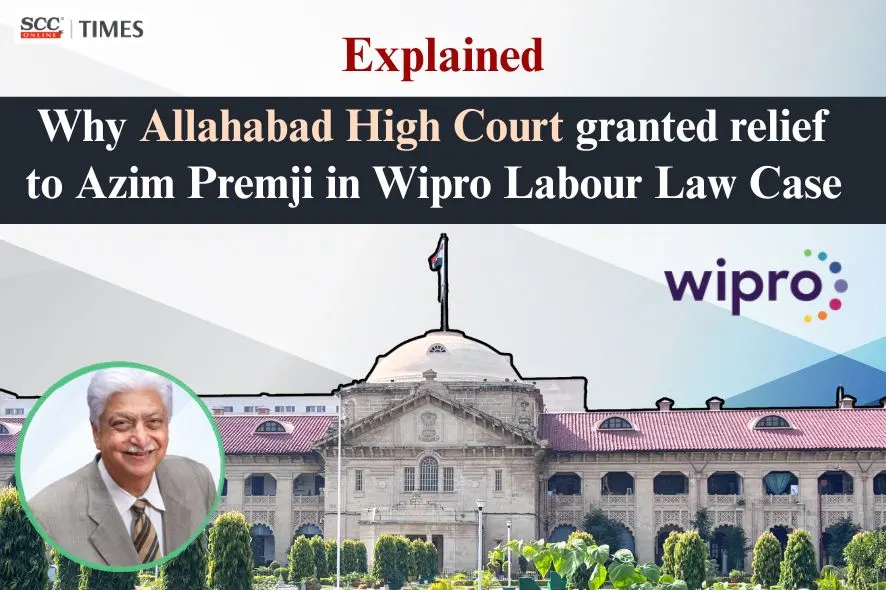
Allahabad High Court: In a petition filed by Wipro Chairman Azim Premji seeking quashing of 2017 criminal proceedings initiated against him in Wipro Labour Law Case, the Single Judge Bench of Zafeer Ahmad, J., allowed the petition, holding that the impugned summoning order was passed in a proforma manner without any discussion of material available on record, satisfaction regarding ingredients of the alleged offence, or the role attributable to Azim Premji. Reiterating that the summoning order must reflect application of mind and satisfaction of the Court regarding the existence of sufficient grounds to proceed against the accused, the Court held that the impugned summoning order did not disclose any such satisfaction and appeared to have been passed mechanically.
Background
A criminal case was filed against Azim Premji, Chairman and Managing Director of Wipro, before the Chief Judicial Magistrate, Lucknow (CJM), for alleged labour law violations at the Wipro Lucknow office. Aggrieved, he filed the present petition under Section 482 Criminal Procedure Code, 1973 (CrPC) seeking quashing of the summoning order dated 8 February 2017 and criminal proceedings.
He contended that he was not involved with the day-to-day functioning of the Wipro office situated in Lucknow. Additionally, the security services at the said establishment had been outsourced to G4S Secure Solutions India Private Limited (G4S) through an agreement, under which the service provider was an independent contractor and solely responsible for payment of wages, statutory dues, provident fund, ESI, and compliance with labour laws in respect of its employees. He neither exercises any administrative or managerial control over G4S nor has any role in supervising its employees.
He further contended that no notice regarding the alleged violation was ever served upon him or at any Wipro establishment and that he came to know about the proceedings only after the issuance of bailable warrants. He added that the present complaint did not disclose any specific allegation or material showing active involvement, criminal intent, or statutory vicarious liability on his part. Lastly, he submitted that, on identical facts and circumstances, a coordinate Bench in State of UP v. Azim Premji1 via order dated 29 May 2024 had quashed the complaint proceedings.
Analysis
Upon perusal of the complaint and the material brought on record, the Court noted that Azim Premji was sought to be prosecuted merely on account of his designation as Chairman and Managing Director of Wipro. No specific allegation had been levelled in the complaint indicating his direct involvement in the alleged violation or his active role in the day-to-day functioning of the establishment situated at Lucknow.
The Court also noted that the material indicated that the security services at the concerned establishment had been outsourced to G4S under an agreement, whereby the said agency was independently responsible for compliance with labour laws and statutory obligations relating to its employees. The Court reiterated that criminal liability cannot be fastened mechanically merely based on designation unless the statute specifically provides for vicarious liability or there exist specific allegations demonstrating an active role and responsibility of the accused in the commission of the alleged offence.
Furthermore, the Court noted that the summoning order passed by the CJM was wholly cryptic and non-speaking in nature. The order was passed in a pro forma manner without any discussion of material available on record, satisfaction regarding ingredients of the alleged offence, or the role attributable to Azim Premji. Even the relevant statutory provisions under which cognizance was taken were not properly discussed in the impugned order. In this regard, the Court reiterated that the summoning of an accused in a criminal case is a serious matter and the Magistrate is required to apply judicial mind to the facts of the case and the material available on record before issuing process. The summoning order must reflect application of mind and satisfaction of the Court regarding the existence of sufficient grounds to proceed against the accused.
In the present case, the Court held that the impugned summoning order did not disclose any such satisfaction and appeared to have been passed mechanically. The Court also found substance in the contention that on a similar set of facts, a coordinate Bench has already decided the matter. Thus, the Court held that continuance of the impugned proceedings against Azim Premji would amount to an abuse of the process of the Court.
Accordingly, the application was allowed and the summoning order, along with the consequential proceedings, was quashed.
[Azim Premji v. State of UP, 2026 SCC OnLine All 10421, decided on 20-5-2026]
Advocates who appeared in this case:
For the petitioner: Karunanidhi Yadav, Prateek Pal Singh
For the respondent: Govt. Advocate Sanjay Kumar Yadav
Buy Code of Criminal Procedure, 1973 HERE

1. Application u/S 482 No. 3261 of 2017