Supreme Court Directs APAAR Consent Form to Include Opt-Out Option; Restricts Disclosure of Student Data
The Supreme Court has directed that the APAAR consent form must expressly allow parents or guardians to refuse consent. The Court also

Bringing you the Best Analytical Legal News


The Supreme Court has directed that the APAAR consent form must expressly allow parents or guardians to refuse consent. The Court also
The Court directed that directions issued in Rohit Anand Das v. State of Odisha, 2025 SCC OnLine Ori 4535, regarding modification of the APAAR consent form should operate on a pan-India basis.
Police entered a woman’s bedroom without a woman constable, seized her mobile phone without a seizure panchnama, and recorded no grounds in the case diary. Bombay HC holds both the search under Section 185 and the seizure under Section 105 of the BNSS violated mandatory procedure and Article 21 of the Constitution.
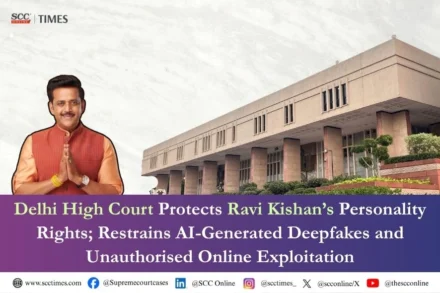
Delhi High Court held that Ravi Kishan’s name, image, likeness, voice, and other distinctive personality attributes constitute valuable personality rights deserving legal protection. Granting an ex parte ad interim injunction, the Court restrained the unauthorised use of his identity, including through AI-generated content and deepfakes, and directed the removal of objectionable online material.

The Delhi High Court had held that seeking hotel stay and call record details to prove the charge of adultery would not violate right to privacy.
In a 144-page ruling on 35+ petitions, Justice Sachin Datta held that the right to be forgotten is a constitutional right under Article 21, allowing acquitted persons, discharged accused, matrimonial dispute parties and sexual offence victims to seek de-indexing of judicial records from name-based search results globally, while declining relief for convicted persons, public figures, and cases involving ongoing public interest.
Justice Pankaj Mithal began his career in law in the 1980s and subsequently went on to become Judge at the Supreme Court of India.

“The parties shall be at liberty to take all remedies available in law for requiring the other spouse to place on record the affidavit as mandated under Rajnesh v. Neha, (2020) 2 SCC 324.”
“The arrest made before the registration of FIR, on the basis of illegal telephone tapping and unauthorized search and seizure, held to be illegal and unconstitutional.”
“Such unauthorized use does not only lead to unjust commercial enrichment but also infringes on the individual personality rights and in cases of a pornographic content tarnish the plaintiff’s reputation and goodwill.”

“The right to human life is to be treated on a much higher pedestal, regardless of a citizen’s religious belief. The mere fact that the petitioners are living in an interfaith relationship would not deprive them of their fundamental right as envisaged in the Constitution, being citizens of India.”
Defendant 1 had created and circulated AI-morphed content of the plaintiff including a movie titled ‘AI Love Story’
The grievance of the plaintiff arose from the manufacture, sale, promotion, and distribution of merchandise such as T-shirts, posters, mugs, keychains, and other products bearing his name, photographs, likeness, and persona, without authorisation.

“A person’s much less a woman’s dignity cannot be publicly maligned or defamed that too without consent which is the sine qua non for such publications.”
While the media enjoys freedom of speech and expression, but such right is not absolute and stands correspondingly delimited by the right of an individual to dignity and reputation.
“If it is intended to be a voluntary act, appropriate provisions clearly specifying such fact ought to have been incorporated in the form by providing option to the parents to refuse to submit their consent or to opt out of it entirely.”

“The Act does not create new constraints; rather, it operationalises the constitutional duties through a registration-cum-standards regime, a transparency mandate, and enforceable minimum requirements for emergency care and stabilisation.”

“It enables the Court to secure important documentary evidence that may be in the possession of individuals or organization and helps prevent the destruction, tampering or loss of crucial documents, thereby maintaining the integrity of the judicial process.”
Read about MeitY’s SOP mandating a 24-hour deadline to remove non-consensual intimate imagery online, empowering victims to reclaim their digital dignity.
“Scientific procedures, however advanced, cannot be employed as instruments of speculation; they must be anchored in demonstrable relevance to the charge and justified by compelling investigative need.”