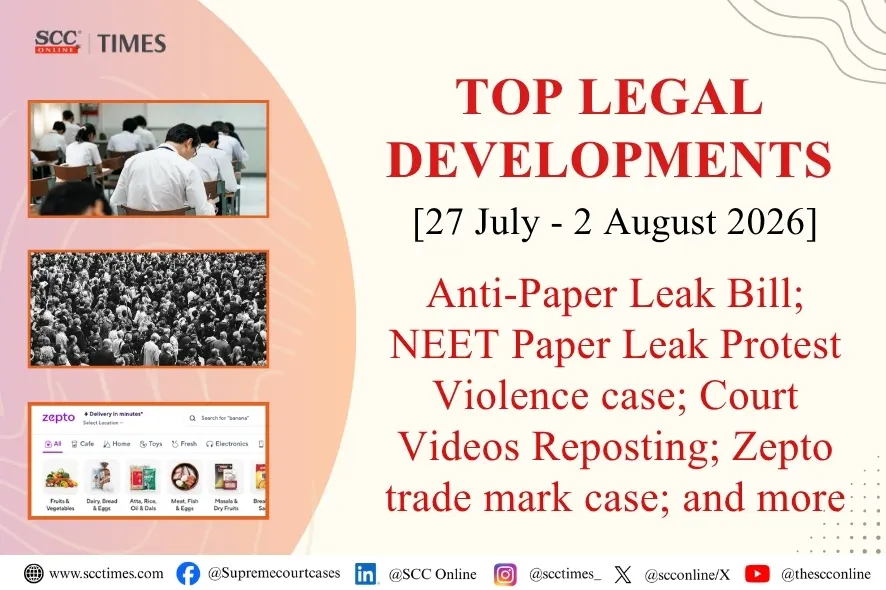
This weekly legal roundup brings together the latest developments from courts, legislatures and across the legal landscape in India. It features significant judicial pronouncements and legal developments, including the Meghalaya Honeymoon Murder Case, the recognition of the Right to Refuse and the Right to Meet, judicial observations on round-the-clock access to constitutional courts, and the threefold test for AI training.
STORY OF THE WEEK
What was Actually Directed on NEET Paper Leak Protest Violence
The Supreme Court held that there was a prima facie case for an independent and impartial investigation into the incidents of violence; notice was issued to the States of Maharashtra, Bihar, Assam, Uttar Pradesh, Madhya Pradesh, West Bengal and Kerala.
[Shailendra Mani Tripathi v. Union of India, SLP (Crl.) No. 280 of 2025, ordered on 28-7-2026]
Read more HERE
SUPREME COURT HIGHLIGHTS OF THE WEEK
APAAR SCHEME | Parents Get the Right to Refuse: Directed that APAAR Consent Form to Include Opt-Out Option; Restricts Disclosure of Student Data Beyond Lawful Purposes
The Supreme Court directed that the prescribed consent form must expressly provide parents or guardians with the option to withhold consent, holding that such a safeguard is essential to ensure that consent is “meaningful and informed”. The Court further clarified that all collection, processing, storage, retention and sharing of personal data under the APAAR Scheme are subject to the Digital Personal Data Protection Act, 2023 (DPDP Act), and that student information cannot be disclosed to private entities or third parties except in accordance with law.
[Abhishek Baxi v. Union of India, 2026 SCC OnLine SC 1391]
Read more HERE
ARBITRATION | Exclusive jurisdiction clause can indicate seat of arbitration: SLP dismissed against Delhi HC order appointing Sole Arbitrator
While considering a special leave petition challenging the order passed by the Delhi High Court appointing a Sole Arbitrator under Section 11(5) read with Section 11(6), Arbitration and Conciliation Act, 1996, the Supreme Court held that there was no good ground to interfere with the impugned order passed by the High Court.
[Sliksync Technologies (P) Ltd. v. Pidge Technologies (P) Ltd., 2026 SCC OnLine SC 1394]
Read more HERE
COURT VIDEOS REPOSTING | Inside the Order: Why and How Clipped, Out-of-Context Court Videos on Social Media were Curbed
The Supreme Court gave an interim direction prohibiting extraction, dissemination, monetisation, posting, re-posting, uploading, transmitting, modification, storing, or hosting of the audio-video recordings of the judicial proceedings on social media or any other digital platforms without prior permission of the Secretary General of the Supreme Court or the Registrar Generals of the jurisdictional High Courts.
[Harshita Grover v. Union of India, 2026 SCC OnLine SC 1393]
Read more HERE
ENVIRONMENTAL LAW | Can an Office Memorandum Create a Perpetual Ex Post Facto Environmental Clearance Regime?
The Supreme Court held that the observations in Common Cause v. Union of India, (2017) 9 SCC 499 and Alembic Pharmaceuticals Ltd. v. Rohit Prajapati, (2020) 17 SCC 157 that ex post facto environmental clearance is impermissible, were context-specific and did not curtail the Central Government’s power to issue a narrowly tailored, one-time amnesty notification under Section 3, Environment (Protection) Act, 1986 (Environment Protection Act).
[Vanashakti v. Union of India, 2026 SCC OnLine SC 1404]
Read more HERE
MEGHALAYA HONEYMOON MURDER CASE | Sonam Raghuvanshi’s bail set aside; fresh bail plea permitted if trial is not concluded within six months
The Supreme Court held that a plea regarding the adequacy of the grounds of arrest cannot be invoked in a subsequent bail application after earlier bail rejections on merits. Distinguishing such a case from complete non-service of the grounds of arrest, the Court set aside the respondent’s bail while permitting a fresh bail application if the trial is not concluded within 6 months.
[State of Meghalaya v. Sonam Raghuvanshi, 2026 SCC OnLine SC 1392]
Read more HERE
MOTOR ACCIDENT COMPENSATION | “Arising Out Of” Is Causal Link, Without This, Liability Falls; Alleged Murder Not Compensable Under MV Act Without Proof Connecting Vehicle to Death
The Supreme Court set aside the impugned judgments of the Motor Accident Claims Tribunal (Tribunal) awarding compensation and High Court affirming the same, holding that deceased’s death did not arise out of the use of the motor vehicle within the meaning of the Motor Vehicles Act. Consequently, neither the owner nor the insurer incurred liability to pay compensation under the Act.
[Dilip Agarwal v. Rajshri Agarwal, 2026 SCC OnLine SC 1374]
Read more HERE
NATIONAL COMMISSION FOR SCHEDULED CASTES | Whether NCSC can adjudicate service disputes and issue binding directions under Article 338 of the Constitution?
The Supreme Court held that although the National Commission for Scheduled Castes (NCSC) and similar constitutional commissions under Articles 338-A and 338-B perform a socially beneficial function, “the Legislature has prescribed a role that is recommendatory and advisory, but certainly not adjudicatory”. While NCSC has powers to requisition documents and receive evidence, but it does not have the power to make an order in furtherance of that evidence. Thus, NCSC does not possess adjudicatory authority to issue binding directions in service matters.
[Mumbai Port Authority v. National Commission for Scheduled Castes, 2026 SCC OnLine SC 1398]
Read more HERE
Also Read: SC: Section 14 IBC moratorium binds only corporate debtor | SCC Times
RIGHT TO MEET | Section 38 BNSS Confers Right to Meet, Not Continuous Presence of Advocate During Interrogation: Police Custody Conditions Modified
The Supreme Court modified the orders of the Magistrate and the High Court and issued the several directions permitting investigating agency to conduct custodial interrogation at designated interrogation centre subject to constitutional safeguards.
[State of A.P. v. Suda Suresh Veera Venkata Naga Raju, 2026 SCC OnLine SC 1389]
Read more HERE
ROUND-THE-CLOCK ACCESS TO CONSTITUTIONAL COURTS | E-Filing, Vacation Officers, Midnight Hearings: System Already Ensures Round the Clock Access to Urgent Constitutional Remedies
The Supreme Court held that the concerns raised by the petitioner were already substantially addressed through the existing institutional, procedural and technological framework. Emphasising that “access to constitutional remedies ought not to be held hostage to the clock”, the Court observed that the e-filing system, virtual hearing infrastructure, dedicated mechanisms for urgent listing, designated Vacation Officers and the long-standing practice of convening Benches beyond notified court hours sufficiently ensure timely access to constitutional remedies in cases involving exceptional urgency.
[Maheravish Rein v. Union of India, Writ Petition(s)(Civil) No(s). 376 of 2026, decided on 14-7-2026]
Read more HERE
HIGH COURT HIGHLIGHTS OF THIS WEEK
COPYRIGHT | Threefold Test for AI Training: Why ANI Failed to Stop OpenAI’s Use of Its News Content
The Delhi High Court held, prima facie, that OpenAI’s storage of ANI’s literary works for training the LLMs underlying ChatGPT fell within the scope of Section 52(1)(a), Copyright Act, 1957 (Copyright Act) and did not amount to infringement. The Court held that such use qualified as “private or personal use, including research” and satisfied the requirements of fair dealing, as it was limited to training, did not result in market substitution, and furthered public interest in technological innovation and dissemination of knowledge.
[ANI Media (P) Ltd. v. OpenAI OPCO LLC, CS(COMM) 1028 of 2024, decided on 24-7-2026]
Read more HERE
COMMERCIAL COURTS ACT | New Suit, New Mediation: Mandatory Section 12A Compliance Under the Commercial Courts Act Reaffirmed
The Calcutta High Court rejected a commercial suit seeking enforcement of a negative covenant in a family agreement as the plaintiff failed to comply with the mandatory pre-institution mediation requirement under Section 12-A, Commercial Courts Act, 2015 (CC Act). The Court highlighted that the statutory pre-institution mediation is an indispensable condition precedent for instituting an independent commercial suit.
[Ramji Lal Agarwal v. Sourav Agarwal, IA NO. GA-COM/1/2026, decided on 24-6-2026]
Read more HERE
CYBER LAW | A Purchaser’s ₹1,000 UPI Payment Froze a Trader’s Entire Bank Account: Unfreezing Ordered
The Andhra Pradesh High Court directed the respondent Bank to unfreeze the petitioner’s account, holding that freezing the petitioner’s account without verifying the credentials of the petitioner and without noticing his involvement in any criminal case was unsustainable, contrary to law and illegal.
[Sri Sai Wines v. Union of India, Writ Petition No. 969 of 2026, decided on 22-6-2026]
Read more HERE
CRIMINAL LAW | A Sour Relationship Isn’t a False Promise: Rape Charge Over Tinder Match Quashed
The Uttaranchal High Court held that a consensual physical relationship between adults who met through the dating app Tinder does not constitute rape merely because the relationship subsequently did not culminate in marriage.
[Ankush Sehgal v. State of Uttarakhand, 2026 SCC OnLine Utt 1837]
Read more HERE
DEMOGRAPHICS AND DEMOGRAPHY | Child Conceived During Separation, But Ex-Husband’s Name Went on the Birth Certificate: Correction to Biological Father Ordered
The Bombay High Court held that when there is adequate material available on record, Section 15, Registration of Births and Deaths Act, 1969 (1969 Act) can be invoked for correction of the birth certificate. The Court observed that the biological mother and the biological father had both conceded the parentage of the child and the DNA test report established the biological relationship with a probability of paternity measured at 99.99 per cent. Accordingly, the Court allowed the petition and directed the authorities concerned to issue a fresh birth certificate by deleting the name of the person earlier recorded as father and adding the name of the biological father.
[N v. Municipal Corpn., Brihanmumbai, 2026 SCC OnLine Bom 6674]
Read more HERE
FAMILY LAW | Can marriage or divorce be performed via a notarised agreement under Hindu Law?
The Madhya Pradesh High Court dismissed the appeal, holding that the appellant was not entitled to any benefits on account of the deceased as he was never married to her and his relationship with her did not have any legal status as she divorced the first husband via a notarised agreement, which was not a valid divorce. Reiterating that long cohabitation can be presumed to be a valid marriage, the Court stated that since the first marriage of the deceased was never severed, and if the long cohabitation (if any) is treated as a presumption of a valid marriage, then such presumption would be contrary to Section 5, Hindu Marriage Act, 1955 (HMA). Under Section 11 HMA, any marriage solemnised in contravention of any of the conditions specified in sub-sections (i), (iv) and (v) of Section 5 would be a void marriage.
[Ram Kripal Singh v. State of Madhya Pradesh, 2026 SCC OnLine MP 22161]
Read more HERE
MOTOR ACCIDENT COMPENSATION | Compensation Enhanced by ₹1.97 lakh on fatal Accident of a Young Woman: Future Prospects and Consortium Granted
The Karnataka High Court modified the compensation award, enhancing it to ₹16,77,000 for the family of a 20-year-old woman who died in a motor vehicle accident. The Court corrected the computational errors committed by the Tribunal and ensured that the claimants received fair compensation consistent with the principles laid down by the Supreme Court in Sarla Verma v. DTC, (2009) 6 SCC 121.
[Chandrika v. Axa Business Services (P) Ltd., 2026 SCC OnLine Kar 8131]
Read more HERE
NI ACT | IBC Moratorium Not a Safe Harbour Against Section 138 NI Act Prosecution; Directors Can’t Escape Cheque Dishonour Liability
The Punjab & Haryana High Court dismissed the petition, holding that subsequent insolvency proceedings cannot efface or obliterate criminal liability already crystallised upon dishonour of cheques, and that prosecution of the persons in-charge remains maintainable despite the moratorium or liquidation.
[Ajay Gupta v. Can Bank Factors Ltd., 2026 SCC OnLine P&H 22396]
Read more HERE
POCSO | “Chest” and “Breast” distinction immaterial in POCSO Cases; Grabbing child’s chest with sexual intent amounts to sexual assault
The Kerala High Court held that the act of grabbing the chest of a child with sexual intent constitutes sexual assault under Section 7, POCSO Act, rejecting a narrow interpretation based on the distinction between the terms “chest” and “breast”. However, the Court observed that a conviction for aggravated sexual assault under Section 9(l) read with Section 10, POCSO Act requires proof of repeated sexual assault and cannot be sustained merely based on an unsubstantiated allegation of an earlier incident.
[Aboobacker v. State of Kerala, 2026 SCC OnLine Ker 6951]
Read more HERE
RAILWAYS LAW | Technical Approval for Concrete Sleeper Plants Cannot Be Judicially Presumed; Deemed Approval Unknown to Railway Policy
The Allahabad High Court dismissed the petition, holding that there is no concept of deemed approval under the Railway policy governing CSPs. The Court observed that approval of a CSP requires satisfaction of technical parameters at multiple stages, which cannot be substituted by judicial determination, and that the benefit of the revised guidelines extending time for commissioning railway sidings is confined to already approved or operational CSPs.
[Calcutta Springs v. Union of India, 2026 SCC OnLine All 22860]
Read more HERE
SC/ST ACT | “Public View” Is Not Optional: SC/ST Act Charge Over Remarks Made Inside an Office Set Aside
The Delhi High Court held that the requirement that the alleged caste-based insult or intimidation must occur “in any place within public view” is an essential statutory ingredient of the offence. The Court found that the complaint itself alleged that the remarks were made inside the petitioners’ offices without any averment that any member of the public or independent person was present. Holding that the foundational requirement of “public view” was not prima facie disclosed, the Court set aside the order framing charges under Section 3(1)(x), 1989 Act and remanded the matter to the trial court for fresh consideration of framing of charges, if any, under the provisions of the IPC.
[Christine Swaroop Raj v. State, 2026 SCC OnLine Del 5274]
Read more HERE
SERVICE LAW | Not a matter of State charity, but an unassailable constitutional right; Tenure-based Senior Residents/Tutors cannot be denied Maternity Benefits
The Jammu & Kashmir and Ladakh High Court held that maternity benefits for Senior Residents/Tutors could not be denied merely because appointments were tenure-based. The Court quashed the impugned communication and directed payment of full pay and allowances during maternity leave as well as the corresponding extended period of residency.
[Sonakshi Gupta v. State (UT of J&K), WP(C) No. 3509 of 2025, decided on 10-7-2026]
Read more HERE
TRADEMARK | Use of “ZEPTO FINANCE” restrained; says deceptively similar marks prima facie infringe ZEPTO trade marks and cause public confusion
The Delhi High Court held that the plaintiffs had made out a prima facie case for grant of interim protection. The Court observed that the plaintiffs’ “ZEPTO” marks had acquired substantial goodwill and reputation through extensive use, commercial expansion, digital presence and promotional activities, while the defendants’ adoption of deceptively similar marks including “ZEPTO FINANCE” in relation to financial services was prima facie intended to encash upon the plaintiffs’ reputation and create a false association with the plaintiffs.
[ZEPTO Ltd. v. Sailendra Kashyap, 2026 SCC OnLine Del 5441]
Read more HERE
Also Read: Manipur High Court protects adults’ Right to choose spouse | SCC Times
TRIBUNAL UPDATES OF THE WEEK
CCI | HP India and authorised resellers penalised for bid rigging and cartelisation in Government e-Marketplace tenders
The Competition Commission of India held that HP India Sales (P) Ltd. facilitated coordination amongst its authorised resellers and functioned as the central enterprise in a hub-and-spoke cartel involving bid rigging, customer allocation and price coordination in relation to the sale and supply of HP Supplies Products through Government e-Marketplace (GeM) tenders.
[Cartelisation amongst HP India v. HP India Sales (P) Ltd., 2026 SCC OnLine CCI 72 and HP India Sales (P) Ltd., In re, 2026 SCC OnLine CCI 73, decided on 13-7-2026]
Read more HERE
EIT&AI DEPARTMENT | A Senior Citizen NRI’s Hacked Email and an Unverified Transfer of USD 92,420: PNB Held Liable and Directed to Pay Unrecovered Amount with Interest
The Electronics, Information Technology and Artificial Intelligence Department, Mumbai held the respondent Bank liable for proceeding with transaction without due diligence imposing compensation of USD 58,092.07 along with 12 per cent interest, stating that it fell short of the standard of care expected and that the banks are under a continuing obligation to maintain and periodically update KYC records ensuring a comprehensive customer profile including updated contact details, alternative communication channels, risk profiling of the customer, etc. and if the respondent had exercised due diligence the fraudulent transaction could have been prevented.
[Jetho Sakhrani v. Chief Manager, Punjab National Bank, Complaint Case No. 1 of 2015, decided on 4-5-2026]
Read more HERE
NCLAT | Mentioning Personal Guarantor as “Director” in SARFAESI demand notice cannot frustrate S. 95 IBC proceedings if terms of guarantee deed are satisfied
The National Company Law Appellate Tribunal, New Delhi held that the demand notice issued under Section 13(2), Securitisation and Reconstruction of Financial Assets and Enforcement of Security Interest Act, 2002 (SARFAESI Act) constituted a valid invocation of the personal guarantee in terms of the deed of guarantee.
[Ujwal Gupta v. Union Bank of India, 2026 SCC OnLine NCLAT 8]
Read more HERE
FOREIGN COURT UPDATES OF THE WEEK
RUSSIAN ARBITRAZH COURT | LCIA Arbitration Proceedings Refused to Halt Despite Claims of Restricted Access to Justice
The Russia Arbitrazh Court considered whether foreign restrictive measures had rendered the parties’ agreement to arbitrate incapable of performance. The Court held that no evidence had been produced demonstrating that restrictive measures in force against the claimant prevented it from protecting its rights or participating in the agreed arbitral process. Thus, finding no basis for displacing the parties’ agreement to arbitrate before the LCIA, the Court dismissed the claim seeking to prohibit the initiation or continuation of the London arbitration proceedings.
[LLC “Intervtorresurs” v. Icdas Celik Enerjy Tersane Ve Ulasim Sanayi A.S. & Vanomet AG, Case No. A56-24342 of 2025, decided on 17-7-2026]
Read more HERE
UNITED KINGDOM COURT OF APPEAL | Can Discussions and Documents Referring to Profit Sharing Give Rise to a Legally Binding Agreement?
The United Kingdom Court of Appeal held that the trial judge was entitled to find that no such agreement had been concluded. The Court further held that the documentary evidence relied upon by the appellants showed discussions and expectations regarding profit sharing but did not establish a legally binding arrangement. Accordingly, the appeal was dismissed.
[EJW Builders Ltd v. Marshall, [2026] EWCA Civ 911, decided on 20-7-2026]
Read more HERE
Also Read: Pakistan SC bans caste & conversion status references in FIRs | SCC Times
OTHER DEVELOPMENTS OF THIS WEEK
LEGISLATION UPDATES
Delayed Birth and Death Registrations to Now Require Magistrates’ Approval; Lok Sabha Passes Bill
On 31 July 2026, the Lok Sabha passed the Registration of Births and Deaths (Amendment) Bill, 2026, seeking to amend the Registration of Births and Deaths Act, 1969.
Read more HERE
More Convictions, Fewer Arrests: What Five Years of NCRB Data Show on SC/ST Atrocities
On 30 July 2026, the Ministry of Social Justice and Empowerment tabled in the Rajya Sabha five-year NCRB data on crimes against Scheduled Castes registered under the SC/ST (Prevention of Atrocities) Act, 1989.
Read more HERE
Lok Sabha Approves Anti-Paper Leak Bill; 2-Month Probe, 3-Month Trial Framework
On 29 July 2026, the Lok Sabha passed the Public Examinations (Prevention of Unfair Means) Amendment Bill, 2026, seeking to strengthen the legal framework governing paper leak cases and other examination-related offences.
Read more HERE
Also Read: Public Examinations Amendment Bill, 2026: Introduced in LS | SCC Times
Rajya Sabha Bill: Vande Mataram to Get the Same Legal Protection as the National Anthem
On 24 July 2026, the Prevention of Insults to National Honour (Amendment) Bill, 2026 was introduced in the Rajya Sabha, extending statutory protection available to the National Anthem to the National Song as well.
Read more HERE
Also Read: BCI Directs Universities to Inspect Law Colleges | SCC Times
No More Paperwork: Maharashtra enables online registration of partnership firms
On 20 July 2026, the Maharashtra Government notified the Indian Partnership (Maharashtra Amendment) Act, 2026, amending the Indian Partnership Act, 1932 in its application to the State of Maharashtra.
Read more HERE
Also Read: Maharashtra Stamp (Fourth Amendment) Act, 2026 Explained | SCC Times
ICSI Urges MCA to Mandate Company Secretaries in Companies with ₹50 Crore Borrowings
On 16 July 2026, the Institute of Company Secretaries of India (ICSI) submitted a representation to the Ministry of Corporate Affairs (MCA) seeking amendment of Rule 8A of the Companies (Appointment and Remuneration of Managerial Personnel) Rules, 2014.
Read more HERE
OP.ED.
-
India’s Mining Revolution: Balancing National Security with Environmental Democracy by Megharanjani Chandu, Senior Associate, SKV Law Offices; Vedant Choudhary, Associate, SKV Law Offices; and Ankit Chugh, Law Student
-
Opt-Out Not an Option: What Indian Businesses Must Know Before Deploying a WhatsApp Chatbot by Ishaan Uday
-
The Myth of the “Noble Profession”: Why This Argument Cannot Stand in the Way of Legal Reform by Dr Sanjeev Gemawat
-
The Salary Fallacy: Why Employment Cannot Determine Who is a Lawyer by Dr Sanjeev Gemawat
-
Algorithmic Control and Platform Liability in the Streaming Era by Akshaya Reddy Kolanu
-
Legal Professional Privilege and In-House Counsel: Why India Must Modernise Its Thinking by Dr Sanjeev Gemawat
-
Who Owns the Harvest? AI Training, Fair Dealing, and the Uncharted Limits of Section 52 by Paidipala Shishira
KNOW THY JUDGE
Also Read:
-
Tenant Rights in India: Legal Protections Every Renter Should Know | SCC Times
-
Kerala Law Academy Inaugurates CLEA-MILAT Research Mentoring Programme 2026 | SCC Times
-
CJI Surya Kant redefines mediation at the Commonwealth Peace Mediation Conference 2026 | SCC Times
-
Commonwealth Peace Mediation Conference 2026 opens in Jaipur | SCC Times
-
Section 74 and The Proof Paradox: Judicial Standards for Liquidated Damages in India | SCC Times