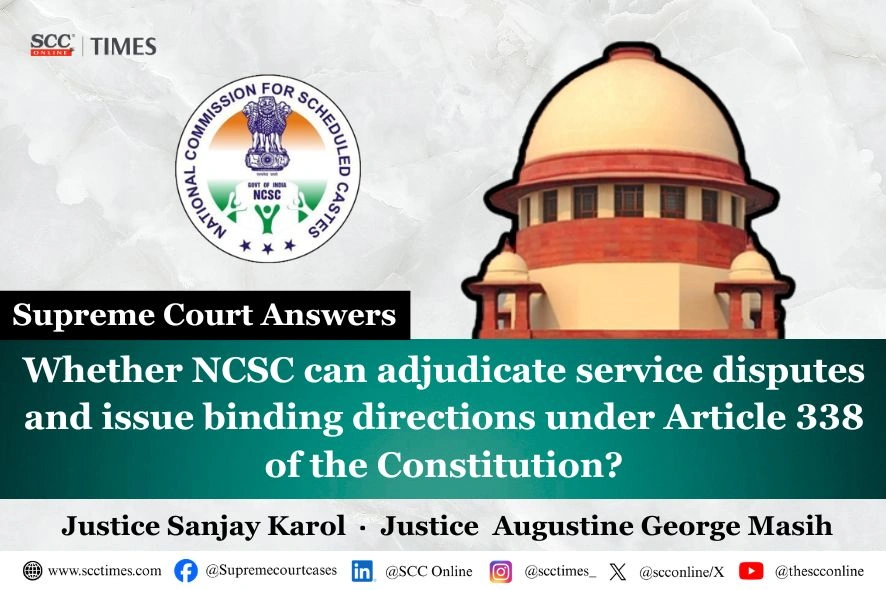
Supreme Court: While examining the constitutional limits of the powers vested in the National Commission for Scheduled Castes (NCSC) under Article 338 of the Constitution in terms of adjudicating service disputes concerning deprivation of the Scheduled Castes’ rights and issuing binding directions, the Division Bench of Sanjay Karol* and Augustine George Masih, JJ., held that although the NCSC and similar constitutional commissions under Articles 338-A and 338-B perform a socially beneficial function, “the Legislature has prescribed a role that is recommendatory and advisory, but certainly not adjudicatory”. while NCSC has powers to requisition documents and receive evidence, but it does not have the power to make an order in furtherance of that evidence. Thus, NCSC does not possess adjudicatory authority to issue binding directions in service matters.
Consequently, the Court set aside the Bombay High Court’s judgment and declared NCSC’s direction requiring the appellant, Mumbai Port Authority, to pay arrears within 30 days was contrary to the Constitution and non est in law.
Factual Matrix
In the instant matter, the Respondent 3, a Scheduled Caste employee, joined the Mumbai Port Authority as a Typist-cum-Computer Clerk in 1997. She was subsequently promoted to the post of Stenographer Grade-I under the Department of Personnel and Training (DoPT) Office Memorandum dated 21 January 2002 (2002 Office Memorandum), which recognised consequential seniority for Scheduled Caste and Scheduled Tribe employees promoted through reservation.
The validity of the 2002 Office Memorandum was later challenged before the Bombay High Court. The High Court quashed the 2002 Office Memorandum and in compliance with that judgment, the Mumbai Port Authority revised the seniority list and issued a circular directing reconsideration of promotions made on the basis of the quashed policy. Consequently, Respondent 3 was issued a show-cause notice and, after being heard, was notionally reverted from Stenographer Grade-I to Grade-II with effect from 19 April 2007 until 30 November 2016.
The Supreme Court clarified, however, that a Special Leave Petition challenging that quashing is separately pending before it, and that the validity of the 2002 Office Memorandum itself was not in issue in the present appeal.
Aggrieved by the reversion, she approached the NCSC. The NCSC directed the appellant to adhere to reservation guidelines, grant promotional benefits in accordance with reservation rules, implement its directions, pay arrears within 30 days and submit an Action Taken Report.
The appellant challenged the NCSC’s authority to issue such mandatory directions. The Bombay High Court dismissed the writ petition, holding that the NCSC had acted within the scope of Article 338 of the Constitution. The High Court had, in part, reasoned that the direction to pay arrears within 30 days merely restated an earlier NCSC order dated 1 June 2023, which had purportedly attained finality.
The appellant challenged this decision before the Supreme Court.
Issues for Determination
-
Whether the NCSC possesses adjudicatory authority under Article 338 of the Constitution to issue binding directions in service matters?
-
Whether directions issued by the NCSC requiring implementation of promotional benefits and payment of arrears are mandatory or merely recommendatory?
Analysis
At the outset, the Court examined Article 338 in detail and traced its constitutional evolution from the office of the Special Officer under the original Constitution to the present NCSC. It observed that Article 338 does not confer adjudicatory power upon the NCSC.
Interpreting Article 338(5), the Court found that NCSC is assigned with functions like, investigating safeguards, inquiring into complaints, advising Governments, presenting reports and making recommendations, etc. The Court stated that powers available to the NCSC is of the civil court for receiving evidence and the examination of witnesses, etc., under Article 338(8), “it does not have the power to make an order in furtherance of that evidence”. Its role under the Constitution is recommendatory and advisory and “not meant to be bodies taking over adjudicatory functions”.
Rejecting the NCSC’s submission that the expression “rights and safeguards” in Article 338(5)(b) authorises enforcement of the safeguards provided under Article 338(5), the Court noted that the NCSC may inquire into deprivation of rights and safeguards, record factual findings and call upon the appropriate Government to take action, but it cannot itself enforce those findings through binding orders. It clarified that the provision “certainly does not confer adjudicatory power, at best recommendatory in nature”.
The Court relied upon All India Indian Overseas Bank SC and ST Employees’ Welfare Assn. v. Union of India, (1996) 6 SCC 606, wherein it had already been held that the NCSC’s powers of a civil court are only for facilitating investigations and do not include the power to grant injunctions or other adjudicatory reliefs. Further, in Collector v. Ajit Jogi, (2011) 10 SCC 357, it was clarified that the Commission cannot determine caste status but may only inquire into complaints and submit reports recommending appropriate governmental action. These precedents, according to the Court, reinforce the limited constitutional role of the Commission.
Summarising the constitutional position, the Court observed that although the NCSC and similar constitutional commissions under Articles 338-A and 338-B perform a socially beneficial function, as “the Legislature has prescribed a role that is recommendatory and advisory, but certainly not adjudicatory”.
Decision
Applying above discussed principles, the Court held that the NCSC’s direction requiring the Mumbai Port Authority to pay arrears within 30 days was beyond the scope of its constitutional powers and was therefore “contrary to the provisions of the Constitution” and “non est in law”.
Also Read: Madras HC dismisses plea praying for dissolving National Commission for Scheduled Caste
[Mumbai Port Authority v. National Commission for Scheduled Castes, 2026 SCC OnLine SC 1398, decided on 28-7-2026]
*Judgment Authored by Justice Sanjay Karol
Advocates who appeared in this case:
For the Appellant: M/S. Meharia & Company, AOR Ms. Rekha Palli, Sr. Adv. Mr. Amit Meharia, Adv. Ms. Tannishtha Singh, Adv. Mr. Abinash Agarwal, Adv. Mr. Sambhav, Adv. Ms. Priya S. Bhalerao, Adv. Mr. Anish Venkatesh Bindlish, Adv. Ms. Bhavya Sharma, Adv. Mr. Vaidushya Parth, Adv.
For the Respondent: Mr. P. V. Yogeswaran, AOR Mr. Ashish Kumar Upadhyay, Adv. Mr. Y. Lokesh, Adv. Mr. V. Kandha Prabhu, Adv. Ms. Dhatri Singh, Adv. Ms. Maitri Goal, Adv. Ms. Hari Preethi, Adv. Mr. Harshit Vashish, Adv. Ms. Bhavini Vashisht, Adv. Ms. Suchismita Bhuyan, Adv. Mr. Guneswaran PV, Adv. Mr. Subodh Kr. Pathak, Adv. Mr. Pawan Kumar Sharma, Adv. Ms. Arunima Chatterjee, Adv. Mr. V. Elangovan, Adv. Mr. Kanishk Mor, Adv. Mr. Dharmendra Kumar Sinha, AOR Mr. Vinod K. Soni, Adv.