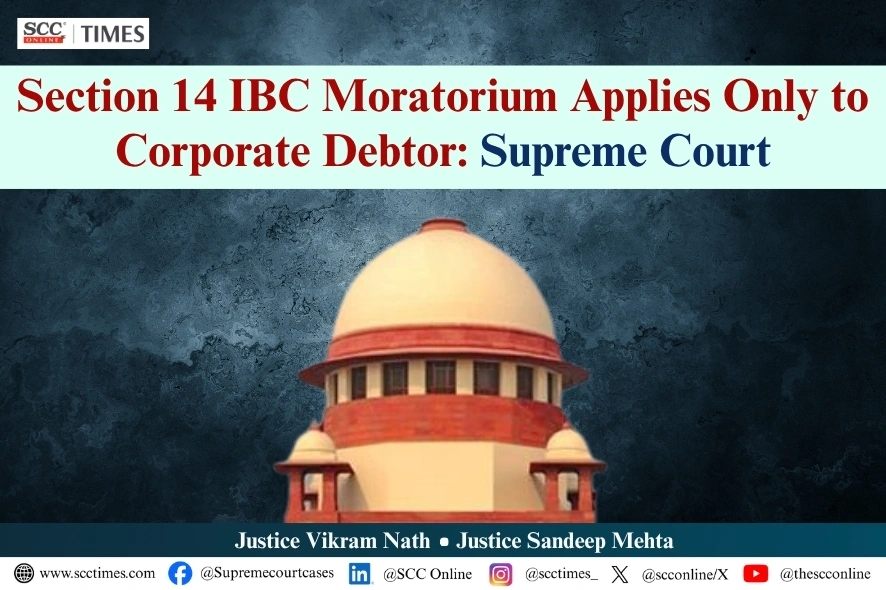
Supreme Court: While deciding appeals concerning the effect of a moratorium under Section 14, Insolvency and Bankruptcy Code, 2016 (IBC) on pending consumer proceedings, a Division Bench of Vikram Nath* and Sandeep Mehta, JJ., held that the statutory moratorium operates only against the corporate debtor and cannot be extended to promoters, directors, landowners or other respondents unless expressly provided by the statute.
The Court observed that the protective sweep of the moratorium must remain within the 4 walls of the IBC and cannot be enlarged in a manner that stultifies remedies available under the Consumer Protection Act, 2019. Holding that the National Consumer Disputes Redressal Commission (NCDRC) had erroneously declined to proceed against the non-corporate debtor respondents at the interlocutory stage, the Court set aside the impugned order and directed the NCDRC to adjudicate the consumer complaint against Respondents 2 to 7 in accordance with law, while clarifying that the proceedings against the corporate debtor would continue to remain governed by the moratorium under Section 14 IBC.
Background
The appeals arise from an order of the NCDRC dated 20 January 2025, whereby it declined to proceed with a consumer complaint filed by homebuyers against the promoters, directors, and landowners of a stalled housing project after a moratorium under Section 14 IBC was imposed against the developer company. The appellants had booked apartments in the Mantri Manyata Energia project being developed by Respondent 1 and entered into agreements for sale in 2016, under which possession was to be delivered by 31 December 2018. Alleging failure to hand over possession despite substantial payments, the homebuyers instituted a consumer complaint before the NCDRC against the developer, its associate company, promoters/directors, and landowners for deficiency in service and unfair trade practices.
During the pendency of the complaint, the National Company Law Tribunal (NCLT), Bengaluru, admitted insolvency proceedings against the developer and declared a moratorium under Section 14 IBC. The appellants subsequently sought continuation of the consumer proceedings against the remaining respondents, contending that the moratorium applied only to the corporate debtor. However, the NCDRC rejected the applications, holding that the liability of the other respondents could not be independently examined at that stage and adjourned the complaint sine die. Aggrieved by this decision, the homebuyers approached the Court.
Analysis
The Court held that the controversy lay in a narrow compass, namely, whether the NCDRC was justified in rejecting the appellants’ applications solely on account of the moratorium operating against Respondent 1 under Section 14 IBC. Referring to the scope of Section 14, the Court reiterated that the moratorium is statutory in nature and operates only against the corporate debtor. Its ambit cannot be enlarged beyond what the statute contemplates. Relying on P. Mohanraj v. Shah Brothers Ispat (P) Ltd., (2021) 6 SCC 258; Ansal Crown Heights Flat Buyers Assn. v. Ansal Crown Infrabuild (P) Ltd., (2024) 5 SCC 745 and Saranga Anilkumar Aggarwal v. Bhavesh Dhirajlal Sheth, (2025) 4 SCC 629, the Court observed that the moratorium does not extend protection to promoters, directors, landowners or other persons unless specifically provided by the statute, and that the protective sweep of the moratorium must remain within the 4 walls of the IBC.
Applying the aforesaid principles, the Court held that since Respondent 1 alone was the corporate debtor undergoing CIRP, no independent moratorium or statutory protection operated in favour of Respondents 2 to 7. It found the NCDRC’s approach erroneous, observing that while the Commission had itself acknowledged that liability for deficiency in service was yet to be determined, it simultaneously concluded that the alleged deficiency was attributable only to Respondent 1, thereby effectively deciding the issue at the interlocutory stage. The Court clarified that the question before the NCDRC was not whether Respondents 2 to 7 were liable, but whether the consumer complaint could proceed against them in the absence of any statutory bar. Such liability was required to be determined only after adjudication on merits.
Decision
Accordingly, the Supreme Court set aside the impugned order rejecting the interlocutory applications and directed the NCDRC to proceed with Consumer Complaint No. 13 of 2023 insofar as Respondents 2 to 7 are concerned. At the same time, the Court declined the appellants’ request to grant the substantive reliefs claimed in the consumer complaint, observing that several objections, including maintainability and absence of privity of contract, were yet to be decided by the NCDRC. The Court clarified that the proceedings against Respondent 1 would continue to remain governed by the moratorium under Section 14 IBC.
Also Read: Section 96 IBC and SARFAESI: Debt-Centric Moratorium | SCC Times
[Tejas J. Shah & Amisha T. Shah v. Mantri Technology Constellations (P) Ltd., 2026 SCC OnLine SC 1388, decided on 27-7-2026]
*Judgement authored by: Justice Vikram Nath
Advocates who appeared in this case:
For the Respondents: D. Seshadri Naidu, Sajan Povayya, Shekhar G Devasa, senior counsels with Ashutosh Dubey, Advocate