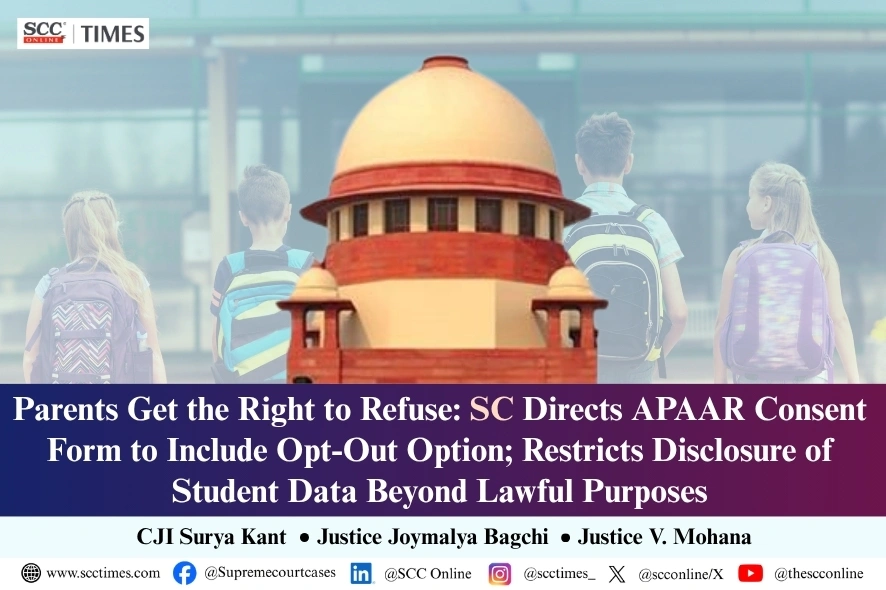
Supreme Court: The instant writ petition instituted under Article 32 of the Constitution, challenging the constitutional validity of the Automated Permanent Academic Account Registry (APAAR) Scheme, which provides every student with an Aadhaar-linked lifelong digital academic identifier. While declining to interfere with the operation of the APAAR Scheme, the three-Judge Bench of Surya Kant, CJI., Joymalya Bagchi and V. Mohana, JJ., directed that the prescribed consent form must expressly provide parents or guardians with the option to withhold consent, holding that such a safeguard is essential to ensure that consent is “meaningful and informed”. The Court further clarified that all collection, processing, storage, retention and sharing of personal data under the APAAR Scheme are subject to the Digital Personal Data Protection Act, 2023 (DPDP Act), and that student information cannot be disclosed to private entities or third parties except in accordance with law.
Background
The petitioners, parents of children studying in Central Board of Secondary Education (CBSE)-affiliated schools, contended that the Scheme required students’ Aadhaar details for generating APAAR IDs and created a centralised repository of students’ academic records from school admission onwards. According to the petitioners, despite the Ministry of Education’s circular stating that parental consent was necessary, the prescribed consent form neither enabled parents to refuse participation nor disclosed material particulars regarding the purpose, retention, processing, or sharing of personal data. They further alleged that subsequent CBSE circulars effectively made APAAR registration mandatory for students appearing in Board examinations from the academic session 2026 onwards, thereby rendering parental consent illusory.
The petitioners also asserted that schools were compelling parents to furnish Aadhaar details by threatening denial of admissions, Board examination registration, and other educational benefits, while some institutions claimed that failure to meet APAAR enrolment targets could adversely affect their recognition or State funding.
Issues for Determination
-
Whether the APAAR Scheme violated the fundamental right to privacy by creating an Aadhaar-linked lifelong educational database?
-
Whether the consent mechanism prescribed under the APAAR Scheme constituted valid, informed and meaningful consent?
-
Whether personal information collected under the APAAR Scheme was adequately protected against misuse and unauthorised disclosure?
Analysis and Decision
At the outset, the Court opined that the safeguards prescribed by the Orissa High Court in Rohit Anand Das v. State of Odisha, 2025 SCC OnLine Ori 4535, be implemented across the country. Specifically, it directed the authorities concerned implementing the APAAR Scheme to amend the model consent form under the APAAR Scheme and expressly provide parents or guardians with the option to withhold or refuse consent, observing that “such a safeguard is essential to ensure that the requirement of consent is meaningful and informed”.
The Court also clarified that concerns regarding misuse of personal information of students voluntarily enrolled under the Scheme were misplaced, since the processing of such data remained fully governed by the DPDP Act, irrespective of the Scheme being administrative rather than statutory. Authorities implementing the Scheme were directed to ensure strict compliance with the safeguards prescribed under the Act.
The Court further emphasised that personal information collected pursuant to the APAAR Scheme cannot be disclosed, shared or otherwise made available to any private entity or third party except in accordance with law and strictly for purposes authorised thereunder, and that any sharing beyond the Scheme or for extraneous purposes would be impermissible.
Since the respondents had not yet been heard, liberty was reserved to them to seek clarification, if required. The writ petition and all pending applications were accordingly disposed of.
[Abhishek Baxi v. Union of India, 2026 SCC OnLine SC 1391, decided on 20-7-2026]
Advocates who appeared in this case:
For the Petitioners: Ms. Indira Jaising, Sr. Adv. Ms. Mishi Choudhary, Adv. Mr. Paras Nath Singh, AOR Mr. Prasanth Sugathan, Adv. Mr. Jayant Malik, Adv. Mr. Syed Haroon, Adv. Mr. Nayan Grover, Adv. Mr. Kabir Choudhary, Adv.
For the Respondents: Ms. Pankhuri Shrivastava, Adv. Ms. Neelam Sharma, AOR Mr. Rajeev Sharma, Adv. Mr. Mukul, Adv.