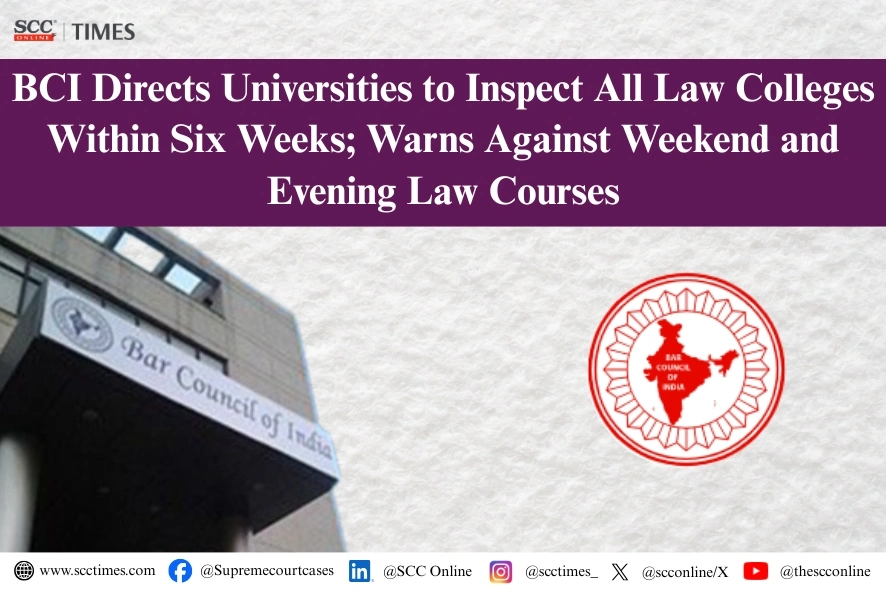
On 23 July 2026, the Bar Council of India (BCI) issued directions to Vice-Chancellors, Registrars, Deans and Heads of Law Faculties across the country, requiring immediate physical inspection of all constituent and affiliated Centres of Legal Education.
The move follows concerns regarding the quality of legal education and compliance with the Rules of Legal Education, 2008.
Key Takeaways:
-
The BCI has directed all universities imparting legal education to conduct immediate physical inspections of every constituent and affiliated Centre of Legal Education under their jurisdiction.
-
The direction comes after the BCI took note of oral observations reportedly made by the Supreme Court in K.R. Sudersan v. Bar Council of Tamil Nadu and Puducherry concerning the quality of legal education institutions and the continued operation of deficient law colleges.
-
The BCI emphasised that a university’s responsibility does not end with the grant of affiliation and that universities have a continuing obligation to ensure compliance with prescribed academic and infrastructural standards.
-
Referring to Rule 11 of the Rules of Legal Education, 2008, the BCI reiterated that all Centres of Legal Education must maintain the minimum infrastructure and academic standards prescribed by the BCI.
-
Universities have been directed to constitute inspection teams and conduct actual, institution-specific physical inspections rather than relying on affidavits, photographs, online submissions or documents furnished by managements.
-
Inspection teams must verify infrastructure including classrooms, libraries, reading areas, journals, databases, computer facilities, internet access, moot court rooms, legal aid clinics, seminar facilities and student amenities.
-
Emphasis has been placed on faculty verification, including verification of qualifications, appointment records, attendance, salary payments, workload and the exclusivity of principals and core faculty members.
-
The BCI clarified that part-time or visiting faculty may support the prescribed core faculty but cannot be treated as substitutes for the full-time core faculty required under Rule 17 of the Rules of Legal Education, 2008.
-
Universities have been specifically directed to ascertain whether any law college is conducting weekend classes, evening classes, compressed courses, shift-based classes or other arrangements designed for part-time students or working persons in a manner inconsistent with a regular course of study.
-
The BCI stated that a regular law course must operate for at least five hours a day and not less than thirty hours a week, and any arrangement diluting this requirement must be stopped immediately.
-
Admissions to impermissible weekend, evening or other non-compliant arrangements have been directed not to be permitted.
-
Inspection reports must be supported by dated and geo-tagged photographs, room measurements, faculty verification documents, salary records, attendance records, library details and class timetables.
-
Universities have been directed to verify whether approved buildings or facilities have been diverted to other institutions, courses or commercial uses.
-
Where a law college is found deficient in essential infrastructure, faculty, library facilities, moot court rooms, legal aid clinics, prescribed teaching hours or other mandatory BCI norms, universities have been directed not to grant or continue affiliation as a routine matter.
-
Serious deficiencies must be immediately reported to the BCI and appropriate proceedings for suspension, discontinuance or withdrawal of affiliation must be initiated in accordance with applicable university statutes.
-
Universities must also report false declarations, fabricated faculty records, misleading photographs, unapproved courses, excess admissions, unauthorised sections and concealment of material facts discovered during inspection.
-
The BCI reiterated that university affiliation cannot be treated as a substitute for Bar Council approval and that no admissions can be permitted without prior and current BCI approval as mandated under Rule 14 of the Rules of Legal Education, 2008.
-
Universities have been directed to verify, course-wise, section-wise and academic-session-wise, whether every Centre of Legal Education possesses prior, current and subsisting approval of the BCI.
-
The entire inspection and reporting exercise must be completed within six weeks from receipt of the communication.
-
Universities have also been directed to acknowledge receipt of the letter within three working days, furnishing the name, designation, mobile number and email address of a University Nodal Officer appointed for implementation, along with a course-wise and campus-wise list of all Centres of Legal Education under the University.
-
Universities have been directed to classify institutions as fully compliant, deficient but capable of correction, or seriously deficient warranting suspension, non-renewal or withdrawal of affiliation.
-
The BCI has stated that it can withhold or defer renewal of approval where a university fails to discharge its inspection and reporting obligations under the present directions.
-
The BCI has warned that failure to complete the exercise within the stipulated period may invite regulatory action by the competent committee of the Bar Council of India.
Also Read: Law Colleges Get Final Chance to Retain BCI Approval; Deadline Ends 31 July
[BCI Letter on immediate inspection, dated 23-7-2026]