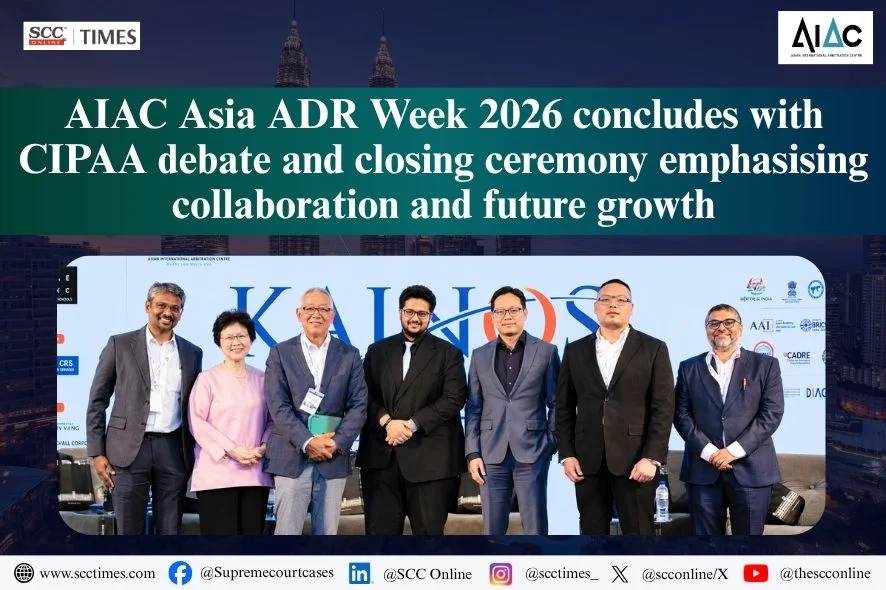
The final day of AIAC Asia ADR Week 2026 in Kuala Lumpur featured the fourth and final session, titled “CIPAA Refined: From View Esteem to Anas – How Far Can an Adjudicator Go?” The session was moderated by Mr Deepak Mahadevan, Partner, Azmi Fadzly Maha & Sim, and featured Dato’ Mary Lim Thiam Suan, President of the AIAC Court of Arbitration, Tan Sri David Wong Dak Wah, AIAC Court of Arbitration, Mr Foo Joon Liang, Partner, Gan Partnership, Mr Ong Yu Shin of The Chambers of Yu Shin Ong, and Mr Chetan Jethwani of Chetan Jethwani & Company.

[In picture from left to right: Mr Deepak Mahadevan, Dato’ Mary Lim Thiam Suan, Tan Sri David Wong Dak Wah, Mr Foo Joon Liang, Mr Ong Yu Shin and Mr Chetan Jethwani]
The panellists examined the implications of the Federal Court decisions in View Esteem Sdn. Bhd. v. Bina Puri Holdings Bhd.1 and Anas Construction Sdn Bhd v. JKP Sdn Bhd2, focusing on the scope of adjudicators’ jurisdiction under Malaysia’s Construction Industry Payment and Adjudication Act, 2012 (CIPAA), procedural fairness, natural justice and possible legislative reforms.
The event concluded with remarks by Datuk Danesh Chandran, Chief Executive Officer, AIAC, thanking the speakers, moderators, sponsors, institutional partners, delegates and the AIAC team for their contributions to the 8th edition of AIAC Asia ADR Week 2026. Reflecting on the event’s international participation and the relationships fostered throughout the week, he emphasised the importance of sustaining international partnerships, strengthening institutional continuity ahead of AIAC’s golden jubilee in 2028, and translating the discussions and ideas exchanged during the event into meaningful outcomes.
The purpose of CIPAA and the flexibility recognised in View Esteem
Introducing the discussion, Mr Deepak Mahadevan described the two Federal Court decisions as landmarks in defining the boundaries of adjudicators’ jurisdiction.
Mr Foo Joon Liang recalled the circumstances surrounding View Esteem. He explained that, during the adjudication, the respondent sought to advance several defences, including a counterclaim relating to defects and an issue concerning an advance payment. At the time, the prevailing understanding was that a defence, particularly a set-off, had to be raised in the payment response. Mr Foo explained that he therefore raised a jurisdictional objection. The adjudicator accepted the objection and did not deal with the set-offs. The High Court and Court of Appeal upheld that approach before the matter proceeded to the Federal Court.
Mr Chetan Jethwani explained that the difficulty lay in reconciling the speed and informality expected of statutory adjudication with the consequences of failing to raise a defence at the payment-response stage. He recalled the concern that a party involved in a substantial construction dispute could lose the opportunity to advance a defence because of an omission in its initial response. As Mr Jethwani observed:
“…you could have 100 million, 200 million government cases, and if you missed something in the payment response, you were done for. That would be it.”
He explained that concerns about such an outcome, alongside questions of natural justice, formed part of the context in which the Federal Court adopted a more flexible approach in View Esteem. The decision permitted additional defences to be raised in the adjudication response, even if they had not been included in the payment response.
Does procedural flexibility undermine efficiency?
Mr Foo expressed concern that allowing defences to be introduced at a later stage could put claimants at a disadvantage. A respondent could introduce allegations relating to defects or delay, potentially supported by expert evidence, in its adjudication response, leaving the claimant only five working days to address them in its adjudication reply. He questioned whether this approach was consistent with the objective of resolving payment disputes quickly. Mr Foo’s concern was that a party might retain arguments until the adjudication stage, leaving the opposing party with limited time to respond. He argued that the statutory process should encourage parties to identify their cases at an early stage rather than introduce substantial new issues at the point when the adjudication is already underway.

[In picture from left to right: Tan Sri David Wong Dak Wah, Mr Foo Joon Liang, Mr Ong Yu Shin and Mr Chetan Jethwani]
Mr Jethwani, however, cautioned against assuming that additional defences would necessarily take the opposing party by surprise. Construction disputes, he observed, generally develop over time, and parties may already know about issues such as defects and delay before the adjudication begins. He also emphasised the unfairness that could arise if a party were prevented from defending a claim because of a procedural omission.
Anas Construction: jurisdiction, contractual provisions and natural justice
The discussion then turned to Anas Construction, in which Mr Ong Yu Shin had represented the unsuccessful appellant before the Federal Court.
Mr Ong explained that the dispute concerned a claim for the cost of a third-party report following the termination of a construction contract. The relevant contractual provision had been referred to in the pre-adjudication correspondence and the payment claim. During the adjudication, the adjudicator referred to that provision while considering the respondent’s defence. The Court of Appeal set aside the adjudication decision, finding that the adjudicator had breached natural justice by addressing the contractual provision without inviting further submissions and had exceeded the limits of the adjudicator’s jurisdiction. The Federal Court majority affirmed the decision. Mr Ong considered that the adjudicator could have avoided the difficulty by inviting the parties to address the relevant contractual provision before relying on it.
The remark captured a central issue in the discussion: whether an adjudicator who identifies a potentially relevant contractual provision must give the parties an opportunity to make submissions before relying on it, even where the provision already appears in the documents before the adjudicator.
The panel also considered the consequences of treating payment claims and adjudication documents as pleadings. Mr Ong explained that practitioners had responded to Anas Construction by identifying as many potentially relevant contractual provisions as possible in their claims. He explained that his first line in payment claims had become a broad reference to the contractual provisions that might be relevant to the adjudication. He questioned whether such an approach served the purpose of identifying the specific contractual basis of a claim or merely created another layer of procedural formality.
Reconciling flexibility with procedural certainty
The panel examined whether View Esteem and Anas Construction could be reconciled, particularly in their treatment of the documents and arguments before an adjudicator. Mr Foo observed that the decisions appeared to adopt different approaches. He explained that View Esteem focused on identifying the underlying cause of action, whereas Anas Construction placed greater emphasis on whether the specific contractual provision relied on by the adjudicator had been identified.
Mr Chetan Jethwani similarly observed that the decisions were difficult to reconcile on the question of how strictly a payment claim must identify the relevant contractual provisions. He added that, in his view, the decisions appeared to depart from each other on the extent to which a party must identify the contractual basis of its claim. He stated:
“When you read View Esteem properly and you read Anas Construction properly, one’s actually very liberal, one’s actually very restrictive.”
The discussion highlighted the practical implications for parties preparing payment claims and adjudication claims. A strict application of Anas Construction could encourage exhaustive references to contractual provisions, while a more flexible approach would focus on whether the underlying claim and dispute had been sufficiently identified. The panel also considered whether an adjudicator could use the inquisitorial powers available under CIPAA to clarify a point that might affect the decision.
Further, Mr Jethwani suggested that an adjudicator could identify the relevant contractual provisions during case management and invite the parties to address them. He observed that, as a practical solution:
“…here you have your inquisitorial powers, use them by all means, but give them a chance to respond to it.”
This approach would allow adjudicators to clarify the issues while giving both parties an opportunity to address matters that could materially affect the determination.
The High Courts’ approach after Anas Construction
Mr Ong explained that he had been tracking the decisions delivered after the Federal Court judgment. He observed that courts had distinguished the decision on its facts or sought to moderate its practical effects, particularly where the circumstances did not disclose a clear breach of natural justice. Mr Foo similarly observed that the High Courts had sought to balance the strict approach in Anas Construction against the factual circumstances of individual disputes. He discussed decisions in which courts had considered whether the parties were already aware of the relevant contractual argument and whether the opposing party had engaged with it during the adjudication.
The panel’s discussion suggested that the question of prejudice had become important in assessing whether a challenge based on Anas Construction could succeed. Where a party knew of the relevant argument and had an opportunity to address it, the circumstances could differ from a case in which an adjudicator relied on a point that had not been addressed by either side. The discussion nevertheless acknowledged that the Federal Court decision remained significant and that its application continued to create uncertainty for practitioners. The courts’ efforts to distinguish subsequent cases reflected the difficulty of applying a strict jurisdictional rule to the varied factual circumstances that arise in construction disputes.
Natural justice and the need to avoid ‘rough justice’
Tan Sri David Wong Dak Wah reflected on the purpose of statutory adjudication and the importance of understanding the rationale behind CIPAA. He recalled being taught that the process was intended to provide contractors and subcontractors with a financial lifeline so that the construction industry could continue to operate. He questioned the idea that this purpose should justify a lower standard of justice, stating:
“…I thought in this world there’s only one type of justice. Justice, it cannot be rough justice.”
Tan Sri David argued that adjudication must be understood within the statutory and commercial context in which it operates. In his view, a highly legalistic approach could overlook the purpose of the legislation and the need to resolve payment disputes efficiently.
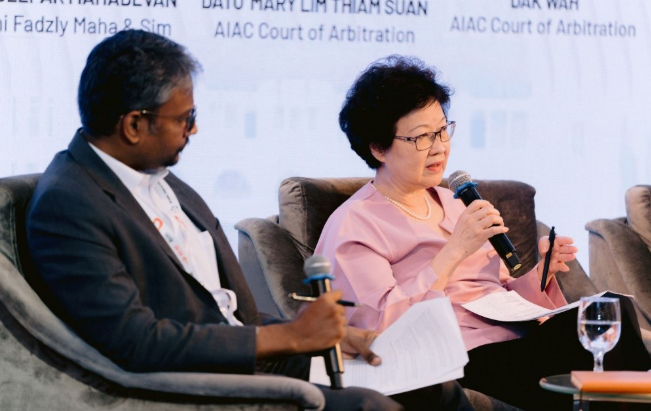
[In picture from left to right: Mr Deepak Mahadevan and Dato’ Mary Lim Thiam Suan]
Dato’ Mary Lim Thiam Suan likewise expressed concern that adjudication was becoming excessively legalistic. She observed that adjudicators, some of whom were technically qualified rather than legally trained, were increasingly required to deal with arguments concerning pleadings, jurisdiction and natural justice. Her remarks questioned how disputes concerning payment for work performed could become dominated by technical arguments about pleadings and procedural requirements. She emphasised that the process should remain accessible to parties who may not have legal representation. Dato’ Mary also stressed the importance of specialist knowledge and purposive interpretation. Referring to the interpretation of legislation, she stated:
“And I believe I’ve said in some judgments, the purposive rule is the rule.”
She argued that those applying the law must understand why it was enacted and how it interacts with the industry and the wider community. Specialist training, she suggested, could help adjudicators and judges avoid mechanical applications of legal rules that fail to account for the purpose of the statutory scheme.
Training adjudicators and considering reform of CIPAA
Addressing the challenges faced by adjudicators, Dato’ Mary explained that the AIAC had recognised the need for continuing training and updates. She stated that workshops would continue and that attendance at relevant sessions would become mandatory for adjudicators seeking further appointments. Adjudicators would also be tiered according to the complexity of the matters they were appointed to determine.
The discussion also turned to possible amendments to CIPAA. The panellists considered whether parties should be restricted from introducing defences that had not been raised in their payment responses. Mr Jethwani supported the possibility of reform but cautioned that any amendment would have to be carefully drafted. He warned against a rule that would allow one party to win simply because the other had made a procedural mistake. As he put it:
“…it cannot be so strict that you end up winning by error of the other side.”
He also argued that any restriction on introducing new defences should be accompanied by an opportunity to correct mistakes within the statutory process. In his view, the law should provide a fair balance between requiring parties to identify their cases early and ensuring that procedural errors do not automatically determine the outcome. The panellists also discussed whether the process for challenging adjudication decisions should be reviewed, including the time and resources consumed by setting-aside proceedings. Questions were raised about the role of oral hearings, the use of adjudicators’ inquisitorial powers and whether procedural reforms could provide greater clarity.

[In picture from left to right: Mr Deepak Mahadevan, Dato’ Mary Lim Thiam Suan, Tan Sri David Wong Dak Wah, Datuk Danesh Chandran Mr Foo Joon Liang, Mr Ong Yu Shin and Mr Chetan Jethwani]
The session concluded with an exchange on the need to preserve the speed and practical purpose of statutory adjudication while ensuring that parties receive a fair opportunity to present their cases. The discussion demonstrated that the relationship between View Esteem and Anas Construction continues to raise significant questions for courts, practitioners and adjudicators.
Closing remarks: strengthening partnerships and building for the future
In his closing remarks, Datuk Danesh Chandran thanked the speakers, moderators, sponsors, institutional partners, delegates and the AIAC team for their contributions to the 8th edition of AIAC Asia ADR Week 2026.
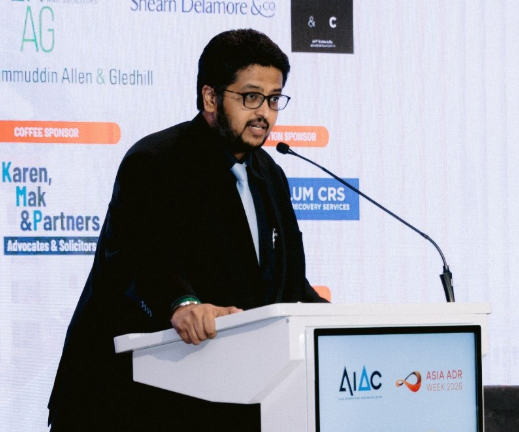
[In picture: Datuk Danesh Chandran]
He highlighted the event’s international participation, noting that delegates had travelled from jurisdictions including Russia, India, China, Brunei, the United States, Italy, the United Kingdom and other parts of the world. He described the event as an opportunity not only to exchange knowledge and ideas but also to strengthen relationships and create opportunities for continued collaboration. Reflecting on the theme of “Kainos”, he explained that it represented more than renewal or transformation in words. It signified a new way of thinking and progress achieved through collective commitment and action. Looking ahead to the AIAC’s golden jubilee in 2028, he stressed the importance of building an institution that would endure beyond any one individual or leadership team. He stated:
“The true legacy of ADR week will not be measured merely by the numbers of sessions that we held and participants that we gathered, but by the ideas we take forward and the partnership that we nurture and meaningful outcomes to follow.”
He reaffirmed the AIAC’s commitment to remaining a welcoming platform for the international alternative dispute resolution community, where ideas could be exchanged, partnerships developed and disputes resolved. Concluding his remarks, Datuk Danesh reminded participants that the end of ADR Week did not mark the end of the work or the relationships formed during the event. He ended with the AIAC’s tagline, “May the world resolve here.”
The closing ceremony brought the programme to an end with a focus on international cooperation, institutional continuity and the importance of translating discussions into meaningful outcomes.
SCC Times is the official media partner for AIAC Asia ADR Week 2026. Read more about AIAC Asia ADR Week 2026:
1. [2018] 2 MLJ 22 (FC)
2. [2024] CLJU 63