Madras High Court: In a matter concerning termination of a 31-week pregnancy following the detection of substantial foetal abnormalities, a Single Judge Bench of P.T. Asha, J. quashed the Medical Board’s refusal to permit termination of a pregnancy beyond 24 weeks, holding that the medical reports established substantial foetal abnormalities and that the pregnant woman’s reproductive autonomy and decision to terminate the pregnancy deserved primacy.
The Court observed that the mother has the right to decide whether she wishes to bring such a child into the world, particularly when the child may not lead a normal life.
Emphasising the considerable risks to the child’s prospects of leading a dignified and self-sustaining life, the Court said:
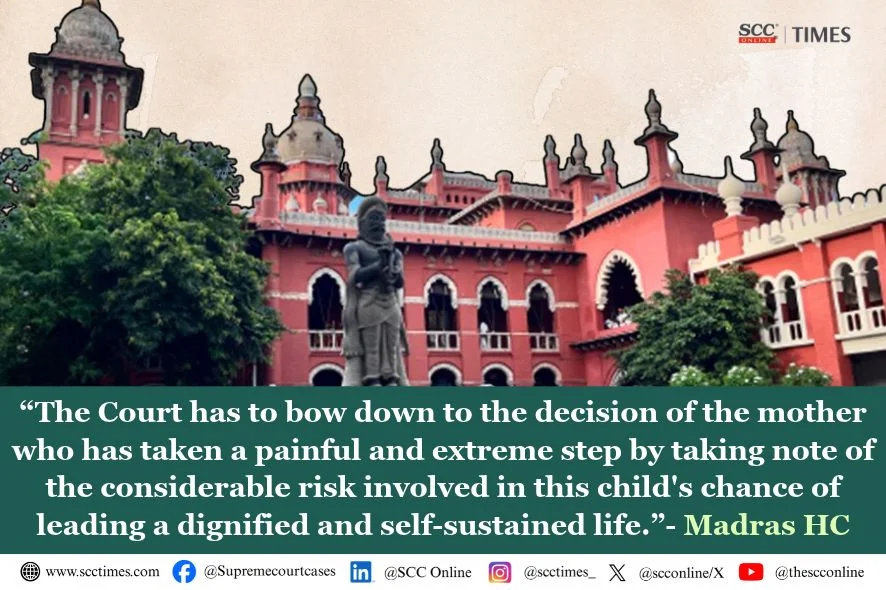
“The mother has the right to take a decision as to whether she would like to bring such a child into the world, particularly when the child is not going to lead a normal life. Therefore, this Court has to bow down to the decision of the mother who has taken a painful and extreme step by taking note of the considerable risk involved in this child’s chance of leading a dignified and self-sustained life.”
The Court accordingly quashed the Medical Board’s refusal and directed termination of the pregnancy by a registered medical practitioner, holding that the refusal could not be sustained in view of the scan reports showing substantial foetal abnormalities and the principles governing reproductive autonomy.
Background
The petitioner, who had a son born on 15 February 2024, conceived for the second time in early 2026. A scan conducted on 1 March 2026 indicated a gestation of approximately 19—20 weeks.
A subsequent scan revealed mild foetal ventriculomegaly. Extended neurosonography conducted on 5 October 2026 detected agenesis of the corpus callosum and bilateral moderate ventriculomegaly. The medical report highlighted the risk of developmental difficulties, including speech and language delay, learning difficulties, cognitive dysfunction, behavioural difficulties, epilepsy and intellectual disability, while noting that the degree of impairment could not be reliably predicted before birth.
A foetal MRI conducted on 6 October 2026 confirmed the absence of the corpus callosum and dilation of both lateral ventricles, measuring 16 mm on the right and 15 mm on the left. The report also noted colpocephaly and recommended further genetic testing, although the results might not influence pregnancy-related decision-making given the advanced gestational age.
On 13 October 2026, the petitioner sought termination of the pregnancy. However, the Medical Board refused approval, observing that the abnormalities were non-lethal and that isolated agenesis of the corpus callosum carried a variable prognosis without genetic testing. Challenging this refusal, the petitioner approached the Court under Article 226 of the Constitution.
Analysis and Decision
The Court examined Sections 3 and 5, Medical Termination of Pregnancy Act, 1971 (MTP Act), along with Rule 3-A, Medical Termination of Pregnancy Rules, 2003.
It noted that Section 3(2-B) excludes the statutory gestational limits under Section 3(2) where termination is necessitated by the diagnosis of substantial foetal abnormalities by a Medical Board. Under Rule 3-A, the Medical Board may allow or deny termination beyond 24 weeks after considering whether the procedure would be safe for the woman at that stage and whether the foetal malformation carries a substantial risk of being incompatible with life or of the child suffering from physical or mental abnormalities so as to be seriously handicapped.
The Court observed that, in the present case, the pregnancy had crossed 24 weeks and the Medical Board had declined approval. It therefore examined whether the refusal could be sustained in light of the medical findings and the principles governing reproductive autonomy.
The Court relied on Suchita Srivastava v. Chandigarh Admn., (2009) 9 SCC 1, in which a three-Judge Bench of the Supreme Court held that the right to make reproductive choices is a facet of Article 21 of the Constitution and that the pregnant woman’s consent in matters of reproductive choice and abortion is paramount.
It also referred to A v. State of Maharashtra, (2024) 6 SCC 327, emphasising that the fundamental rights to reproductive autonomy, dignity and privacy must be given primacy when Medical Boards and courts consider termination beyond 24 weeks. The Supreme Court had cautioned that delays caused by changes in a Medical Board’s opinion or court procedures must not frustrate these rights and had held that a Medical Board assessing a pregnancy beyond 24 weeks must provide the court with a full opinion on the pregnant woman’s physical and mental health.
The Court further considered X v. State (NCT of Delhi), 2022 SCC OnLine Del 4274, in which the Delhi High Court examined the meaning of “substantial foetal abnormalities” under the MTP Act. The decision referred to statutory formulations in other jurisdictions concerning serious physical or mental abnormalities and foetal impairment. The Court noted that judicial decisions had permitted termination even at an advanced stage of pregnancy, including the ninth month, where substantial foetal abnormalities were detected.
The Court also relied on X2 v. State (NCT of Delhi), (2023) 9 SCC 433 which recognised that reproductive autonomy is intrinsically linked to bodily autonomy and that the decision to continue or terminate a pregnancy falls within a woman’s bodily and decisional autonomy.
Applying these principles, the Court observed that the scan reports clearly indicated substantial foetal abnormalities. It held that the mother had the right to decide whether she wished to bring the child into the world, particularly in view of the risks to the child’s ability to lead a normal life.
The Court considered the findings of the extended neurosonography and the foetal MRI, which confirmed agenesis of the corpus callosum and bilateral ventriculomegaly. It noted that the medical reports identified a risk of developmental difficulties and that the extent of impairment could not reliably be predicted before birth.
The Court acknowledged the petitioner’s painful decision, taken in light of the considerable risks to the child’s prospects of leading a dignified and self-sustaining life. It observed that the parents would have to witness the child’s suffering and that their decision was intended to avoid bringing the child into the world to lead a life of indignity.
The Court also considered the child’s life after the parents’ lifetime and observed that the child should not be subjected to ridicule.
“It is the parents who would have to watch, day in and day out, the suffering that such a child would have to undergo. The parents have taken this decision to ensure that the child is not brought into this world to lead a life of indignity. Further, the unborn child also has the right to live a life of dignity and not be a subject of ridicule. This Court also has to consider the life of this child after the lifetime of the parents.”
In these circumstances, the Court held that the petitioner’s decision, supported by the medical records and the judicial principles governing reproductive autonomy, had to be respected. In light of the scan reports and the judicial pronouncements, the Court held that the impugned order could not be sustained. The Court quashed the impugned order dated 13 October 2026 passed by the hospital refusing approval for termination of the pregnancy.
The Court directed the respondents to terminate the petitioner’s pregnancy in accordance with the medical records, with the procedure to be carried out by a registered medical practitioner forthwith.
The writ petition was accordingly allowed, with no order as to costs.
[B.T. Pavithra Kumari v. Secretary, Health and Family Welfare Department, W.P. No. 42910 of 2026, decided on 15-10-2026]
Advocates who appeared in this case:
For the Petitioner: Mr. N. Manokaran, for Mr. A. Kanakavelappan.
For Respondents: Mr. J. V. Sakthi Balakrishnan, Government Advocate, Mr. V. Bharanidharan, Standing Counsel.