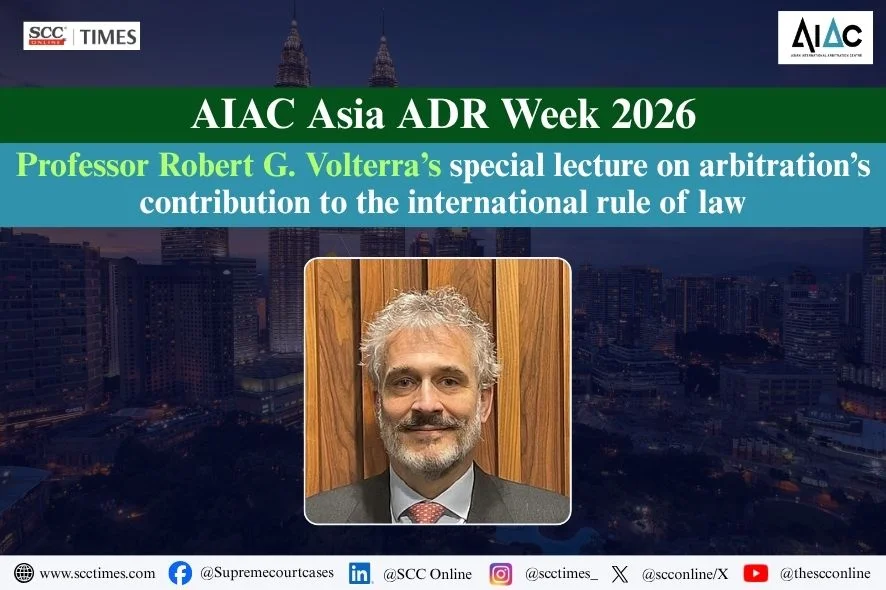
As part of Asia ADR Week 2026, organised by the Asian International Arbitration Centre (AIAC), Professor Robert G. Volterra, Member of the Board of Directors, AIAC and Partner at Volterra Fietta, delivered a special lecture examining the contribution of international arbitration to the international rule of law, tracing its historical evolution and highlighting Malaysia’s role in shaping international dispute resolution. The lecture was followed by an interactive question-and-answer session addressing the importance of evidence, litigation strategy, professional expertise, and the enduring values of arbitration.

Speaking against the backdrop of growing geopolitical uncertainty, disruptions to global supply chains and changing international economic relations, Professor Volterra examined how arbitration continues to provide a framework for resolving disputes and maintaining stability in cross-border relationships.
International rule of law amid global uncertainty
Professor Volterra began by distinguishing between changes in the rules governing international relations and the abandonment of the rule of law itself. He observed that modifications in the way States approach their international obligations do not necessarily amount to a rejection of the legal framework governing their conduct.
Drawing comparisons with domestic legal systems, he explained that legal norms may evolve through established processes without undermining the underlying principle that rules and procedures must be followed. He also acknowledged that the contemporary international environment has generated considerable uncertainty, particularly concerning trade, tariffs, geopolitical tensions, and economic cooperation.
The consequences extend beyond relations between States. Interruptions to supply chains, disruptions in the movement of manufactured goods and uncertainty surrounding energy supplies have created challenges for businesses operating across jurisdictions.
Against this backdrop, Professor Volterra emphasised that international arbitration has an important role in facilitating the application of legal rules and norms across borders. By providing mechanisms for resolving disputes between States and commercial actors, arbitration can contribute to predictability, stability, and the continued functioning of international economic relationships.
He also highlighted the opportunity for arbitral institutions in Asia, including AIAC, to strengthen their position as destinations for international disputes arising from an increasingly complex global economy.
From State-to-State disputes to commercial arbitration
Tracing the historical development of international arbitration, Professor Volterra explained that its early modern applications primarily involved disputes between States. Arbitration offered an alternative to resolving disagreements through military force, diplomatic pressure or unilateral action, helping establish the principle that disputes could be settled through agreed legal processes.
He referred to historical examples, including the Jay Treaty between Great Britain and the newly independent United States, which provided mechanisms for referring certain disputes to arbitration commissions. Such arrangements demonstrated how States could agree in advance on procedures for resolving disagreements without resorting to armed conflict.
The development of arbitration gained further significance as international trade and investment expanded during the nineteenth century. Disputes involving foreign property, commercial interests and State regulation increasingly required mechanisms that could address the concerns of foreign investors without escalating tensions between their home States and host States.
Professor Volterra explained how these developments contributed to the evolution of investment-related arbitration and, subsequently, modern international commercial arbitration.
He also discussed the growth of commercial arbitration following the Second World War, when expanding international trade and investment increased the need for effective cross-border dispute resolution. In this context, he highlighted the importance of the 1958 Convention on the Recognition and Enforcement of Foreign Arbitral Awards (New York Convention), which facilitates the recognition and enforcement of foreign arbitral awards across jurisdictions.
He noted that the Convention provides a particularly valuable framework for international commerce by enabling parties to seek enforcement of arbitral awards abroad through a widely adopted international instrument.
Three forms of arbitration and their contribution to the rule of law
Professor Volterra distinguished between three principal forms of international arbitration, each serving a different purpose within the international legal order:
-
International commercial arbitration: Resolves disputes arising from cross-border commercial relationships between private parties.
-
Investor-State arbitration: Provides a mechanism for foreign investors to bring claims against host States under applicable investment treaties and public international law.
-
State-to-State arbitration: Enables States to resolve disputes concerning their international rights and obligations through agreed procedures.
He explained that these mechanisms collectively support the international rule of law by providing structured alternatives to unilateral action and helping parties obtain decisions through established legal processes.
Malaysia’s contribution to international arbitration
Drawing on his experience advising Malaysia in international disputes, Professor Volterra highlighted the country’s participation in significant developments in international arbitration and public international law.
He referred to the Case Concerning Sovereignty over Pulau Ligitan and Pulau Sipadan, 2002 SCC OnLine ICJ 2 dispute, explaining how evidence of the exercise of State authority, including Malaysia’s regulatory measures concerning protected turtles, contributed to the outcome. The example illustrated his broader argument that the effective presentation of facts and evidence can be decisive in international litigation.
He also discussed the railway lands arbitration between Malaysia and Singapore, which involved the transfer and development of railway land and questions concerning the financial obligations arising from the arrangement. The dispute illustrated the interaction between commercial interests and sovereign considerations in international arbitration.
Professor Volterra further addressed Malaysia’s response to the arbitration brought by by claimants who described themselves as heirs of the Sultan of Sulu, in which an award of approximately US$15 billion was issued against Malaysia. He described the subsequent challenges to the award, enforcement proceedings and related legal developments, highlighting the importance of challenging allegedly fraudulent arbitral processes through established legal mechanisms.
These examples demonstrated how States can use international dispute resolution procedures to protect their interests while continuing to operate within the legal framework governing international relations.
Evidence and strategy: Why practical litigation experience matters
A central theme of Professor Volterra’s lecture was the importance of evidence, case preparation, and strategic decision-making in international disputes.
He observed that international litigation is not determined by legal theory alone. Even where the applicable legal principles are relatively straightforward, the outcome may depend on how effectively a party identifies relevant facts, manages documentary evidence and presents its case.
His discussion underscored the importance of treating evidence as a central component of litigation strategy rather than as a supporting element introduced after the legal arguments have been developed.
The lecture also highlighted the value of experienced legal teams capable of combining factual investigation, witness evidence, documentary analysis, and coherent legal argument. These skills, he suggested, are particularly important in complex State-to-State disputes, where the factual record can be extensive, and the consequences of an unsuccessful case may be substantial.
Question-and-answer Session: Evidence, expertise and the core values of arbitration
The special lecture was followed by an interactive question-and-answer session in which Professor Robert G. Volterra elaborated on the practical challenges of conducting international disputes, the importance of evidence and strategic case preparation, the composition of effective legal teams, and the principles underpinning international arbitration.
Evidence and strategic case preparation in international disputes
Responding to a question from Dato’ Mary Lim Thiam Suan, President of the AIAC Court of Arbitration, concerning his use of inquisitorial methods in cases involving Malaysian interests, Professor Volterra highlighted the importance of documentary analysis and the systematic examination of evidence within the common law tradition.
He explained that preparing a strong case requires lawyers to examine extensive historical records, identify relevant facts and integrate the evidence into a coherent legal strategy. Drawing on his work with Malaysia’s Attorney General’s Chambers and other Malaysian institutions, he emphasised that effective collaboration between domestic legal teams and international counsel can substantially strengthen a party’s position.
Professor Volterra also observed that international arbitration has increasingly incorporated analytical and procedural approaches associated with common law litigation, even where the governing substantive law originates from a different legal tradition.
Building effective legal teams: Government, private practice and academia
The discussion also examined whether States should build legal teams combining expertise from government, private practice and academia.
Professor Volterra distinguished between academic excellence and practical litigation experience. While academics play an important role in developing and interpreting international law, conducting complex international disputes requires additional capabilities, including strategic planning, tactical decision-making, evidence management and witness examination.
Illustrating this distinction, he referred to the Case Concerning Sovereignty over Pedra Branca/Pulau Batu Puteh, Middle Rocks and South Ledge, 2008 SCC OnLine ICJ 3. He highlighted the importance of effective case management, the careful selection of evidence and the integration of appropriate legal and governmental expertise in international litigation.
He stressed that States should draw on the capabilities of their Attorney General’s Chambers, foreign ministries, government-linked companies and private legal practitioners. A coordinated approach enables institutional knowledge, domestic expertise and international litigation experience to contribute to a unified case strategy.
Becoming an international lawyer: Strong foundations before specialisation
Addressing a question on career opportunities for aspiring international lawyers, Professor Volterra referred to advice from former International Court of Justice President Stephen Schwebel: becoming an effective international lawyer begins with becoming a good lawyer.
He emphasised the importance of developing strong foundational skills in litigation, legal analysis, strategy and evidence before specialising in public international law or international arbitration.
He identified opportunities for aspiring practitioners across government departments, the Attorney General’s Chambers, foreign ministries, government-linked companies and private law firms. Participation in conferences, specialised courses and dispute resolution programmes can also help develop the knowledge and practical experience necessary for international practice.
His remarks underscored that international arbitration is not an isolated specialisation; it draws on a broad range of legal, analytical and professional skills.
Consent, party autonomy and procedural control: The enduring values of arbitration
A participant from Vietnam invited Professor Volterra to identify the fundamental values that have enabled arbitration to endure and evolve amid changing global circumstances.
In response, he identified consent, party autonomy, control over the proceedings and effective dispute resolution as central to arbitration’s continuing relevance.
He explained that arbitration allows parties to agree to submit their disputes to a third party for a binding determination while retaining considerable influence over the proceedings. This includes decisions concerning the appointment of arbitrators, the seat of arbitration, the applicable rules and procedural arrangements.
Professor Volterra further observed that arbitration can be particularly valuable when parties seek a binding resolution without bringing their underlying commercial relationship to an end. This is especially relevant in sectors such as construction, oil and gas, and joint ventures, where parties may need to resolve significant disagreements while continuing to work together.
He cautioned against treating speed and cost as the defining advantages of arbitration in every case. Instead, he emphasised consent, procedural control, fairness and the ability to resolve disputes in a manner suited to the parties’ needs.
Concluding Reflections: Arbitration and the international rule of law
Concluding the discussion, Professor Volterra reiterated that international arbitration has contributed significantly to the development of the international rule of law, spanning disputes between States and contemporary commercial and investment disputes.
His lecture highlighted that arbitration’s enduring value lies not merely in the existence of a tribunal or an award, but in the legal framework, procedural safeguards and professional expertise through which disputes are resolved. The discussion also reinforced the importance of thorough case preparation, institutional cooperation and practical legal training for the next generation of international dispute resolution practitioners.
As AIAC continues to advance alternative dispute resolution in the region, the discussion highlighted the institution’s potential to strengthen its position as a centre of arbitration excellence for Asia and the wider international community.