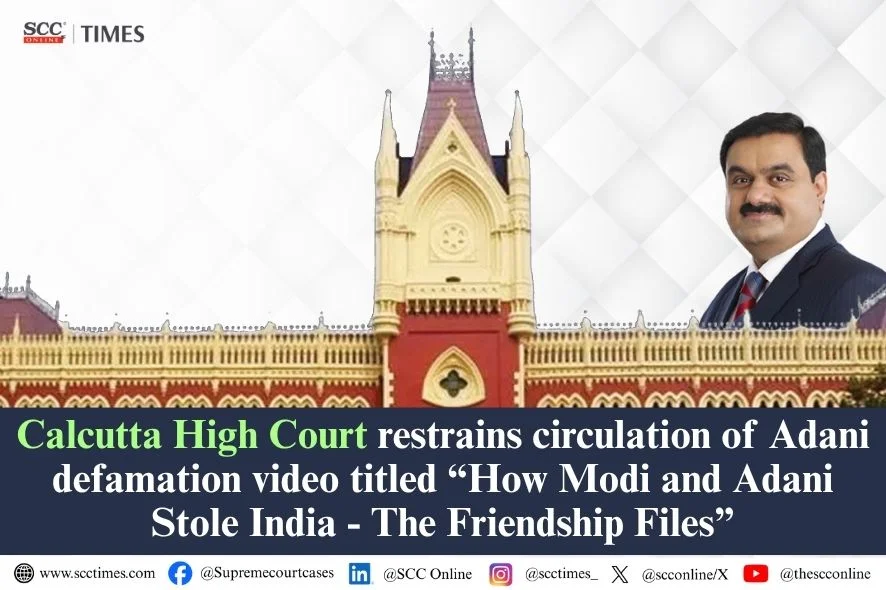
Calcutta High Court: In a defamation suit filed by Adani Enterprises Ltd. against Sabeer Bhatia and others seeking damages for defamation and permanent and mandatory injunctions, Aryak Dutt, J., granted an ad interim injunction restraining the publication and circulation of a video titled “How Modi and Adani Stole India – The Friendship Files”, along with its clips and materially identical reproductions. The Court also directed the relevant platforms, including YouTube, X and Instagram, to remove or disable access to the identified URLs and preserve specified account and access records.
Background
A suit was filed alleging that the video, uploaded on 9 October 2026 on the YouTube channel “Bcubed (Breaking Boundaries with Sabeer Bhatia)” in collaboration with “Shadow Citizens”, and subsequently posted on X, contained false and defamatory imputations against the company and the Adani Group. The suit names Sabeer Bhatia (Respondent 1), creator and operator of the YouTube channel and the X account @sabeer; YouTube, X and Instagram (Respondents 2, 3 and 4); and two unidentified persons said to be uploading and coordinating circulation of the content (Respondents 5 and 6).
According to the plaint, the video received substantial viewership shortly after its publication. Although access to the original YouTube upload had been disabled in India, allegedly following a government complaint under Rule 3(1)(d), Information Technology (Intermediary Guidelines and Digital Media Ethics Code) Rules, 2021, the plaintiff alleged that the video continued to circulate through re-uploads, reposts and Instagram reels. The plaintiff also alleged that the first respondent reposted the video on X after the original upload had been disabled.
Adani Enterprises submitted that the video falsely attributed serious wrongdoing to the company and the wider group. It argued that the right to reputation forms part of Article 21 of the Constitution and that the relief sought was confined to the identified video, its reproductions and the allegedly defamatory imputations. The company stated that it did not seek to restrain constructive criticism of government policy, business concentration or its commercial activities generally. It also submitted that the first respondent had suppressed material facts, including payment of premium for several land projects; that the plaintiff had received enquiries from investors, including a communication dated 12 October 2026; and that Respondents 2 to 4, as intermediaries, were bound to remove or disable access to unlawful content on a court order under Section 79(3)(b), Information Technology Act, 2000 and Rule 3(1)(d) of the 2021 Rules.
Analysis and decision
The Court acknowledged that pre-trial injunctions in defamation cases involving matters of public interest must be granted with great caution. Relying on the Supreme Court’s decision in Bloomberg Television Production Services India (P) Ltd. v. Zee Entertainment Enterprises Ltd., 2024 SCC OnLine SC 426, the Court noted that, apart from the requirements of a prima facie case, balance of convenience and irreparable injury, the public’s right to know and the potential chilling effect of an injunction must also be considered. The Court noted that such relief before trial should be confined to exceptional cases where the content is prima facie malicious or palpably false, with reasons recorded by the Court.
On examining the material placed before it, the Court formed a prima facie view that the case fell within that exceptional category. It observed that the video was not a news report or an account of proceedings but a dramatised narrative whose title expressly imputed theft and whose narration and visuals were presented as factual. The Court further noted that allegations linking the plaintiff’s group to narcotics smuggling associated with terror funding, and to police violence and false prosecution against a farmer, were assertions of fact. It observed that no material placed before it showed any finding by an authority substantiating those allegations.
The Court also took note of the disabling of the original upload in India and the allegation that the video had subsequently been reposted. It considered the balance of convenience to be in the plaintiff’s favour, observing that continued online republication could cause reputational injury that might not be adequately compensated in money.
Accordingly, the Court restrained the respondents, their agents, collaborators and persons acting under their authority from publishing, republishing, uploading, sharing or otherwise disseminating the impugned video, its clips, excerpts, shortened versions or materially identical reproductions, and from making the allegedly defamatory statements identified in the petition or similar statements.
The Court directed YouTube, X and Instagram to remove or disable access to the specified URLs listed in Schedule A, including engagements through which the video remained accessible. It also directed the platforms to preserve subscriber information, registration details, IP logs at the time of upload and access logs relating to the identified accounts and URLs. The Court further directed that basic subscriber information for accounts whose holders could not be identified from Schedule A was to be disclosed in a sealed cover by affidavit within 2 weeks of communication of the order.
The platforms were further directed not to serve advertisements on, or share revenue in respect of, the specified URLs or the impugned video containing the allegedly defamatory statements, and to preserve records of any advertising revenue generated from them. The Court also directed Respondent 2 to disclose the identity of Respondent 5 to enable the plaintiff to amend the plaint and serve the relevant documents.
The Court clarified that the order did not restrain constructive criticism or fair reporting concerning Adani Enterprises, the Adani Group or government policy, except through the impugned video, its reproductions or the specified allegedly defamatory statements. The Court expressly stated that its observations were prima facie.
The ad interim injunction will remain in force until 31 January 2027 or until further orders, whichever is earlier. The respondents were directed to file affidavits of compliance within 2 weeks of communication of the order, and the application was listed for hearing in the Monthly List of January 2027.
[Adani Enterprises Ltd. v. Sabeer Bhatia, CS No. 75 of 2026, IA/GA No. 1 of 2026, decided on 26-10-2026]
Advocates who appeared in this case:
For the Petitioner: Mr Anirban Ray, Senior Advocate; Mr Sanjay Basu, Mr Amit Kumar Nag, Mr Piyush Agarwal, Ms Shivangi Thard, Ms Ranjabati Ray, Ms Shrivalli Kajaria and Mr Debojyoti Das, Advocates.
For Respondent No. 2: Ms Pragya Jain, Advocate (via video conferencing).