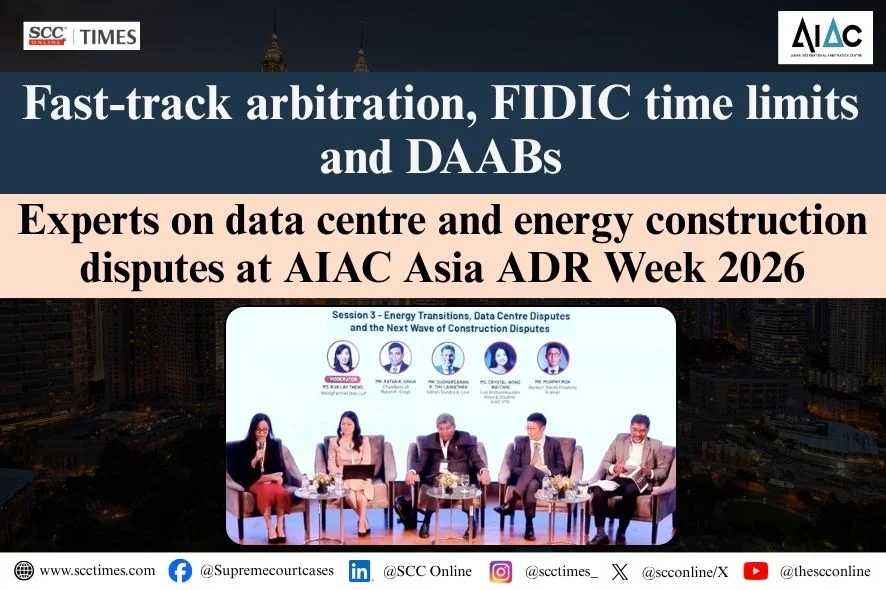
As part of Asia ADR Week 2026, organised by the Asian International Arbitration Centre (AIAC) from October 12 to 16, 2026, in Kuala Lumpur, Malaysia, Session 3 on Day 5 examined emerging challenges in disputes arising from energy-transition projects, cross-border power infrastructure and data centres. The discussion explored technical integration, commercial and regulatory risks, fragmented contractual structures, dispute avoidance mechanisms, limitation periods under FIDIC contracts and dispute resolution procedures under the AIAC Arbitration Rules.
Titled “Energy Transitions, Data Centre Disputes and the Next Wave of Construction Disputes”, the session was moderated by Lay Theng Kua, Partner, Construction Practice, WongPartnership LLP. The panellists were Ratan Kumar Singh, Senior Advocate and Arbitrator, New Delhi, and International Member, Keating Chambers; Sudharsanan Thillainathan, Partner, Adnan Sundra & Low; Crystal Wong Wai Chin, Partner, Lee Hishammuddin Allen & Gledhill; and Murphy Mok, Partner, Herbert Smith Freehills Kramer.
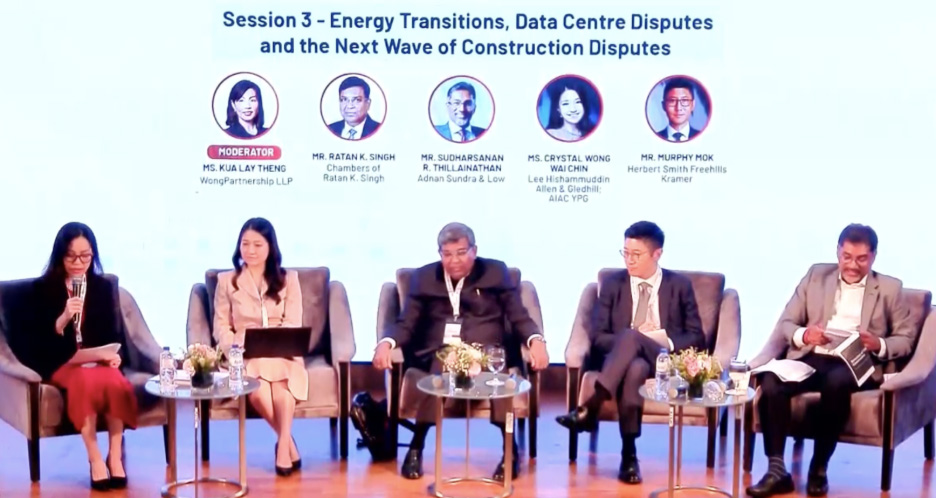
[In picture from left to right: Ms. Lay Theng Kua, Ms. Crystal Wong Wai Chin, Mr. Ratan Kumar Singh, Mr. Murphy Mok and Mr. Sudharsanan Thillainathan]

“Energy transition projects bring together construction, power, finance and regulation. When something goes wrong, the dispute rarely stays within one contract.”— Lay Theng Kua
System integration and the importance of preserving evidence

“If we talk about data centre, we are not only constructing a building. It is much beyond that. And therefore, eventually, it comes to the system integration.”— Ratan Kumar Singh
Opening the discussion on the technical challenges of energy-transition projects, Ratan Kumar Singh explained that disputes involving data centres and other complex infrastructure projects go beyond conventional construction claims. The challenge is not merely to construct a building but to ensure that multiple systems, equipment and components work together as intended.
He noted that these projects involve numerous stakeholders, including employers, contractors, subcontractors, financiers, insurers, suppliers and system integrators. Data centres, in particular, have demanding requirements concerning water, electricity and the consistency of power supply. The use of multiple suppliers and long-lead equipment can further complicate project delivery.
Mr. Singh observed that difficulties often emerge when different components are integrated. Although individual suppliers may consider their respective obligations fulfilled, the overall system may not perform as expected. Identifying the equipment responsible for a failure and determining when the problem arose can therefore become difficult.
Emphasising the importance of contemporaneous records, he advised parties to preserve project logs and relevant technical data to establish the status of the project when a failure occurs. Addressing commissioning failures specifically, he stressed that evidence should be preserved before remedial work begins. Records concerning the electricity supply, the systems in operation and the stage at which the failure occurred can help establish the circumstances surrounding the problem.
He also highlighted the need for contractual forms that better reflect the complexity of data centre projects. He observed that existing design-and-build arrangements and other standard forms may not adequately address the interactions between different systems and stakeholders. More suitable contractual frameworks, he suggested, could improve predictability and facilitate clearer risk allocation.
Standing DAABs and dispute avoidance under FIDIC contracts
Mr. Singh subsequently discussed the role of Dispute Avoidance/Adjudication Boards (DAABs) under FIDIC contracts. He observed that a DAAB can both resolve disputes and help prevent them, but its effectiveness depends on its composition and the stage at which it is appointed.
He emphasised the need for technical members who understand the relevant work and, in his view, a member with legal expertise to address contractual interpretation issues.
Distinguishing between standing and ad hoc DAABs, Ratan explained that a board appointed only after a dispute arises can adjudicate the matter but cannot provide the same degree of ongoing dispute avoidance. A standing board, by contrast, can develop familiarity with the project’s history through site visits and continued involvement, enabling it to identify emerging problems and advise the parties before they escalate.
He also noted that the effect of DAAB decisions and whether referral to a board is a precondition to arbitration can vary across jurisdictions. He observed that such referral is not a precondition to arbitration in India, although it is required in some other jurisdictions.
Risk allocation and cross-border power disputes

“Because if you allocate risks to parties that are not in a position to manage those risks, then that party could suffer adverse financial consequences.”— Sudharsanan Thillainathan
Sudharsanan Thillainathan examined the commercial and financial risks associated with energy-transition projects. He explained that these projects may face many of the difficulties encountered in traditional construction, alongside additional risks arising from their integration into wider energy systems.
Using a hypothetical solar power plant, he illustrated how a project could be technically complete and ready to operate but still face financial difficulties if the electricity grid could not absorb all the power generated. The grid operator might require the plant to reduce or stop its output, affecting the operator’s ability to generate revenue and meet its financial commitments.
He stressed that risks should be allocated to the parties best placed to manage them. Assigning risks to parties that cannot effectively control them may have adverse financial consequences and could ultimately threaten the project’s viability.
Disputes arising from the ASEAN power grid
The discussion then turned to cross-border electricity infrastructure, with the ASEAN Power Grid serving as an example of the challenges that can arise when projects span multiple jurisdictions.
Mr. Thillainathan identified three broad categories of disputes. The first comprises conventional construction disputes between project companies, EPC contractors and other contractors. The second concerns operational and commercial disputes involving transmission capacity, electricity curtailment, transmission losses, outages and payments for electricity. These disputes may involve generators, transmission operators, system operators and electricity buyers.
The third category involves disputes with states, including those arising from changes in electricity export rules and licensing requirements, which may lead to investment treaty claims.
On whether a single dispute resolution clause could govern all contracts associated with a cross-border electricity project, he considered this impractical given the involvement of multiple parties, contractual arrangements and regulatory regimes. He emphasised the need for a comprehensive dispute resolution framework that promotes compatibility between the mechanisms governing different parts of a project.
Adjudication, arbitration and urgent relief
Mr. Thillainathan also discussed the relationship between contractual adjudication, statutory adjudication and arbitration. He explained that these mechanisms serve different purposes: adjudication is generally intended to provide a quicker and often temporary determination, while arbitration ordinarily provides a final resolution.
He observed that an arbitral tribunal is generally not bound by a statutory adjudication decision. A DAAB decision, however, may become final and binding under the applicable contractual procedure if a notice of dissatisfaction is not issued within the prescribed period.
Addressing urgent relief under the AIAC Arbitration Rules, he distinguished between emergency arbitration before the tribunal is appointed and interim measures sought after its constitution. He identified the risk of serious harm, the balance between the parties and the applicant’s reasonable prospects of success as relevant considerations.
He further explained that the choice between approaching a court and seeking interim measures from an arbitral tribunal may depend on the circumstances. Where coercive enforcement is required, a court may be preferable; where confidentiality is a priority, an application to the tribunal may be more suitable.
Regulatory change and the contractual challenges of data centres

“To me, the gap isn’t really in the contract itself. It’s what the contract assumes will stay.”— Crystal Wong Wai Chin
Ms. Crystal Wong Wai Chin examined how changing energy-market regulations can affect long-term contractual arrangements. She observed that power purchase agreements (PPAs) may operate for approximately 20 years, during which the regulatory and commercial assumptions underlying a project may change.
Discussing Malaysia’s incentive-based regulation framework, she explained that electricity tariffs are determined for specified periods, with mechanisms for reviewing fuel costs. However, existing price-review mechanisms may not necessarily address structural regulatory changes or changes to incentive schemes.
She noted that these considerations are particularly relevant as electricity demand grows, including through the expansion of data centres. Lawyers drafting future-generation PPAs would therefore need to consider how regulatory developments could affect tariff structures and the economics of a project.
Who bears the risks when data centre projects face constraints?
In her presentation on data centre disputes, Ms. Wong identified electricity supply and regulation as two significant constraints. She discussed the challenges of locating data centres in areas where electricity demand is already high and determining whether the transmission network can support additional demand.
She also highlighted questions concerning the time required to expand infrastructure, the allocation of related costs and the arrangements needed to ensure reliable power supply.
Turning to contractual arrangements, Ms. Wong explained that data centre projects may involve several agreements, including interconnection, supply, construction, financing, offtake and service-level agreements. Since each participant controls a different part of the project lifecycle, contractual obligations and dispute resolution mechanisms may not always align.
She pointed out that grid-level disputes in Malaysia may be governed by statutory procedures under the applicable grid code. This raises questions about how those procedures interact with arbitration clauses in construction contracts and PPAs.
Another issue concerns the distinction between committed electricity demand and the actual capacity generated or delivered. Where the infrastructure required to meet a commitment is not available when expected, the parties may disagree about the resulting payment obligations.
Ms. Wong further emphasised the importance of aligning equipment warranties with contractual performance obligations. Data centres depend on critical equipment, including uninterruptible power supply systems, backup generators, transformers, switchgear and cooling systems. Even after a building is completed, a failure in any of these systems may prevent the facility from delivering the performance expected by its customers.
She observed that warranties may commence upon delivery or installation rather than when operations begin. This can create a gap between warranty coverage and the period during which the equipment must meet the project’s performance requirements. Accordingly, she highlighted performance obligations, interface responsibilities, warranty commencement dates and assignment rights as important considerations when drafting data centre contracts.
Consolidation and joinder under the AIAC Arbitration Rules
Ms. Wong also discussed the AIAC Arbitration Rules in the context of consolidating related disputes and joining additional parties. She emphasised that clear contractual provisions are important when several agreements govern different aspects of the same project.
A standalone dispute resolution protocol signed by the relevant parties may help coordinate disputes arising under multiple contracts. However, Ms. Wong cautioned that consolidation is not merely a procedural decision; counsel must also consider whether combining proceedings would be strategically beneficial for their client.
She illustrated how clearly drafted provisions connecting payment obligations under a PPA with a sponsor guarantee may facilitate consolidation or joinder in appropriate circumstances. Her discussion highlighted the importance of considering dispute resolution arrangements at the contract-drafting stage.
Mediation and settlement dynamics involving Chinese state-owned and private companies
Ms. Wong also challenged the assumption that mediation is invariably the preferred dispute resolution mechanism for Chinese parties. Drawing on her experience with state-owned enterprises (SOEs), she explained that internal approval requirements may make it difficult for representatives to agree to settlements at an early stage.
Mediation requires someone within the organisation to approve the proposed settlement, whereas arbitration places the decision before a tribunal. She contrasted this with private companies, where negotiators may have greater authority and financial accountability.
Ms. Wong therefore suggested that the suitability of mediation depends on the counterparty’s structure and its ability to negotiate and approve a settlement. She did not dismiss mediation as a mechanism but emphasised the need to assess the circumstances of the particular dispute.
Managing fragmented contracts and FIDIC time limits

“There are two clocks running at the same time that we need to be aware of. One is the clock for the claim and dispute process under contract. And the other is the clock for limitation period under applicable law.”— Murphy Mok
Murphy Mok observed that energy-transition projects continue to generate familiar construction claims involving delay, variations and defects. The additional difficulty, he explained, often lies in the fragmented contractual structures through which these projects are delivered.
For example, an employer may procure specialist equipment directly from suppliers while the main contractor retains overall responsibility for the project. This can leave the contractor with less control over the critical path and greater dependence on third parties.
Consequently, determining the root cause of a delay may require consideration of several contributing factors. Different contracts may also contain different time limits, liability caps, exclusions, governing laws and dispute resolution mechanisms.
Mr. Mok highlighted the risk of parallel proceedings arising when related disputes move through different levels of the contractual chain. Coordinating procedural timelines, pleadings, evidence and witnesses can become increasingly complicated when several proceedings are underway.
He emphasised the importance of dispute avoidance throughout the project lifecycle, including clear interface matrices, effective document control, timely notices and close coordination between the parties involved.
FIDIC procedures and limitation periods
Mr. Mok explained that parties must distinguish between contractual time limits under FIDIC contracts alongside limitation periods under the applicable law, and dispute resolution procedures under the AIAC Arbitration Rules 2026. Under FIDIC contracts, a claim may need to pass through several stages before arbitration can begin, including notification, submission of a detailed claim, the engineer’s determination, referral to a DAAB, notices of dissatisfaction and an attempt at settlement.
Referring to the 2017 FIDIC form, he explained that the prescribed periods for these steps can collectively extend beyond a year, even before accounting for delays or extensions. Meanwhile, the applicable limitation period may continue to run.
He advised counsel to identify limitation deadlines at an early stage rather than wait for the contractual dispute resolution process to conclude. Depending on the applicable law, parties may consider a standstill agreement to suspend or extend the limitation period. Where subcontractors are involved, corresponding back-to-back arrangements may also be necessary.
If a standstill agreement is unavailable, counsel may need to consider commencing arbitration to protect the claim and seeking a stay while the remaining pre-arbitration steps are completed.
He cautioned that the consequences of failing to comply with pre-arbitration procedures differ across jurisdictions. He noted that, under English and Hong Kong law, such non-compliance is generally treated as an issue of admissibility rather than jurisdiction, while the position may differ in other jurisdictions, including Malaysia.
His discussion underscored the importance of checking the applicable law and managing contractual procedures alongside limitation periods.
Fast-track arbitration under the AIAC Arbitration Rules
Mr. Mok also discussed the fast-track procedure under the 2026 AIAC Arbitration Rules. He explained that a party may request fast-track arbitration at the commencement of proceedings or before the tribunal is constituted, subject to the applicable requirements, including party agreement, the relevant monetary threshold or exceptional urgency.
Under the procedure he described, the default approach involves a sole arbitrator and a documents-only process, with the award expected within six months of the tribunal’s constitution.
He identified certain payment disputes supported by clear records, disputes concerning the valuation of instructed variations, enforcement of binding decisions and single-issue defect or variation claims with limited evidentiary requirements as potentially suitable for fast-track proceedings.
However, he cautioned that disputes requiring extensive documentary evidence, witness testimony or expert evidence may not be suited to an accelerated timetable. A dispute that initially appears straightforward can become more complex as the proceedings progress.
“The point is the fast track is not just about speed or how the claim looks on day one, but actually about whether the process can remain fair.”— Murphy Mok
Drawing on his experience as a sole arbitrator in an expedited proceeding, Mr. Mok described how a payment-default dispute developed into a more complicated matter involving a challenge to the validity of the agreement and requests for additional evidentiary steps. Although the parties ultimately agreed not to hold an evidentiary hearing, he noted that such a hearing could have placed pressure on the six-month timetable.
He emphasised that fast-track arbitration should not be assessed solely by the value or apparent simplicity of a claim. The procedure must also be capable of accommodating the dispute while preserving fairness and due process for both parties.
Conclusion: Effective dispute management begins before a dispute arises
The session highlighted how energy-transition and data centre projects are reshaping the challenges faced by construction practitioners and dispute resolution professionals. Multiple technical systems, interconnected contracts, evolving regulatory requirements and several parties with different responsibilities can make it difficult to identify the source of a problem and determine how a dispute should be resolved.
Mr. Singh emphasised the importance of preserving contemporaneous evidence and having standing DAABs in place from the beginning of a project. Mr. Thillainathan highlighted appropriate risk allocation and the need for coherent dispute resolution frameworks in cross-border projects. Ms. Wong drew attention to regulatory changes, equipment warranties and the coordination of related contractual disputes. Mr. Mok stressed the importance of monitoring limitation periods, managing pre-arbitration procedures and assessing whether fast-track arbitration can accommodate the evidentiary requirements of a dispute.
The central message was that effective dispute management begins well before a dispute arises. Clear contractual drafting, realistic risk allocation, early identification of potential problems and dispute resolution mechanisms designed to work across different project agreements can help parties manage the growing complexity of energy-transition and data centre projects.
The discussion reinforced the importance of coordinated contractual arrangements, effective dispute avoidance mechanisms and careful monitoring of contractual notices and limitation periods.
SCC Times is the official media partner for AIAC Asia ADR Week 2026. Read more from AIAC Asia ADR Week 2026.