


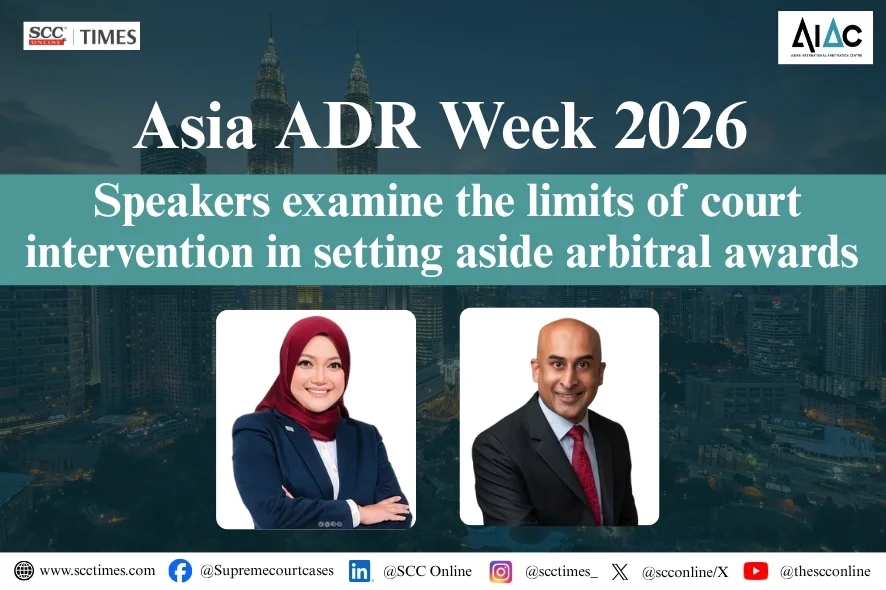
The opening day of Asia ADR Week 2026, organised by the Asian International Arbitration Centre (AIAC), featured a session examining the boundaries of court supervision over arbitral decisions. Titled “Error of law, excess of jurisdiction or public policy? Where should the courts draw the line in setting aside arbitral awards?”, the session brought together Ms Farah Shuhadah Razali and Mr Vinayak Sri Ram from Rosli Dalan Sarawana Partnership, Kuala Lumpur, Malaysia. Their discussion considered how Malaysian arbitration law addresses challenges to arbitral awards, particularly in construction disputes, and why judicial scrutiny must safeguard procedural fairness without turning setting-aside proceedings into appeals on the merits.
Setting aside is not an appeal on the merits
Opening the session, Ms Farah Shuhadah Razali explained that an unsuccessful party’s dissatisfaction with an arbitral award does not automatically provide grounds for setting it aside. Counsel must identify the precise statutory defect rather than rely merely on an alleged error apparent on the face of the award.

[In picture: Ms Farah Shuhadah Razali]
Referring to Section 37, Malaysian Arbitration Act, 2005 (Malaysian Arbitration Act), she organised the enquiry around three questions: whether the tribunal acted within its mandate, whether the parties received a fair opportunity to address the issues, and whether a genuine public policy objection arose.
Ms Razali emphasised that counsel should examine the arbitration agreement, pleadings, procedural orders, hearing transcripts, evidence and submissions before assessing the award. This would help determine whether the tribunal decided the dispute submitted to it or introduced a new issue that the parties had no meaningful opportunity to address.
She also distinguished an application to set aside an award under Section 37, Malaysian Arbitration Act from resisting recognition or enforcement under Section 39, Malaysian Arbitration Act.
“There must be something genuinely fundamental in the objection.”
On public policy, Ms Razali cautioned against treating it as a fallback argument whenever a party is dissatisfied with the outcome. If an allegation of illegality was raised and considered during arbitration, a losing party cannot simply ask the court to reconsider the same contractual evidence by relabelling the disagreement as a public policy objection.
She concluded that the objective should not be to build technical objections for a subsequent challenge, but to secure a fair process and a reasoned award based on matters the parties had a proper opportunity to address.
Arbitral finality requires a narrow scope of judicial review
Taking the discussion forward, Mr Vinayak Sri Ram focused on construction disputes and the relationship between arbitral finality and judicial supervision. He observed that parties choose arbitration for procedural certainty, confidence in the tribunal and for finality, rather than an assurance that every legal or factual conclusion will be correct.

[In picture: Mr Vinayak Sri Ram]
Mr Sri Ram noted that the removal of the former provision permitting challenges on the basis of an error of law was, in his view, appropriate because allowing such challenges would undermine arbitration’s speed and certainty.
“It’s not an appellate process. So really it’s very, very narrow.”
He explained that technical complexity, particularly in construction disputes involving competing delay analyses, quantum assessments and expert evidence, does not itself constitute a ground for setting aside an award. A tribunal is not necessarily required to choose between the opposing experts and may undertake its own analysis, including drawing on its expertise where permitted by law.
Referring to Section 21(3)(b), Malaysian Arbitration Act, Mr Sri Ram highlighted the ability of arbitrators to rely on their own knowledge and expertise in analysing evidence and reaching conclusions. He also noted that arbitral tribunals need not consult the parties about every step in their deliberative process.
However, he distinguished the use of general industry knowledge from reliance on a new, case-specific issue that the parties had no opportunity to address. Where a tribunal decides a dispute on a genuinely new issue that was neither examined by the experts nor addressed through evidence or submissions, a potential natural justice concern may arise.
Distinguishing general expertise from a new issue
Illustrating this distinction through construction arbitration, Mr Sri Ram discussed a dispute involving an arbitrator who relied on industry knowledge concerning the standard percentage for profit in attendance while assessing loss of profit. The challenge concerned the absence of specific evidence from either party on that percentage.
He explained that the court distinguished general facts forming part of industry expertise from special facts particular to the dispute. Where an issue falls within the parties’ reasonable contemplation and a party chooses not to lead relevant evidence, the tribunal may be entitled to rely on its expertise.
Mr Sri Ram proposed three questions to consider before pursuing a setting-aside application: whether the tribunal relied on general industry knowledge, whether the issue was reasonably foreseeable, and whether the decision concerned a fact specific to the dispute.
“So if there’s really something very specific, a specific factual point you want to raise in establishing the evidence, make sure you do that.”
He also discussed a construction dispute involving extension-of-time claims and expert evidence that developed beyond the bases originally advanced in the applications. The challenge to the award was rejected because the tribunal had determined the extension-of-time and delay issues submitted by the parties. The development of additional considerations in expert evidence did not, by itself, transform the dispute into an entirely different one.
The discussion underscored that the relevant question is whether the tribunal has genuinely departed from the dispute referred to it, rather than whether its reasoning differs from the parties’ submissions.
Natural justice requires a meaningful opportunity to respond
The speakers then examined the circumstances in which a tribunal’s independent reasoning could raise concerns about procedural fairness.
Ms Razali observed that arbitrators are not passive decision-makers. They may test the parties’ cases, probe the evidence and identify possible legal routes. The critical distinction arises when a point raised during the hearing becomes a decisive basis for the award.
In such circumstances, the relevant question is whether the parties understood that the point might become a live issue and had a meaningful opportunity to address its contractual foundation, calculation and consequences.
Mr Sri Ram agreed that tribunals should consider involving the parties where an issue becomes particularly significant. He acknowledged that counsel may not always recognise the importance of a question during lengthy and complex hearings, even when they are attentive to the proceedings.
Ms Razali added that tribunals should communicate the significance of a potentially decisive issue and, where appropriate, invite specific submissions. Counsel, in turn, should seek clarification rather than wait for the award and subsequently raise every possible objection.
The discussion highlighted the importance of communication between tribunals and counsel in identifying procedural concerns before an award is issued.
Courts should not reassess every item of evidence
Mr Sri Ram also addressed challenges alleging that a tribunal had failed to consider particular evidence. He observed that courts must be cautious about becoming involved in the tribunal’s assessment of the record or prescribing how extensively an award must discuss each item of evidence. Requiring tribunals to address every document or witness statement individually could lead to excessive judicial supervision and encourage reliance on formulaic statements that evidence had been considered.
He emphasised that the absence of a specific discussion of an individual piece of evidence does not necessarily establish a ground for setting aside an award. The focus must remain on the applicable legal threshold and whether the complaint concerns a genuine procedural defect, rather than dissatisfaction with the tribunal’s evaluation of the evidence.
A fair process and a reasoned award
In the concluding exchange, Ms Razali reiterated that counsel should clarify potentially decisive issues during the proceedings and ensure that the record accurately captures the parties’ positions. Rather than merely reserving objections, counsel should seek a fair opportunity to address a point that may materially affect the outcome.

[In picture: Mr Vinayak Sri Ram and Ms Farah Shuhadah Razali]
Mr Sri Ram similarly emphasised the value of involving parties in the decision-making process where a tribunal wishes to explore an issue that has not been fully addressed, provided this does not unnecessarily prolong the proceedings.
The session concluded with Ms Razali returning to the distinction between an unfavourable award and an award that may lawfully be set aside. Referring to the session’s opening analogy, she observed that an unhappy outcome does not automatically entitle a party to a second attempt before the courts.
As she put it:
“The courts are not there to give parties a different ending, but to ensure that the process meets the standards required by law.”
The discussion emphasised that the line between permissible arbitral reasoning and an award vulnerable to challenge depends on the tribunal’s mandate, the opportunity afforded to the parties to address decisive issues, and the existence of a recognised statutory ground for intervention.
Read more about Asia ADR Week 2026:





