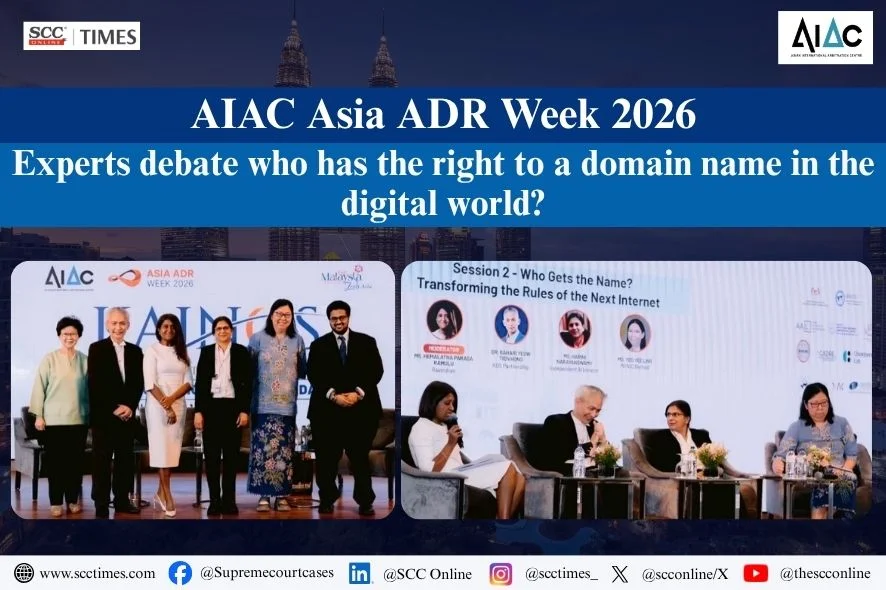
At AIAC Asia ADR Week 2026, the session titled “Who Gets the Name? Transforming the Rules of the Next Internet” examined how existing legal and dispute resolution frameworks must evolve alongside the internet. The discussion focused on the 2026 round of the Internet Corporation for Assigned Names and Numbers’ (ICANN) New Generic Top-Level Domain (gTLD) Programme, the formal objection grounds, Malaysia’s domain-name dispute resolution framework and the balance between procedural efficiency and fairness.
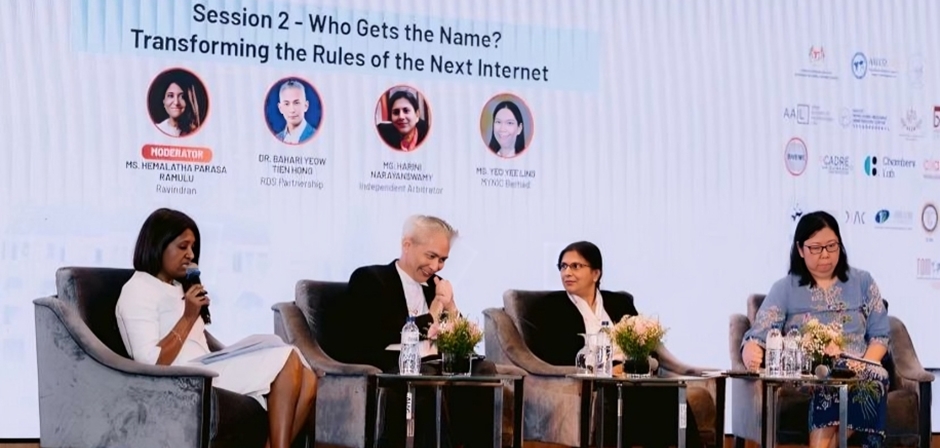
[In picture from left to right: Ms. Hemalata Parasa Ramulu, Dr. Bahari Yeow Tien Hong, Ms. Harini Narayanswamy and Ms. Yeo Yee Ling]
The session was moderated by Ms. Hemalata Parasa Ramulu, a Fellow of the Chartered Institute of Arbitrators and Partner at Ravindran. The speakers were Dr. Bahari Yeow Tien Hong, Senior Partner at RDS Partnership, Ms. Harini Narayanswamy, Partner and Founder of Narayanswamy Associates, an independent arbitrator and World Intellectual Property Organisation (WIPO) panellist and Ms. Yeo Yee Ling, Head of Legal Operations and Legal Strategy at MYNIC Berhad.
Who owns a name in the digital world?
Dr. Bahari Yeow Tien Hong began by asking whether ownership of a domain name should depend on who registered it first, who owns the trademark, who built a reputation around the name, or whether a community has used the name for generations.

[In picture: Dr. Bahari Yeow Tien Hong]
He illustrated the issue through Cinderella. If Cinderella had registered before Disney, would Disney have the right to take the domain name away from them? He then extended the question to a small businesswoman in Kuala Lumpur, who had legitimately used the same name for her business, asking whether the answer would remain the same. Dr. Bahari discussed the broader question of who owns a name in the digital world and whether trademark rights automatically extend to every domain name containing the same word. He stated:
“A trademark is not a universal passport to every possible use of a word.”
Dr. Bahari explained that trademarks protect business goodwill and help consumers identify the source of goods and services. However, trademark protection has boundaries determined by the applicable law, the nature of the mark and the likelihood of confusion.
A name may function as a trademark while also serving as a surname, geographical reference, descriptive expression or cultural term used by several businesses independently. Consequently, the fact that one party occupies a particular digital address does not necessarily establish a legitimate claim to the name itself.
He illustrated the problem through Coca-Cola’s Chinese-language name, which conveys the idea of a pleasant or delicious drink. He presented three situations: a trader deliberately imitating the Chinese name and similar packaging to mislead consumers, a local trader independently using the same expression for years in a different commercial context, and two businesses presenting competing evidence of use and disputing the scope of their rights.
The first situation would raise clear concerns about imitation and consumer deception. The other two would require closer consideration of the parties’ legitimate interests, the linguistic and commercial contexts, and the likelihood of confusion. Dr. Bahari also referred to Nike and its Chinese name, to illustrate why a change of language cannot automatically protect an imitation from legal scrutiny. At the same time, the existence of a trademark does not necessarily give its owner control over every similar expression in every language.
Returning to Cinderella, he emphasised that Disney should receive protection for the intellectual property it legitimately owns. Equally, a person using the name for a genuine business should not automatically lose that right, provided the use does not intrude upon Disney’s legitimate rights. He identified three guiding principles for the internet of tomorrow:
-
Context must matter: Decision makers should examine the relevant legal rights, linguistic meaning, commercial circumstances and conduct of the parties.
-
Global consistency must coexist with local understanding: International rules must account for regional and linguistic differences.
-
Procedural efficiency must not come at the expense of fairness: Speed should not prevent parties from receiving a fair opportunity to establish their rights.
Dr. Bahari concluded that names may represent businesses, families, communities, cultures and commercial reputations built over decades. The internet allows these identities to cross borders almost instantly, but it also makes copying, imitation, translation and exploitation easier.
He drew a distinction between the systems governing domain names and the justice required to resolve competing claims:
“Name open doors to the digital world, justice determines who has the right to walk through that door.”
ICANN’s 2026 gTLD Programme: Understanding the objection process
Ms. Harini Narayanswamy explained the framework governing applications for new generic top-level domains, focusing on legal rights objections and the changes introduced for the 2026 application round. She distinguished top-level domains, which appear after the final dot in a domain name, from second-level domain names registered beneath them. She explained that the 2012 expansion of the domain-name system also allowed branded top-level domains, where the registry operator can control who is permitted to register second-level names.

[In picture: Ms. Harini Narayanswamy]
According to Ms. Narayanswamy, the 2026 application round received 1,615 applications from approximately 481 applicants, compared with around 1,900 applications in the 2012 round. Ms. Narayanswamy explained that the new rules also introduced an appellate mechanism for legal rights objection decisions, potentially extending the overall dispute process to approximately a year or a year and a half.
She noted that the generic extension “.agent” had attracted multiple applications, raising the question of which applicant would ultimately control that namespace. Applicants included major technology companies such as Google, Meta etc. Ms. Narayanswamy also referred to an application by TAS Rights Management, the company managing Taylor Swift’s brand, for “.taylorswift”. She explained that this type of branded extension would be controlled by the relevant organisation rather than being open to unrestricted public registration. She emphasised that a legal rights objection does not itself determine which applicant receives a top-level domain. Instead, the process determines whether the objection is sustained, while ICANN makes the ultimate determination concerning the application in accordance with the applicable process.
The four formal grounds for objections
Ms. Narayanswamy outlined four categories of objections under the new gTLD application framework.
1. String confusion objection
This concerns competing applications involving identical or confusingly similar domain-name strings. Where multiple applicants seek the same generic extension, the framework must determine which applicant is entitled to control that namespace. Using “.agent” as an example, Ms. Narayanswamy explained that competing applicants would have to present their arguments and could seek a settlement. However, ICANN no longer permits applicants to resolve these disputes through an auction between themselves. The matter must be handled through the prescribed institutional process.
2. Legal rights objection (LRO)
Legal rights objections are typically brought by trademark owners or other rights holders who contend that a proposed top-level domain would infringe their rights. Ms. Narayanswamy explained that the process may involve registered or unregistered trademarks and can also apply to claims involving the names of intergovernmental organisations.
3. Public interest objection
This category concerns applications alleged to conflict with applicable public-interest standards, including moral or legal considerations. Ms. Narayanswamy explained that objections may be raised where a proposed domain string is considered contrary to public morality or other relevant public-interest requirements.
4. Community objection
A community objection may arise where a defined community contends that an applicant should not be permitted to control a domain extension associated with its collective interests. Ms. Narayanswamy used “.bank” as an example, explaining that other banks could object if one bank sought to control the entire namespace. She cautioned that granting a single applicant control over an entire domain extension can affect other legitimate users. Decisions must therefore account for the nature of the name, the rights asserted and the wider consequences of granting exclusive control.
Del Monte and Coach: How legal rights objections are assessed
To explain how legal rights objections are assessed, Ms. Narayanswamy discussed two disputes from the 2012 application round: the “.delmonte” dispute and the “.coach” dispute.
-
The Del Monte dispute: Earlier use, licensing and concurrent rights
In the Del Monte dispute, an African entity that had used the Del Monte mark under a licence from the parent company applied for the “.delmonte” top-level domain. The parent company, based in California, objected to the application. A three-member panel upheld the objection by a majority of two panellists. The dissenting panellist considered that the respondent’s established use and trademark registrations in Africa and other countries supported a claim to concurrent rights.
Ms. Narayanswamy explained that the parent company had coined and used the mark before the respondent. The respondent had used it as a licensee, but the licence agreement did not authorise it to register the trademark or the top-level domain in its own right.
She maintained that the respondent was a subsequent user and that the licence did not confer the rights necessary to control the entire top-level domain. In her view, the panel was justified in upholding the objection. The dispute also raised a procedural issue concerning supplementary documents. The respondent had submitted trademark registration certificates through supplementary filings, but the panel declined to consider those documents under its procedural approach. Ms. Narayanswamy maintained that panels have discretion over supplementary filings and considered that the additional certificates would not have changed the outcome because the respondent’s licence did not authorise it to register the mark or the top-level domain.
-
The Coach dispute: Reputation and potential harm to a trademark
The second dispute concerned “.coach”, a generic word that was also a widely recognised American brand. A three-member panel unanimously upheld the trademark owner’s claim to control the corresponding top-level domain.
Ms. Narayanswamy explained that the trademark owner had submitted evidence of the mark’s international recognition and argued that unrestricted use could potentially result in disparaging use of the name. The panel accepted that the mark had achieved the level of recognition necessary to justify control over the “.coach” namespace. The two disputes illustrated that a legal rights objection does not turn solely on whether a party owns a trademark. The strength and scope of the rights, the history and terms of use, the evidence presented and the potential consequences of allowing one party to control an entire domain extension may all be relevant.
Ms. Narayanswamy cautioned against granting monopolistic control over generic or dictionary words without carefully considering the interests of the wider community. She also clarified that the legal rights objection process determines whether an objection is sustained; it does not itself award the top-level domain. ICANN makes the ultimate decision on the application in accordance with the panel’s determination and the applicable rules.1
MYNIC’s role in Malaysia’s domain-name framework
Ms. Yeo Yee Ling explained MYNIC Berhad’s role as the registry operator for Malaysia’s “.my” country-code top-level domain. Malaysia was assigned the extension in 1987, when the registry operated as a division of the Malaysian Institute of Microelectronic Systems (MIMOS). MYNIC Berhad was incorporated as a company limited by guarantee in 2006 and operates under the supervision of Malaysia’s Ministry of Digital and the regulatory oversight of the Malaysian Communications and Multimedia Commission (MCMC).

[In picture: Ms. Yeo Yee Ling]
She distinguished the registry, which manages and maintains the domain-name system, from registrars, which provide registration and renewal services. Since “.my” became available for global registration in June 2024, individuals and entities outside Malaysia have been able to register second-level domain names. However, certain third-level extensions, including “.com.my”, “.net.my”, “.org.my”, “.name.my” and “.biz.my”, remain subject to eligibility requirements. Other extensions, such as “.gov.my”, “.edu.my” and “.mil.my”, are reserved for specified categories of organisations.
Ms. Yeo also discussed internationalised domain names, explaining that MYNIC had previously permitted registrations using Jawi, Chinese and Tamil scripts. The facility had been temporarily closed, with its reintroduction expected to be announced through MYNIC’s corporate website.
Malaysia’s domain-name dispute resolution and data protection framework
Ms. Yeo explained that MYNIC works with the Asian International Arbitration Centre (AIAC) on the Malaysia Domain Name Dispute Resolution Policy (MyDRP), which was modelled on ICANN’s Uniform Domain Name Dispute Resolution Policy (UDRP). Although MYNIC considered adopting the Uniform Rapid Suspension (URS) mechanism when “.my” registrations opened globally in 2024, it retained the MyDRP framework.
She referred to Malaysia’s regulatory framework under the Communications and Multimedia Act 1998 in explaining the basis for the dispute resolution policy. Ms. Yeo also noted an increase in international registrars following the expansion of global registration and stated that AIAC had received a record number of complaints under the “.my” and “.com.my” categories in 2026, compared with complaints filed under the UDRP.
The discussion also addressed the relationship between domain-name disputes and personal data protection. Ms. Yeo explained that MYNIC redacted registrants’ names, addresses and email addresses from publicly available domain-name records in 2022, in line with Malaysia’s Personal Data Protection Act. However, registrant information may be disclosed to AIAC for proceedings under the MyDRP, subject to the applicable consent provisions and terms.
The public WHOIS service continues to provide technical and administrative information, including registration and expiry dates, registrar details, nameserver information and whether a domain uses Domain Name System Security Extensions (DNSSEC).
The discussion highlighted the need to balance registrant privacy with access to information required to resolve domain-name disputes. While personal data must be protected, dispute resolution mechanisms must also be able to obtain the information necessary to process complaints fairly and effectively.
Questions and answers
Before opening the floor to questions from the audience, Ms. Hemalata Parasa Ramulu raised a question concerning the Del Monte domain-name dispute and the treatment of supplementary evidence. Providing context to the dispute, Ms. Ramulu explained that the Del Monte trademark had existed since the 1800s and originated in the United States. Over time, the parent company entered into licensing agreements across different jurisdictions. In the dispute discussed during the session, the African licensee had used the mark for products such as papayas and pineapples, while the United States retained the use of the mark for tomatoes. The territorial licensing arrangement had continued for many years.

[In picture: Ms. Hemalata Parasa Ramulu]
Ms. Ramulu highlighted the difference between the majority and dissenting opinions concerning the respondent’s trademark registration certificates. While the majority had considered the absence of the certificates in its assessment, the dissenting panellist observed that the certificates had been submitted through supplementary documents. Both parties had filed supplementary documents, but the panel had declined to consider the additional filings because permission had not been granted for further supplementary submissions.
Against this background, Ms. Ramulu asked Ms. Narayanswamy whether rejecting the supplementary documents was consistent with the principles of natural justice applicable to alternative dispute resolution proceedings.
Ms. Narayanswamy responded that the decision to permit supplementary filings generally falls within the panel’s discretion. She emphasised that Del Monte was a coined and distinctive mark that had been created and used by the parent company before the respondent began using it under a licence. She further explained that the licence agreement did not authorise the respondent to register the trademark, domain names or a top-level domain in its own right. In her view, allowing a subsequent user operating under a licence to control the entire top-level domain would give that party a degree of control not supported by the agreement. Ms. Narayanswamy therefore supported the majority decision, explaining that the supplementary trademark registration certificates would not, in her assessment, have changed the outcome. She considered the panel’s decision not to admit the additional documents to be justified in the circumstances.
Dr. Bahari, however, offered the dissenting perspective, linking his response to the theme of the event. He acknowledged that the ultimate outcome might favour one party but argued that the fairness of the process through which the decision was reached was equally important. Questioning whether publicly available trademark registration records should be disregarded merely because they had not been submitted initially, Dr. Bahari observed:
“…speed is an important element, but justice is equally an important element.”
He explained that, although an expeditious process is important in domain-name disputes, procedural speed should not necessarily prevent a panel from considering relevant public records. For him, achieving the correct result was important, but so was ensuring fairness throughout the proceedings. He therefore supported the minority opinion.
Ms. Narayanswamy agreed with Dr. Bahari on the importance of providing parties with an opportunity to present their case, while maintaining her position on the outcome of the dispute. She stated:
“Even if you can see that the party is a losing party, opportunity should always be given to the other side to put forth their arguments and their evidence.”
Ms. Ramulu agreed with this observation. The exchange highlighted the distinction between a panel’s discretion to regulate supplementary filings and the broader principle that parties should have a meaningful opportunity to present their arguments and evidence.
Conclusion
The session examined how the expansion of the domain-name system is challenging established approaches to trademark protection, ownership and dispute resolution. Through Dr. Bahari’s Cinderella example, the Del Monte and Coach disputes, and MYNIC’s account of Malaysia’s domain-name framework, the speakers demonstrated that ownership cannot always be determined by registration priority or trademark rights alone.
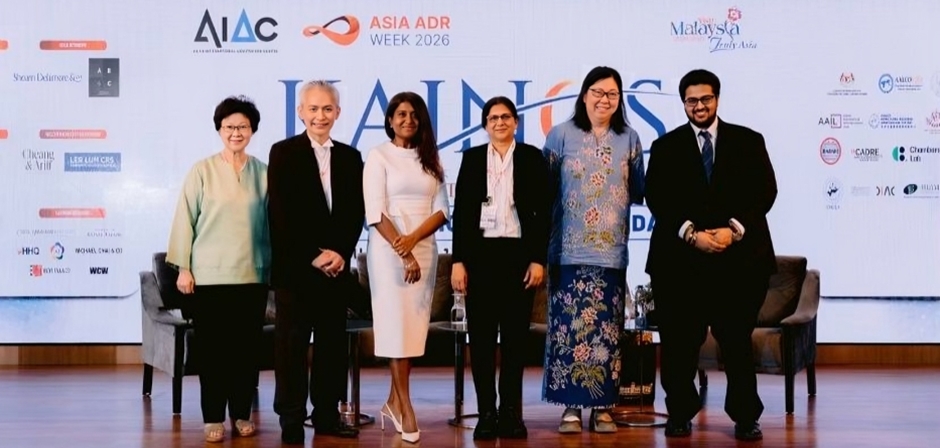
[In picture from left to right: Dato’ Mary Lim Thiam Suan, Dr. Bahari Yeow Tien Hong, Ms. Hemalata Parasa Ramulu, Ms. Harini Narayanswamy, Ms. Yeo Yee Ling and Ybhg. Datuk Danesh Chandran]
The discussion also covered ICANN’s four formal objection grounds, the new appellate mechanism for the 2026 gTLD round, the role of AIAC in domain-name dispute resolution and the relationship between registrant privacy and access to information for adjudicating complaints. As domain names increasingly accommodate different languages, commercial interests and communities across borders, effective dispute resolution will depend on clear rules, contextual assessment, protection of legitimate rights and fair procedures. The central challenge remains ensuring that the expansion of the digital namespace does not come at the expense of justice.
SCC Times is the official media partner for AIAC Asia ADR Week 2026. Read more about AIAC Asia ADR Week 2026:
1. Ed. Note: The original WIPO determination in Coach, Inc. v. Koko Island, LLC, Case No. LRO2013-0002, dated 14 August 2013, denied the legal rights objection to the proposed “.coach” gTLD. The Panel held that the Objector had failed to establish the grounds necessary to deny the application.