legal judgment in technology
Events & CollaborationsInternationalLegalTechTalk

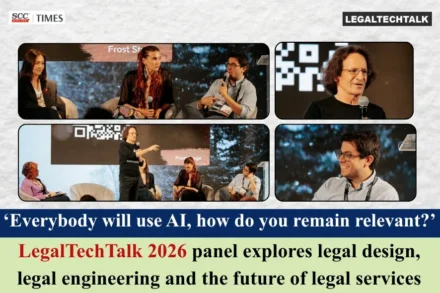
The legal industry is moving from information to intelligence, a shift examined in the session “From Information to Intelligence: How Law Firms Embed Legal Judgment in Technology” at LegalTechTalk 2026, where speakers highlighted AI’s role in scaling expertise while keeping human judgment at the centre of legal decision-making.

Continue reading
AI in-house legal function LegalTechTalk 2026
Events & CollaborationsInternationalLegalTechTalk

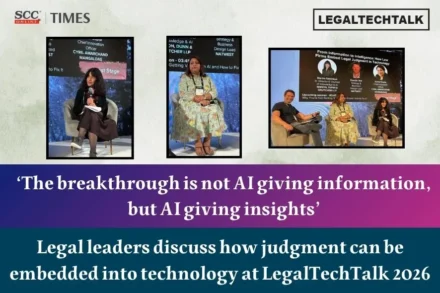
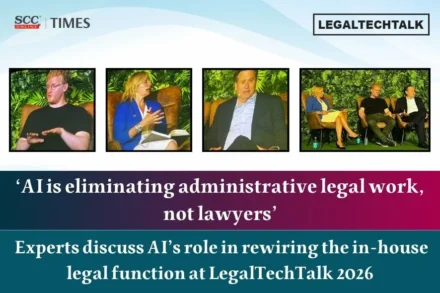
The session “The New Legal Stack: How AI Is Rewiring the In-House Legal Function” at LegalTechTalk 2026 highlighted that while AI is transforming research, workflows, compliance, and contract management, leaders from Airbnb and Wordsmith stressed that human judgment remains essential for complex legal strategy, negotiation, and decision-making.

Continue reading
advocates welfare health insurance annual premium Jharkhand
Case BriefsHigh Courts

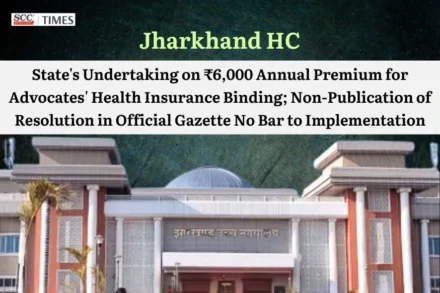
Jharkhand High Court, in a petition concerning welfare measures for practising advocates, observed that State resolutions and budgetary allocations for health insurance were already in place, and held that the reliefs prayed for stood substantially worked out.

Continue reading
future of hybrid ADR in Indo-UK commercial dispute
Events & CollaborationsICA Conference

A technical session at the ICA Conference on “Arbitrating Indo-UK Commercial Disputes” highlighted that while hybrid ADR frameworks are gaining traction, corporate users remain cautious about mediation’s role in high-value disputes, and arbitration, despite concerns of cost and complexity, continues to be the preferred mechanism for certainty and enforceability in Indo-UK commerce.

Continue reading
CJI Surya Kant Oxford Union address
Events & CollaborationsInstitutional Events

Delivering an address at the Oxford Union, Chief Justice of India Justice Surya Kant said technology has the power to democratise justice but must remain anchored to constitutional values and human judgment, emphasising that innovation should complement rather than replace the human heart of justice.

Continue reading
mediation arbitration India UK commercial disputes
Events & CollaborationsInstitutional Events

At the UK Supreme Court, Chief Justice of India Justice Surya Kant urged modern legal systems to shift from “forum convenience” to “process convenience,” positioning mediation as the next frontier of commercial justice while reaffirming the complementary role of courts and arbitration.

Continue reading
AI arbitrator New York Convention enforcement
Events & CollaborationsICA Conference

If the AI systems driving arbitral decisions are trained on materials from other jurisdictions, the awards they generate may be unenforceable or worse, systematically biased. Sir Geoffrey Vos used his keynote at the ICA’s 4th Indo-UK Commercial Disputes Conference to draw a line between AI in arbitration, where party consent makes adoption feasible, and AI in courts, where constitutional legitimacy makes it impossible.

Continue reading
India arbitration hub global commercial disputes
Events & CollaborationsICA Conference

India’s growing trade ties, pro-arbitration judiciary, and legal reforms are opening new avenues for cross-border dispute resolution, with Dr. N. G. Khaitan at the ICA’s Indo-UK conference in London urging global businesses to see India not just as a commercial hub but as an emerging centre for arbitration.

Continue reading
AI in the Legal Profession
Events & CollaborationsLondon International Disputes Week

Artificial intelligence is making lawyers faster, research more accessible and legal services more efficient. But as AI systems become increasingly sophisticated, legal practitioners are confronting a more difficult question: how can the profession embrace technological transformation without surrendering the human judgment, ethics and accountability that lie at the heart of legal practice?

Continue reading
mediation vs arbitration commercial disputes
Events & CollaborationsLondon International Disputes Week

India’s mediation tradition predates its legislation by millennia. England’s mediation culture was built by judicial pressure and adverse costs. At LIDW 2026, practitioners from both jurisdictions found more agreement than disagreement and a shared frustration with what arbitration has become.

Continue reading
Data Centre Disputes
Events & CollaborationsLondon International Disputes Week

Experts examined how data centre projects are generating disputes involving AI infrastructure, energy supply, construction risk, data regulation and damages assessment, highlighting the growing gap between technological innovation and legal frameworks.

Continue reading
deep sea mining international law
Events & CollaborationsLondon International Disputes Week

From deep-sea mining and Arctic trade routes to lunar resource extraction and orbital congestion, experts at LIDW26 examined whether existing international legal frameworks can withstand growing geopolitical rivalry, commercial competition and technological change.

Continue reading
geopolitical risks international arbitration
Events & CollaborationsLondon International Disputes Week

At LIDW26, Mr. Sean West examined how geopolitical fragmentation, legal uncertainty and rapid advances in artificial intelligence are creating an increasingly “unruly” world and reshaping the future of international dispute resolution.

Continue reading
Due Process Challenges and Public Policy Review in Indian Arbitration
Events & CollaborationsLondon International Disputes Week

The distinction drawn at LIDW26 between due process challenges and public policy review finds a close parallel in Indian arbitration jurisprudence, where courts examine procedural fairness and public policy concerns through separate legal lenses.

Continue reading
Reimagining Arbitration Three Bold Ideas
Events & CollaborationsLondon International Disputes Week

At International Arbitration Day at LIDW26, leading arbitration practitioners proposed three bold reforms for the future of dispute resolution: institutional sanctions against counsel misconduct, scientific analysis of persuasion and decision-making, and mandatory AI-assisted case assessments before arbitration.

Continue reading
Due Process Challenges in Arbitration
Events & CollaborationsLondon International Disputes Week

At International Arbitration Day during LIDW26, leading practitioners, academics and judges examined due process challenges in arbitration, discussing public policy review, the Semenya litigation, corruption-based challenges, AI-assisted decision-making, expert evidence and judicial scrutiny of arbitral awards.

Continue reading
DNA test not required for mother
Case BriefsHigh Courts

The High Court noted that since documentary evidence clearly established the mother-son relationship, the Authorisation Committee’s refusal was arbitrary and unsustainable, and therefore directed immediate permission for transplantation without delay.

Continue reading
Case BriefsHigh Courts

The Bombay High Court noted that since the FIR was registered under Section 376 IPC without prima facie examination of the allegations and given the unexplained delay and contradictions in the victim’s statements, the prosecution case lacked legal foundation and the conviction was liable to be set aside.

Continue reading
Penalty under RTI Act unsustainable without mala fide
Case BriefsHigh Courts

The High Court noted that since the State Information Commission failed to record any findings on mala fide denial, unreasonable delay, or contumacious conduct, the penalty order lacked legal foundation and was therefore liable to be quashed.

Continue reading
CEDRAC Center
Cyprus Arbitration DayEvents & Collaborations

CEDRAC was showcased by Christodoulos Christodoulou, reflecting its evolution into a more active and operational institution. His remarks underscored CEDRAC’s commitment to neutrality, procedural flexibility, and the institutional support that strengthens its role in international arbitration

Continue reading