Supreme Court: In a special leave petition filed by Yuvajana Sramika Rythu Congress Party, the principal opposition party in Andhra Pradesh, alleging that its candidates were prevented from filing nominations for the 2026 municipal elections in Andhra Pradesh, a Division Bench of Joymalya Bagchi and V. Mohana, JJ., held that judicial restraint during an ongoing election process does not preclude intervention where alleged violence or coercion threatens a level playing field. The Court further held that
“Free and fair elections are a basic structure of the Constitution. Right to freely participate in such election by filing nomination papers without hindrance is a facet of the free and fair election process.”
Accordingly, the Court issued interim directions requiring the State Election Commission (the Commission) to postpone publication of the final list of candidates until 25 October 2026, consider the representations made by the petitioner party and various candidates, provide an opportunity for affected candidates to file nominations where warranted and strengthen security arrangements at nomination centres.
Brief Facts
The petitioner is a registered political party and the principal opposition party in the State of Andhra Pradesh. The State Election Commission issued the schedule for the 2026 local body elections in Andhra Pradesh on 14 October 2026. Before the notification, the petitioner approached the Andhra Pradesh High Court, alleging widespread violence and apprehending that its party members would be prevented from filing nominations.
The petitioner sought additional and optional nomination facilities at district headquarters, adequate security during the nomination period, safe custody of nomination papers, and neutral nomination centres in place of those allegedly situated near ruling-party strongholds.
The High Court dismissed the writ petition as premature, while permitting individual candidates facing threats to approach the Election Officer concerned for designation of an alternative nomination centre.
In the subsequent appeal proceedings, the petitioner sought for the extension of the nomination deadline and placed materials and representations on record to support its allegations that candidates had been forcibly prevented from filing nominations. The application was dismissed, inter alia, on the grounds that such relief was beyond the scope of the writ petition, that the decision of the State Election Commission on the representations was not on record, and that, as the election process had begun and the time for filing nominations had already expired, it would be imprudent to interfere with the election process.. Aggrieved, the petitioner approached the Supreme Court.
Issues for Consideration
-
Can Constitutional Courts intervene during an ongoing election process when alleged violence and coercion impair candidates’ ability to file nominations freely?
-
Whether the Commission should reconsider representations alleging that candidates were prevented from filing nominations and extend the deadline where justified by the law-and-order situation?
Analysis
At the outset, the Court observed that “free and fair elections are a basic structure of the Constitution” and the right to freely participate in such election by filing nomination papers without hindrance is a facet of the free and fair election process. Under Article 243Z-A, the State Election Commission has a constitutional duty to conduct and supervise municipal elections fairly, which necessarily includes ensuring that candidates can file their nominations without obstruction.
The Court acknowledged that Constitutional Courts ordinarily exercise restraint once the election process has commenced, allowing an independent constitutional authority to complete the process within the prescribed timeline. However, judicial review cannot be said to be wholly negated where the discharge of the Commission’s constitutional duty is hampered by widespread violence impairing peace and tranquillity and thereby skewing a level playing field in filing nominations. The Court emphasised that where ample representations and supporting material disclose serious apprehensions regarding the filing of nominations, judicial intervention may be imperative to ensure a fair and impartial conclusion to the election process. Such intervention does not amount to “calling in question an election” when it facilitates the completion of the electoral process.
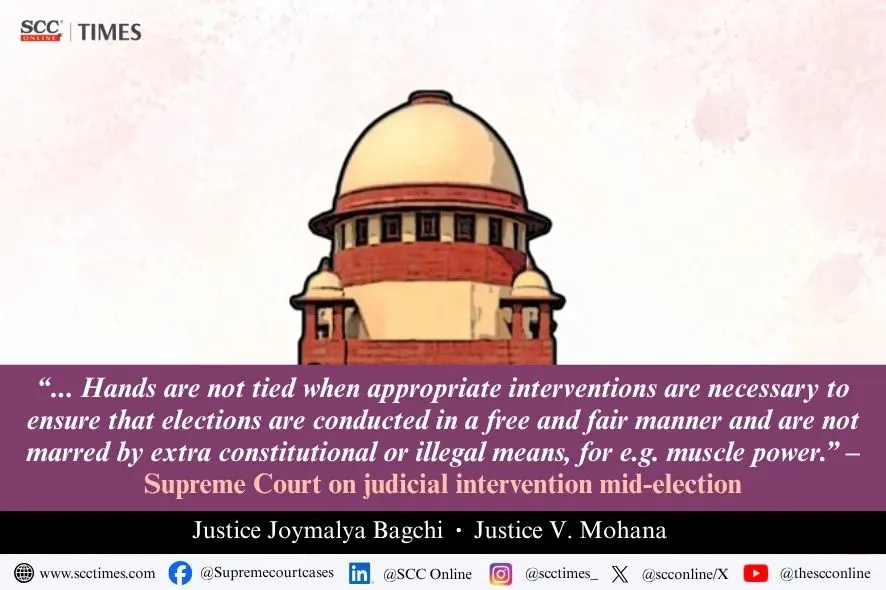
Relying on Election Commission of India v. Ashok Kumar, (2000) 8 SCC 216, State (UT of Ladakh) v. J&K National Conference, (2024) 18 SCC 643 and Bharatiya Janata Party v. State of W.B., (2018) 5 SCC 365, the Court reiterated that “while constitutional courts would ordinarily not interfere with election process, but their hands are not tied when appropriate interventions are necessary to ensure that elections are conducted in a free and fair manner and are not marred by extraconstitutional or illegal means, for eg. muscle power”.
Relying on principles discussed above and the supporting documentary and electronic evidence placed on record, the Court prima facie opined that the petitioner had made out a case for interim directions to address the apprehended obstruction of candidates and ensure their effective participation.
Decision and Directions
The Court issued notice and passed the following interim directions:
-
The Commission was directed to postpone publication of the final list of candidates until 25 October 2026.
-
The Commission was directed to consider the representations made by the petitioner party and candidates, including the supporting documentary and electronic evidence, and decide by 22 October 2026 whether to extend the nomination deadline in urban local bodies where candidates were unable to file nominations because of the law-and-order situation. Wherever an extension was granted, it was to be for not less than 48 hours from publication of the decision, through an amendment to the election notification.
-
The Commission was directed to make additional arrangements for filing nominations at district headquarters before the District Collector, wherever necessary.
-
The Commission was required to take all necessary steps to remove apprehensions that the petitioner and prospective candidates would not have a fair opportunity to participate in the elections, and to submit a compliance report.
-
The Director General of Police was directed to ensure adequate police deployment, CCTV coverage at nomination centres and necessary protection for candidates filing their nominations, and to submit a compliance report.
-
The matter was directed to be listed on 27 October 2026.
[Yuvajana Sramika Rythu Congress Party v. State of A.P., Special Leave Petition (Civil) No. 37476 of 2026, decided on 21-10-2026]
Advocates who appeared in this case:
For the Petitioner: Mr. Maninder Singh, Sr. Adv. Mr. Nikhil Goel, Sr. Adv. Mr. Mahfooz Ahsan Nazki- 2744, AOR Mr. Vivek Rajan D.
For the Respondent: Mr. Mukul Rohatgi, Sr. Adv. Mr. Sidharth Luthra, Sr. Adv. Mr. Dammalapati Srinivas, AG Mr. Guntur Prabhakar, Adv. Mr. Guntur Pramod Kumar, AOR Ms. Prerna Singh, Adv. Mr. Arijeet Shukla, Adv. Mr. Dhruv Yadav, Adv. Mr. Keshav Sehgal, Adv. Mr. Suhail Ahmad, Adv. Mr. Parv Arora, Adv. Ms. Rakshita, Adv. Mr. K. Parameshwar, Sr. Adv. Mr. Amit Pai, AOR Mr. N. Ashwani Kumar, Adv. Ms. Pankhuri Bhardwaj, Adv. Mr. Sai Kaushal, Adv. Mr. Arjun Sagar, Adv.