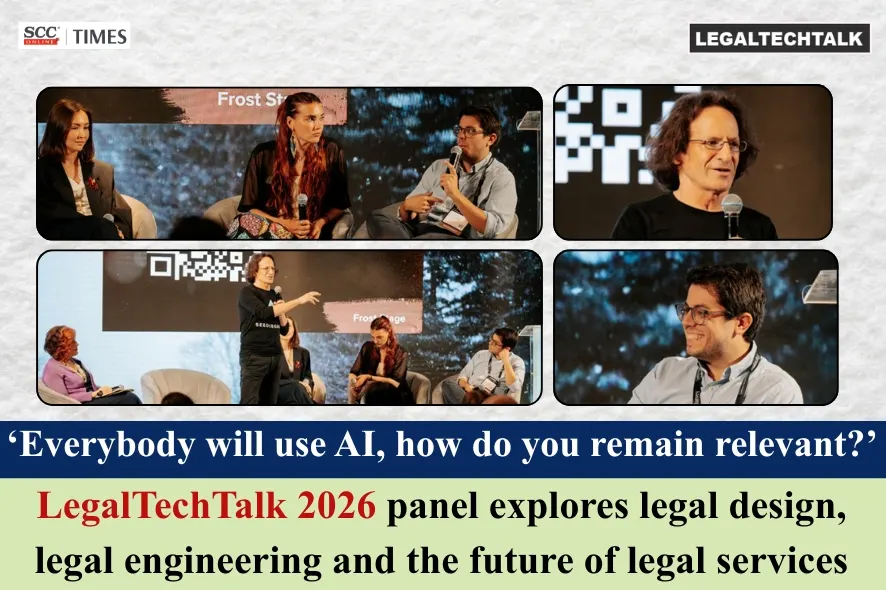
Moderated by Mr. Anthony Rose, Founder and CEO of SeedLegals, the session, “Design Thinking in Legal: Real Examples, Real Outcomes”, brought together Ms. Mia Ihamuotila, Legal Tech and Design Lawyer, Castrén & Snellman, Ms. Ellie Heiland, Independent Consultant, Writer & Podcast Host, Ms. Anna De Stefano, Founder, ADS Studio — Legal Design for Trust & Value in the AI era and Mr. David Planes, Head of Product at Lexidy, during LegalTechTalk 2026.

Through practical examples and industry perspectives, the panel explored how legal design is reshaping legal services, the growing importance of legal engineering, the increasing accessibility of technology for lawyers, and the ways in which AI is challenging traditional law firm structures, workflows and business models.
Legal design is a methodology, not a technology
One of the central themes of the discussion was the distinction between legal design and technology. While AI and automation tools are becoming increasingly powerful, the speakers repeatedly emphasised that legal design should not be confused with technology itself.
Ms. Anna De Stefano described legal design as a methodology that begins with understanding purpose, values and client needs rather than technological solutions.
According to her, legal design helps organisations understand who they are, who their clients are and what value they seek to deliver. She argued that technology alone cannot create differentiation because access to advanced tools is becoming increasingly widespread.
As she observed:
“Everybody is going to use AI. Everybody is going to use the same tool. So how do you remain relevant?”
Ms. De Stefano suggested that long-term competitiveness will depend on a firm’s ability to understand its unique strengths, values and client expectations rather than simply adopting new technologies.
AI is the tool; Legal design provides the logic
Ms. Ellie Heiland echoed this distinction by arguing that legal design provides the underlying logic that guides technology deployment.
She noted that many organisations mistakenly assume that advanced AI systems can replace design thinking. In reality, she argued, technology merely executes the logic that has already been embedded within systems and processes.
Ms. Heiland noted that legal design determines how information is structured, how workflows operate and how legal services are delivered. She cautioned that firms with poorly organised data, inefficient processes or poorly drafted documents risk automating existing problems rather than solving them.
“AI agents are still the technology. It’s the tool that we’re using. But the legal design is the logic that you implement into this.”
As she explained, technology can amplify efficiency, but without proper design and governance, it may simply replicate existing inefficiencies at scale.
The rise of the legal engineer
The discussion also examined the growing prominence of legal engineers and hybrid professionals who combine legal expertise with technological understanding.

Mr. Anthony Rose noted that technology is becoming increasingly accessible to non-technical users, enabling lawyers to create systems, workflows and products without extensive programming knowledge.
Responding to this trend, Mr. David Planes observed that lawyers are increasingly moving beyond traditional legal work and becoming active participants in product development and innovation. However, he cautioned that this shift creates new governance challenges.

Mr. Planes observed that lawyers are now capable of building applications and automations at a pace that can sometimes exceed formal development processes. While this creates significant opportunities for innovation, he stressed the need for appropriate safeguards and governance frameworks to ensure that experimentation does not compromise quality, security or compliance.
Legal design engineering begins before automation
Ms. Heiland distinguished between legal engineering and what she described as legal design engineering.
According to her, legal engineering focuses on implementing technology within legal processes, whereas legal design engineering occurs earlier in the process and involves structuring information, processes and workflows before automation takes place.
She explained that organisations must first determine how information should be organised, how documents should function and what outcomes they wish to achieve before technology can be effectively deployed.
Without this foundation, firms risk generating large volumes of poor-quality outputs regardless of how advanced their technology may be.
Creating legal sandboxes for innovation
Ms. Mia Ihamuotila emphasised the importance of creating environments that encourage experimentation and innovation.
Drawing on her experience in legal transformation, she explained that legal design thinking helps lawyers understand processes, identify inefficiencies and explore new ways of delivering value.
“The world now requires many, many other thinking modes that are not inherent to legal thinking.”
According to Ms. Ihamuotila, many organisations struggle because their structures do not provide sufficient space for experimentation. She argued that firms should create “sandboxes” where lawyers can test ideas, explore new technologies and develop new ways of working without fear of failure. Such environments, she suggested, are essential because the future lawyer will require a broader range of thinking skills than traditional legal education has historically emphasised.
These include systems thinking, computational thinking, process-oriented thinking, creative thinking and intuitive thinking.
Why culture matters more than technology
A recurring theme throughout the discussion was the importance of organisational culture.
Ms. De Stefano argued that culture ultimately determines whether technology creates meaningful value. She suggested that firms must move beyond viewing AI solely as an efficiency tool and instead focus on understanding how technology can support their broader mission and client objectives.
According to her, both clients and employees increasingly seek organisations that demonstrate purpose, shared values and clear vision. She also highlighted the growing importance of storytelling, interdisciplinary collaboration and purpose-driven leadership in attracting both clients and talent.
Rethinking the Billable Hour
Mr. Rose observed that technology is enabling legal work to be completed more efficiently, raising questions about whether traditional hourly billing models remain sustainable.
Ms. De Stefano suggested that AI challenges the fundamental assumptions underlying the billable hour because clients increasingly care about outcomes rather than the time spent achieving them. She argued that firms must focus on identifying new forms of value that can justify pricing models beyond hourly billing. These may include industry expertise, strategic advice, risk assessment, scenario planning and business-focused legal guidance.
According to her, changes to pricing structures may eventually require corresponding changes to compensation models, career progression systems and law firm leadership structures.
Value is not about doing the same work faster
Mr. Planes explained that his organisation has adopted a fixed-fee approach rather than charging clients by the hour. He compared hourly billing to entering a taxi without knowing the final fare until the journey is complete.
“Our lawyers now are coding faster than our developers.”
In his view, clients increasingly value predictability and transparency over time-based billing.
Ms. Heiland similarly argued that technology should not merely enable lawyers to complete existing tasks more quickly.
Instead, she suggested that efficiency gains should allow lawyers to devote greater attention to surrounding business issues, adjacent risks and broader client objectives. By using technology to reduce routine work, lawyers can focus on delivering additional value that was previously difficult to provide due to time constraints.
Design thinking enables new legal products and services
Ms. Ihamuotila highlighted the role of legal design in helping firms productise legal services.
She explained that many legal processes can be transformed into scalable products, while emerging technologies simultaneously create opportunities for entirely new service offerings. According to her, design thinking provides a framework for both improving existing services and developing innovative solutions that address previously unmet client needs.
In this sense, legal design functions not merely as a process improvement tool but as a driver of service innovation.
The future lawyer will spend time differently
One of the most notable observations from the discussion concerned the future role of lawyers within law firms.
Ms. Ihamuotila argued that lawyers cannot spend their entire working day focused exclusively on billable client work if firms expect innovation to occur. She suggested that future legal roles will likely incorporate a mix of client service, business development, experimentation, product development and strategic initiatives.
This shift may require lawyers to develop broader commercial, technological and innovation-focused skills alongside traditional legal expertise.
Agentic AI raises new questions about control and design
The discussion concluded with reflections on the next generation of AI systems capable of performing tasks autonomously.
While speakers acknowledged the potential of these systems, Ms. Heiland stressed that organisations must remain focused on the underlying logic that guides them. She argued that automated systems ultimately operate according to rules, structures and assumptions established by humans.
Do you want it to be decided for you, or do you want to have it customised?
The key question, therefore, is not simply what technology can do, but who determines how it should behave and what outcomes it should pursue. According to Ms. Heiland, organisations that understand and control this underlying design logic will enjoy a significant competitive advantage.
Start with Why
In her closing remarks, Ms. De Stefano offered what became one of the defining messages of the session.
Rather than beginning with technology, she encouraged organisations to begin by understanding their purpose.
As she put it:
“Start with why.”
According to Ms. De Stefano, firms must understand the purpose behind their services, the needs of their clients and the objectives that technology is intended to support. Only then can legal design, legal engineering and AI be deployed effectively.
Concluding Reflections

The discussion highlighted that legal design is becoming increasingly important as technology becomes more accessible and more powerful. While AI may automate tasks and accelerate workflows, speakers repeatedly emphasised that technology alone does not create competitive advantage.
Instead, differentiation will come from understanding clients, designing better processes, building innovative services and creating meaningful value.
As legal services continue to evolve, legal design may become the bridge between technological capability and human judgment, helping firms navigate a future where efficiency is expected but value remains the ultimate differentiator.