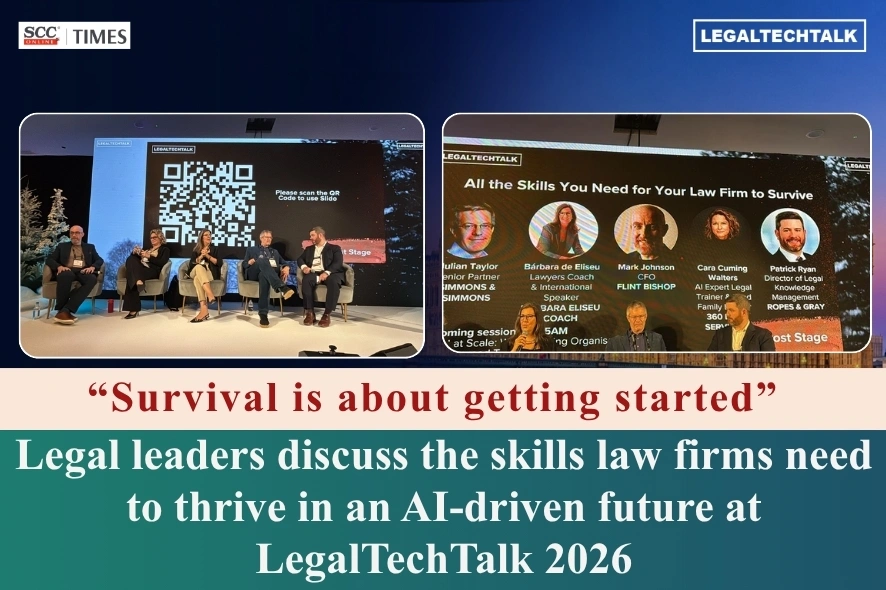
At LegalTechTalk 2026, a panel of legal industry leaders examined how law firms can remain competitive amid rapid technological change, evolving client expectations, and increasing market pressures. Moderated by Ms. Bárbara de Eliseu, Lawyers Coach and International Speaker, the session titled “All the Skills You Need for Your Law Firm to Survive” brought together Mr. Patrick Ryan, Director of Legal Knowledge Management at Ropes & Gray; Mr. Julian Taylor, Senior Partner at Simmons & Simmons; Mr. Mark Johnson, CFO at Flint Bishop; and Ms. Cara Cuming Walters, AI Expert Legal Trainer and Lead Family Lawyer at 360 Law Services.

The discussion focused on the capabilities law firms must develop to navigate an increasingly technology-driven legal landscape, with particular emphasis on AI adoption, leadership, commercial awareness, client relationships, professional development, and organisational adaptability.
Survival requires experimentation and a willingness to adapt
Opening the discussion, Ms. Bárbara de Eliseu asked what “survival” looks like for law firms in the current environment. Mr. Patrick Ryan responded that survival begins with a willingness to engage with new technologies rather than waiting for certainty.

According to Mr. Ryan, the legal sector has undergone a significant shift since the emergence of generative AI technologies, and firms cannot afford to organise themselves around assumptions that existed only a few years ago. He stressed that firms must experiment with new tools, learn from practical use, and determine what works within their own organisations.
Drawing on Ropes & Gray’s experience, Mr. Ryan highlighted initiatives designed to encourage lawyers to engage with emerging technologies. He explained that the firm had created opportunities for associates to test new tools and learn through experimentation, emphasising that while firms may not know what the eventual end state of legal technology adoption will be, they must nevertheless begin the journey.
AI transformation is ultimately a people challenge
Mr. Julian Taylor argued that many law firms remain structured around long-established systems, compensation models, and ways of working that were developed for a different era. While technology itself continues to evolve rapidly, he suggested that the greater challenge lies in persuading people to change their behaviour and adopt new methods of working.

“I see AI as more of a people issue than a tech issue.” — Mr. Julian Taylor
Describing AI transformation as fundamentally a people issue rather than a technology issue, Mr. Taylor observed that legal professionals are already managing significant workloads and competing priorities. Asking them to simultaneously maintain existing responsibilities while learning entirely new skills creates a substantial challenge for law firm leadership.
At the same time, he expressed confidence in the profession’s ability to adapt. He noted that many law firms have survived and evolved over decades, if not centuries, and that growing client expectations are creating strong incentives for firms to embrace innovation. He also emphasised the importance of working closely with clients throughout the transformation process and developing collaborative approaches to technology adoption.
Competition is no longer limited to other law firms
Discussing the changing competitive landscape, Mr. Mark Johnson suggested that law firms are no longer competing solely with one another. He observed that legal technology providers are becoming increasingly sophisticated and are learning how legal workflows operate through their partnerships with law firms.
Mr. Johnson noted that some technology providers are developing products capable of delivering certain legal processes directly to clients. While he acknowledged that complex advisory work would continue to require legal expertise and professional judgement, he suggested that some high-volume legal tasks may increasingly be delivered through technology-enabled solutions.
The discussion highlighted how legal technology companies, alternative service providers, and AI platforms are becoming important participants in a legal services market that was once dominated almost exclusively by traditional law firms.
Clients are increasingly turning to AI before turning to lawyers
A significant part of the discussion focused on the changing relationship between lawyers, clients, and AI-generated information.

Ms. Cara Cuming Walters explained that clients are increasingly using AI tools to obtain legal information before consulting lawyers. Drawing on examples from her family law practice, she described situations in which clients placed considerable reliance on AI-generated answers, even when those answers conflicted with the views of experienced legal practitioners and judges.
The panellists acknowledged that clients are becoming more comfortable with technology and that AI tools are likely to become increasingly trusted as they continue to improve. However, the discussion underscored the continuing need for lawyers to explain legal issues in context and to help clients understand the limitations of automated outputs.
Mr. Patrick Ryan observed that the increasing accessibility of information requires lawyers to communicate more effectively about how legal conclusions are reached and why professional judgement remains essential. Similarly, Mr. Taylor noted that open discussions with clients about how firms use technology can strengthen rather than weaken client relationships.
Technology must fit the organisation
The panellists cautioned against adopting technology simply because it is new or popular.
Ms. de Eliseu observed that many firms appear eager to experiment with every emerging platform and tool available in the market. In response, the speakers stressed the importance of understanding an organisation’s specific needs before investing in technology.
Mr. Patrick Ryan highlighted the importance of determining what works within a particular organisation, while Mr. Mark Johnson pointed out that technology evolves so rapidly that firms face constant pressure to reassess available solutions. The discussion suggested that successful technology adoption requires strategic decision-making rather than indiscriminate implementation.
The human impact of AI cannot be ignored
Beyond efficiency gains and technological innovation, the panel repeatedly returned to the human consequences of transformation.
Ms. Cara Cuming Walters questioned what increasing automation means for future generations of legal professionals and support staff. The discussion considered how technological change may affect career progression, employment opportunities, and professional development across law firms.
Mr. Patrick Ryan responded by emphasising the importance of continued investment in people. He stated that firms must continue developing junior lawyers and helping them acquire the critical thinking skills necessary to work effectively alongside AI technologies. According to him, technological investment should not come at the expense of human capital.
The panel broadly agreed that while AI may transform the delivery of legal services, successful firms will continue to depend on talented professionals capable of exercising judgement, creativity, and critical analysis.
AI should enhance training, not replace learning
The discussion also explored the implications of AI for legal education and professional development.
Mr. Julian Taylor suggested that AI creates an opportunity to rethink how lawyers are trained. Referring to the medical profession, he argued that junior lawyers should be exposed to greater responsibility at earlier stages of their careers while receiving appropriate supervision and support.
Mr. Patrick Ryan similarly emphasised the importance of using AI as a teaching tool. He argued that technology can help create simulated learning experiences that allow lawyers to develop judgement through repetition and practice. However, he stressed that lawyers must also develop what he described as “AI judgement”, the ability to assess outputs critically, understand the limitations of technology, and determine when further scrutiny is required.
“We don’t know what the end state looks like, but we know what the journey looks like.” — Mr. Patrick Ryan
The panel agreed that firms will need to invest significantly in training if lawyers are to use AI effectively while maintaining professional standards.
Understanding AI’s limitations remains essential
As an AI trainer, Ms. Cara Walters cautioned against treating AI-generated outputs as definitive answers.
She observed that AI systems are only as effective as the information on which they are trained and warned that they can generate inaccurate, incomplete, or misleading outputs. According to Ms. Walters, AI should be viewed as a starting point for legal analysis rather than an end point.
Comparing AI tools to junior trainees, she suggested that even highly capable systems require supervision and review. The discussion reinforced the view that technological competence must be accompanied by professional judgement and critical evaluation.
Commercial awareness and the future of the billable hour
One of the most extensive discussions centred on commercial awareness and the future of legal pricing models.

Mr. Mark Johnson argued that AI-driven efficiency presents a significant challenge for traditional billable-hour structures. While technology may enable lawyers to complete tasks more quickly, many firms continue to operate within business models that reward time spent rather than value delivered.
“I think this is where having commercial awareness as a lawyer is now going to be crucial because we’re going to have to move away from billable hours and pricing on that basis to charging based on outputs instead of inputs…” — Mr. Mark Johnson
According to Mr. Johnson, lawyers will increasingly need commercial awareness skills to communicate value to clients, participate in pricing discussions, and operate effectively within evolving commercial models. He suggested that the profession may need to move towards charging for outputs rather than inputs, requiring lawyers to develop a stronger understanding of value creation and client expectations.
The discussion also explored tensions between encouraging technology adoption and maintaining traditional chargeable-hour targets. The panellists noted that firms will need to reconcile these competing pressures if they wish to achieve meaningful transformation.
Adaptability, judgement, creativity and common sense
As the session drew to a close, the panellists reflected on the skills they believe legal professionals should prioritise over the coming months and years.
Mr. Johnson encouraged lawyers to engage directly with new technologies and learn through practical experience. Mr. Taylor identified agility and adaptability as essential capabilities in an environment where change continues to accelerate. Mr. Johnson returned to the importance of commercial thinking and maintaining focus on organisational objectives when adopting new tools. Ms. Walters highlighted flexibility and common sense as qualities that remain indispensable despite technological advances.
Concluding the discussion, Ms. de Eliseu emphasised the importance of creating time and space for reflection, creativity, and strategic thinking. She suggested that firms must allow professionals to step away from day-to-day pressures in order to rethink how legal services are delivered and how organisations can continue to evolve.
While the speakers differed in their perspectives on the pace and consequences of technological change, they shared a common view that the future of successful law firms will depend not only on adopting new technologies but also on developing the human capabilities necessary to use them effectively.