Disclaimer: This has been reported after the availability of the order of the Court and not on media reports so as to give an accurate report to our readers.
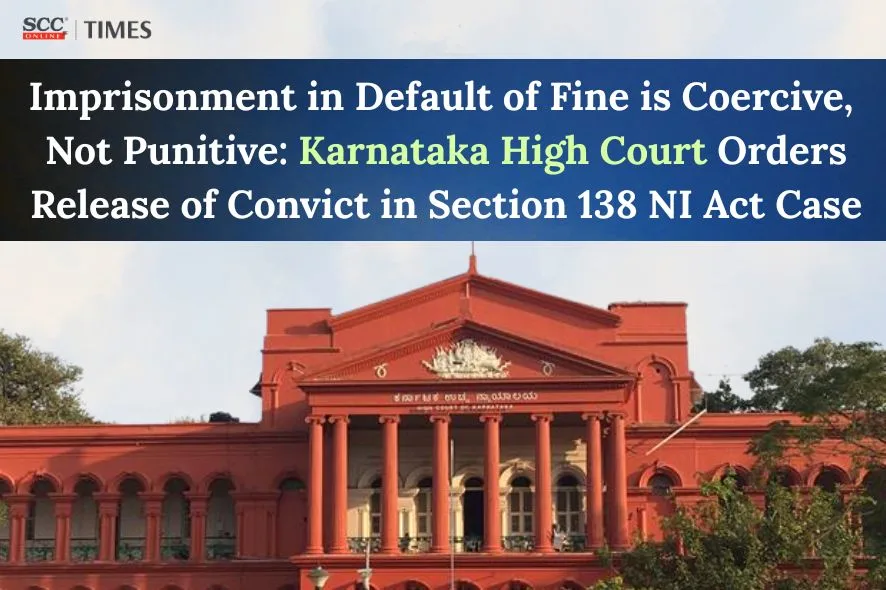
Karnataka High Court: While considering a petition filed under Section 528, Nagarik Suraksha Sanhita 2023 (BNSS) seeking petitioner’s immediate release from judicial custody by way of a reduction in the default sentence of imprisonment, imposed for non-payment of the fine amount awarded by the trial court, upon his conviction for the offence punishable under Section 138 Negotiable Instruments Act, 1881 (NI Act), a Single Judge Bench of M. Nagaprasanna, J., held that imprisonment in default of payment of fine is intended to operate as a coercive mechanism for recovery and not as a disproportionately punitive measure.
Thus, the Court moderated the aggregate default sentence to the period already undergone and directed his release.
Background
In the present case, on 22 December 2017, the petitioner and Respondent 3 entered into a loan agreement under which Respondent 3 agreed to lend Rs 1,00,00,000 to the petitioner, and Rs 5,96,00,000 was immediately disbursed. The outstanding amount was to be repaid by 15 August 2020. Towards repayment of the loan with interest, the petitioner issued three cheques for Rs 50,00,000, Rs 3,50,00,000, and Rs 5,00,00,000. All three cheques, issued from a single transaction and presented on the same day, were dishonoured for insufficiency of funds. Consequently, Respondent 3 issued a statutory demand notice dated 11 September 2020 under Section 138 NI Act. The petitioner responded, citing financial inability and hardship.
Thereafter, Respondent 3 filed three separate complaints, and the petitioner was convicted under Section 138 NI Act, sentenced as follows:
-
Regarding the cheque of Rs 50,00,000, a fine of Rs 61,67,000 with Rs 10,000 payable to the State under Section 357(1)(b) Criminal Procedure Code, 1973 (CrPC);
-
Regarding the cheque of Rs 3,50,00,000, a fine of Rs 4,31,66,670 with Rs 10,000 payable to the State; and
-
Regarding the cheque of Rs 5,00,00,000, a fine of Rs 6,16,67,000 with Rs 10,000 payable to the State.
and in default, 3 months’ simple imprisonment.
As the petitioner failed to pay the fine amounts, separate orders dated 29 May 2025 directed him to undergo the default sentence of 3 months’ simple imprisonment in each case. Subsequently, on 6 November 2025, attachment orders under Section 421(1) CrPC were passed.
Aggrieved, the petitioner filed the present criminal petition seeking:
-
Reduction of the default sentence to a total of 3 months for all three cases, a declaration that the sentence already undergone satisfied the default imprisonment arising from the same transaction and single statutory demand notice; or
-
Release upon completion of 6 months’ imprisonment in terms of Section 24 Nyaya Sanhita 2023 (BNS) [Section 65 Penal Code 1860 (IPC)], along with a direction for immediate release from judicial custody.
Issue and Analysis
The Court stated that the issue involved in the case at hand was whether or not the imposition of separate default sentences in three distinct prosecutions result in a punitive excess contrary to the mandate of Section 8(3) BNS (Section 65 IPC), thereby entitling the petitioner to immediate release from custody.
After perusal of the relevant provisions, the Court stated that Section 65 IPC, now reincarnated as Section 8(3) BNS, embodies a salutary restraint on the sentencing power of criminal courts. It mandates that where an offence is punishable with both imprisonment and fine, the imprisonment imposed in default of payment of fine shall not exceed one-fourth of the maximum term of imprisonment prescribed for the offence. The Court emphasised that the legislative intent is clear that imprisonment in default is not meant to be a disproportionately oppressive penalty but merely a coercive mechanism to secure payment of fine.
Further, the Court stated that equally relevant is Section 30 CrPC and its successor provision, Section 24 BNSS, which further circumscribes the authority of a Magistrate while imposing imprisonment in default of payment of fine. The Court stated that the sentence in default cannot exceed one-fourth of the term of imprisonment which the Magistrate is otherwise competent to impose for the substantive offence. The statutory architecture, thus, reflects a clear legislative intent to prevent excessive incarceration merely on account of inability or unwillingness to discharge a pecuniary liability.
The Court stated that under Section 138 NI Act, it is evident that the maximum punishment prescribed is two years’ imprisonment, or fine extending to twice the cheque amount, or both. Accordingly, when Section 65 IPC and Section 8(3) BNS are read together with Section 138, the maximum imprisonment in default of payment of fine cannot exceed six months in each case.
Considering petitioner’s demonstrated financial incapacity to satisfy the enormous fine amounts imposed upon him, the acute hardship and destitution suffered by his family during his prolonged incarceration, and the principles so luminously enunciated in K. Pranil Reddy v. State of Telangana 2024 SCC OnLine SC 6206; Sanjay Vasudeva v. State 2025 SCC OnLine Del 6733 and Cyrus Noshirwan Kartak v. State of Maharashtra 2026 SCC OnLine Bom 2921, the Court found that the petitioner made out a compelling case for grant of relief.
The Court stated that the petitioner has undergone the sentence imposed upon him and was consequently entitled to be released from prison forthwith. The Court further clarified that the proceedings initiated under Section 421(1) CrPC for attachment and recovery against the properties of the petitioner would continue independently and uninfluenced. The Court emphasised that the “present adjudication concerns only the legality and proportionality of continued incarceration in default of payment of fine and shall not eclipse or dilute the statutory right of the complainant or the State to pursue recovery proceedings in accordance with law.”
Decision
Hence, the Court allowed the petition and stated that the aggregate default sentence of imprisonment imposed upon the petitioner proportionately staggered, was moderated and consequently equalized to the period of imprisonment already undergone by him.
The Court, thus, held that the petitioner should be enlarged from custody.
Also read: Section 138 of NI Act Explained: Cheque Bounce Notice, Procedure & Landmark Rulings
[Dinesh Malpani v. State of Karnataka, 2026 SCC OnLine Kar 4401, decided on 4-6-2026]
Advocates who appeared in this case :
For the Petitioner: Keerthi Reddy and Adbhuth J. Kaushik, advocates
For the Respondent: B. N. Jagadeesha, Addl. SPP, Vikram Huilgol, Sr. Advocate and Amrita Shivaprasad, Advocate